

Feed aggregator
New Material Could Help NASA Melt Moon Rocks, Harness Lunar Resources
4 min read
Preparations for Next Moonwalk Simulations Underway (and Underwater) Researchers Dr. Kevin Yu, left, and Dr. Jamesa Stokes prepare to remove a sample of a new material they discovered from a furnace inside a laboratory at NASA’s Glenn Research Center in Cleveland in October 2024. Quenching, or bringing the temperature of the sample down as quickly as possible, helps to ensure no more reactions occur as the sample cools so scientists can focus on studying how it behaves at high temperatures.NASA/Jef Janis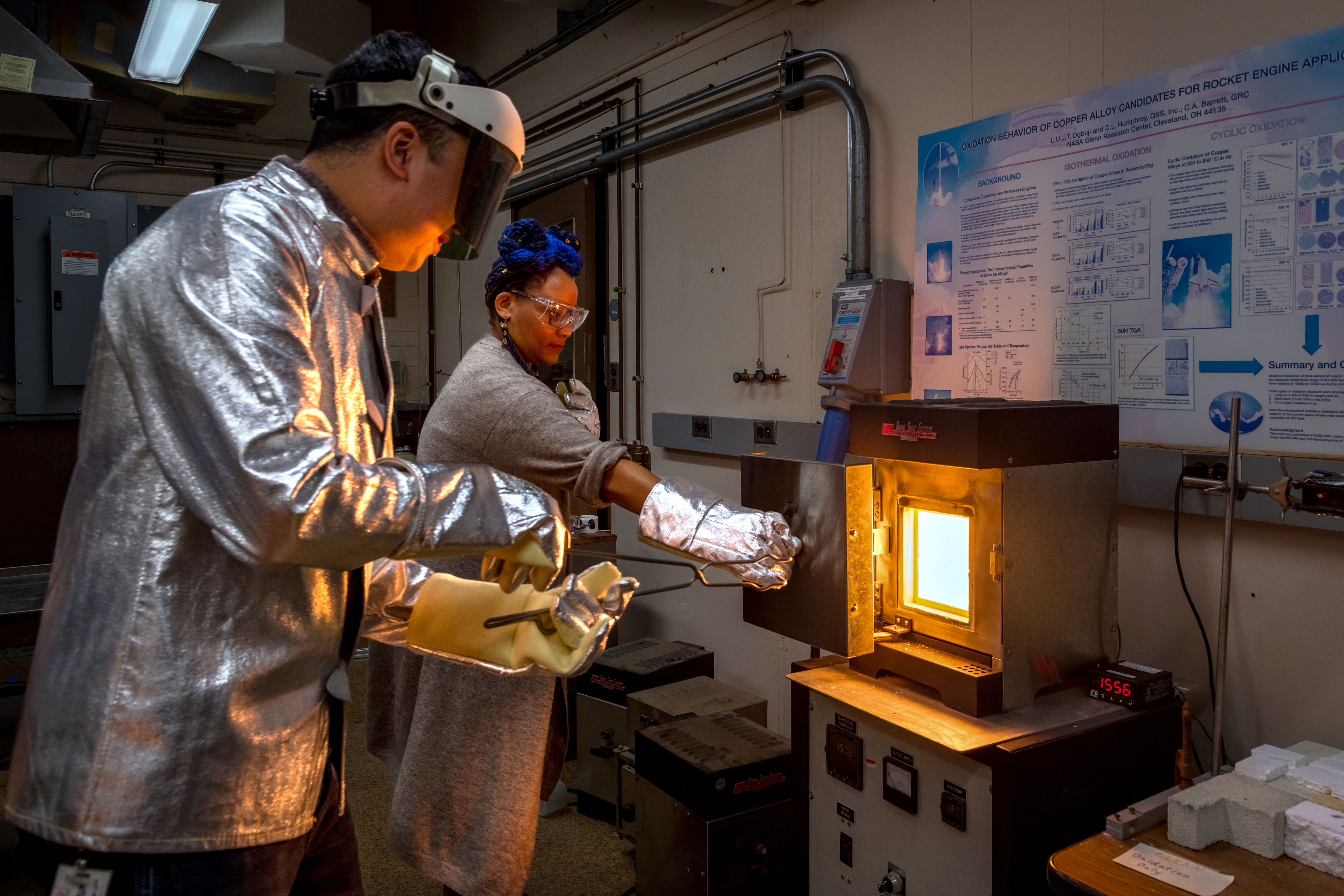
A material recently discovered and tested at NASA’s Glenn Research Center in Cleveland could help astronauts pack lighter for future missions to the Moon. NASA is researching ways explorers could “live off the land” by harnessing lunar resources, including melting Moon rocks to extract metals for building infrastructure and oxygen for fuel and life support.
As part of a graduate fellowship through the agency’s Space Technology Graduate Research Opportunities, Dr. Kevin Yu, who now works as a technologist at NASA’s Jet Propulsion Laboratory in Southern California, teamed up with Dr. Jamesa Stokes, a materials research engineer at NASA Glenn, to study how a variety of substances interacted with liquefied Moon dust.
You could call it lava, because it’s basically rocks that are crushed up and then melted. It’s very corrosive, and it will very quickly eat through a lot of commonly used refractory, or heat-resistant, materials.Dr. kevin yu
Technologist at NASA's Jet Propulsion Laboratory
About six months into their research, Stokes and Yu realized they’d stumbled across something promising and entirely new. After combining simulated lunar dust with a compound called scandium oxide and heat treating the mixture using a red-hot furnace, they discovered that an unknown material had formed. The researchers checked and double-checked their work, but the material didn’t match any of the more than 1 million substances in their X-ray analysis database.
A sample of the new material researchers discovered at NASA’s Glenn Research Center in Cleveland sits inside a platinum crucible, or heat-resistant container, after being removed from a high-temperature furnace. Behind the silver-colored container is a dome that protects the sample during handling.NASA/Jef Janis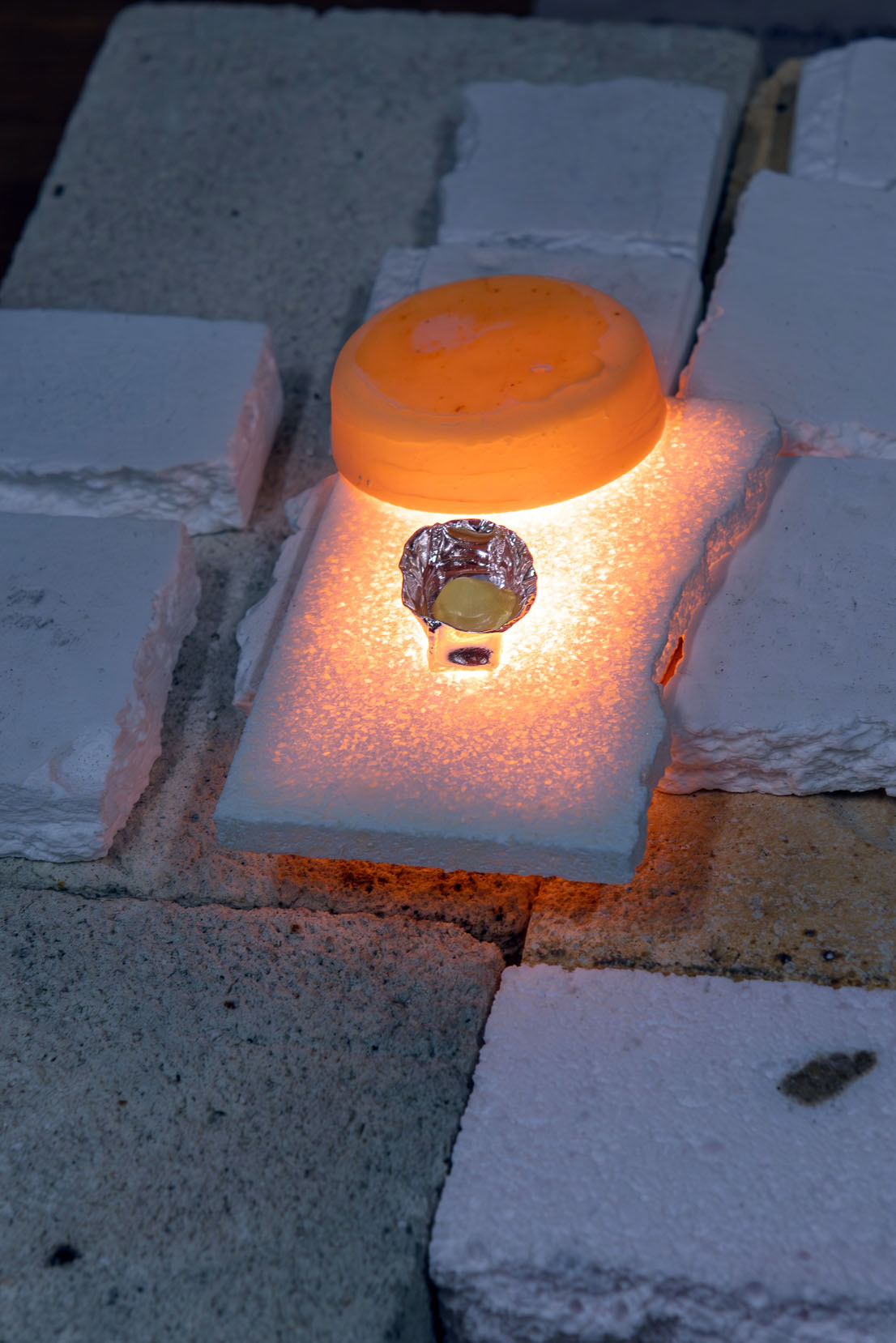
Nothing about the material had ever been studied before, so the team started from scratch, measuring the substance’s chemical composition. To make small, isolated samples and continue testing how it reacted with molten Moon dust, they used special grinding and mixing equipment in their laboratory to crush up around eight basic oxide components in ethyl alcohol before baking the mixture at more than 2,900 degrees Fahrenheit inside the furnace.
“It’s actually a very cool-looking powder; it goes in pink, almost like strawberry milk,” Yu said. “It has a built-in color indicator, so by the time you’re done with it, it turns to a light beige or tan color, and that’s how you know the reaction has proceeded the way you wanted it to.”
The pink powder shown at the far right is used to make the new material researchers discovered at NASA’s Glenn Research Center in Cleveland. The other powders to the left are two types of simulated Moon dirt used to represent dust from both the brighter regions of its surface (referred to as lunar highlands) and the darker regions (referred to as lunar maria).NASA/Jef Janis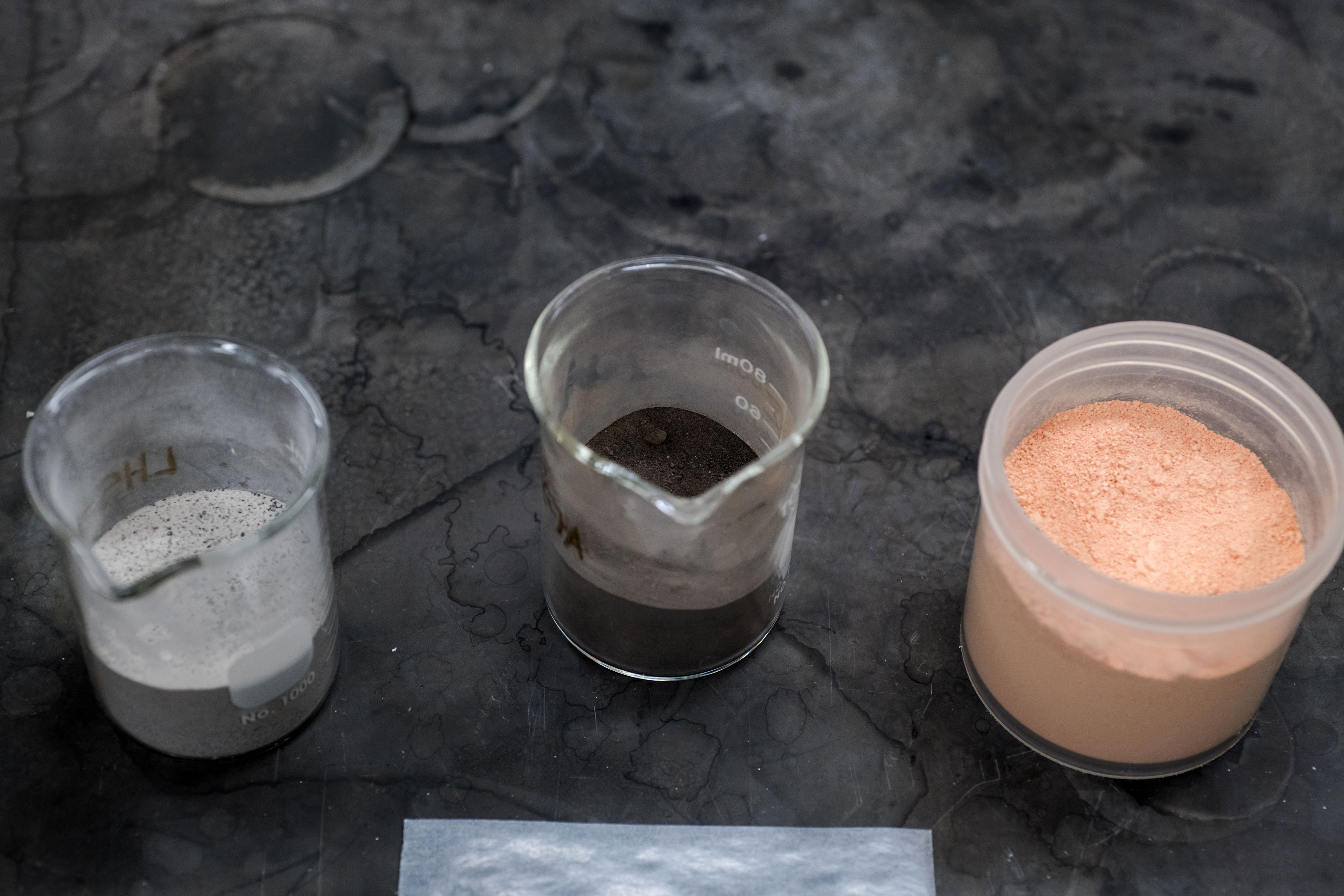
After analyzing their results, the team found that the new substance isn’t corroded too quickly by the molten Moon dirt and can withstand the high temperatures needed to melt it — up to six times hotter than the oven in your kitchen. While it’s made with scandium oxide, which can be expensive, it costs much less than precious metals like platinum that would normally be used in these types of high-temperature processes.
The researchers’ insights could help influence NASA’s designs for a future technology that would extract resources from Moon rocks, and the new material could be used to make the pipes or basins holding molten dust inside this potential technology.
The new material’s characteristics also could prove ideal for making coatings that protect parts inside of jet engines, which can reach similarly scorching temperatures. The researchers found it is lighter, less dense, and better at insulating heat than current state-of-the-art coating materials.
Researchers Dr. Jamesa Stokes, left, and Dr. Kevin Yu pose for a portrait inside of a laboratory at NASA’s Glenn Research Center in Cleveland in October 2024.NASA/Jef Janis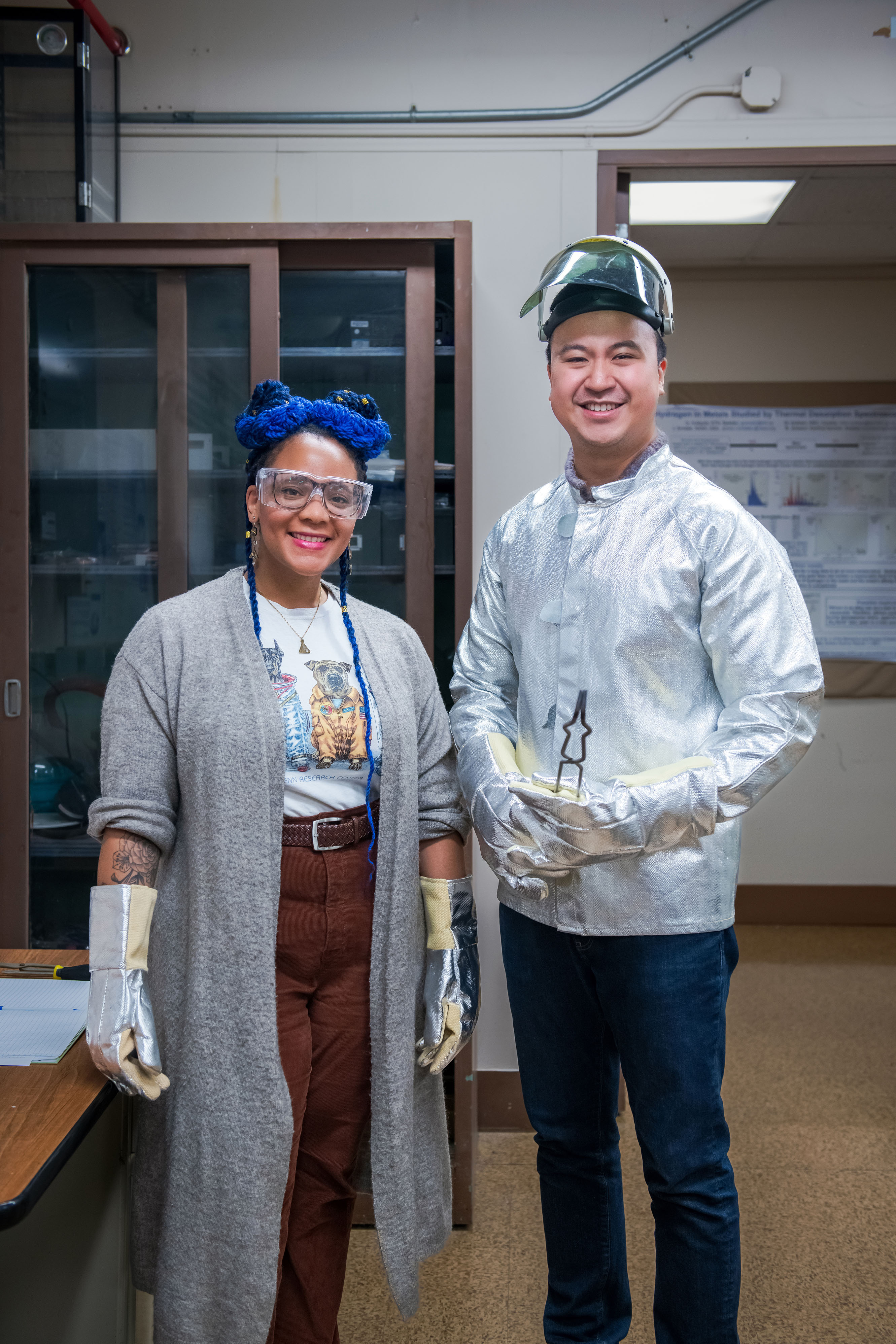
While Yu and Stokes have now completed their initial tests, they hope to fine-tune the material in the future to purify it and make it even more affordable to produce. Materials research will be integral to exploring the harsh environments of the Moon and beyond.
You can have the best idea in the world for a structure or a vehicle, but if you don’t have the materials that have the right properties to make your vision come true, it’s not going to succeed no matter how well you design it.Dr. Jamesa stokes
Materials Research Engineer at NASA Glenn
Studying new materials also advances NASA’s work on Earth.
“I think trying to push what’s possible with materials also allows for a lot of breakthroughs on the terrestrial side. Having a better understanding of materials for all sorts of applications is what gets me excited to go to work in the morning,” Yu said. “That’s why I love NASA’s mission; it’s for the benefit of all.”
This materials research is supported by NASA’s Space Technology Mission Directorate and NASA’s Aeronautics Research Mission Directorate.
For more information, visit:
Share Details Last Updated May 22, 2026 Related Terms Explore More 4 min read Keeping NASA Flying: Ground Crews Ensure Aircraft Readiness Article 3 days ago 2 min read Hubble Captures Galaxy ClusterLook closely at this image from NASA’s Hubble Space Telescope and you’ll see galaxies of…
Article 3 days ago 2 min read NASA Seeks Interest for Artemis Mission CubeSats Article 4 days ago Keep Exploring Discover Related TopicsMissions
Humans in Space
Climate Change
Solar System
New Material Could Help NASA Melt Moon Rocks, Harness Lunar Resources
4 min read
Preparations for Next Moonwalk Simulations Underway (and Underwater) Researchers Dr. Kevin Yu, left, and Dr. Jamesa Stokes prepare to remove a sample of a new material they discovered from a furnace inside a laboratory at NASA’s Glenn Research Center in Cleveland in October 2024. Quenching, or bringing the temperature of the sample down as quickly as possible, helps to ensure no more reactions occur as the sample cools so scientists can focus on studying how it behaves at high temperatures.NASA/Jef JanisA material recently discovered and tested at NASA’s Glenn Research Center in Cleveland could help astronauts pack lighter for future missions to the Moon. NASA is researching ways explorers could “live off the land” by harnessing lunar resources, including melting Moon rocks to extract metals for building infrastructure and oxygen for fuel and life support.
As part of a graduate fellowship through the agency’s Space Technology Graduate Research Opportunities, Dr. Kevin Yu, who now works as a technologist at NASA’s Jet Propulsion Laboratory in Southern California, teamed up with Dr. Jamesa Stokes, a materials research engineer at NASA Glenn, to study how a variety of substances interacted with liquefied Moon dust.
You could call it lava, because it’s basically rocks that are crushed up and then melted. It’s very corrosive, and it will very quickly eat through a lot of commonly used refractory, or heat-resistant, materials.Dr. kevin yu
Technologist at NASA's Jet Propulsion Laboratory
About six months into their research, Stokes and Yu realized they’d stumbled across something promising and entirely new. After combining simulated lunar dust with a compound called scandium oxide and heat treating the mixture using a red-hot furnace, they discovered that an unknown material had formed. The researchers checked and double-checked their work, but the material didn’t match any of the more than 1 million substances in their X-ray analysis database.
A sample of the new material researchers discovered at NASA’s Glenn Research Center in Cleveland sits inside a platinum crucible, or heat-resistant container, after being removed from a high-temperature furnace. Behind the silver-colored container is a dome that protects the sample during handling.NASA/Jef JanisNothing about the material had ever been studied before, so the team started from scratch, measuring the substance’s chemical composition. To make small, isolated samples and continue testing how it reacted with molten Moon dust, they used special grinding and mixing equipment in their laboratory to crush up around eight basic oxide components in ethyl alcohol before baking the mixture at more than 2,900 degrees Fahrenheit inside the furnace.
“It’s actually a very cool-looking powder; it goes in pink, almost like strawberry milk,” Yu said. “It has a built-in color indicator, so by the time you’re done with it, it turns to a light beige or tan color, and that’s how you know the reaction has proceeded the way you wanted it to.”
The pink powder shown at the far right is used to make the new material researchers discovered at NASA’s Glenn Research Center in Cleveland. The other powders to the left are two types of simulated Moon dirt used to represent dust from both the brighter regions of its surface (referred to as lunar highlands) and the darker regions (referred to as lunar maria).NASA/Jef JanisAfter analyzing their results, the team found that the new substance isn’t corroded too quickly by the molten Moon dirt and can withstand the high temperatures needed to melt it — up to six times hotter than the oven in your kitchen. While it’s made with scandium oxide, which can be expensive, it costs much less than precious metals like platinum that would normally be used in these types of high-temperature processes.
The researchers’ insights could help influence NASA’s designs for a future technology that would extract resources from Moon rocks, and the new material could be used to make the pipes or basins holding molten dust inside this potential technology.
The new material’s characteristics also could prove ideal for making coatings that protect parts inside of jet engines, which can reach similarly scorching temperatures. The researchers found it is lighter, less dense, and better at insulating heat than current state-of-the-art coating materials.
Researchers Dr. Jamesa Stokes, left, and Dr. Kevin Yu pose for a portrait inside of a laboratory at NASA’s Glenn Research Center in Cleveland in October 2024.NASA/Jef JanisWhile Yu and Stokes have now completed their initial tests, they hope to fine-tune the material in the future to purify it and make it even more affordable to produce. Materials research will be integral to exploring the harsh environments of the Moon and beyond.
You can have the best idea in the world for a structure or a vehicle, but if you don’t have the materials that have the right properties to make your vision come true, it’s not going to succeed no matter how well you design it.Dr. Jamesa stokes
Materials Research Engineer at NASA Glenn
Studying new materials also advances NASA’s work on Earth.
“I think trying to push what’s possible with materials also allows for a lot of breakthroughs on the terrestrial side. Having a better understanding of materials for all sorts of applications is what gets me excited to go to work in the morning,” Yu said. “That’s why I love NASA’s mission; it’s for the benefit of all.”
This materials research is supported by NASA’s Space Technology Mission Directorate and NASA’s Aeronautics Research Mission Directorate.
For more information, visit:
Share Details Last Updated May 22, 2026 Related Terms Explore More 4 min read Keeping NASA Flying: Ground Crews Ensure Aircraft Readiness Article 3 days ago 2 min read Hubble Captures Galaxy ClusterLook closely at this image from NASA’s Hubble Space Telescope and you’ll see galaxies of…
Article 3 days ago 2 min read NASA Seeks Interest for Artemis Mission CubeSats Article 4 days ago Keep Exploring Discover Related TopicsMissions
Humans in Space
Climate Change
Solar System
Week in images: 18-22 May 2026
Week in images: 18-22 May 2026
Discover our week through the lens
Australia is battling its largest diphtheria outbreak in living memory
Australia is battling its largest diphtheria outbreak in living memory
Span wants to turn homes into mini data centers
Smart-panel start-up Span wants to turn spare household electricity into AI computing power. How far it can scale and what effect that would have on the residential grid remain unsettled
Hubble Captures Galaxy Cluster
- Hubble Home
- Overview
- Impact & Benefits
- Science
- Observatory
- Team
- Multimedia
- News
- More
2 min read
Hubble Captures Galaxy Cluster NASA’s Hubble Space Telescope captured this scene of galaxy cluster MACS J1141.6-1905 in visible and infrared light. NASA, ESA, H. Ebeling (University of Hawaii); Image Processing: G. Kober (NASA/Catholic University of America)Look closely at this image from NASA’s Hubble Space Telescope and you’ll see galaxies of various shapes and sizes clustered together toward the center-left of the image. A few foreground stars shine brightly and are easily distinguished by the spikes that appear to extend outward from each star. These spikes, called diffraction spikes, are the result of how point sources of light (such as stars) bend, or diffract, around the supports for Hubble’s secondary mirror.
Hubble captured this scene of MACS J1141.6-1905 in visible and infrared light. The image includes data from two Hubble observing programs that looked at massive galaxy clusters that shine very brightly in X-rays. Both programs were looking for distant galaxies gravitationally lensed by the cluster. They also wanted to better understand the physical nature of interactions at each cluster’s core. An extra bonus was the addition of Hubble’s visible and infrared observations of these very bright X-ray clusters to its archive.
Hubble’s archive of 1.7 million observations, and counting, is a valuable tool for current and future astronomers. They can mine Hubble’s 36 years of observations and examine the data with new tools, enabling researchers to make new discoveries.
MACS J1141.6-1905 is around four billion light-years away in the constellation Crater (the Cup).
Facebook logo @NASAHubble @NASAHubble Instagram logo @NASAHubbleMedia Contact:
Claire Andreoli
NASA’s Goddard Space Flight Center, Greenbelt, MD
claire.andreoli@nasa.gov
Since its 1990 launch, the Hubble Space Telescope has changed our fundamental understanding of the universe.
Hubble Spectroscopy
Hubble’s Partners in Science
AI and Hubble Science
Hubble Captures Galaxy Cluster
- Hubble Home
- Overview
- Impact & Benefits
- Science
- Observatory
- Team
- Multimedia
- News
- More
2 min read
Hubble Captures Galaxy Cluster NASA’s Hubble Space Telescope captured this scene of galaxy cluster MACS J1141.6-1905 in visible and infrared light. NASA, ESA, H. Ebeling (University of Hawaii); Image Processing: G. Kober (NASA/Catholic University of America)Look closely at this image from NASA’s Hubble Space Telescope and you’ll see galaxies of various shapes and sizes clustered together toward the center-left of the image. A few foreground stars shine brightly and are easily distinguished by the spikes that appear to extend outward from each star. These spikes, called diffraction spikes, are the result of how point sources of light (such as stars) bend, or diffract, around the supports for Hubble’s secondary mirror.
Hubble captured this scene of MACS J1141.6-1905 in visible and infrared light. The image includes data from two Hubble observing programs that looked at massive galaxy clusters that shine very brightly in X-rays. Both programs were looking for distant galaxies gravitationally lensed by the cluster. They also wanted to better understand the physical nature of interactions at each cluster’s core. An extra bonus was the addition of Hubble’s visible and infrared observations of these very bright X-ray clusters to its archive.
Hubble’s archive of 1.7 million observations, and counting, is a valuable tool for current and future astronomers. They can mine Hubble’s 36 years of observations and examine the data with new tools, enabling researchers to make new discoveries.
MACS J1141.6-1905 is around four billion light-years away in the constellation Crater (the Cup).
Facebook logo @NASAHubble @NASAHubble Instagram logo @NASAHubbleMedia Contact:
Claire Andreoli
NASA’s Goddard Space Flight Center, Greenbelt, MD
claire.andreoli@nasa.gov
Since its 1990 launch, the Hubble Space Telescope has changed our fundamental understanding of the universe.
Hubble Spectroscopy
Hubble’s Partners in Science
AI and Hubble Science
What will happen if the Milky Way and Andromeda galaxies collide?
Our galaxy and its nearest large companion, Andromeda, may be headed for a collision on a cosmic scale. What happens then?
What is E15 fuel? Why higher-ethanol gasoline could raise summer smog levels
In an effort to reduce prices at the pump, an EPA wavier allows the sale of fuel with 15 percent ethanol content
Bixonimania’—the fake illness that AI fell for
How an experiment involving a made-up skin condition exposes the risks of increasingly popular AI medical advice
This Week's Sky at a Glance, May 22 – 31
Venus and Jupiter — the Evening Star and the False Evening Star — draw closer together in the western twilight and point down to Mercury. The waxing Moon shows off its rich telescopic detail.
The post This Week's Sky at a Glance, May 22 – 31 appeared first on Sky & Telescope.
How ageing on Earth mimics the effects of space travel
How ageing on Earth mimics the effects of space travel
Earth from Space: Algerian arid landscape
Nereid Could be Neptune’s Only Original Moon
New research suggests that Triton — or a Triton-like object — might have disrupted Neptune's original moon system. Nereid might be the sole survivor.
The post Nereid Could be Neptune’s Only Original Moon appeared first on Sky & Telescope.
Tornado Draws a Jagged Line in Mississippi
- Earth
- Earth Observatory
- Image of the Day
- EO Explorer
- Topics
- More Content
- About
Tornado Draws a Jagged Line in Mississippi
- Earth
- Earth Observatory
- Image of the Day
- EO Explorer
- Topics
- More Content
- About
Both Hemispheres of 3I/ATLAS Observed Simultaneously by JUICE and Europa Clipper
The Southwest Research Institute-led Ultraviolet Spectrograph (UVS) instruments aboard ESA’s Jupiter Icy Moons Explorer (Juice) spacecraft and NASA’s Europa Clipper made unique observations of interstellar comet 3I/ATLAS in late 2025. SwRI leads the UVS instruments on both spacecraft, simultaneously imaging both hemispheres of the comet and detecting the comet’s ultraviolet emissions.