

Feed aggregator
Attack on Iran’s oil released as much pollution as a volcano
Attack on Iran’s oil released as much pollution as a volcano
A Full Moon Checkup
- Earth
- Earth Observatory
- Image of the Day
- EO Explorer
- Topics
- More Content
- About
A Full Moon Checkup
- Earth
- Earth Observatory
- Image of the Day
- EO Explorer
- Topics
- More Content
- About
Jaclyn Kagey Shapes Humanity’s Return to the Moon
For Jaclyn Kagey, preparing astronauts to put boots on the Moon is part of her daily work.
As the Artemis extravehicular activity lead in NASA’s Flight Operations Directorate, Kagey plays a central role in preparing astronauts to safely explore the lunar surface.
Official portrait of Jaclyn Kagey. NASA/Robert Markowitz My mission is to shape the historic endeavor by working closely with scientists and industry partners to define lunar surface activities. We are setting the standard for humanity’s return to the Moon.
Jaclyn Kagey
Artemis Extravehicular Activity Lead
During Artemis missions, astronauts will explore the Moon’s South Pole, a region never visited by humans, paving the way for future deep space exploration.
Kagey helps define how astronauts will work on the Moon, from planning detailed spacewalk timelines to guiding real-time operations. Crews will conduct these activities after stepping outside NASA’s human landing system, a commercial lander designed to safely transport astronauts from lunar orbit to the surface and back.
Jaclyn Kagey conducts lunar surface operations training in the Rock Yard at Johnson Space Center, where teams test tools and procedures for future Artemis missions. NASA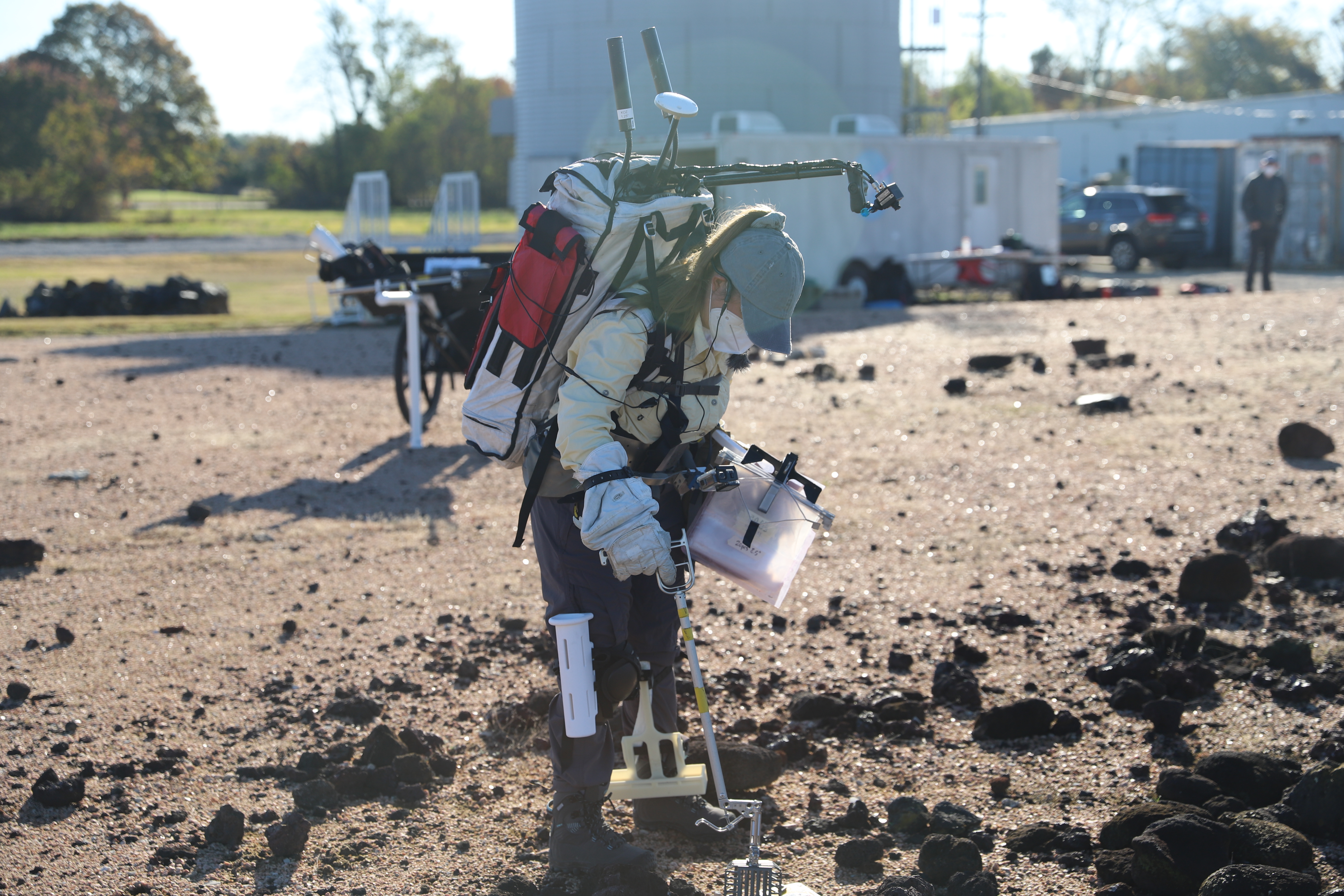
Kagey’s NASA career spans more than 25 years and includes work across some of the agency’s most complex programs.
While studying at Embry-Riddle Aeronautical University, she watched space shuttle launches that solidified her goal of working at NASA. “From a young age, my aspirations were singularly focused on contributing to the nation’s aircraft and spaceflight endeavors,” she said.
That goal became reality through United Space Alliance, where she and her husband began their careers as contractors.
Jaclyn Kagey works in the Mission Control Center during a spacewalk simulation at NASA’s Johnson Space Center in Houston.NASA/Robert Markowitz
One of her career-defining moments came during a high-pressure operation aboard the International Space Station.
“I’ve planned and executed seven spacewalks, but one that stands out was U.S. EVA 21,” she said. “We had a critical ammonia leak on the station, and from the time the issue was identified, we had just 36 hours to plan, prepare the spacesuits, and execute the repair.”
The team successfully completed the spacewalk and restored the system. “The agility, dedication, and teamwork shown during that operation were remarkable,” Kagey said. “It demonstrated what this team can accomplish under pressure.”
Jaclyn Kagey trains in NASA’s Neutral Buoyancy Laboratory, where astronauts and flight controllers rehearse spacewalk procedures in a simulated microgravity environment.NASA There are times when the mission requires everything you have. There are also times when you have to step back. Learning when to do each is critical.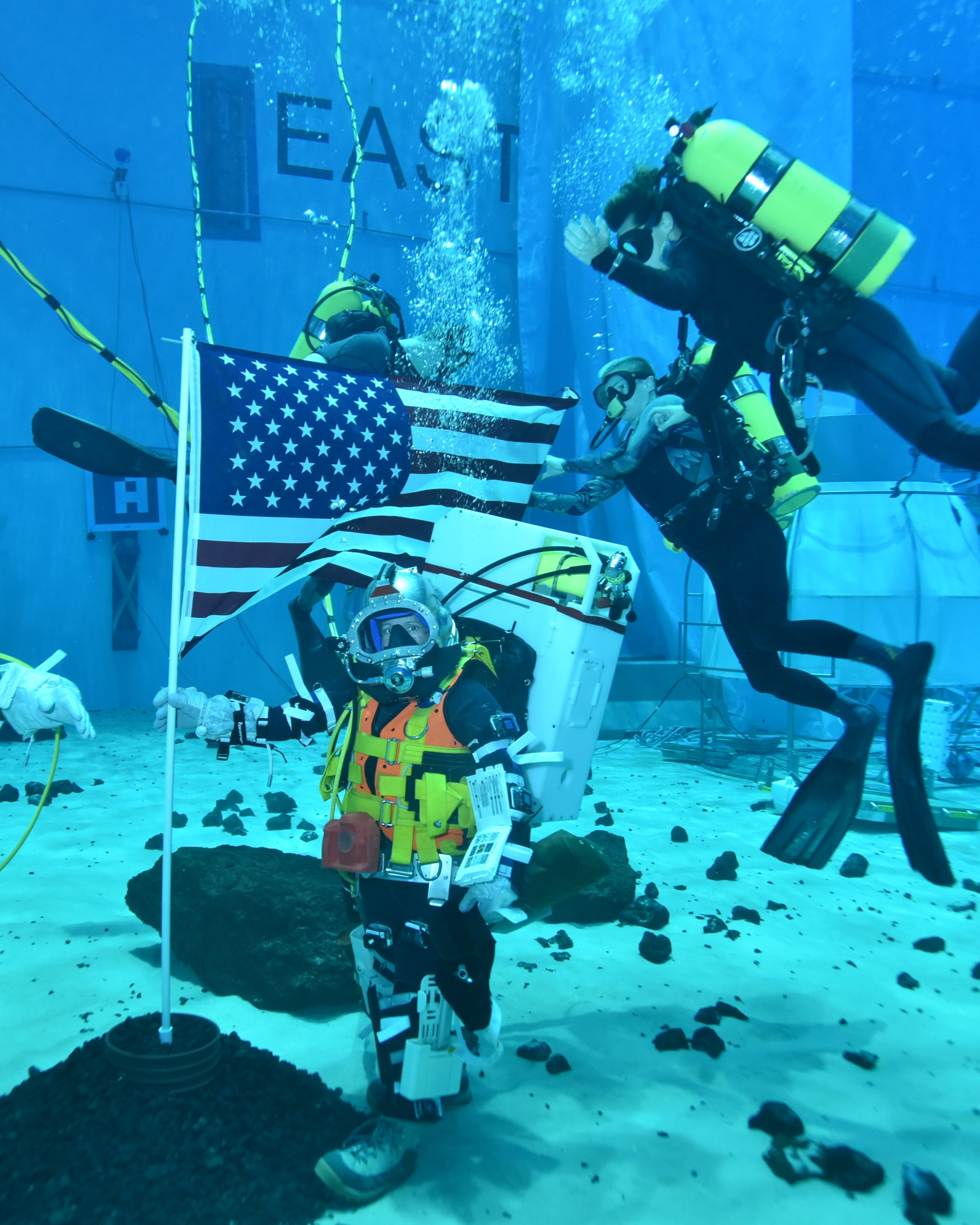
Jaclyn Kagey
Artemis Extravehicular Activity Lead
Throughout her career, Kagey has learned that adaptability is an essential skill.
“Things rarely go exactly as planned, and my job is to respond in a way that keeps the crew safe and the mission moving forward,” she said.
Jaclyn Kagey suited up in Axiom Space’s Extravehicular Mobility Unit (AxEMU) spacesuit during a test on the Active Response Gravity Offload System (ARGOS) at Johnson’s Space Vehicle Mockup Facility. Axiom Space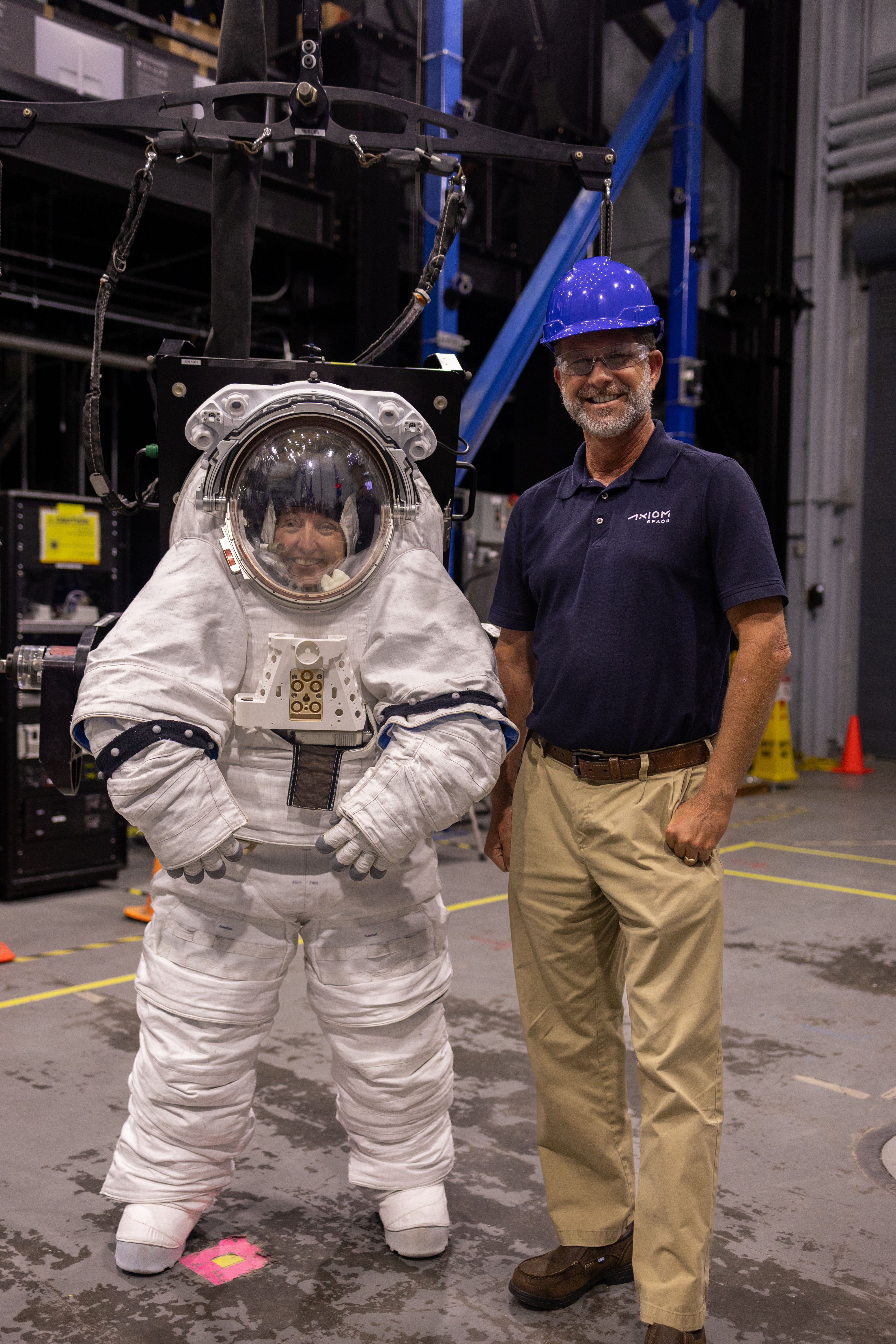
Kagey’s influence also extends to the future of spacesuit development. Standing on the shorter end of the height spectrum, she once could not complete a full test in the legacy Extravehicular Mobility Unit despite passing the fit check. Although Kagey could don the suit, its proportions were too large for her and made it difficult to move as needed for the test. That experience drove her to advocate for designs that better support a wider range of body types.
That effort came full circle when she recently completed her first test in Axiom Space’s lunar spacesuit, called the Axiom Extravehicular Mobility Unit (AxEMU), on the Active Response Gravity Offload System (ARGOS) at Johnson Space Center in Houston.
“It’s exciting to literally fit into the future of spacewalks!” Kagey said.
About the AuthorSumer Loggins Share Details Last Updated May 25, 2026 Related Terms Explore More 2 min read NASA Seeks Interest for Artemis Mission CubeSats Article 5 days ago 3 min read Lunar Robots: NASA Spotlights Moon Base at 2026 FIRST Robotics Competition Article 6 days ago 4 min read I Am Artemis: Tim Goddard Article 6 days ago Keep Exploring Discover More Topics From NASAMissions
Humans in Space
Climate Change
Solar System
Jaclyn Kagey Shapes Humanity’s Return to the Moon
For Jaclyn Kagey, preparing astronauts to put boots on the Moon is part of her daily work.
As the Artemis extravehicular activity lead in NASA’s Flight Operations Directorate, Kagey plays a central role in preparing astronauts to safely explore the lunar surface.
Official portrait of Jaclyn Kagey. NASA/Robert Markowitz My mission is to shape the historic endeavor by working closely with scientists and industry partners to define lunar surface activities. We are setting the standard for humanity’s return to the Moon.Jaclyn Kagey
Artemis Extravehicular Activity Lead
During Artemis missions, astronauts will explore the Moon’s South Pole, a region never visited by humans, paving the way for future deep space exploration.
Kagey helps define how astronauts will work on the Moon, from planning detailed spacewalk timelines to guiding real-time operations. Crews will conduct these activities after stepping outside NASA’s human landing system, a commercial lander designed to safely transport astronauts from lunar orbit to the surface and back.
Jaclyn Kagey conducts lunar surface operations training in the Rock Yard at Johnson Space Center, where teams test tools and procedures for future Artemis missions. NASAKagey’s NASA career spans more than 25 years and includes work across some of the agency’s most complex programs.
While studying at Embry-Riddle Aeronautical University, she watched space shuttle launches that solidified her goal of working at NASA. “From a young age, my aspirations were singularly focused on contributing to the nation’s aircraft and spaceflight endeavors,” she said.
That goal became reality through United Space Alliance, where she and her husband began their careers as contractors.
Jaclyn Kagey works in the Mission Control Center during a spacewalk simulation at NASA’s Johnson Space Center in Houston.NASA/Robert MarkowitzOne of her career-defining moments came during a high-pressure operation aboard the International Space Station.
“I’ve planned and executed seven spacewalks, but one that stands out was U.S. EVA 21,” she said. “We had a critical ammonia leak on the station, and from the time the issue was identified, we had just 36 hours to plan, prepare the spacesuits, and execute the repair.”
The team successfully completed the spacewalk and restored the system. “The agility, dedication, and teamwork shown during that operation were remarkable,” Kagey said. “It demonstrated what this team can accomplish under pressure.”
Jaclyn Kagey trains in NASA’s Neutral Buoyancy Laboratory, where astronauts and flight controllers rehearse spacewalk procedures in a simulated microgravity environment.NASA There are times when the mission requires everything you have. There are also times when you have to step back. Learning when to do each is critical.Jaclyn Kagey
Artemis Extravehicular Activity Lead
Throughout her career, Kagey has learned that adaptability is an essential skill.
“Things rarely go exactly as planned, and my job is to respond in a way that keeps the crew safe and the mission moving forward,” she said.
Jaclyn Kagey suited up in Axiom Space’s Extravehicular Mobility Unit (AxEMU) spacesuit during a test on the Active Response Gravity Offload System (ARGOS) at Johnson’s Space Vehicle Mockup Facility. Axiom SpaceKagey’s influence also extends to the future of spacesuit development. Standing on the shorter end of the height spectrum, she once could not complete a full test in the legacy Extravehicular Mobility Unit despite passing the fit check. Although Kagey could don the suit, its proportions were too large for her and made it difficult to move as needed for the test. That experience drove her to advocate for designs that better support a wider range of body types.
That effort came full circle when she recently completed her first test in Axiom Space’s lunar spacesuit, called the Axiom Extravehicular Mobility Unit (AxEMU), on the Active Response Gravity Offload System (ARGOS) at Johnson Space Center in Houston.
“It’s exciting to literally fit into the future of spacewalks!” Kagey said.
About the AuthorSumer Loggins Share Details Last Updated May 25, 2026 Related Terms Explore More 2 min read NASA Seeks Interest for Artemis Mission CubeSats Article 5 days ago 3 min read Lunar Robots: NASA Spotlights Moon Base at 2026 FIRST Robotics Competition Article 5 days ago 4 min read I Am Artemis: Tim Goddard Article 6 days ago Keep Exploring Discover More Topics From NASAMissions
Humans in Space
Climate Change
Solar System
How Mars Can Help Us Understand 'Marginal' Exoplanets
We've discovered large numbers of small rocky exoplanets, but they're at such great distances that habitability is extremely difficult to determine. New research suggests than since Mars is on the edge of being habitable, studying it in detail can shed light on rocky exoplanets. If we can understand things like tectonic activity and atmospheric escape on Mars, we can understand how they may play out on rocky exoplanets.
Ultrahigh-energy Cosmic Rays May Be Ultraheavy in Origin
New research led by Penn State scientists suggests that some of the highest-energy cosmic rays may consist of atomic nuclei heavier than iron and could help narrow down the cosmic sources capable of accelerating these particles.
NASA's Next-Generation AI Processor Passes Early Testing
As part of a commercial partnership, NASA is developing a sophisticated chip that will give spacecraft the processing capabilities to think for themselves.
Early Life on Earth May Have Thrived in Impact Craters
A team of South Korean scientists has uncovered new evidence that could help explain how Earth’s atmosphere became rich in oxygen, one of the most transformative events in the planet’s history. Researchers from the Korea Institute of Geoscience and Mineral Resources (KIGAM) report the finding of stromatolites, layered structures formed by microbial communities, within the Hapcheon impact crater on the Korean Peninsula. While the Hapcheon crater is only about 40,000 years old, it shows how stromatolites got a boost from the heat in impact crater hydrothermal systems.
Does gravity create reality? A shocking path to a theory of everything
Does gravity create reality? A shocking path to a theory of everything
How mathematicians use Minecraft to calculate pi
A battle between “slimes” and “zoglins” could be the best way to calculate pi—at least for fans of this megahit game
Experts explain how sunscreen really works—and why better ones may be coming soon
Thick and creamy, gloopy or spray-on, sunscreen can be confounding. This science-backed guide can help you get ready for summer
Mars astronauts may do laundry by blasting clothes with a plasma beam
Mars astronauts may do laundry by blasting clothes with a plasma beam
Why your brain needs plenty of “Aha!” moments
Why your brain needs plenty of “Aha!” moments
An Early “Decoration Day” Celebration
- Earth
- Earth Observatory
- Image of the Day
- EO Explorer
- Topics
- More Content
- About