
Feed aggregator
Top U.S. science funder slows research grants to universities
It's not clear why the National Science Foundation may be limiting funding to certain U.S. universities
Lasers at the Lunar Poles Could Help Astronauts Navigate
A team of scientists is exploring ways to use dark craters at the lunar poles as sites for ultrastable lasers to aid in surface and near-lunar navigation. The group, led by Physicist Jun Ye, an expert on lasers and precision measurements, were discussing the types of instruments that Artemis astronauts could install and use during their time on the Moon.
New protein-folding AI vastly expands on Alphafold's efforts
The new open-source atlas, generated by an AI tool called ESMFold2, vastly increases the known protein universe
Who You Send to the Moon Matters More Than You Think
Building a permanent base on the Moon sounds like an engineering problem. Design the habitat, sort the power supply, figure out life support, and you're most of the way there. But the engineers who've spent time thinking hard about this will tell you the real challenge isn't the hardware — it's the humans inside it. Now researchers have built a virtual Moon base and run tens of thousands of simulated missions inside it, studying not the rocket engines or the radiation shielding, but the astronauts themselves. What they found could reshape how we plan humanity's return to the lunar surface.
The best new science-fiction books of June 2026
The best new science-fiction books of June 2026
NASA’s Hubble captures gorgeous new photo of a spiral galaxy as it wanders through the Virgo Cluster
Messier 88 is an active galaxy with a central supermassive black hole that is gobbling up gas and dust
Photons behave very strangely if you try to cut them
Photons behave very strangely if you try to cut them
MAVEN Spacecraft Finds New Plasma Squeezing at Mars
A cloaked alien invasion force is approaching Earth and coming up on Mars. The first officer looks through a viewfinder and says, “Captain, the fourth planet’s atmosphere is behaving strangely. As though it were trying to block incoming energy.” The captain takes a moment, then his (already big) eyes get wide and he exclaims, “It’s a defense shield! The Earthlings are hiding on the fourth planet and are prepared to attack us! Abort the invasion!” The first officer responds, “Aye aye, Captain!”
How the success of D-Day hinged on a weather forecast
As General Dwight D. Eisenhower prepared for D-Day, he needed a forecast. The new movie Pressure shows the tense make-or-break weather prediction that led to the successful invasion of Europe that spelled the beginning of the end of World War II
NASA Awards Contract for Johnson Space Center Infrastructure
NASA has selected seven companies to provide construction, revitalization, and infrastructure improvements at the agency’s Johnson Space Center in Houston.
The Johnson Space Center Multiple Award Construction Contract supports up to $300 million in upgrades to mission‑support facilities, utilities, and equipment across the NASA Johnson campus. All funds must be obligated by Sept. 30, 2026.
The indefinite-delivery/indefinite-quantity award enables rapid execution of facility projects essential to sustaining astronaut crew training, engineering development, and mission readiness. Task orders will be competed among awardees to ensure fair opportunity and best value to the government.
Contract awardees are:
- Coho Construction Management, LLC
- Conti Federal Services, LLC
- Healtheon, Inc.
- HITT Contracting, Inc.
- Ross Group Construction Corporation, LLC
- Energy EPC Solutions, LLC, doing business as S&B Services
- Sauer Construction, LLC
For more information about NASA and its missions, visit:
-end-
Jennifer Dooren / Jessica Taveau
Headquarters, Washington
202-358-1600
jennifer.m.dooren@nasa.gov / jessica.c.taveau@nasa.gov
Chelsey Ballarte
Johnson Space Center, Houston
281-483-5111
chelsey.n.ballarte@nasa.gov
NASA Awards Contract for Johnson Space Center Infrastructure
NASA has selected seven companies to provide construction, revitalization, and infrastructure improvements at the agency’s Johnson Space Center in Houston.
The Johnson Space Center Multiple Award Construction Contract supports up to $300 million in upgrades to mission‑support facilities, utilities, and equipment across the NASA Johnson campus. All funds must be obligated by Sept. 30, 2026.
The indefinite-delivery/indefinite-quantity award enables rapid execution of facility projects essential to sustaining astronaut crew training, engineering development, and mission readiness. Task orders will be competed among awardees to ensure fair opportunity and best value to the government.
Contract awardees are:
- Coho Construction Management, LLC
- Conti Federal Services, LLC
- Healtheon, Inc.
- HITT Contracting, Inc.
- Ross Group Construction Corporation, LLC
- Energy EPC Solutions, LLC, doing business as S&B Services
- Sauer Construction, LLC
For more information about NASA and its missions, visit:
-end-
Jennifer Dooren / Jessica Taveau
Headquarters, Washington
202-358-1600
jennifer.m.dooren@nasa.gov / jessica.c.taveau@nasa.gov
Chelsey Ballarte
Johnson Space Center, Houston
281-483-5111
chelsey.n.ballarte@nasa.gov
NASA Hosts SpaceX Crew-11 Astronauts for Public Event at Headquarters
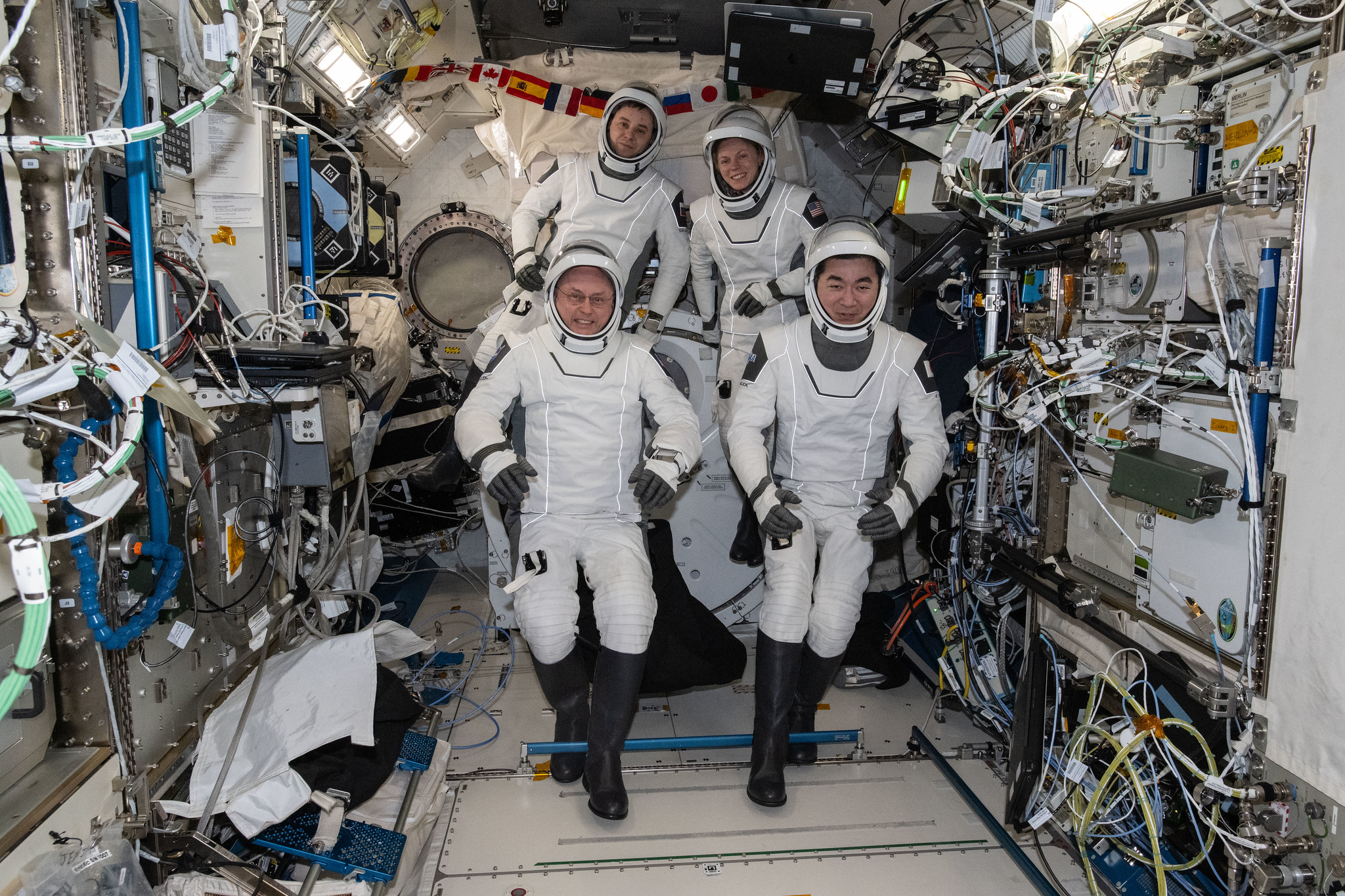
NASA will host a public event featuring three crew members from the agency’s SpaceX Crew-11 mission at 11 a.m. EDT Monday, June 1. The event, which takes place during the crew’s standard postflight visit, will be held in the Webb Auditorium at NASA Headquarters in the Mary W. Jackson building, 300 E. Street SW in Washington.
The crew members, including NASA astronauts Zena Cardman and Mike Fincke and JAXA (Japan Aerospace Exploration Agency) astronaut Kimiya Yui, will discuss their recent 167-day mission aboard the International Space Station, where they conducted a wide range of science experiments to benefit life on Earth and advance human space exploration as part of International Space Station Expedition 73/74.
The Crew-11 mission lifted off on Aug.1, 2025, from Launch Complex 39A at NASA’s Kennedy Space Center in Florida. The crew’s SpaceX Dragon spacecraft docked to the orbital outpost on Aug. 2.
During their mission, the three astronauts, along with crewmate Roscosmos cosmonaut Oleg Platonov, traveled nearly 71 million miles and completed more than 2,670 orbits around Earth. The Crew-11 mission was Fincke’s fourth spaceflight, Yui’s second, and the first for Cardman and Platonov. Fincke has logged 549 days in space, ranking him fourth among all NASA astronauts for cumulative days in space. The crew members returned to Earth on Jan. 15, splashing down off the coast of San Diego.
Along the way, Crew-11 logged hundreds of hours of research, maintenance, and technology demonstrations. The crew members also celebrated the 25th anniversary of continuous human presence aboard the orbiting laboratory on Nov. 2, 2025. Research conducted aboard the space station advances scientific knowledge and demonstrates new technologies that enable us to prepare for human exploration of the Moon and Mars.
Media interested in attending the event must RSVP by 8 a.m., June 1, by emailing the NASA Headquarters newsroom at hq-media@mail.nasa.gov. NASA’s media accreditation policy is online. Based on the crew’s schedule, NASA will not be able to accommodate interviews.
This opportunity also is part of NASA’s Frontiers Forum: Voices Shaping the Future of Space speaking series designed to convene bold thinkers and senior leaders at the forefront of exploration and innovation. The series will spotlight mission-critical priorities from advancing the Artemis campaign and strengthening commercial partnerships to shaping the future workforce and accelerating breakthrough technologies. The agency will share more details soon.
To learn more about the International Space Station and its research and crews, visit:
-end-
Gerelle Dodson
Headquarters, Washington
202-358-1600
gerelle.q.dodson@nasa.gov
NASA Hosts SpaceX Crew-11 Astronauts for Public Event at Headquarters
NASA will host a public event featuring three crew members from the agency’s SpaceX Crew-11 mission at 11 a.m. EDT Monday, June 1. The event, which takes place during the crew’s standard postflight visit, will be held in the Webb Auditorium at NASA Headquarters in the Mary W. Jackson building, 300 E. Street SW in Washington.
The crew members, including NASA astronauts Zena Cardman and Mike Fincke and JAXA (Japan Aerospace Exploration Agency) astronaut Kimiya Yui, will discuss their recent 167-day mission aboard the International Space Station, where they conducted a wide range of science experiments to benefit life on Earth and advance human space exploration as part of International Space Station Expedition 73/74.
The Crew-11 mission lifted off on Aug.1, 2025, from Launch Complex 39A at NASA’s Kennedy Space Center in Florida. The crew’s SpaceX Dragon spacecraft docked to the orbital outpost on Aug. 2.
During their mission, the three astronauts, along with crewmate Roscosmos cosmonaut Oleg Platonov, traveled nearly 71 million miles and completed more than 2,670 orbits around Earth. The Crew-11 mission was Fincke’s fourth spaceflight, Yui’s second, and the first for Cardman and Platonov. Fincke has logged 549 days in space, ranking him fourth among all NASA astronauts for cumulative days in space. The crew members returned to Earth on Jan. 15, splashing down off the coast of San Diego.
Along the way, Crew-11 logged hundreds of hours of research, maintenance, and technology demonstrations. The crew members also celebrated the 25th anniversary of continuous human presence aboard the orbiting laboratory on Nov. 2, 2025. Research conducted aboard the space station advances scientific knowledge and demonstrates new technologies that enable us to prepare for human exploration of the Moon and Mars.
Media interested in attending the event must RSVP by 8 a.m., June 1, by emailing the NASA Headquarters newsroom at hq-media@mail.nasa.gov. NASA’s media accreditation policy is online. Based on the crew’s schedule, NASA will not be able to accommodate interviews.
This opportunity also is part of NASA’s Frontiers Forum: Voices Shaping the Future of Space speaking series designed to convene bold thinkers and senior leaders at the forefront of exploration and innovation. The series will spotlight mission-critical priorities from advancing the Artemis campaign and strengthening commercial partnerships to shaping the future workforce and accelerating breakthrough technologies. The agency will share more details soon.
To learn more about the International Space Station and its research and crews, visit:
-end-
Gerelle Dodson
Headquarters, Washington
202-358-1600
gerelle.q.dodson@nasa.gov
Why high-bandwidth memory is a bottleneck for AI chips
High-bandwidth memory keeps powerful AI chips fed with data, and demand for it helped Boise, Idaho–based Micron briefly top $1 trillion in market value
NASA Brings Its Lunar Ambitions into Focus with Moon Base Missions
Rovers, drones, and landers will usher in a sustained lunar presence, under the new plan NASA announced this week.
The post NASA Brings Its Lunar Ambitions into Focus with Moon Base Missions appeared first on Sky & Telescope.
The Sun is Changing and We Don’t Know Why
The Sun has a heartbeat. Every eleven years it swells with magnetic fury, hurling solar flares and charged particles into space, sparking auroral displays and threatening power grids, all before quietening down again. We've tracked this rhythm for centuries. But now, scientists listening to sound waves deep inside our local star have found something deeply unexpected, that heartbeat is changing. And nobody yet knows what it means.
NASA’s Roman Space Telescope Primary Mirror Gets Last Look
Engineers at NASA’s Goddard Space Flight Center in Greenbelt, Maryland, have completed their final inspection of a key element for the agency’s Nancy Grace Roman Space Telescope: the primary mirror. This 7.9-foot (2.4-meter) mirror will collect and focus light from cosmic objects near and far, helping Roman capture stunning panoramas of space.
The primary mirror for NASA’s Nancy Grace Roman Space Telescope has passed its final inspection. On May 20 and 21, engineers at NASA’s Goddard Space Flight Center in Greenbelt, Md., confirmed that no specks fell onto the mirrors during testing and that there are no changes in the mirror path and alignment. With this milestone complete, the primary mirror is ready for its next view: space.NASA’s Goddard Space Flight Center
“The Roman engineering team laid eyes on the telescope for the final time before it, in turn, becomes the eyes of humanity, revealing the wonders of the cosmos,” said J. Scott Smith, the Roman telescope manager at NASA Goddard. “It is a profoundly humbling moment to witness the culmination of hard work from so many dedicated individuals, teams, and partner organizations, including L3Harris.”
On May 20, engineers turned the Roman observatory onto its side and deployed the “hood” that will be stowed for launch to protect the mirror. Then the team conducted a meticulous visual inspection to ensure no specks fell onto the mirrors during testing and confirm there are no changes in the mirror path and alignment.
“We developed a method of using a high-resolution camera equipped with a very powerful zoom lens to do a multi-purpose inspection,” said Bente Eegholm, optics lead for Roman’s Optical Telescope Assembly at NASA Goddard. “The mirror passed with flying colors, keeping the mission on track for an early September launch.”
Technicians stow Roman’s deployable aperture cover, a large sunshade designed to keep unwanted light out of the telescope.NASA/Sydney Rohde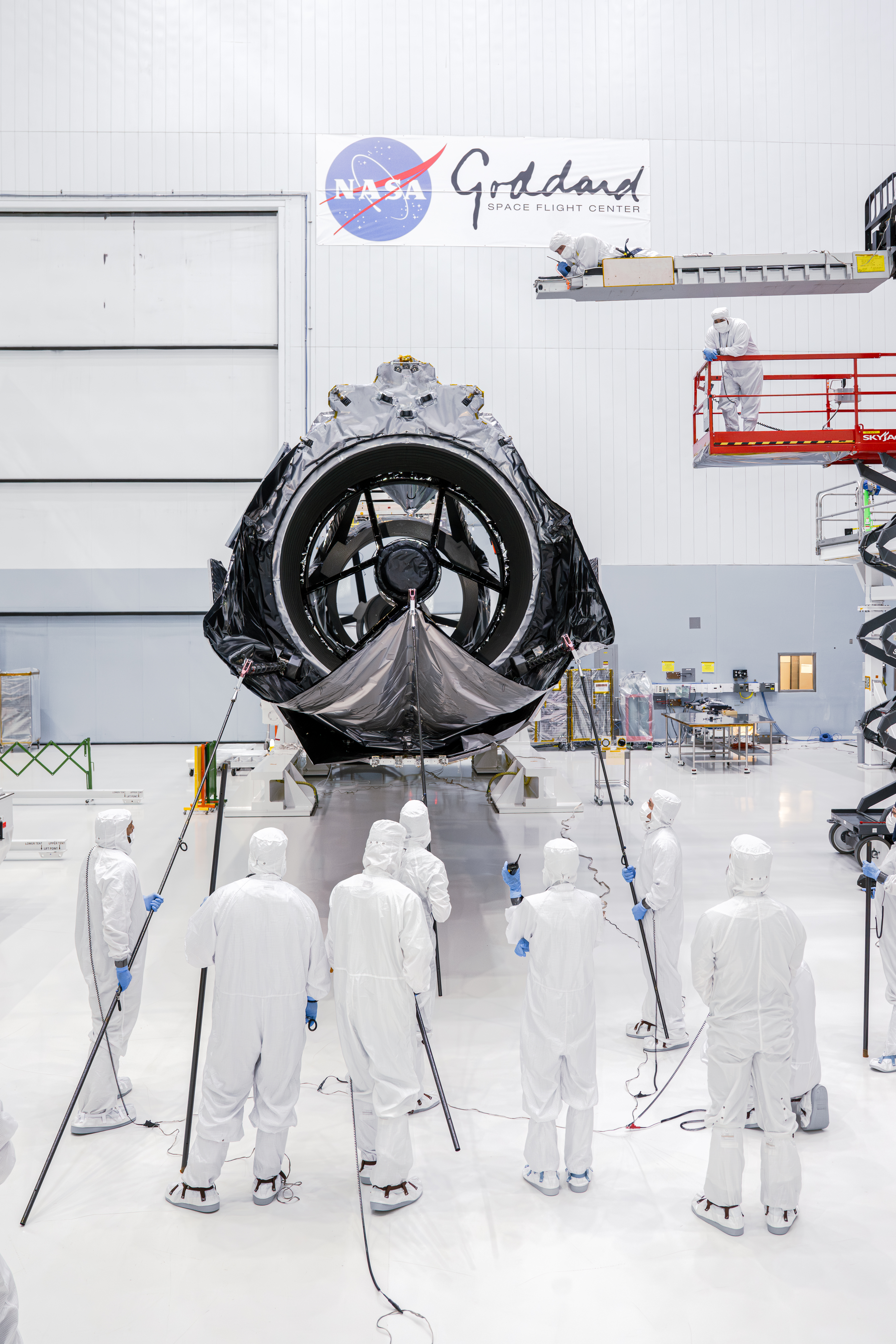
The team carefully observed the optics along the path light will follow to the Wide Field Instrument detector array and confirmed it remains in proper alignment following the observatory shake test.
“In order to gather very sensitive measurements of objects strewn throughout space, all of Roman’s components have to be ultraprecise,” Eegholm said. “The primary mirror certainly delivers on that precision.”
Roman’s primary mirror sports a layer of silver less than 400 nanometers thick — about 200 times thinner than a human hair. The silver coating was specifically chosen for Roman because of how well it reflects near-infrared light. By contrast, the Hubble Space Telescope’s mirror is coated with layers of aluminum and magnesium fluoride to optimize visible and ultraviolet light reflectivity. Likewise, the James Webb Space Telescope’s mirrors have a gold coating to suit its longer wavelength infrared observations.
The Roman mirror is so finely polished that the average bump on its surface is only 1.2 nanometers tall — more than twice as smooth as the mission requires. If the mirror were scaled up to Earth’s size, these bumps would be just a quarter of an inch high.
In this photo, which peers directly down the barrel of Roman’s telescope, the photographer’s camera is reflected in the primary mirror.NASA/Sydney Rohde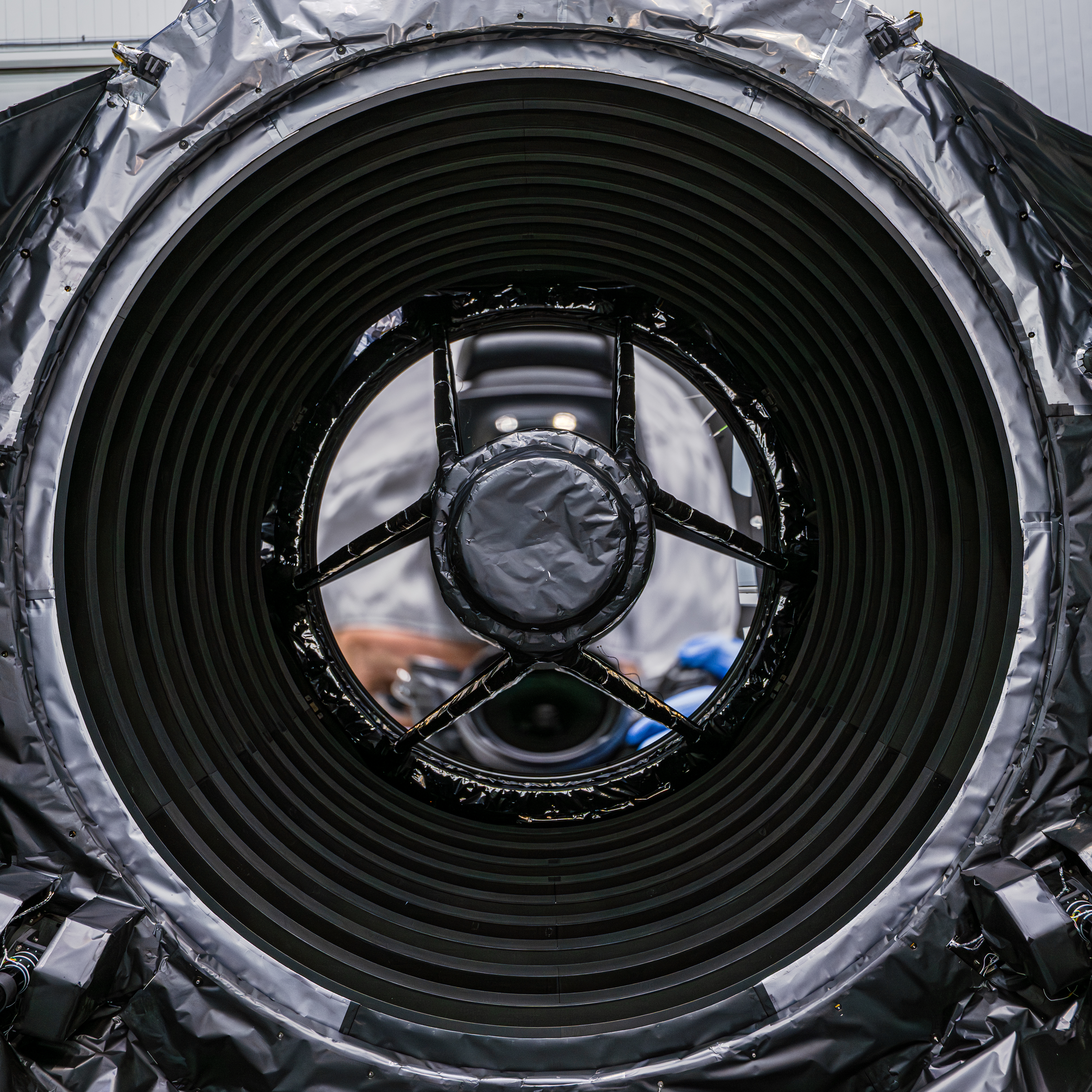
Since it’s made of a specialty ultralow-expansion glass, the mirror will resist flexing, which can happen to materials during temperature changes (like going from balmy Earth conditions to the deep freeze of space). This preserves Roman’s image quality, because if the primary mirror changed shape, it would distort the images from the telescope.
“We’re really proud of the amazing optical system we’ve delivered for the Roman mission alongside our partners at L3Harris,” said Josh Abel, lead Optical Telescope Assembly systems engineer at NASA Goddard. “Now that it’s assembled, aligned, and all shined up, we’re ready to go.”
Now, the Roman team is preparing to ship the observatory to the launch site at NASA’s Kennedy Space Center in Florida in the coming weeks. NASA expects the mission to begin returning incredible cosmic vistas within several months after launch.
To learn more about NASA’s Roman mission, visit:
The Nancy Grace Roman Space Telescope is managed at NASA’s Goddard Space Flight Center in Greenbelt, Maryland, with participation by NASA’s Jet Propulsion Laboratory and Caltech/IPAC in Southern California, the Space Telescope Science Institute (STScI) in Baltimore, and scientists from various research institutions.
Media contact:
Claire Andreoli
NASA’s Goddard Space Flight Center, Greenbelt, Md.
301-286-1940
Ashley is the lead science writer for NASA's Nancy Grace Roman Space Telescope.
Share Details Last Updated May 30, 2026 EditorAshley BalzerContactAshley Balzerashley.m.balzer@nasa.govLocationGoddard Space Flight Center Related Terms Explore More 6 min read NASA’s Roman Mission Preps to Unveil New Populations of Faraway Worlds Article 4 days ago 4 min read NASA’s Roman Observatory Passes Final Major Prelaunch Tests Article 2 months ago 7 min read NASA Announces Plan to Map Milky Way With Roman Space Telescope Article 6 months ago Keep Exploring Discover More Topics From NASAMissions
Humans in Space
Climate Change
Solar System