

Feed aggregator
Why you need to future-proof your brain in middle age and how to start
How the electromagnetic spectrum opened our eyes to the universe
How the electromagnetic spectrum opened our eyes to the universe
How Early Earth's Unlikely Chemical Hero Appeared
Though it's a toxic chemical, hydrogen cyanide (HCN) is also important for the development of life. It's a precursor to things like amino acids and nucleic acids and plays a central role in theories of the origin of life on Earth. Recently, difficult questions have been asked about how it could have formed on the early Earth. But the authors of new research in PNAS seemed to have figured it out.
Trump’s new AI executive order drastically shifts the administration’s stance on the tech
This order asks artificial intelligence companies to give the U.S. government up to 30 days to assess frontier models before they are released
Mars Hid its Warm, Wet Crystals Underground
The search for any sign of life on Mars continues. In the latest update, a new data release from Curiosity’s Chemistry and Mineralogy (CheMin) - essentially the rover’s portable X-ray diffraction lab - and published in a paper in Science, analyzes 20 different rock samples from various elevations of Mount Sharp, the mountain in the center of Gale Crater that Curiosity has been slowly climbing. In the paper, the researchers describe how the size of the crystals in those samples could help scientists determine where to look for evidence that life might have evolved on the Red Planet.
The best new popular science books of June 2026
The best new popular science books of June 2026
Trump administration takes aim at crucial ocean monitoring network
The Ocean Observatories Initiative has been collecting data on physical, chemical, geological and biological conditions in the Atlantic and Pacific Oceans for the past decade
Look Up!
Look Up!
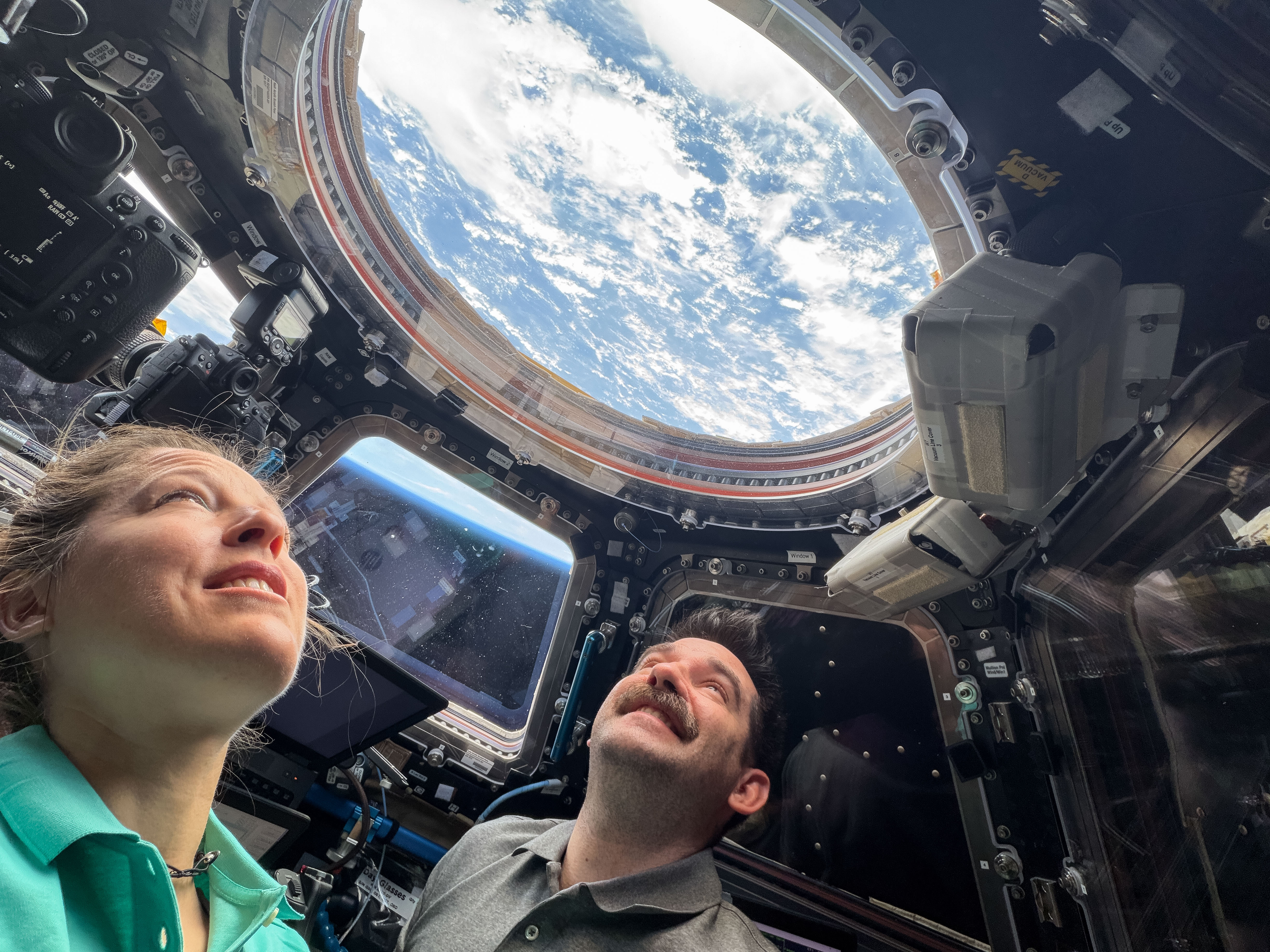
Astronauts Sophie Adenot of ESA (European Space Agency) and Jack Hathaway of NASA, both Expedition 74 flight engineers, look out a window in the cupola, monitoring the automated approach and docking of the SpaceX Dragon cargo spacecraft to the International Space Station on May 17, 2026. The orbital outpost was soaring 259 miles above the Indian Ocean just west of the Maldives at the time of this photograph.
See the cupola and other parts of the space station in our guided tour.
Image credit: ESA/Sophie Adenot
Look Up!
Astronauts Sophie Adenot of ESA (European Space Agency) and Jack Hathaway of NASA, both Expedition 74 flight engineers, look out a window in the cupola, monitoring the automated approach and docking of the SpaceX Dragon cargo spacecraft to the International Space Station on May 17, 2026. The orbital outpost was soaring 259 miles above the Indian Ocean just west of the Maldives at the time of this photograph.
See the cupola and other parts of the space station in our guided tour.
Image credit: ESA/Sophie Adenot
Hearing loss is bad for the whole body – but new treatments are coming
Hearing loss is bad for the whole body – but new treatments are coming
Hidden store of manganese may have helped Earth get its oxygen
Hidden store of manganese may have helped Earth get its oxygen
Could the Milky Way’s Missing Mass Be Hiding in a Swarm of Interstellar Comets?
3I/ATLAS has caused quite a stir over the last year, inviting astronomers to update what they know about other solar systems as well as our own. However, this third interstellar visitor may have an unexpected impact on our understanding of dark matter. A new paper, available in pre-print on arXiv from researchers at the University of Hamburg, attempts to calculate the impact that the presence of large amounts of interstellar objects (ISOs) would have on our calculation of dark matter in our galaxy.
NASA Testing Wastewater Treatment Facility for Future Moon Base

A mobile wastewater treatment system built at NASA’s Kennedy Space Center in Florida that can help prepare for long-duration missions on the Moon and Mars departed the spaceport and arrived at the University of North Dakota in Grand Forks. Graduate students at the university will test the technology under conditions designed to closely mimic the challenges of operating on another planetary surface.
The Divergent Deployable Wastewater Treatment Facility is designed to turn crew wastewater into useful resources, which future explorers will need every day. At the University of North Dakota, teams will integrate this new wastewater system with the university’s Integrated Lunar/Martian Analog Habitat. Student operators and NASA researchers will study how the facility performs when connected to a habitat-like environment and exposed to the kinds of operational limits crews could face on another planet.
“NASA’s Artemis program is laying the groundwork for a sustained human presence on the Moon, where habitats will need to operate far from the steady resupply chain that supports astronauts in partial gravity,” said Luke Roberson, surface water systems lead within the Mars Campaign Office at NASA Kennedy. “To solve that challenge, we are developing the future of sustainable lunar surface systems to process wastewater into nutrient feedstocks for plants and biomanufacturing.”
How Treatment System WorksHoused inside an 8.5-by-24-foot trailer, the facility brings together three biological reactor systems, a vertical garden, water-polishing hardware, environmental monitoring, autonomous control software, and safety systems. The trailer was outfitted at NASA Kennedy to function as a deployable laboratory and to travel between at least two simulation test sites as the technology matures.
Unlike wastewater systems on Earth, this facility keeps waste streams separate. That divergent approach is important for small crews, because wastewater from four to eight people can be highly concentrated. Urine, hygiene water, laundry water, fecal waste, and food waste each contain different levels of salts, solids, carbon, nitrogen, phosphorus, and other compounds. Treating them separately allows each stream to be processed by the reactor best suited for the job.
To do that, the system uses three different bioreactors to treat waste streams. The Anaerobic Phototrophic Membrane Bioreactor processes fecal and food waste and converts it into a nutrient-rich wastewater that can support plant growth. The Suspended Aerobic Membrane Bioreactor processes urine and flush water. The Membrane Aerated Biological Reactor treats graywater from hygiene and laundry activities. Collectively, the bioreactors process nutrients to feed the facility’s vertical garden and prepare the water for reuse. Inside that garden, crops will grow hydroponically, or without using soil, by using nutrient solutions derived from the bioreactors. Researchers will compare crop performance with plants grown using standard hydroponic nutrients.
NASA’s Dr. Roberson demonstrating the Divergent Wastewater Treatment Facility to UND Chair Dr. De Leon and Dr. Robert Kraus, Dean of UND’s School of Aerospace Sciences.University of North Dakota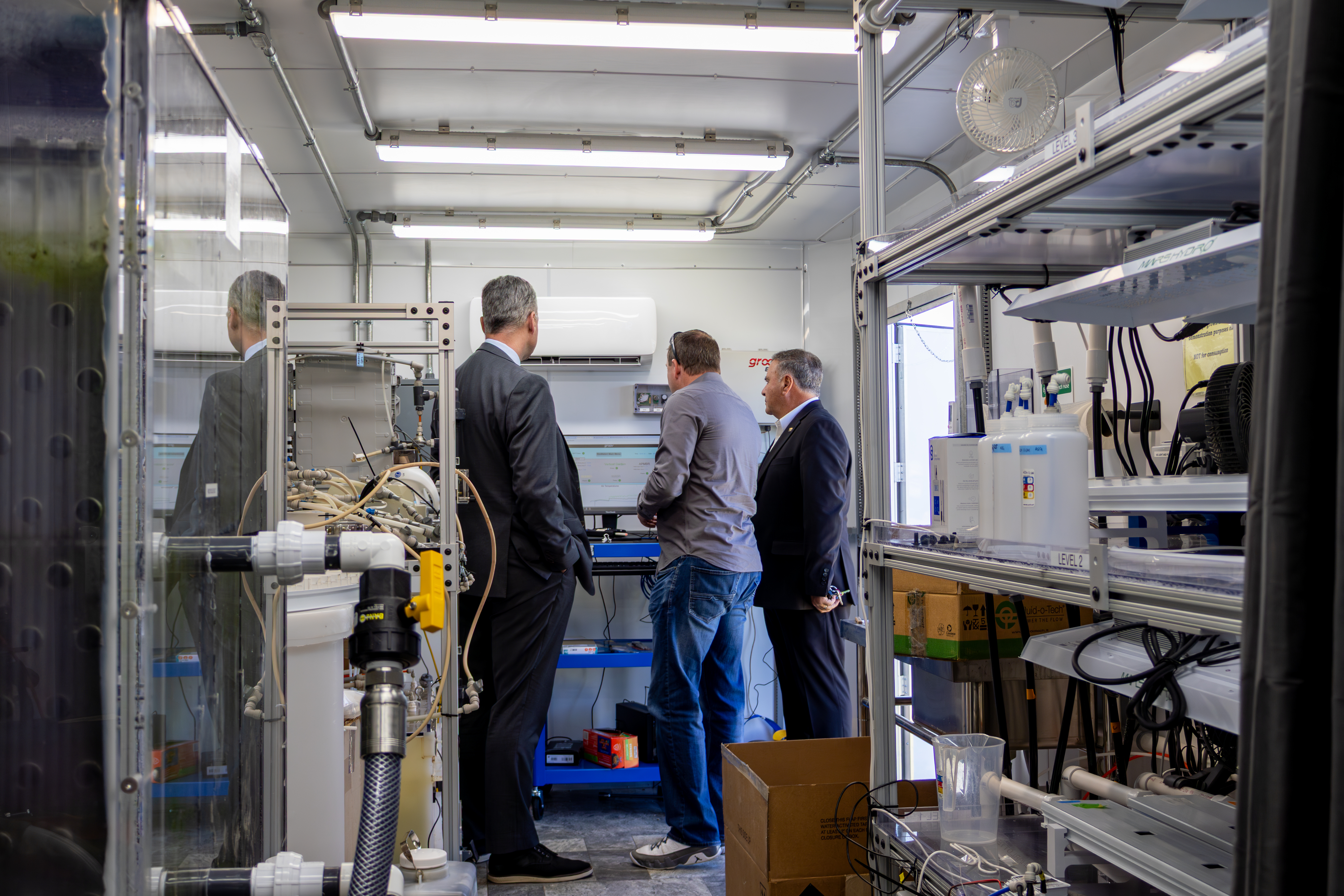
At North Dakota, under a NASA EPSCoR (Established Program to Stimulate Competitive Research) grant, the facility was connected to the Integrated Lunar/Martian Analog Habitat through a bathroom interface that includes a urine-diverting toilet. The setup will allow different waste streams to be separated at the source and sent to the correct treatment systems. In parallel, Ali Alshami’s team is developing novel membrane-based separation technologies intended for future integration into the divergent wastewater facility to improve water recovery efficiency, contaminant rejection, and overall system resilience for long-duration habitation missions.
“The tests will help NASA evaluate real-world operation, crew training needs, system reliability, and how wastewater simulants compare with actual human metabolic waste in an analog mission environment,” said Alshami.
These efforts are focused on advancing compact, energy-efficient treatment approaches capable of handling complex wastewater streams generated in closed-loop extraterrestrial environments.
“The testing campaign at the University of North Dakota supports the facility’s technology maturation from laboratory-scale validation toward demonstration in a relevant Inflatable Lunar/Martian Analog Habitat environment,” said Pablo De Leon, professor and department chair of Space Studies at the University of North Dakota.
Lessons learned could inform future higher-fidelity tests, including potential integration with NASA’s next generation of yearlong simulated Mars missions via isolation analogs at the agency’s Johnson Space Center in Houston.
Technology for Making Moon Base SustainableThe work is part of NASA’s broader Bioregenerative Life Support Systems effort, which is developing biological approaches to reduce dependence on Earth-supplied consumables. In future lunar or Martian habitats, systems like the wastewater treatment facility could help close life support loops by recovering water, recycling nutrients, supporting crop production, and reducing the amount of waste that must be stored or discarded. Further NASA research completed trade studies demonstrating how bioregenerative life support becomes more effective for space travel over current life support technologies.
NASA researchers also are exploring how wastewater-recovered resources could support in-space manufacturing. One effort is studying how nutrient-rich water from bioregenerative wastewater systems could feed microbes that produce lactic acid, which can be turned into polylactic acid. The material could one day serve as a binder for 3D printing with lunar or Martian regolith, the loose, fragmental surface material, or could be used for replacement parts, extending the value of recovered waste beyond water and food systems.
“By sending the facility from NASA Kennedy to North Dakota, the agency is moving a key part of that circular economy out of the lab and into a real-world test,” said J.J. Edelmann, surface systems domain lead for the Mars Campaign Office at NASA Headquarters in Washington. “The work may begin with wastewater, but its goal is much larger. We want to help future crews live sustainably on the Moon, learn how to operate farther from Earth, and carry those lessons forward to Mars.”
To learn more about the agency’s lunar and Mars exploration, visit:
NASA Testing Wastewater Treatment Facility for Future Moon Base
A mobile wastewater treatment system built at NASA’s Kennedy Space Center in Florida that can help prepare for long-duration missions on the Moon and Mars departed the spaceport and arrived at the University of North Dakota in Grand Forks. Graduate students at the university will test the technology under conditions designed to closely mimic the challenges of operating on another planetary surface.
The Divergent Deployable Wastewater Treatment Facility is designed to turn crew wastewater into useful resources, which future explorers will need every day. At the University of North Dakota, teams will integrate this new wastewater system with the university’s Integrated Lunar/Martian Analog Habitat. Student operators and NASA researchers will study how the facility performs when connected to a habitat-like environment and exposed to the kinds of operational limits crews could face on another planet.
“NASA’s Artemis program is laying the groundwork for a sustained human presence on the Moon, where habitats will need to operate far from the steady resupply chain that supports astronauts in partial gravity,” said Luke Roberson, surface water systems lead within the Mars Campaign Office at NASA Kennedy. “To solve that challenge, we are developing the future of sustainable lunar surface systems to process wastewater into nutrient feedstocks for plants and biomanufacturing.”
How Treatment System WorksHoused inside an 8.5-by-24-foot trailer, the facility brings together three biological reactor systems, a vertical garden, water-polishing hardware, environmental monitoring, autonomous control software, and safety systems. The trailer was outfitted at NASA Kennedy to function as a deployable laboratory and to travel between at least two simulation test sites as the technology matures.
Unlike wastewater systems on Earth, this facility keeps waste streams separate. That divergent approach is important for small crews, because wastewater from four to eight people can be highly concentrated. Urine, hygiene water, laundry water, fecal waste, and food waste each contain different levels of salts, solids, carbon, nitrogen, phosphorus, and other compounds. Treating them separately allows each stream to be processed by the reactor best suited for the job.
To do that, the system uses three different bioreactors to treat waste streams. The Anaerobic Phototrophic Membrane Bioreactor processes fecal and food waste and converts it into a nutrient-rich wastewater that can support plant growth. The Suspended Aerobic Membrane Bioreactor processes urine and flush water. The Membrane Aerated Biological Reactor treats graywater from hygiene and laundry activities. Collectively, the bioreactors process nutrients to feed the facility’s vertical garden and prepare the water for reuse. Inside that garden, crops will grow hydroponically, or without using soil, by using nutrient solutions derived from the bioreactors. Researchers will compare crop performance with plants grown using standard hydroponic nutrients.
NASA’s Dr. Roberson demonstrating the Divergent Wastewater Treatment Facility to UND Chair Dr. De Leon and Dr. Robert Kraus, Dean of UND’s School of Aerospace Sciences.University of North DakotaAt North Dakota, under a NASA EPSCoR (Established Program to Stimulate Competitive Research) grant, the facility was connected to the Integrated Lunar/Martian Analog Habitat through a bathroom interface that includes a urine-diverting toilet. The setup will allow different waste streams to be separated at the source and sent to the correct treatment systems. In parallel, Ali Alshami’s team is developing novel membrane-based separation technologies intended for future integration into the divergent wastewater facility to improve water recovery efficiency, contaminant rejection, and overall system resilience for long-duration habitation missions.
“The tests will help NASA evaluate real-world operation, crew training needs, system reliability, and how wastewater simulants compare with actual human metabolic waste in an analog mission environment,” said Alshami.
These efforts are focused on advancing compact, energy-efficient treatment approaches capable of handling complex wastewater streams generated in closed-loop extraterrestrial environments.
“The testing campaign at the University of North Dakota supports the facility’s technology maturation from laboratory-scale validation toward demonstration in a relevant Inflatable Lunar/Martian Analog Habitat environment,” said Pablo De Leon, professor and department chair of Space Studies at the University of North Dakota.
Lessons learned could inform future higher-fidelity tests, including potential integration with NASA’s next generation of yearlong simulated Mars missions via isolation analogs at the agency’s Johnson Space Center in Houston.
Technology for Making Moon Base SustainableThe work is part of NASA’s broader Bioregenerative Life Support Systems effort, which is developing biological approaches to reduce dependence on Earth-supplied consumables. In future lunar or Martian habitats, systems like the wastewater treatment facility could help close life support loops by recovering water, recycling nutrients, supporting crop production, and reducing the amount of waste that must be stored or discarded. Further NASA research completed trade studies demonstrating how bioregenerative life support becomes more effective for space travel over current life support technologies.
NASA researchers also are exploring how wastewater-recovered resources could support in-space manufacturing. One effort is studying how nutrient-rich water from bioregenerative wastewater systems could feed microbes that produce lactic acid, which can be turned into polylactic acid. The material could one day serve as a binder for 3D printing with lunar or Martian regolith, the loose, fragmental surface material, or could be used for replacement parts, extending the value of recovered waste beyond water and food systems.
“By sending the facility from NASA Kennedy to North Dakota, the agency is moving a key part of that circular economy out of the lab and into a real-world test,” said J.J. Edelmann, surface systems domain lead for the Mars Campaign Office at NASA Headquarters in Washington. “The work may begin with wastewater, but its goal is much larger. We want to help future crews live sustainably on the Moon, learn how to operate farther from Earth, and carry those lessons forward to Mars.”
To learn more about the agency’s lunar and Mars exploration, visit:
Be a Clump Scout and Help Reveal Secrets of Stellar Nurseries
In the mid-20th century, astronomers discovered strange “clumpy” galaxies filled with mysterious bright blobs – massive stellar nurseries where stars are born at an explosive rate. Curiously, these clumpy galaxies were much more common in the early universe than they are today. We still don’t know why they vanished.
The Euclid space telescope, an ESA (European Space Agency) mission with critical contributions from NASA, has begun to capture images of millions of galaxies. These images – far more than any team of professional scientists could ever catalog alone – include high-definition views of clumpy galaxies that promise to reveal structure within and among the clumps. Astronomers hope to use these images to obtain new information about which galaxies host clumps, where the clumps are, how and why they evolved, and more – but they need your help!
To tackle this mountain of data, scientists are creating a “digital assistant” in the form of machine learning, a kind of artificial intelligence. The machine algorithm has been partially trained with results from an earlier project called “Galaxy Zoo: Clump Scout.” Now, as a volunteer for the new Galaxy Zoo: Clump Scout II project, you’ll improve and train this tool further. You’ll examine images of galaxies that the machine has labelled with squares where it thinks it sees a real clump. The machine often gets confused by distant stars or camera glitches. So you’ll gently move those squares around, delete them, or add new ones, to help the algorithm learn.
As a part of Galaxy Zoo: Clump Scout II, you will help investigate how giant star-forming nurseries formed, solve the mystery of their disappearance over cosmic time, and reveal more about how star formation really works in galaxies. All you need is a laptop or smartphone. Click here to learn more!
A clumpy galaxy seen by telescopes with the Sloan Digital Sky Survey (left), the Hyper Suprime-Cam (middle) and the Euclid mission (right). You can see how the better resolving power of each subsequent telescope helps us see more and more detail about the star-forming clumps. (The bright object at the bottom right is a foreground star.) Image data: SDSS (left; Sloan Digital Sky Survey – CC BY 4.0); HSC (center; NAOJ/HSC Project – CC BY 4.0); Euclid (right; ESA/Euclid/Euclid Consortium/NASA – CC BY 3.0 IGO). Image post-processing and compilation by Hugh Dickinson and Jürgen Popp. Learn More and Get Involved Galaxy Zoo: Clump Scout II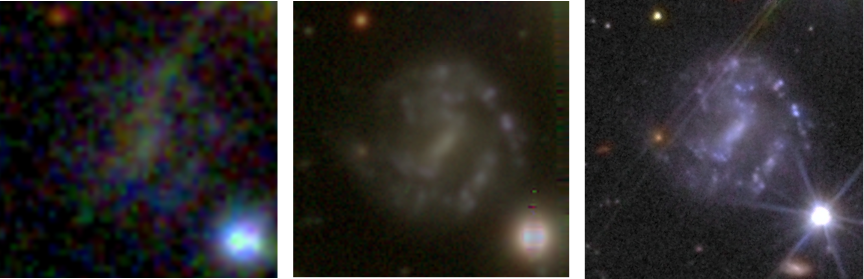
Identify star-forming clumps in galaxy images, and help train machines to do the same.
Facebook logo @nasascience_ @nasascience_ Instagram logo @nasascience_ Linkedin logo @nasascience_