
Feed aggregator
Quantum computing is reaching its make-or-break moment
Will computers based on quantum physics really change the world?
How commercial satellites are changing modern warfare
Commercial satellites can now watch much of Earth in near-real time. Militaries are learning new ways to fool them
Readers respond to the February 2026 issue
Letters to the editors for the February 2026 issue of Scientific American
New ways to keep from losing muscle on Ozempic
Ozempic and just getting older take off muscle. New therapies could retain it
Helion Energy is building a fusion power plant. Can its technology deliver?
This company says its pulsed plasma machine will deliver electricity to the grid by 2029. Some physicists warn that its promises are outrunning what the technology has proved
The Riemann hypothesis is a million-dollar math problem hardly anyone is trying to solve
The intimidating legacy of the scariest problem in mathematics
Science crossword: At the same time
Play this crossword inspired by the June 2026 issue of Scientific American
June 2026: Science history from 50, 100 and 150 years ago
Door-building spiders; a new quantum liquid
The future of robot armies is here – and it’s not what you think
Smile launch highlights
ESA’s Smile satellite launched aboard a Vega-C rocket from Europe’s Spaceport in French Guiana. The rocket lifted off on at 04:52 BST / 05:52 CEST (00:52 local time) on 19 May 2026.
Smile flew to space on Vega-C flight VV29. At 35 m tall, a Vega-C weighs 210 tonnes on the launch pad and the rocket used three solid-propellant-powered stages to take Smile to orbit before the fourth liquid-propellant stage took over for a precise drop-off around Earth.Smile (the Solar wind Magnetosphere Ionosphere Link Explorer) is a joint mission between the European Space Agency (ESA) and the Chinese Academy of Sciences (CAS).
Smile will use four science instruments to study how Earth responds to the solar wind from the Sun. In doing so, Smile will improve our understanding of solar storms, geomagnetic storms and the science of space weather.
SMILE: European Space Weather Mission Launches
An innovative new mission will probe the mystery of how the Earth’s magnetosphere interacts with the solar wind.
The post SMILE: European Space Weather Mission Launches appeared first on Sky & Telescope.
Smile lifts off on quest to reveal Earth’s invisible shield against the solar wind
The Smile spacecraft lifted off on a Vega-C rocket from Europe’s Spaceport in French Guiana at 04:52 BST / 05:52 CEST (00:52 local time) on 19 May 2026. The launch marks the beginning of an ambitious mission to better understand solar storms, geomagnetic storms, and the science of space weather.
TESS Data Reveals 27 New Planet Candidates in Binary Systems
You’re doing some late afternoon work on the habitat as part of humanity’s first exoplanet settlement, but the sun is going down so you’re trying to speed things up. Just as the light dims, everything suddenly starts getting brighter. You look up and see the sun starting to rise again, except it’s your second sun. You kick yourself for not checking the daily sunrise and sunset logs, but you’re happy you get to put in a bit more work before you eat dinner.
Farming in Ancient Lake Agassiz
- Earth
- Earth Observatory
- Image of the Day
- EO Explorer
- Topics
- More Content
- About
Farming in Ancient Lake Agassiz
- Earth
- Earth Observatory
- Image of the Day
- EO Explorer
- Topics
- More Content
- About
A lamp flickering on and off inspires the math mystery of Thomson’s lamp
If you switch a lamp on and off an infinite number of times, will the light end up on or off? Somehow math says both
Astronomers Find New Circumbinary "Tatooine-like" Planet Candidates
There's a distinct category of exoworlds out there that orbit two stars. They're called "circumbinary" planets and up until recently, astronomers had only found about 18 of them among the 6000+ other known exoplanets and candidates. Now, a team at the University of New South Wales (UNSW) in Sydney, Australia, have found 27 more potential circumbinary worlds. They credit a new method, called apsidal precession, for their finding.
Curiosity Blog, Sols 4893-4899: Drilling at Campo Marte and a Visit From the Psyche Spacecraft
- Curiosity Home
- Science
- News and Features
- Multimedia
- Mars Missions
- Mars Home
3 min read
Curiosity Blog, Sols 4893-4899: Drilling at Campo Marte and a Visit From the Psyche Spacecraft NASA’s Mars rover Curiosity acquired this image, as the rover used its APXS instrument to measure the composition of the “Campo Marte” block in preparation for drilling. Curiosity captured the image using its Front Hazard Avoidance Camera (Front Hazcam) on May 14, 2026 — Sol 4895, or Martian day 4,895 of the Mars Science Laboratory mission — at 16:29:02 UTC. NASA/JPL-Caltech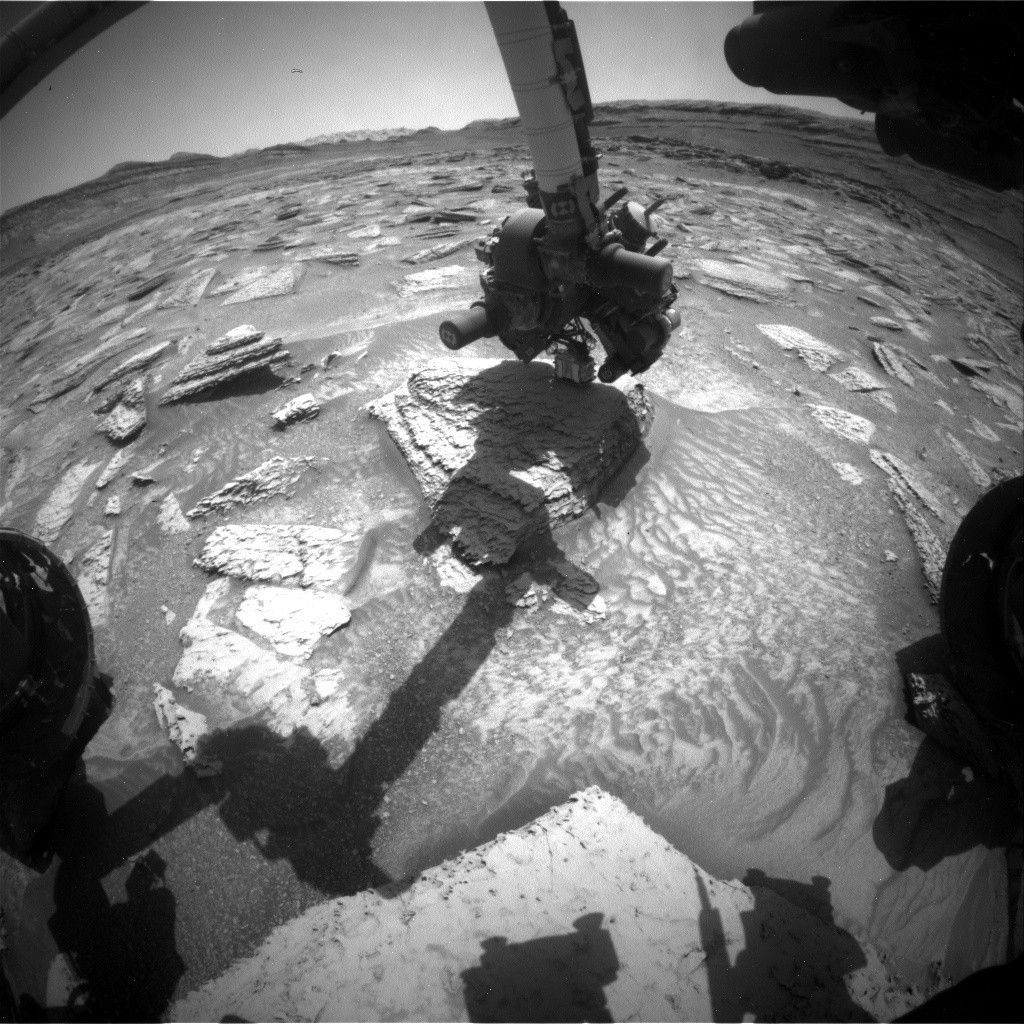
Written by Lucy Lim, Planetary Scientist at NASA Goddard Space Flight Center
Earth planning date: Friday, May 15, 2026
After freeing the rover’s arm from the “Atacama” block, we are ready to drill again! The new drill target will represent the same geologic stratum as Atacama, which is the layered sulfate unit above the boxwork structures. We’ve named the new block “Campo Marte” after a natural red sandstone feature in Bolivia, following the theme of choosing target names in this Martian quadrangle from locations near the Uyuni region in South America. The name can be literally translated from Spanish as “Field of Mars” or “Mars Field,” appropriate for a target on Mars. In preparation for drilling, we measured the composition of Campo Marte with the ChemCam LIBS and the APXS as well as obtaining close-up imaging with MAHLI. Additional LIBS rasters provided geochemical data on nearby blocks, including a couple of vein and nodule-like features. As we’ve seen in several rover stops in this unit, the “Paso Malo” block and several others are covered in a prominent polygonal texture.
We’ve also imaged the Campo Marte block from several angles and determined that it’s substantially thicker than the Atacama block, so we’re hoping that its greater mass will keep it on the ground after drilling so that we can withdraw the drill bit normally this time. The team did get some interesting data on the volume and density of the Atacama block from our little adventure but we don’t feel the need to repeat that particular experiment.
In the meantime, we had a chance to support another solar system exploration mission as the Psyche spacecraft flew close by Mars in order to pick up a gravitational boost on its way to the main asteroid belt.
The Psyche spacecraft’s eventual destination is the asteroid 16 Psyche, one of the largest members of an unusual spectral category of asteroids that hasn’t yet been visited by a spacecraft. Although 16 Psyche is expected to be quite different from Mars as a science target (for example, it is too small to maintain a Mars-like atmosphere) this flyby was still a valuable opportunity to exercise the spacecraft’s instruments and data analysis pipelines, and validate their calibration. Because of this the Curiosity team planned an extra set of atmospheric observations timed to coordinate with the Psyche flyby: a zenith movie with Navcam to document clouds and a Mastcam solar observation to measure atmospheric opacity. The Mastcam was also supported by a fresh set of calibration data. Together with other coordinated observations from the Mars orbiters and Perseverance rover, these are intended to contribute to the Psyche instrument validation effort.
-
Want to read more posts from the Curiosity team?
-
Want to learn more about Curiosity’s science instruments?
Article
7 days ago
3 min read Curiosity Blog, Sols 4879-4885: Struggle at Atacama
Article
2 weeks ago
2 min read Curiosity Blog, Sols 4873-4878: Welcome to the Atacama Drill Target
Article
3 weeks ago
Keep Exploring Discover More Topics From NASA Mars
Mars is the fourth planet from the Sun, and the seventh largest. It’s the only planet we know of inhabited…
All Mars Resources
Explore this collection of Mars images, videos, resources, PDFs, and toolkits. Discover valuable content designed to inform, educate, and inspire,…
Rover Basics
Each robotic explorer sent to the Red Planet has its own unique capabilities driven by science. Many attributes of a…
Mars Exploration: Science Goals
The key to understanding the past, present or future potential for life on Mars can be found in NASA’s four…