
Feed aggregator
NASA Wins Four Telly Awards for Artemis Moon Coverage, More
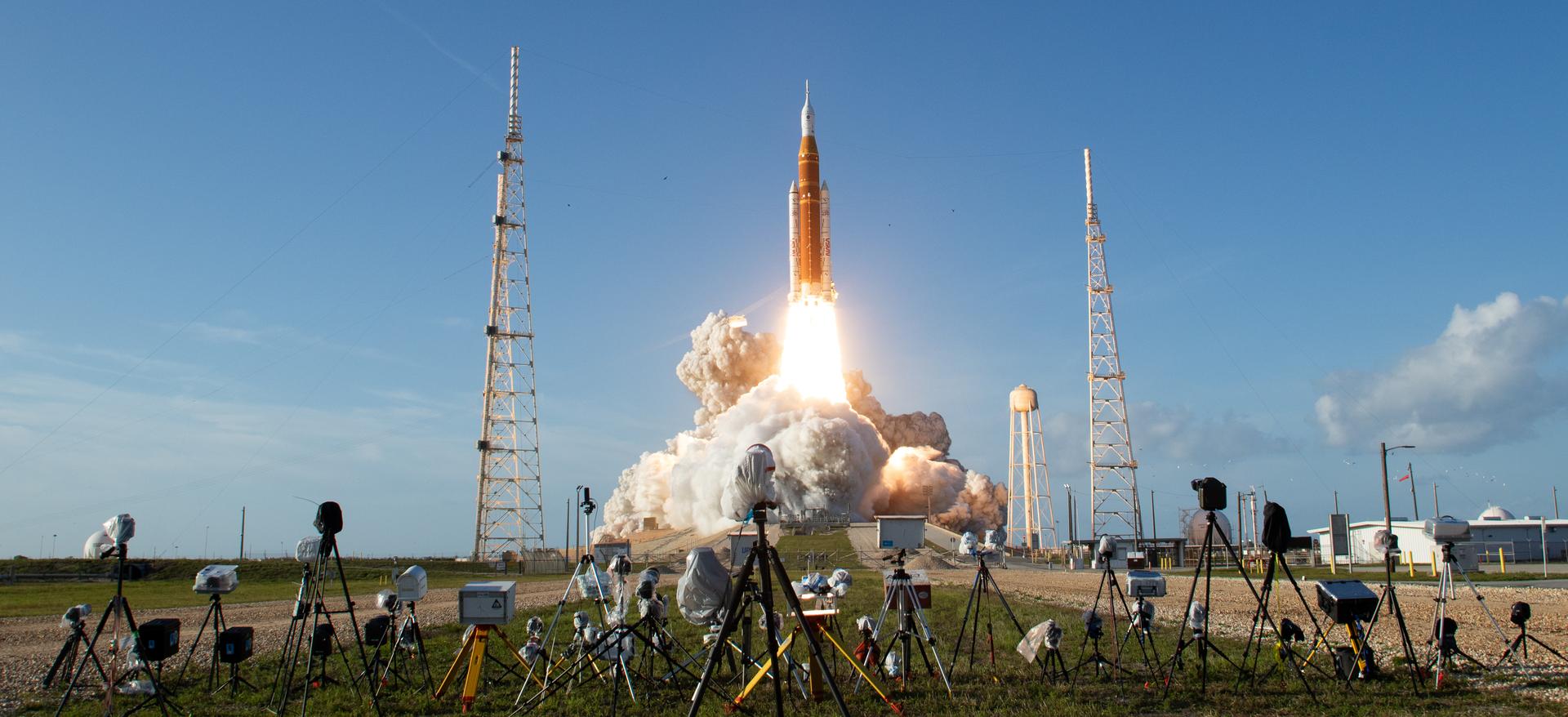
NASA’s historic Artemis II mission coverage, which connected global audiences to watch the first humans to travel around the Moon in more than half a century, is among the agency’s video productions recognized with four 2026 Telly Awards.
“President Trump’s leadership in establishing the Artemis program reignited America’s bold vision for space exploration and set our nation on a course back to the Moon. During America’s 250th birthday, Artemis II marked the beginning of that new era by sending astronauts around the Moon for the first crewed lunar mission since Apollo, inspiring millions across the country and around the world,” said Will Boyington, associate administrator, Office of Communications, NASA Headquarters in Washington. “These Telly Awards recognize the extraordinary NASA teams who brought that historic journey into homes everywhere through innovative storytelling, live coverage, and an unprecedented digital experience that showcased American leadership in space and renewed the spirit of exploration for a new generation.”
The agency’s continuous, 24/7 livestream of the Artemis II mission, which functioned as both a live event and as a science storytelling experience, combined visuals, real-time mission data, and expert analysis to make a complex spaceflight clear and accessible for an international audience. NASA’s video documentation of mission astronauts and support teams conducting geology training on Earth to prepare for future Artemis missions on the Moon also won a science and technology storytelling award.
In addition, NASA won a screenwriting award for a documentary on the agency’s Hubble Space Telescope, James Webb Space Telescope, and Nancy Grace Roman Space Telescope, narrated by actor John Rhys-Davies.
“By following NASA’s Artemis II coverage in real time on multiple platforms, millions of viewers around the world were able to experience the mission inside the Orion spacecraft and alongside the crew, from lunar flyby to splashdown,” said Brittany Brown, director, Office of Communications Digital and Technology Division, NASA Headquarters in Washington. “Our team’s coordination, from the Mission Control Center at NASA’s Johnson Space Center in Houston to the Moon, technical expertise, and around-the-clock dedication turned a single spaceflight mission into a shared, global experience of wonder and inspiration.”
Full list of NASA’s Telly Award wins:
- NASA’s Artemis II: Humanity’s Return to the Moon
Gold Winner, Science and Technology - NASA’s Artemis II: Humanity’s Return to the Moon
Silver Winner, Live Events and Experiences - Preparing for Artemis: NASA’s Geology Training for Lunar Exploration
Silver Winner, Science and Technology - The Fellowship of the Telescopes
Bronze Winner, Craft-Writing
Livestream coverage of the mission and milestones reached NASA’s largest streaming audience ever on its individual platforms, ultimately reaching nearly 290 million combined views across agency platforms. Commercial streaming partners expanded the mission’s reach to a global audience of hundreds of millions more potential viewers.
Watch all NASA content through a variety of online platforms:
https://www.nasa.gov/ways-to-watch
Share Details Last Updated May 22, 2026 EditorJessica TaveauLocationNASA Headquarters Related TermsJWST sees partly cloudy skies on a distant, giant exoplanet
An out-of-this-world weather report from NASA’s James Webb Space Telescope reveals how clouds move across a giant planet hundreds of light-years from Earth
A new study says you need 10 hours of exercise a week. Can that really be possible?
Experts question this study’s design and its recommendations—and point out that you probably get more exercise than you think
Scientists discover why gold doesn’t ‘rust’
Gold doesn’t tarnish like similar metals do. A new paper says that the key is the intricate “herringbone” pattern of its atoms.
Hubble Sights Galaxy in Transition
Psyche Spacecraft Completes Mars Flyby
Hubble Sights Galaxy in Transition
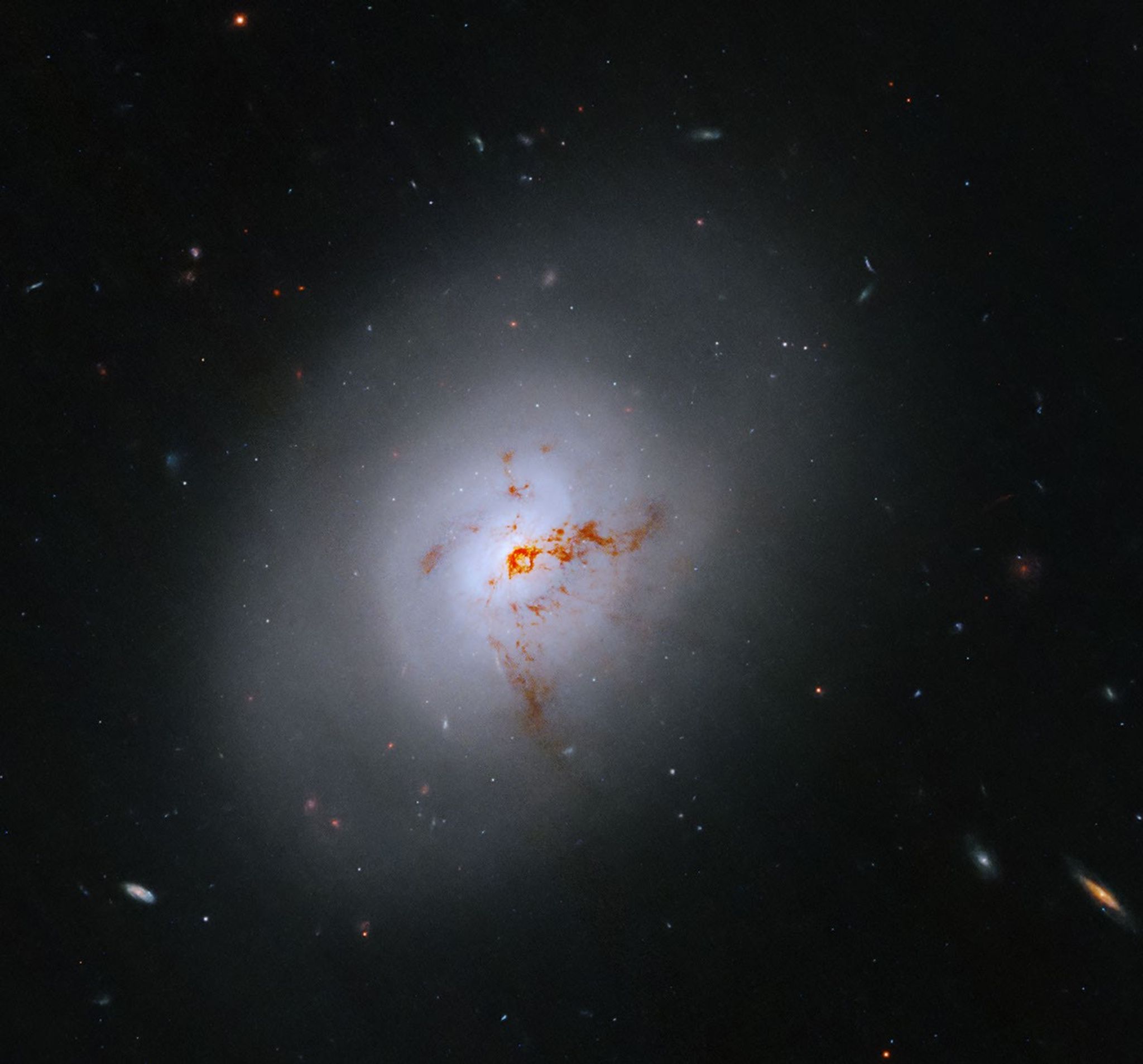
This NASA Hubble Space Telescope image reveals an enigmatic galaxy with a bright center and a face that hints at spiral structure, yet it holds no obvious spiral arms. Reddish-brown clumps and filaments of dust partially obscure the galaxy’s full face, while red, blue, and orange light from distant galaxies shines through its diffuse outer regions and dots the inky-black background.
NGC 1266 is a lenticular galaxy located some 100 million light-years away in the constellation Eridanus (the Celestial River). Astronomers classify lenticulars as transitional galaxies that represent an evolutionary bridge between spirals and ellipticals. Lenticulars are “lens-shaped” and have a bright central bulge and flattened disk like spirals, but they have no spiral arms and little to no star formation like ellipticals.
Read more about NGC 1266, its interesting features, and why astronomers study galaxies like it.
Image credit: NASA, ESA, K. Alatalo (STScI); Image Processing: G. Kober (NASA/Catholic University of America)
Hubble Sights Galaxy in Transition
This NASA Hubble Space Telescope image reveals an enigmatic galaxy with a bright center and a face that hints at spiral structure, yet it holds no obvious spiral arms. Reddish-brown clumps and filaments of dust partially obscure the galaxy’s full face, while red, blue, and orange light from distant galaxies shines through its diffuse outer regions and dots the inky-black background.
NGC 1266 is a lenticular galaxy located some 100 million light-years away in the constellation Eridanus (the Celestial River). Astronomers classify lenticulars as transitional galaxies that represent an evolutionary bridge between spirals and ellipticals. Lenticulars are “lens-shaped” and have a bright central bulge and flattened disk like spirals, but they have no spiral arms and little to no star formation like ellipticals.
Read more about NGC 1266, its interesting features, and why astronomers study galaxies like it.
Image credit: NASA, ESA, K. Alatalo (STScI); Image Processing: G. Kober (NASA/Catholic University of America)
NOAA predicts quieter Atlantic hurricane season for 2026—but the Pacific is another story
This year’s expected El Niño could hamper hurricanes in the Atlantic but boost them in the central and eastern Pacific
Mathematicians stunned by AI's biggest breakthrough in mathematics yet
Mathematicians stunned by AI's biggest breakthrough in mathematics yet
The Magnetar at the Heart of a Superluminous Supernova
Superluminous supernovae are the royalty in the supernova world. They're up to 100 times brighter than a standard supernova, and astrophysicists want to know why. New research shows that magnetars are responsible.
Trial of next-gen weight-loss drug retatrutide brings it one step closer to FDA approval
While drugs such as Wegovy target a single gut hormone, retatrutide is among a new class of GLP-1 drugs that aims at three hormone receptors
Epic dreaming is leaving people exhausted and distressed
Epic dreaming is leaving people exhausted and distressed
AI just solved an 80-year-old ‘Erdős problem,’ and mathematicians are amazed
A chatbot’s result for the 80-year-old “unit distance” conjecture is the first AI proof that would likely be published in math’s top journal if humans had done it alone
Can math predict the end of humanity? Inside the ‘doomsday argument’
This eerily simple math says our days are numbered—and nobody can agree why it’s wrong
Is Dust the Best Thing in the Universe? Part 2: The Astronomer's Headache
Dust scatters light, absorbs light, re-emits light, and ruins everything. It's why our maps of the Milky Way were wrong before 1930, and it's why one of the biggest cosmological announcements of the 2010s quietly evaporated.
NASA Welcomes 16th Deputy Administrator Matt Anderson

Matt Anderson was sworn in Thursday as NASA’s 16th deputy administrator by NASA Administrator Jared Isaacman. The oath was taken during a ceremony held at the Eisenhower Executive Office Building in Washington.
As NASA deputy administrator, Anderson will help lead the agency’s efforts to execute the President’s national space policy, strengthen America’s leadership in space, and advance NASA’s missions in exploration, science, and aeronautics.
“Matt Anderson brings exactly the kind of operational leadership, technical expertise, and mission focus NASA needs right now,” said NASA Administrator Jared Isaacman. “His decades of experience across the Air Force, Space Command, and the aerospace industry give him a valuable perspective as we work to strengthen America’s leadership in space and enter the next era of exploration. I’m excited to have him helping lead NASA as we take on the near-impossible and push the boundaries of what we can achieve.”
“I’m deeply honored to serve as the deputy administrator and support the men and women across NASA who carry out some of the most ambitious and important work in the world,” said NASA Deputy Administrator Matt Anderson. “NASA has been entrusted with a mission of enormous strategic, scientific, and economic significance, and delivering on that mission will require disciplined execution, technical excellence, and a strong culture of accountability. I’m grateful to President Trump for the trust and confidence he has placed in me with this nomination, and I look forward to serving alongside Administrator Isaacman and the extraordinary NASA workforce as we strengthen America’s leadership in space and build toward the next golden era of space exploration.”
“NASA succeeds when we pair clear mission goals with empowered teams and disciplined execution,” said NASA Associate Administrator Amit Kshatriya. “Matt Anderson has spent his career leading in complex operational environments where the stakes are high and mission success depends on trust in the people doing the work. I look forward to working with him as we continue building the capabilities, partnerships, and workforce needed for the challenging missions ahead of us.”
Anderson was nominated by President Donald J. Trump on Jan. 13, and confirmed by the U.S. Senate on May 18.
Read Anderson’s official biography on the agency’s website:
https://www.nasa.gov/people/matt-anderson
-end-
Bethany Stevens / George Alderman
Headquarters, Washington
202-358-1600
bethany.c.stevens@nasa.gov / george.a.alderman@nasa.gov
NASA Welcomes 16th Deputy Administrator Matt Anderson
Matt Anderson was sworn in Thursday as NASA’s 16th deputy administrator by NASA Administrator Jared Isaacman. The oath was taken during a ceremony held at the Eisenhower Executive Office Building in Washington.
As NASA deputy administrator, Anderson will help lead the agency’s efforts to execute the President’s national space policy, strengthen America’s leadership in space, and advance NASA’s missions in exploration, science, and aeronautics.
“Matt Anderson brings exactly the kind of operational leadership, technical expertise, and mission focus NASA needs right now,” said NASA Administrator Jared Isaacman. “His decades of experience across the Air Force, Space Command, and the aerospace industry give him a valuable perspective as we work to strengthen America’s leadership in space and enter the next era of exploration. I’m excited to have him helping lead NASA as we take on the near-impossible and push the boundaries of what we can achieve.”
“I’m deeply honored to serve as the deputy administrator and support the men and women across NASA who carry out some of the most ambitious and important work in the world,” said NASA Deputy Administrator Matt Anderson. “NASA has been entrusted with a mission of enormous strategic, scientific, and economic significance, and delivering on that mission will require disciplined execution, technical excellence, and a strong culture of accountability. I’m grateful to President Trump for the trust and confidence he has placed in me with this nomination, and I look forward to serving alongside Administrator Isaacman and the extraordinary NASA workforce as we strengthen America’s leadership in space and build toward the next golden era of space exploration.”
“NASA succeeds when we pair clear mission goals with empowered teams and disciplined execution,” said NASA Associate Administrator Amit Kshatriya. “Matt Anderson has spent his career leading in complex operational environments where the stakes are high and mission success depends on trust in the people doing the work. I look forward to working with him as we continue building the capabilities, partnerships, and workforce needed for the challenging missions ahead of us.”
Anderson was nominated by President Donald J. Trump on Jan. 13, and confirmed by the U.S. Senate on May 18.
Read Anderson’s official biography on the agency’s website:
https://www.nasa.gov/people/matt-anderson
-end-
Bethany Stevens / George Alderman
Headquarters, Washington
202-358-1600
bethany.c.stevens@nasa.gov / george.a.alderman@nasa.gov