

Feed aggregator
NASA to Announce Artemis III Crew, Provide Mission Progress Update
NASA will provide an update on the agency’s Artemis III mission and announce the astronauts assigned to the test flight during a live event at 11 a.m. EDT on Tuesday, June 9, at the agency’s Johnson Space Center in Houston.
The event will stream on NASA+ and on the agency’s YouTube channel. Learn how to watch NASA content through a variety of online platforms, including social media.
Following the event, the Artemis III crew will be available for limited in-person and virtual interviews.
Interview requests must be submitted to the NASA Johnson newsroom by 5 p.m. on Thursday, June 4. International media interested in attending must contact the NASA Johnson newsroom at jsccommu@mail.nasa.gov by 5 p.m., Thursday, May 28. U.S. media must contact the newsroom by 5 p.m., June 4. Registered media will receive confirmation and additional event details by email. NASA’s media accreditation policy is available online.
Artemis III will launch four astronauts from NASA’s Kennedy Space Center in Florida aboard the Orion spacecraft on the SLS (Space Launch System) rocket. The mission will test critical rendezvous and docking capabilities between Orion and commercial human landing systems needed to deliver astronauts to the lunar surface. Building on the successful Artemis II crewed test flight in April, Artemis III will pave the way for future surface missions.
As part of the Golden Age of innovation and exploration, NASA will send Artemis astronauts on increasingly complex missions to explore more of the Moon for scientific discovery, economic benefits, establish an enduring human presence on the lunar surface, and to build on our foundation for the first crewed missions to Mars.
Learn more about NASA’s Artemis program:
-end-
Rachel Kraft
Headquarters, Washington
202-358-1600
rachel.h.kraft@nasa.gov
Anna Schneider
Johnson Space Center, Houston
281-483-5111
anna.c.schneider@nasa.gov
NASA to Announce Artemis III Crew, Provide Mission Progress Update
NASA will provide an update on the agency’s Artemis III mission and announce the astronauts assigned to the test flight during a live event at 11 a.m. EDT on Tuesday, June 9, at the agency’s Johnson Space Center in Houston.
The event will stream on NASA+ and on the agency’s YouTube channel. Learn how to watch NASA content through a variety of online platforms, including social media.
Following the event, the Artemis III crew will be available for limited in-person and virtual interviews.
Interview requests must be submitted to the NASA Johnson newsroom by 5 p.m. on Thursday, June 4. International media interested in attending must contact the NASA Johnson newsroom at jsccommu@mail.nasa.gov by 5 p.m., Thursday, May 28. U.S. media must contact the newsroom by 5 p.m., June 4. Registered media will receive confirmation and additional event details by email. NASA’s media accreditation policy is available online.
Artemis III will launch four astronauts from NASA’s Kennedy Space Center in Florida aboard the Orion spacecraft on the SLS (Space Launch System) rocket. The mission will test critical rendezvous and docking capabilities between Orion and commercial human landing systems needed to deliver astronauts to the lunar surface. Building on the successful Artemis II crewed test flight in April, Artemis III will pave the way for future surface missions.
As part of the Golden Age of innovation and exploration, NASA will send Artemis astronauts on increasingly complex missions to explore more of the Moon for scientific discovery, economic benefits, establish an enduring human presence on the lunar surface, and to build on our foundation for the first crewed missions to Mars.
Learn more about NASA’s Artemis program:
-end-
Rachel Kraft
Headquarters, Washington
202-358-1600
rachel.h.kraft@nasa.gov
Anna Schneider
Johnson Space Center, Houston
281-483-5111
anna.c.schneider@nasa.gov
NASA Astronauts to Answer Questions from Students in New York
2 min read
Preparations for Next Moonwalk Simulations Underway (and Underwater) NASA astronaut and Expedition 74 flight engineer Jessica Meir configures research gear inside the Destiny laboratory module’s Microgravity Science Glovebox aboard the International Space Station.Credit: NASA/Jessica Meir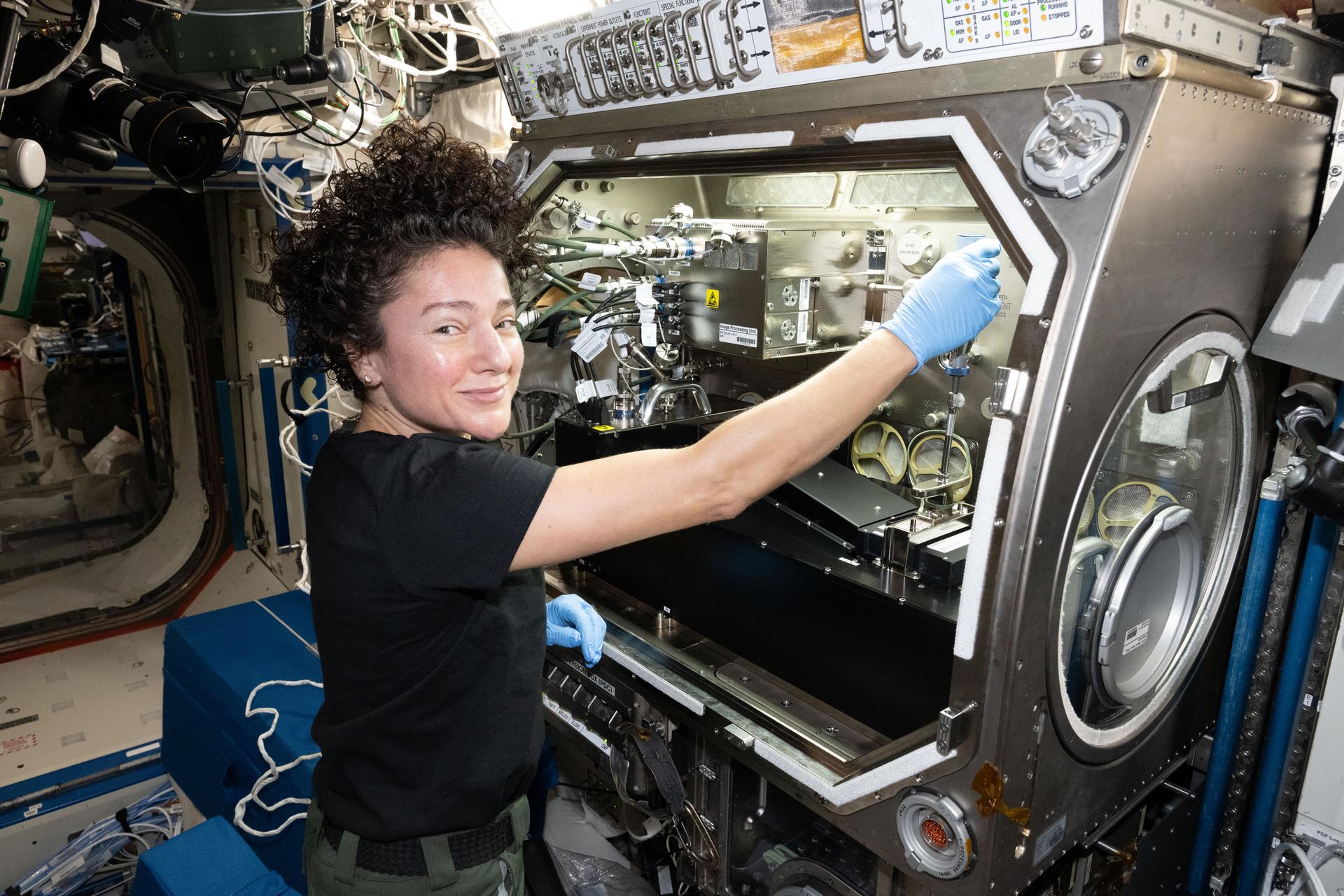
Students in New York will hear from NASA astronaut Jessica Meir as she answers their prerecorded science, technology, engineering, and mathematics (STEM) questions while aboard the International Space Station.
The Earth-to-space call will begin at 11:05 p.m. EDT Thursday, May 28, and will stream live on the agency’s Learn With NASA YouTube channel.
This event is hosted by the Cradle of Aviation Museum in Garden City, New York, for students in grades K-12 and members of the community. This unique opportunity aims to deepen understanding of space exploration and enhance awareness of STEM careers.
Media interested in covering the event must RSVP no later than 5 p.m. EDT, Wednesday, May 27, to Jerelyn Zontini at: 516-567-0537 or jzontini@cradleofaviation.org.
For more than 25 years, astronauts have continuously lived and worked aboard the space station, testing technologies, performing science, and developing skills needed to explore farther from Earth. Astronauts communicate with NASA’s Mission Control Center in Houston 24 hours a day through SCaN’s (Space Communications and Navigation) Near Space Network.
Research and technology investigations taking place aboard the space station benefit people on Earth and lay the groundwork for other agency deep space missions. As part of NASA’s Artemis program, the agency will send astronauts to the Moon to prepare for future human exploration of Mars, inspiring the world through discovery in a new Golden Age of innovation and exploration.
For more information on NASA in-flight calls, visit:
https://www.nasa.gov/stemonstation
Share Details Last Updated May 26, 2026 Related Terms Explore More 7 min read NASA’s 2026 Lunabotics: Winning Student Teams Engineering Lunar Future Article 3 hours ago 4 min read NASA’s AWE Completes Mission to Study Earth’s Effect on Space WeatherOn May 21, ground controllers powered down NASA’s AWE (Atmospheric Waves Experiment) instrument, bringing the…
Article 6 days ago 5 min read NASA Highlights 2025 International Space Station Science Results Article 6 days ago Keep Exploring Discover Related TopicsMissions
Humans in Space
Learning Resources
In-Flight STEM Downlinks
NASA Astronauts to Answer Questions from Students in New York
2 min read
Preparations for Next Moonwalk Simulations Underway (and Underwater) NASA astronaut and Expedition 74 flight engineer Jessica Meir configures research gear inside the Destiny laboratory module’s Microgravity Science Glovebox aboard the International Space Station.Credit: NASA/Jessica MeirStudents in New York will hear from NASA astronaut Jessica Meir as she answers their prerecorded science, technology, engineering, and mathematics (STEM) questions while aboard the International Space Station.
The Earth-to-space call will begin at 11:05 p.m. EDT Thursday, May 28, and will stream live on the agency’s Learn With NASA YouTube channel.
This event is hosted by the Cradle of Aviation Museum in Garden City, New York, for students in grades K-12 and members of the community. This unique opportunity aims to deepen understanding of space exploration and enhance awareness of STEM careers.
Media interested in covering the event must RSVP no later than 5 p.m. EDT, Wednesday, May 27, to Jerelyn Zontini at: 516-567-0537 or jzontini@cradleofaviation.org.
For more than 25 years, astronauts have continuously lived and worked aboard the space station, testing technologies, performing science, and developing skills needed to explore farther from Earth. Astronauts communicate with NASA’s Mission Control Center in Houston 24 hours a day through SCaN’s (Space Communications and Navigation) Near Space Network.
Research and technology investigations taking place aboard the space station benefit people on Earth and lay the groundwork for other agency deep space missions. As part of NASA’s Artemis program, the agency will send astronauts to the Moon to prepare for future human exploration of Mars, inspiring the world through discovery in a new Golden Age of innovation and exploration.
For more information on NASA in-flight calls, visit:
https://www.nasa.gov/stemonstation
Share Details Last Updated May 26, 2026 Related Terms Explore More 4 min read NASA’s AWE Completes Mission to Study Earth’s Effect on Space WeatherOn May 21, ground controllers powered down NASA’s AWE (Atmospheric Waves Experiment) instrument, bringing the…
Article 5 days ago 5 min read NASA Highlights 2025 International Space Station Science Results Article 5 days ago 4 min read Great Balls of FireAn astronaut on the International Space Station was surprised to photograph a shower of light…
Article 1 week ago Keep Exploring Discover Related TopicsMissions
Humans in Space
Learning Resources
In-Flight STEM Downlinks
Where Are All the Intermediate Mass Black Holes? Microlensing Fast Radio Bursts Might Reveal Them
In the heirarchy of black holes, intermediate mass black holes (IMBH) lie in between stellar mass black holes and supermassive black holes. But the problem is that we've never found one. There have been hints, but nothing conclusive. Could gravitational microlensing of Fast Radio Bursts help find them?
NASA Provides Update on Moon Base Rovers, Landers, Missions
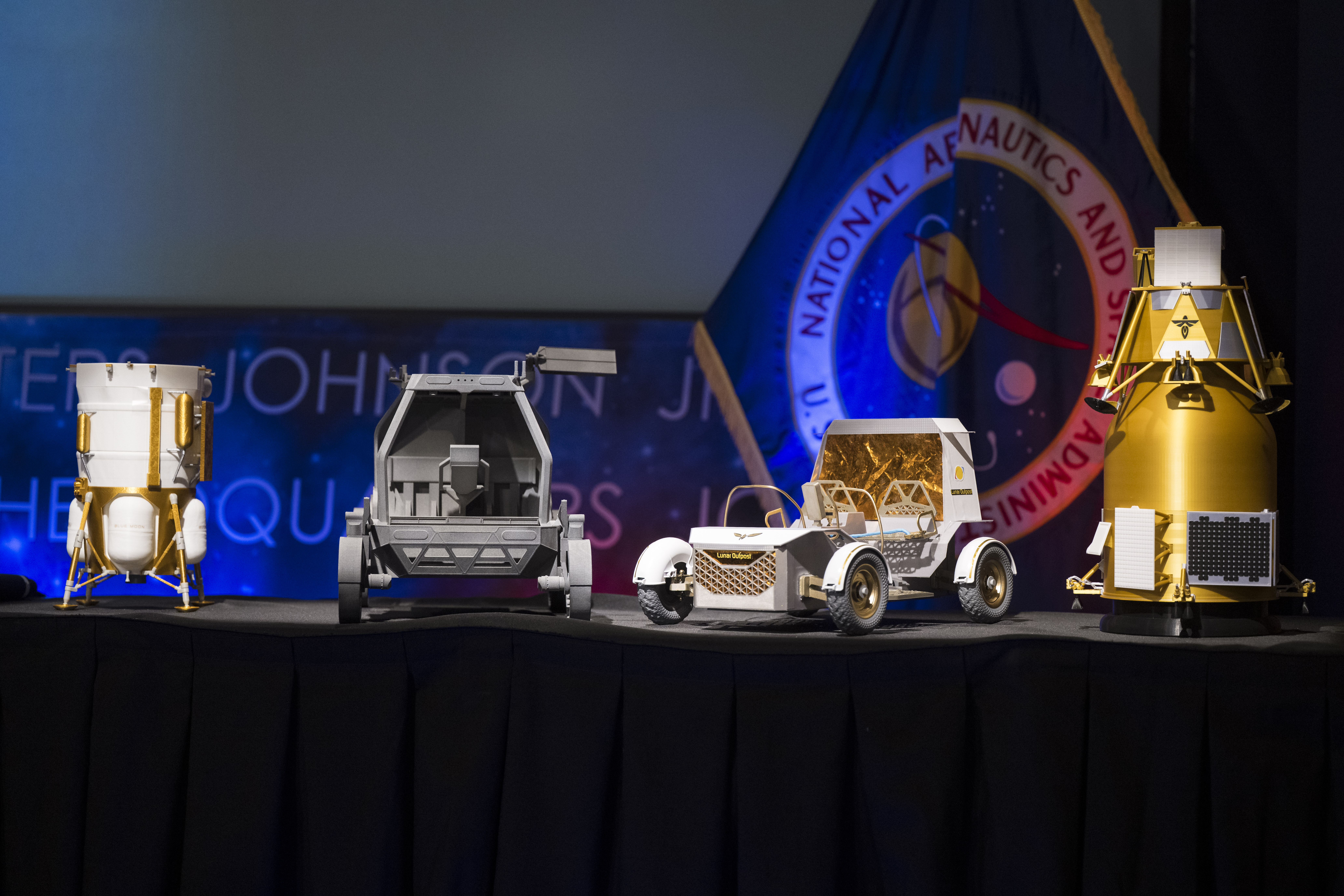
During a Moon Base event Tuesday at NASA’s Headquarters in Washington, the agency announced new contracts for lunar rovers for crew to drive and uncrewed cargo landers bound for the Moon. NASA leaders also shared target launch timeframes and upcoming milestones for the first Moon Base infrastructure and exploration missions to the lunar South Pole region ahead of Artemis astronaut landings.
“The Moon Base will be America’s and humanity’s first outpost on another celestial world,” said NASA Administrator Jared Isaacman. “Every mission, crewed and uncrewed, will be a learning opportunity as we return to the lunar surface, build the infrastructure to stay, and master the skills required to live and operate in one of the most demanding and dangerous environments imaginable. We will go for the science, for all we stand to gain from an economic and technological perspective, for the innovations that will make life better here on Earth, and to prepare for where we will inevitably go next. We are grateful for President Trump’s leadership, the bipartisan commitment from Congress, our industry and international partners, and the dedicated NASA workforce whose expertise enables us to achieve the near-impossible.”
NASA announced the first three Moon Base missions to begin building sustained operations:
- Moon Base I: Targeted for launch no earlier than fall 2026, this mission will use Blue Origin’s Blue Moon Mark 1 Endurance lander to deliver NASA payloads. Equipment will include the Stereo Cameras for Lunar Plume-Surface Studies instrument to study how thrusters interact with the Moon’s surface, and the Laser Retroreflective Array, which helps orbiting spacecraft determine a more precise location using reflected laser light. The mission will land on the Shackleton Connecting Ridge to demonstrate capabilities that reduce risk for future crewed Artemis landing missions in 2028.
- Moon Base II: Planned for launch later this year, this mission will deliver more than 1,100 pounds of cargo on Astrobotic’s Griffin lander, including Astrolab’s FLIP rover, to mature mobility systems that inform future lunar terrain vehicle, or LTV, operations.
- Moon Base III: Also targeted for this year, this mission will fly the first payload selected through NASA’s Payloads and Research Investigations on the Surface of the Moon initiative. Its anchor investigation, Lunar Vertex, will fly on Intuitive Machines’ Nova-C Trinity lunar lander and study lunar swirls, or light spots on the surface of the Moon, to improve understanding of surface evolution and material behavior under extreme conditions. The mission will include payloads from ESA (European Space Agency) and the Korea Astronomy and Space Science Institute, reflecting commercial and international participation in Moon Base activities.
These missions are the first of more than a dozen missions that will be announced this year, each designed to generate operational data and reduce risk ahead of crewed Artemis surface activities.
NASA has awarded Astrolab $219 million and Lunar Outpost $220 million to build and deliver the first phase of LTVs. Awarded under the Phase 1 High Achievability Mission task orders of the Lunar Terrain Vehicle Services contract, these firm-fixed-price, performance-based milestones will enable NASA to deploy crewed and uncrewed mobility systems to the lunar surface by 2028 through the agency’s CLPS (Commercial Lunar Payload Services) initiative. Early surface mobility is a foundational component of the national space policy priority to create an enduring lunar presence.
Astrolab’s Crewed Lunar Vehicle, or CLV‑1, adapted from the company’s FLEX architecture, is a crewed rover designed to transport astronauts, carry supplies, and support remote operations, with a compact stowed configuration, a mass of about 2,000 pounds, and the ability to reach more than 6 mph on level terrain.
Complementing this capability, Lunar Outpost’s Pegasus is a lighter, mission‑ready evolution of its Eagle rover designed explicitly to meet NASA’s updated LTV requirements. Operational for up to a year and capable of manual, autonomous, or teleoperated driving at speeds more than 9 mph, Pegasus incorporates Apollo‑heritage technologies and builds on prototype and flight experience to deliver human‑centered mobility essential for establishing a sustained Moon Base.
Deploying multiple LTVs early in Moon Base development will accelerate technology demonstrations, inform site planning, and reduce operational risk ahead of crewed Artemis missions, enabling NASA to characterize terrain hazards, move materials, pre-stage resources, and mature systems needed for long-duration lunar exploration.
Over the next 18 months, the selected providers will finalize rover designs, conduct crewed evaluations, and qualify flight units for operational readiness, with the resulting LTVs supporting autonomous traverses, terrain preparation, scientific investigations, technology demonstrations, and astronaut transport.
As Moon Base efforts advance, NASA will expand opportunities for additional vendors through on‑ramp competitions, fostering a robust, sustainable approach to lunar mobility and strengthening national priorities in space capability.
To deliver these rovers to the Moon’s South Pole region, NASA awarded Blue Origin $188 million with an option period worth $280.4 million for two task orders, which includes an option period based on initial phase performance. NASA can choose to extend the task order for payload delivery.
This competitive procurement, executed under the CLPS 1.0 indefinite-delivery/indefinite-quantity framework, the CX-2 task order represents a strategic investment in lunar exploration and will play a critical role in enabling mobility and infrastructure development for sustained lunar operations, marking a significant step toward establishing a permanent human presence on the Moon.
Building on the successes and lessons learned from CLPS 1.0, the agency also outlined how the next generation of cargo landers under CLPS 2.0 will continue to deliver payloads to the lunar surface and lunar orbit, supporting NASA’s ambitious goals for sustained lunar operations. This next phase introduces enhanced flexibility, allowing NASA to order turn-key delivery services or start accepting delivery of CLPS hardware for integration into its own missions. The final CLPS 2.0 request for proposal was released on May 15, with responses due on Tuesday, June 30.
Moonfall update
The agency also shared new updates on MoonFall, a mission that will send four drones to fly short hops on the lunar surface as they survey potential landing sites for Artemis astronauts. NASA‘s Jet Propulsion Laboratory in Southern California has been developing the design and testing prototype hardware and has selected Firefly Aerospace to build the spacecraft that will transport the drones from Earth orbit to the Moon. Launch is targeted for 2028.
The drones will independently land on the lunar surface and then gather high-resolution imagery of hard-to-reach terrain over the course of a single lunar day. After each drone’s final flight, its survive-the-night payload will continue to operate for several months, marking a sustained U.S. presence at the lunar South Pole.
More robotic missions to come
Finally, NASA stated in the coming weeks that a selection of additional CLPS 1.0 task awards, issued during the agency’s Ignition event, for Moon Base payloads and technology demonstrations, is forthcoming. In the coming months, there also will be additional opportunities to compete for CLPS 1.0 and 2.0 task orders as Phase 1 technology demonstrations are defined and planned for Moon Base missions.
During the update, NASA leadership reiterated that establishing a sustained lunar presence is aligned with the agency’s broader exploration strategy, supported by increased launch cadence, expanded industry partnerships, and agencywide coordination.
As part of the Golden Age of innovation and exploration, NASA will send astronauts on increasingly difficult missions to explore more of the Moon for scientific discovery, economic benefits, and to build on our foundation for the first crewed missions to Mars.
For more on Moon Base, visit:
-end-
George Alderman / James Gannon
Headquarters, Washington
202-358-1600
george.a.alderman@nasa.gov / james.h.gannon@nasa.gov
NASA Provides Update on Moon Base Rovers, Landers, Missions
Editor’s note: Release was updated May 27, 2026, to provide additional details on the crewed lunar terrain vehicles.
During a Moon Base event Tuesday at NASA’s Headquarters in Washington, the agency announced new contracts for lunar rovers for crew to drive and uncrewed cargo landers bound for the Moon. NASA leaders also shared target launch timeframes and upcoming milestones for the first Moon Base infrastructure and exploration missions to the lunar South Pole region ahead of Artemis astronaut landings.
“The Moon Base will be America’s and humanity’s first outpost on another celestial world,” said NASA Administrator Jared Isaacman. “Every mission, crewed and uncrewed, will be a learning opportunity as we return to the lunar surface, build the infrastructure to stay, and master the skills required to live and operate in one of the most demanding and dangerous environments imaginable. We will go for the science, for all we stand to gain from an economic and technological perspective, for the innovations that will make life better here on Earth, and to prepare for where we will inevitably go next. We are grateful for President Trump’s leadership, the bipartisan commitment from Congress, our industry and international partners, and the dedicated NASA workforce whose expertise enables us to achieve the near-impossible.”
NASA announced the first three Moon Base missions to begin building sustained operations:
- Moon Base I: Targeted for launch no earlier than fall 2026, this mission will use Blue Origin’s Blue Moon Mark 1 Endurance lander to deliver NASA payloads. Equipment will include the Stereo Cameras for Lunar Plume-Surface Studies instrument to study how thrusters interact with the Moon’s surface, and the Laser Retroreflective Array, which helps orbiting spacecraft determine a more precise location using reflected laser light. The mission will land on the Shackleton Connecting Ridge to demonstrate capabilities that reduce risk for future crewed Artemis landing missions in 2028.
- Moon Base II: Planned for launch later this year, this mission will deliver more than 1,100 pounds of cargo on Astrobotic’s Griffin lander, including Astrolab’s FLIP rover, to mature mobility systems that inform future lunar terrain vehicle, or LTV, operations.
- Moon Base III: Also targeted for this year, this mission will fly the first payload selected through NASA’s Payloads and Research Investigations on the Surface of the Moon initiative. Its anchor investigation, Lunar Vertex, will fly on Intuitive Machines’ Nova-C Trinity lunar lander and study lunar swirls, or light spots on the surface of the Moon, to improve understanding of surface evolution and material behavior under extreme conditions. The mission will include payloads from ESA (European Space Agency) and the Korea Astronomy and Space Science Institute, reflecting commercial and international participation in Moon Base activities.
These missions are the first of more than a dozen missions that will be announced this year, each designed to generate operational data and reduce risk ahead of crewed Artemis surface activities.
NASA has awarded Astrolab $219 million and Lunar Outpost $220 million to build and deliver the first phase of LTVs. Awarded under the Phase 1 High Achievability Mission task orders of the Lunar Terrain Vehicle Services contract, these firm-fixed-price, performance-based milestones will enable NASA to deploy crewed and uncrewed mobility systems to the lunar surface by 2028 through the agency’s CLPS (Commercial Lunar Payload Services) initiative. Early surface mobility is a foundational component of the national space policy priority to create an enduring lunar presence.
Astrolab’s Crewed Lunar Vehicle, or CLV‑1, adapted from the company’s FLEX architecture, is a crewed rover designed to transport astronauts, carry supplies, and support remote operations, with a compact stowed configuration, a mass of about 2,000 pounds, and the ability to reach more than 6 mph on level terrain.
Complementing this capability, Lunar Outpost’s Pegasus is a lighter, mission‑ready evolution of its Eagle rover designed explicitly to meet NASA’s updated crewed LTV requirements. Operational for up to a year and capable of manual, autonomous, or teleoperated driving at speeds more than 9 mph, Pegasus incorporates Apollo‑heritage technologies and builds on prototype and flight experience to deliver human‑centered mobility essential for establishing a sustained Moon Base.
Deploying multiple LTVs early in Moon Base development will accelerate technology demonstrations, inform site planning, and reduce operational risk ahead of crewed Artemis missions, enabling NASA to characterize terrain hazards, move materials, pre-stage resources, and mature systems needed for long-duration lunar exploration.
Over the next 18 months, the selected providers will finalize rover designs, conduct crewed evaluations, and qualify flight units for operational readiness, with the resulting LTVs supporting autonomous traverses, terrain preparation, scientific investigations, technology demonstrations, and astronaut transport.
As Moon Base efforts advance, NASA will expand opportunities for additional vendors through on‑ramp competitions, fostering a robust, sustainable approach to lunar mobility and strengthening national priorities in space capability.
To deliver these rovers to the Moon’s South Pole region, NASA awarded Blue Origin $188 million with an option period worth $280.4 million for two task orders, which includes an option period based on initial phase performance. NASA can choose to extend the task order for payload delivery.
This competitive procurement, executed under the CLPS 1.0 indefinite-delivery/indefinite-quantity framework, the CX-2 task order represents a strategic investment in lunar exploration and will play a critical role in enabling mobility and infrastructure development for sustained lunar operations, marking a significant step toward establishing a permanent human presence on the Moon.
Building on the successes and lessons learned from CLPS 1.0, the agency also outlined how the next generation of cargo landers under CLPS 2.0 will continue to deliver payloads to the lunar surface and lunar orbit, supporting NASA’s ambitious goals for sustained lunar operations. This next phase introduces enhanced flexibility, allowing NASA to order turn-key delivery services or start accepting delivery of CLPS hardware for integration into its own missions. The final CLPS 2.0 request for proposal was released on May 15, with responses due on Tuesday, June 30.
Moonfall update
The agency also shared new updates on MoonFall, a mission that will send four drones to fly short hops on the lunar surface as they survey potential landing sites for Artemis astronauts. NASA‘s Jet Propulsion Laboratory in Southern California has been developing the design and testing prototype hardware and has selected Firefly Aerospace to build the spacecraft that will transport the drones from Earth orbit to the Moon. Launch is targeted for 2028.
The drones will independently land on the lunar surface and then gather high-resolution imagery of hard-to-reach terrain over the course of a single lunar day. After each drone’s final flight, its survive-the-night payload will continue to operate for several months, marking a sustained U.S. presence at the lunar South Pole.
More robotic missions to come
Finally, NASA stated in the coming weeks that a selection of additional CLPS 1.0 task awards, issued during the agency’s Ignition event, for Moon Base payloads and technology demonstrations, is forthcoming. In the coming months, there also will be additional opportunities to compete for CLPS 1.0 and 2.0 task orders as Phase 1 technology demonstrations are defined and planned for Moon Base missions.
During the update, NASA leadership reiterated that establishing a sustained lunar presence is aligned with the agency’s broader exploration strategy, supported by increased launch cadence, expanded industry partnerships, and agencywide coordination.
As part of the Golden Age of innovation and exploration, NASA will send astronauts on increasingly difficult missions to explore more of the Moon for scientific discovery, economic benefits, and to build on our foundation for the first crewed missions to Mars.
For more on Moon Base, visit:
-end-
George Alderman / James Gannon
Headquarters, Washington
202-358-1600
george.a.alderman@nasa.gov / james.h.gannon@nasa.gov
When the Sun Tries to Explode and Fails
Scientists have captured one of the most detailed observations ever of a failed solar eruption, a powerful blast from the Sun that built into what should have been a billion tonne plasma ejection, then stalled and collapsed back to the surface. Using data from five spacecraft simultaneously, the team identified a double magnetic process that strangled the eruption from both above and below.
The Sun Just Did Something Nobody Expected and it Kept Going For 19 Days
In August 2025, a NASA spacecraft detected a solar radio burst that refused to stop lasting 19 days, nearly four times longer than any previously recorded. A team of researchers used data from four spacecraft spread across the inner Solar System to track the event and pinpoint its source to a magnetic structure called a helmet streamer, likely supercharged by a series of powerful solar eruptions.
Three Stars, One Extraordinary System and a Drama Still to Come
Astronomers have discovered a remarkable triple star system in which two Sun like stars orbit each other every 4.75 days, while a giant star, ten times the size of our Sun circles the pair every 412 days. All three orbit in almost exactly the same plane, and because we view that plane edge on from Earth, the stars eclipse each other in a distinctive pattern that allows all three to be measured simultaneously. The giant is slowly swelling and will eventually overflow its gravitational boundary, triggering a dramatic mass transfer event that could reshape or even destroy the system.
The Definitive Census of Multiple Star Systems Within 10 Parsecs
Our Sun is a loner. It lacks a stellar companion hurtling through interstellar space with it. But we’ve known for a long time that’s actually relatively rare - most stars have at least one gravitationally bound partner. Understanding how exactly those stars are related to each other is critical for observational campaigns - especially for those of exoplanets. So a new paper from researchers at the University of Madrid that categorizes almost every star within ten light years into companion categories is a welcome addition to the literature on the subject, and could be used to inform the next round of planet habitable planet hunting satellites.
Anthropic asks religious thinkers to help shape Claude as pope warns about AI
Anthropic has been consulting theologians and ethicists on Claude’s behavior, raising questions about who gets to shape a chatbot’s values
How the mathematician Gödel proved that not everything can be proven
A statement can be true or false. But as Kurt Gödel demonstrated, there will always be mathematical assumptions that can neither be proven nor disproven
Are Satellite Megaconstellations Accidentally Geoengineering the Earth?
We’ve been reporting a lot lately on the negative impacts of satellite constellations. And unfortunately it’s time for another article about a paper pointing out the potential hazards of them. This one, by lead author Conner Barker of University College London, focuses on the pollution caused by rocket launches - and admittedly contains some good news, but also a cautionary tale that policy makers should be aware of.
Why a ‘heat dome’ over Europe is shattering temperature records right now
Western Europe is essentially trapped in the weather equivalent of a Dutch oven, a situation that one scientist said has “the fingerprints of climate change all over it”
China just launched a bunch of fake human embryos into space on a new research mission
China’s artificial embryos are part of an experiment to learn more about how human pregnancies could develop under microgravity conditions
How a radical new view of life could reveal its origin – and aliens
How a radical new view of life could reveal its origin – and aliens
Chennai City Lights
Chennai City Lights

Chennai, on India’s southern coast along the Bay of Bengal and with a metropolitan population of about 8.7 million, shines with white LED streetlights in this photograph taken at approximately 9:13 p.m. local time on May 2, 2026, from the International Space Station.
Earth observations from the space station let us see how our planet changes over time. In combination with NASA-developed technologies, these observations provide the foundation needed to explore and sustain human life on the Moon, Mars, and beyond.
Image credit: NASA/Chris Williams