
Feed aggregator
Horror video game gets its creepiness from a quantum computer
Horror video game gets its creepiness from a quantum computer
Europe’s deadly spring heat wave is obliterating temperature records
Unseasonably hot weather in Europe has already claimed at least 18 lives. And history shows more are likely on the way
ESA Selects Two New Scout-Class Missions
When it comes to understanding Earth and our changing environment, space is the place. Not only does it give us an overall holistic view of the planet below, but satellite-based imagery can transcend national boundaries and give us an understanding of key changes that often go unseen at ground level. Now, the European Space Agency (ESA) has chosen two new missions to address key questions in Earth environmental science: Hibidis and SOVA-S.
We're becoming more individualistic and it's affecting our love lives
We're becoming more individualistic and it's affecting our love lives
Mirror life: Scientists clash over threat of lab-engineered bacteria
Mirror life: Scientists clash over threat of lab-engineered bacteria
Hubble Captures M88 on Journey to Center of Virgo Cluster
- Hubble Home
- Overview
- Impact & Benefits
- Science
- Observatory
- Team
- Multimedia
- News
- More
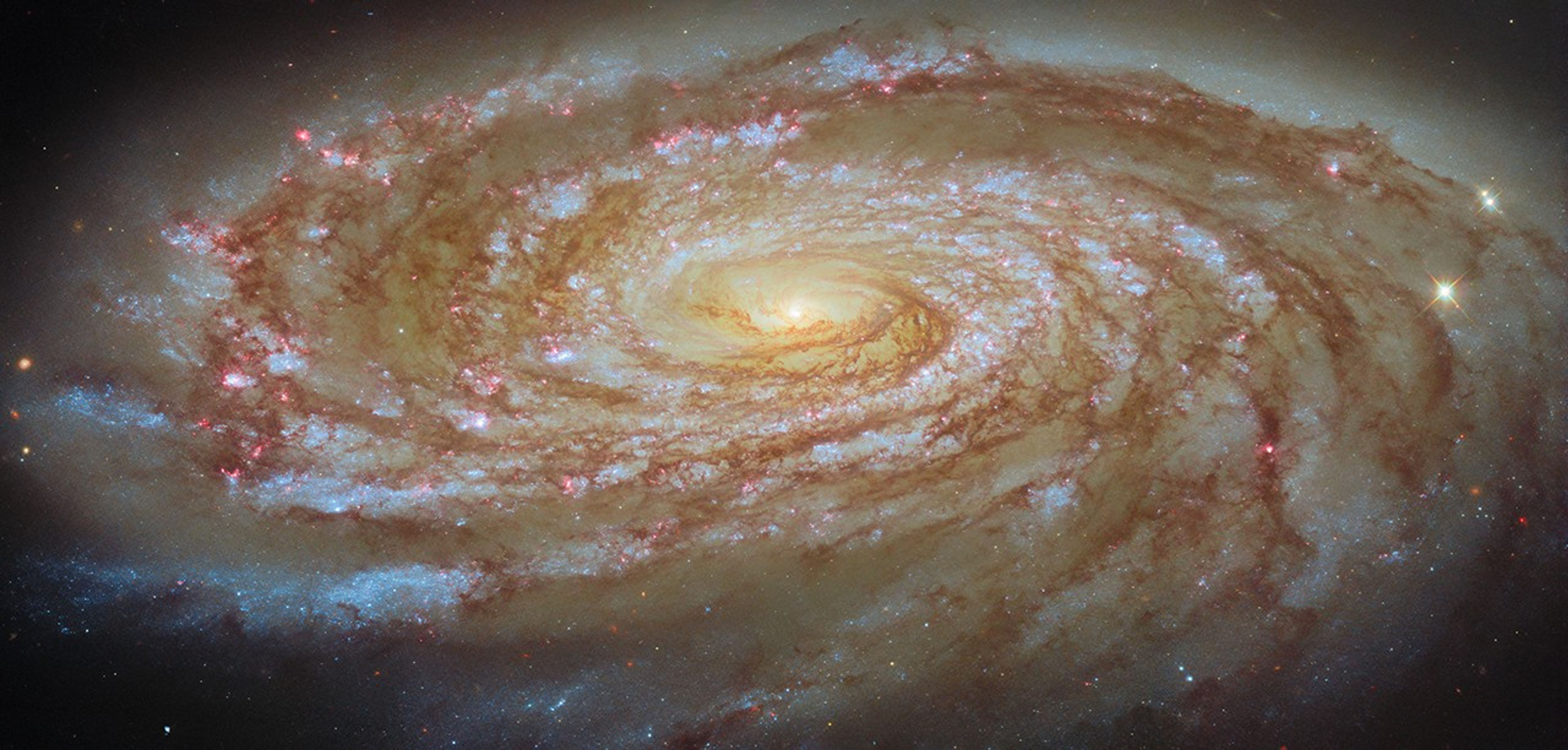
The focus of this NASA/ESA Hubble Space Telescope image is an active spiral galaxy on a journey lasting hundreds of millions of years. The galaxy Messier 88 (M88), also known as NGC 4501, is located about 63 million light-years away in the constellation Coma Berenices (Berenice’s Hair).
M88 is an active galaxy, which means that its center harbors a supermassive black hole that is snacking on gas and dust. Astronomers estimate the black hole is around 100 million times as massive as the Sun, and it appears to be powering outflows of gas from the galaxy’s center.
A population of old, reddish stars around the black hole give M88 its warmly glowing heart. Spreading out from the galaxy’s center are several tightly wound, symmetrical spiral arms, each outlined by sparkling pink and blue star clusters and knotted clouds of dust. We see M88 from an angle that makes it appear elongated, and its spiral arms delicately fan out before it.
M88 is a member of the Virgo Cluster, a collection of more than a thousand galaxies held together by gravity. As this massive galaxy group moves through space, the galaxies themselves are in constant motion as they orbit the cluster’s center of gravity. M88 itself is on a long and somewhat perilous cosmic journey that will bring it to the innermost reaches of the cluster.
As is the case with any epic journey, M88 will be fundamentally changed by its trek to the center of the Virgo Cluster, about two million light-years from where it is today. In 200–300 million years, M88 will make its closest approach to Messier 87, the massive elliptical galaxy that anchors the entire cluster. As it draws close to this gravitational behemoth, M88 will experience intense ram pressure stripping. Ram pressure stripping is a process through which a galaxy’s gas is swept away as it pushes through the ever-present gas between the galaxies in a cluster.
Researchers have already seen this process at work in M88. The galaxy’s swirling disk of gas is truncated and appears compressed on the leading edge of the galaxy, piling up gas and dust like snow before a plough. In fact, M88 appears to have considerably less cold gas — the raw fuel for star formation — than expected for a galaxy of its size, especially in its outer regions. This is a clear sign that M88 will be altered by its journey, which will affect its ability to form stars and alter the course of its evolution.
Astronomers observed M88 with Hubble as part of an observing program (#18103; PI: D. Thilker) dedicated to understanding the lives of spiral galaxies in crowded environments. This program uses Hubble’s Wide Field Camera 3, which can finely resolve individual star clusters and nebulae in galaxies tens of millions of light-years away. By studying galaxies on these scales, astronomers can understand how a journey through a cluster impacts a galaxy’s evolution and ability to form new stars.
Text credit: ESA/Hubble
Facebook logo @NASAHubble @NASAHubble Instagram logo @NASAHubbleMedia Contact:
Claire Andreoli
NASA’s Goddard Space Flight Center, Greenbelt, MD
claire.andreoli@nasa.gov
Since its 1990 launch, the Hubble Space Telescope has changed our fundamental understanding of the universe.
Messier 88
This galaxy’s core holds supermassive black hole roughly 100 million times more massive than our Sun.
Hubble Science Highlights
Hubble e-Books
Hubble Captures M88 on Journey to Center of Virgo Cluster
- Hubble Home
- Overview
- Impact & Benefits
- Science
- Observatory
- Team
- Multimedia
- News
- More
The focus of this NASA/ESA Hubble Space Telescope image is an active spiral galaxy on a journey lasting hundreds of millions of years. The galaxy Messier 88 (M88), also known as NGC 4501, is located about 63 million light-years away in the constellation Coma Berenices (Berenice’s Hair).
M88 is an active galaxy, which means that its center harbors a supermassive black hole that is snacking on gas and dust. Astronomers estimate the black hole is around 100 million times as massive as the Sun, and it appears to be powering outflows of gas from the galaxy’s center.
A population of old, reddish stars around the black hole give M88 its warmly glowing heart. Spreading out from the galaxy’s center are several tightly wound, symmetrical spiral arms, each outlined by sparkling pink and blue star clusters and knotted clouds of dust. We see M88 from an angle that makes it appear elongated, and its spiral arms delicately fan out before it.
M88 is a member of the Virgo Cluster, a collection of more than a thousand galaxies held together by gravity. As this massive galaxy group moves through space, the galaxies themselves are in constant motion as they orbit the cluster’s center of gravity. M88 itself is on a long and somewhat perilous cosmic journey that will bring it to the innermost reaches of the cluster.
As is the case with any epic journey, M88 will be fundamentally changed by its trek to the center of the Virgo Cluster, about two million light-years from where it is today. In 200–300 million years, M88 will make its closest approach to Messier 87, the massive elliptical galaxy that anchors the entire cluster. As it draws close to this gravitational behemoth, M88 will experience intense ram pressure stripping. Ram pressure stripping is a process through which a galaxy’s gas is swept away as it pushes through the ever-present gas between the galaxies in a cluster.
Researchers have already seen this process at work in M88. The galaxy’s swirling disk of gas is truncated and appears compressed on the leading edge of the galaxy, piling up gas and dust like snow before a plough. In fact, M88 appears to have considerably less cold gas — the raw fuel for star formation — than expected for a galaxy of its size, especially in its outer regions. This is a clear sign that M88 will be altered by its journey, which will affect its ability to form stars and alter the course of its evolution.
Astronomers observed M88 with Hubble as part of an observing program (#18103; PI: D. Thilker) dedicated to understanding the lives of spiral galaxies in crowded environments. This program uses Hubble’s Wide Field Camera 3, which can finely resolve individual star clusters and nebulae in galaxies tens of millions of light-years away. By studying galaxies on these scales, astronomers can understand how a journey through a cluster impacts a galaxy’s evolution and ability to form new stars.
Text credit: ESA/Hubble
Facebook logo @NASAHubble @NASAHubble Instagram logo @NASAHubbleMedia Contact:
Claire Andreoli
NASA’s Goddard Space Flight Center, Greenbelt, MD
claire.andreoli@nasa.gov
Since its 1990 launch, the Hubble Space Telescope has changed our fundamental understanding of the universe.
Messier 88
This galaxy’s core holds supermassive black hole roughly 100 million times more massive than our Sun.
Hubble Science Highlights
Hubble e-Books
How big can a galaxy get?
Deep surveys of the sky have turned up galaxies vastly larger than our own. Are there even bigger ones yet to be seen?
How smartphones and AI are reshaping our bodies and minds
A new look at how everything from handwriting to AI quietly reshapes our bodies, habits and sense of connection
20,000 Eyes on the Universe
We live in a golden age of astronomical imaging. Telescopes are capturing billions of galaxy images, painting the universe in breathtaking detail. But there's a problem, and it's a big one. A photograph tells you what something looks like but it doesn't tell you what it's made of, how fast it's moving, or how far away it really is. For that, you need spectroscopy. And right now, astronomy has a catastrophic imbalance, billions of images and nowhere near enough spectra to match them. A new telescope currently under construction in the mountains of western China is about to change that quite dramatically.
The Flash Memory That Space Can't Destroy
Every byte of data a spacecraft collects, every image, every reading, every scientific measurement has to survive one of the most hostile environments imaginable. Space is awash with radiation, and that radiation is the silent enemy of conventional data storage. Now, a team of researchers have built a new kind of memory chip that doesn't just tolerate radiation, it laughs in its face. Using a quirk of physics called ferroelectricity, this technology can withstand radiation levels equivalent to 100 million X-rays, and it could transform how we store data on missions heading deeper into the Solar System than we've ever ventured before.
We Can Now Weigh Galaxies Using Dead Stars As Scales
Researchers at the University of Alabama in Huntsville have found a new way to measure the mass of neighbouring galaxies using pulsars. Using the universe's most precise natural clocks it’s possible to detect tiny gravitational disturbances rippling through the Milky Way. By analysing 54 millisecond pulsars, the team directly measured the gravitational pull of both the Large Magellanic Cloud and the Sagittarius Dwarf Galaxy, including their dark matter. The same technique could eventually map dark matter across the entire Galaxy bringing us closer to understanding what it actually is.
Pancreatic cancer halted by virus injection in three patients
Pancreatic cancer halted by virus injection in three patients
Q-Day could destroy bitcoin – and our retirement savings
Q-Day could destroy bitcoin – and our retirement savings
This Week's Sky at a Glance, May 29 – June 7
Venus and Jupiter grab your eyes in the west in late twilight. The Summer Triangle marks the dark in the east. So will the subtler Milky Way once the glary Moon is gone.
The post This Week's Sky at a Glance, May 29 – June 7 appeared first on Sky & Telescope.