
Feed aggregator
Hyperbaric oxygen therapy is being explored as a long COVID treatment. Here’s what the research shows
Some clinics are touting pressurized oxygen chambers as a treatment for long COVID, but the evidence is mixed
What’s Up: June 2026 Skywatching Tips from NASA
Venus and Jupiter meet after sunset, the Moon passes in front of Venus, summer begins, and deep-sky treasures rise into view.
Skywatching Highlights- June 9: Venus and Jupiter conjunction
- June 11–15: Mercury joins Venus and Jupiter after sunset
- June 17: Moon passes in front of Venus & close Moon and Venus pairing
- June 21: June solstice & start of astronomical summer
- June: Summer Triangle and deep-sky observing targets rise into view
Planets gather after sunset, the Moon passes in front of Venus, summer officially begins and deep sky treasures rise into view. That’s What’s Up for June.
Early this month, look west shortly after sunset to see Venus and Jupiter. They are two of the brightest planets in our sky and around June 9th, they’ll appear close together after sunset. This is called a planetary conjunction—when two planets appear near each other from our point of view on Earth, even though they’re still millions of miles apart in space.
NASA/JPL-Caltech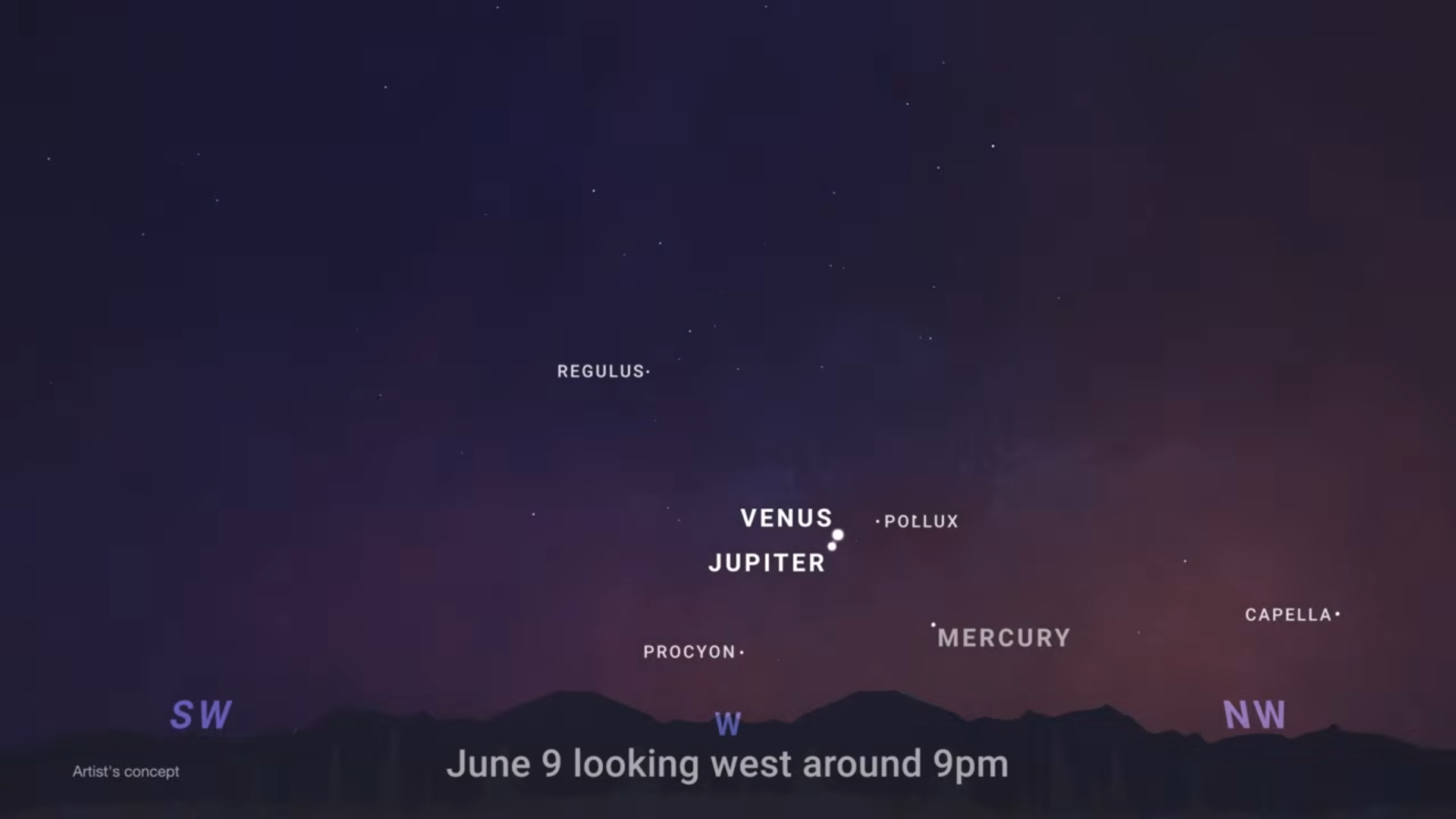
From June 11th through June 15th, Mercury joins the scene, creating a mini parade of planets low in the western sky. This happens because the planets orbit the sun along nearly the same path in our sky, called the ecliptic. So from our point of view on Earth, they sometimes appear to gather in the same part of the sky.
NASA/JPL-Caltech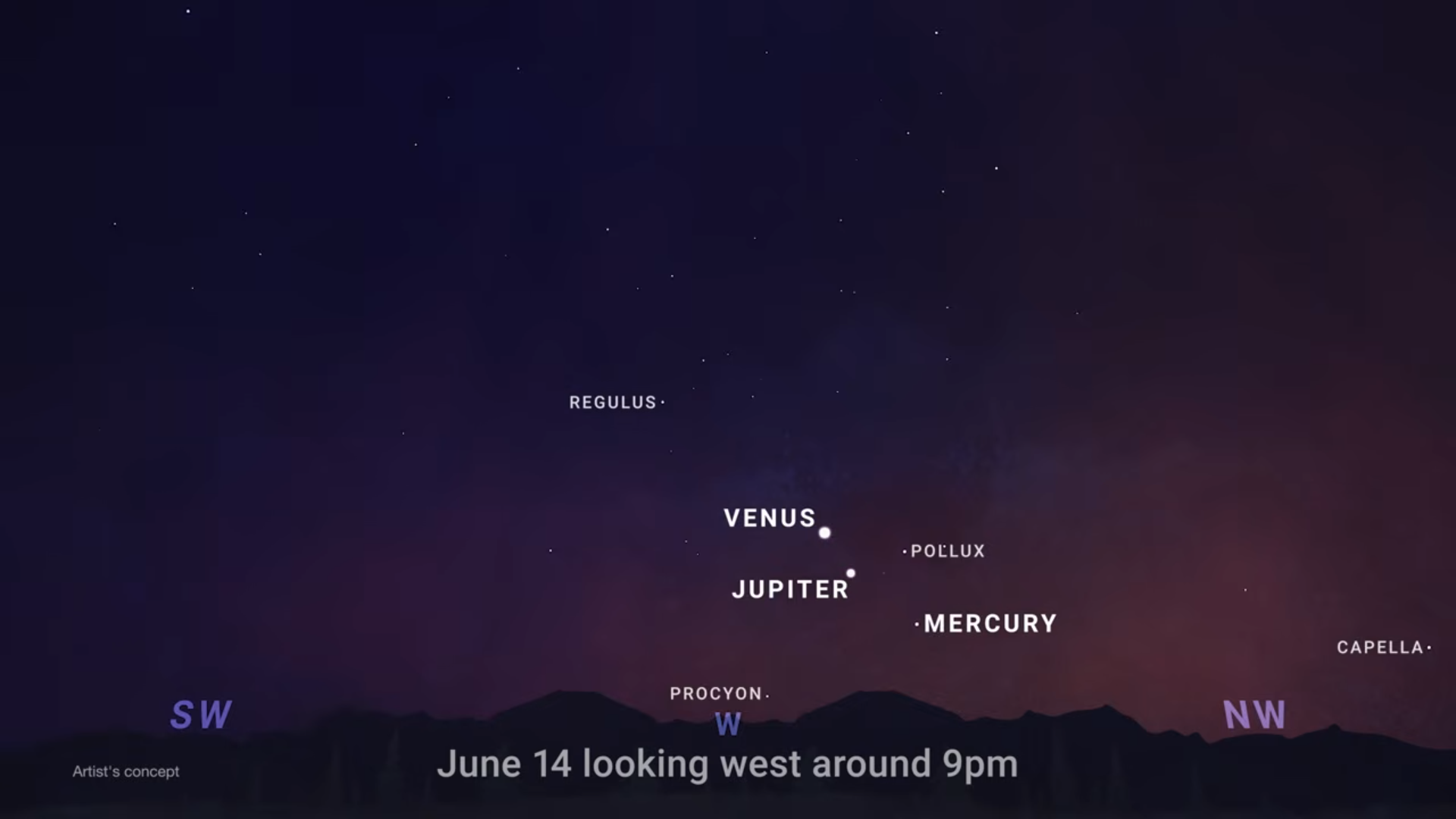
Venus will be the brightest and easiest to spot with Jupiter nearby. Mercury will sit lower toward the horizon, so you will need a clear view to the west to catch it in the glow of twilight.
On June 17th, from some locations the Moon will pass in front of Venus. This is called a lunar occultation. For viewers in the right viewing path, Venus will look like it disappears behind the Moon, then reappears later. The event will be visible from parts of the United States, Canada, Brazil and Venezuela. Outside of the exact viewing path, many skywatchers may still see a close pairing of the Moon and Venus, but this comes with an important safety note. For many viewers this will happen during the daytime.
If you’re trying to observe the occultation, do not point binoculars, a telescope, or a camera near the sun unless you’re using proper solar safety equipment. Looking at or near the sun through optics can cause serious eye injury.
June also brings the summer solstice. In the Northern Hemisphere, the June solstice marks the start of the astronomical summer. In Pacific time, it happens on Sunday, June 21st at 1:24 a.m.
Around the solstice, the Northern Hemisphere gets its longest days and shortest nights of the year.
But here’s a fun fact, the longest day does not usually line up exactly with the earliest sunrise or latest sunset. For example, in Los Angeles, the earliest sunrise comes before the solstice, while the latest sunset comes after it.
And once the sky gets dark, summer brings some favorite targets for telescope users and astrophotographers. First, look for the Summer Triangle, formed by the bright stars Vega, Altair, and Deneb. Inside and around this region are deep sky objects like the Dumbbell Nebula, the Ring Nebula, the North America Nebula, and the Veil Nebula. The Dumbbell Nebula, also known as Messier 27, was the first planetary nebula ever discovered.
These objects are not bright like planets, but with telescopes or long exposure photography, they reveal glowing gas, dying stars, and stellar nurseries in our galaxy.
NASA/JPL-Caltech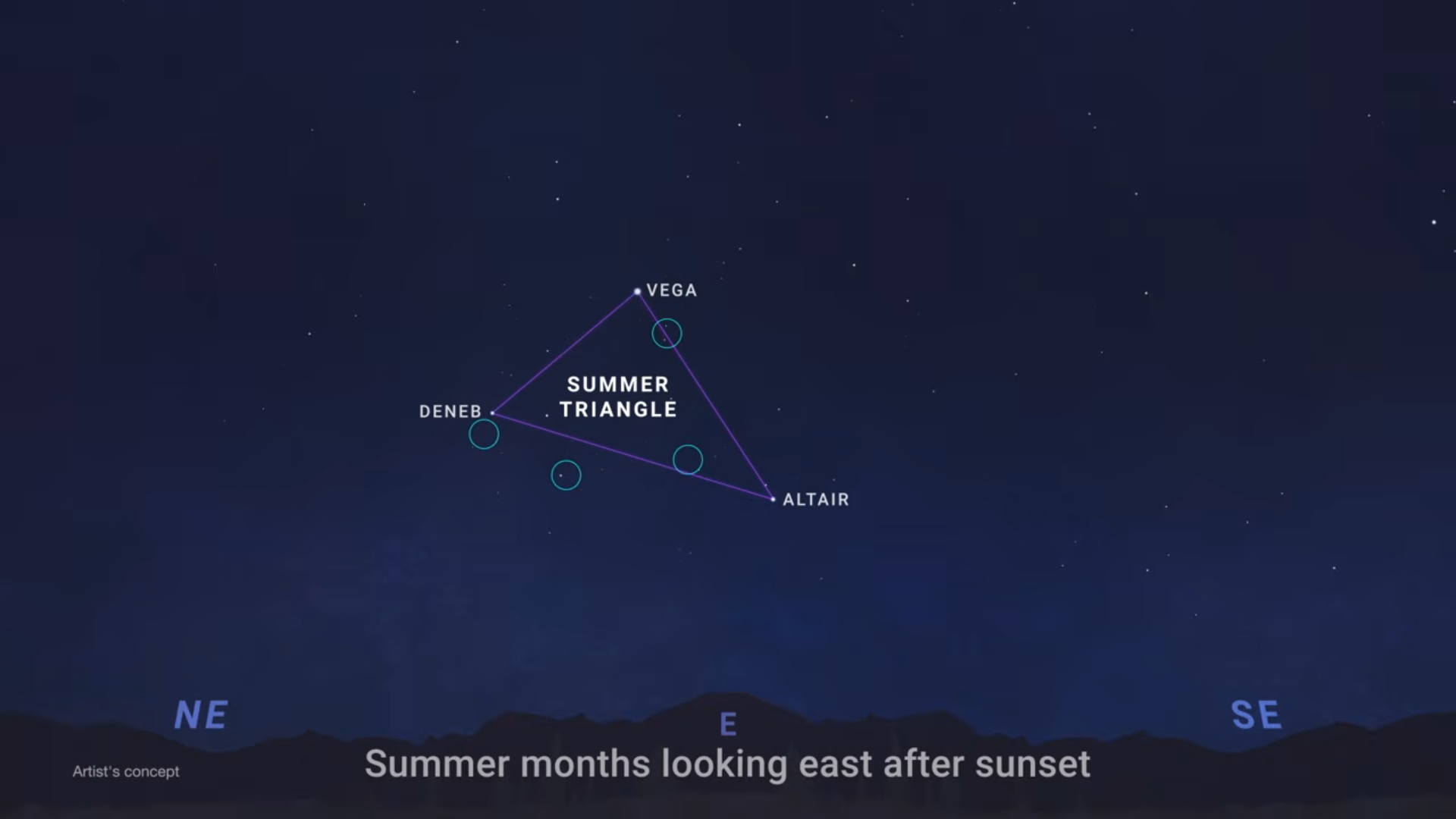
Here are the phases of the Moon for June. You can stay up to date on all of NASA’s missions exploring the solar system and beyond at science.nasa.gov. I’m Raquel Villanueva from NASA’s Jet Propulsion Laboratory, and that’s What’s Up this month.
NASA/JPL-Caltech Keep Exploring Discover More Topics From NASA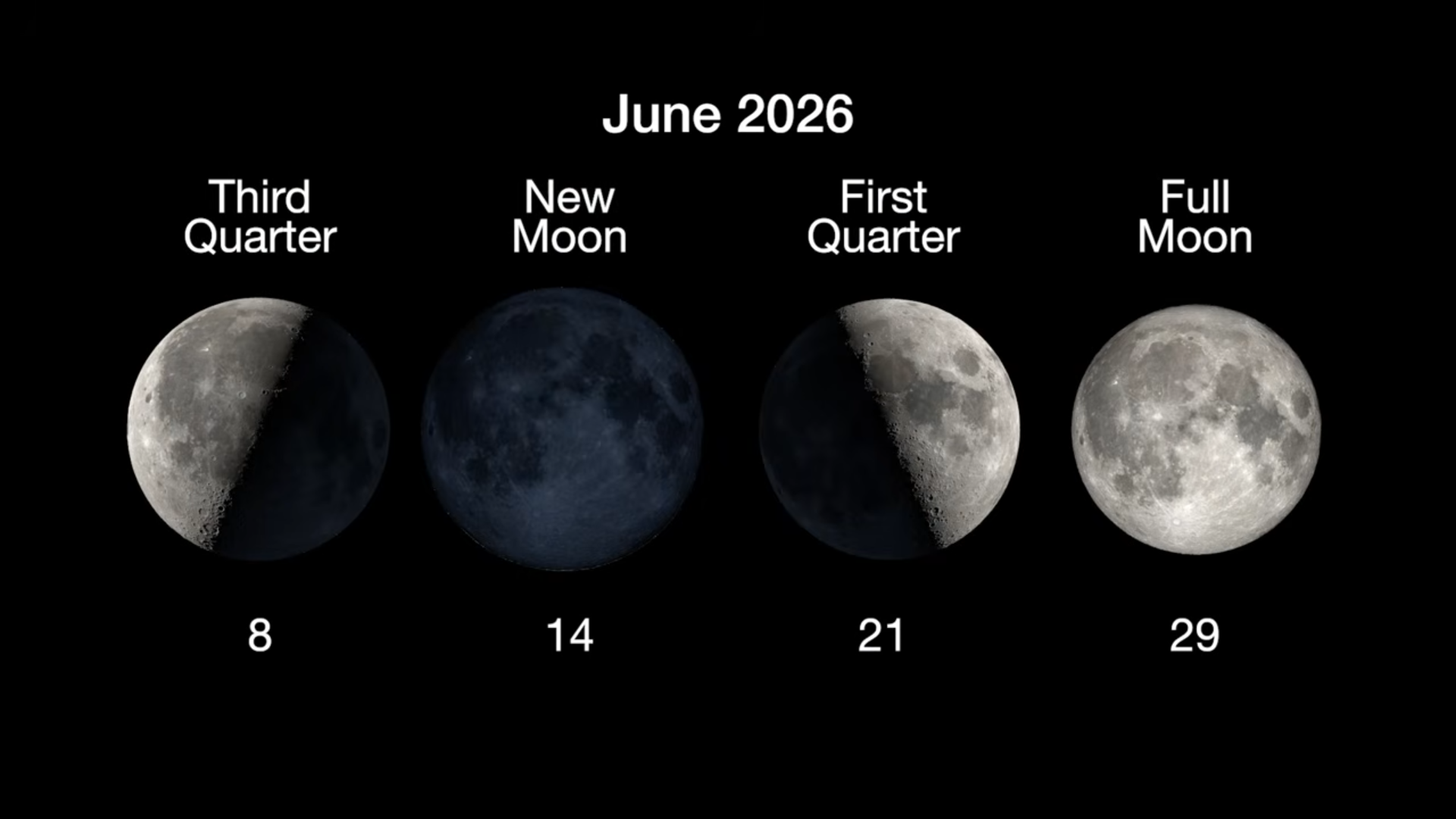
What’s Up
Skywatching
Galaxies
Stars
What’s Up: June 2026 Skywatching Tips from NASA
Venus and Jupiter meet after sunset, the Moon passes in front of Venus, summer begins, and deep-sky treasures rise into view.
Skywatching Highlights- June 9: Venus and Jupiter conjunction
- June 11–15: Mercury joins Venus and Jupiter after sunset
- June 17: Moon passes in front of Venus & close Moon and Venus pairing
- June 21: June solstice & start of astronomical summer
- June: Summer Triangle and deep-sky observing targets rise into view
Planets gather after sunset, the Moon passes in front of Venus, summer officially begins and deep sky treasures rise into view. That’s What’s Up for June.
Early this month, look west shortly after sunset to see Venus and Jupiter. They are two of the brightest planets in our sky and around June 9th, they’ll appear close together after sunset. This is called a planetary conjunction—when two planets appear near each other from our point of view on Earth, even though they’re still millions of miles apart in space.
NASA/JPL-CaltechFrom June 11th through June 15th, Mercury joins the scene, creating a mini parade of planets low in the western sky. This happens because the planets orbit the sun along nearly the same path in our sky, called the ecliptic. So from our point of view on Earth, they sometimes appear to gather in the same part of the sky.
NASA/JPL-CaltechVenus will be the brightest and easiest to spot with Jupiter nearby. Mercury will sit lower toward the horizon, so you will need a clear view to the west to catch it in the glow of twilight.
On June 17th, from some locations the Moon will pass in front of Venus. This is called a lunar occultation. For viewers in the right viewing path, Venus will look like it disappears behind the Moon, then reappears later. The event will be visible from parts of the United States, Canada, Brazil and Venezuela. Outside of the exact viewing path, many skywatchers may still see a close pairing of the Moon and Venus, but this comes with an important safety note. For many viewers this will happen during the daytime.
If you’re trying to observe the occultation, do not point binoculars, a telescope, or a camera near the sun unless you’re using proper solar safety equipment. Looking at or near the sun through optics can cause serious eye injury.
June also brings the summer solstice. In the Northern Hemisphere, the June solstice marks the start of the astronomical summer. In Pacific time, it happens on Sunday, June 21st at 1:24 a.m.
Around the solstice, the Northern Hemisphere gets its longest days and shortest nights of the year.
But here’s a fun fact, the longest day does not usually line up exactly with the earliest sunrise or latest sunset. For example, in Los Angeles, the earliest sunrise comes before the solstice, while the latest sunset comes after it.
And once the sky gets dark, summer brings some favorite targets for telescope users and astrophotographers. First, look for the Summer Triangle, formed by the bright stars Vega, Altair, and Deneb. Inside and around this region are deep sky objects like the Dumbbell Nebula, the Ring Nebula, the North America Nebula, and the Veil Nebula. The Dumbbell Nebula, also known as Messier 27, was the first planetary nebula ever discovered.
These objects are not bright like planets, but with telescopes or long exposure photography, they reveal glowing gas, dying stars, and stellar nurseries in our galaxy.
NASA/JPL-CaltechHere are the phases of the Moon for June. You can stay up to date on all of NASA’s missions exploring the solar system and beyond at science.nasa.gov. I’m Raquel Villanueva from NASA’s Jet Propulsion Laboratory, and that’s What’s Up this month.
NASA/JPL-Caltech Keep Exploring Discover More Topics From NASA
What’s Up
Skywatching
Galaxies
Stars
'Transformative' pancreatic cancer drug doubles survival time
'Transformative' pancreatic cancer drug doubles survival time
How Heavy Can a Neutron Star Get?
The physics of neutron stars are almost too fantastic to believe. Something the weight of two Suns compacted to a sphere the size of a city. Each teaspoon of its material would weigh billions of tons. If you’ve done any reading on the topic, you’ve heard these facts before. But despite the intense interest these extreme objects hold, we are still actively learning lots about them. One of the most pertinent outstanding questions is where is the line between becoming a neutron star and becoming a black hole when a star dies. A new paper by researchers at the HUN-REN Wigner Research Centre for Physics in Hungary describes what they believe to be a definitive answer to that question - between 2.2 and 2.3 solar masses.
Do turmeric and curcumin have any actual health benefits?
Do turmeric and curcumin have any actual health benefits?
Oldest cave art in the U.K. discovered inside Welsh cave
A new analysis of red lines inside a cave in Wales suggests they were made deliberately by ancient humans some 17,000 years ago
A golden age of maths is dawning and mathematicians are freaking out
A golden age of maths is dawning and mathematicians are freaking out
How human error became a weapon against large language models
How human error became a weapon against large language models
How the war in Iran is affecting your dinner plate
Agriculture is at risk of a crisis because of this Middle East conflict. The reason why has to do with how fertilizer is made
Jupiter Created the Birthplace of Rocky Bodies in the Early Solar System
Jupiter helped create the different rocky bodies in the Solar System. The massive gas giant created a planet-induced pressure bump in the gas in the disk surrounding the young Sun. This pressure bump filtered different types of dust at different times, leading to the formation of planetesimals with different compositions at different times.
Andrew Scott talks about World War II, D-Day and weather forecasting for his new film Pressure
Andrew Scott plays World War II meteorologist James Stagg in a new film Pressure, which explores the crucial role weather forecasting played in D-Day
Join the Scientific American Summer Reading Challenge
Fill your bingo card with fascinating science stories, discoveries and ideas all summer long for a chance to win prizes
China launches rival to SpaceX Falcon 9 with zero warning
China apparently didn’t issue any airspace or maritime notices ahead of the maiden launch of this rocket on Monday
How a Giant Moon and a Steam Atmosphere Built the Recipe for Life
4.5 billion years ago was an interesting time for the Earth. The atmosphere was thick and what we would now think of as toxic. The Moon, which was freshly formed, looks much more massive than it does today and faintly glows with the residual heat from its own creation. And the floor was literally lava. Everywhere. If there were any children alive at the time, they would have no chance of winning that game. But for a long time, scientists had thought this molten phase of the Earth didn’t last long. But according to a new paper, available in preprint on arXiv by researchers at the Kapteyn Astronomical Institute, it might have lasted for upwards of half a billion years.