

Feed aggregator
ExoMars rover targets vast bed of clay in search for life
In the region where the ExoMars Rosalind Franklin rover will search for signs of life, clay deposits extend beyond previous estimates, a new study finds. One hypothesis even suggests a vast ocean once covered the landing site.
A Moonlit Earth as Seen From Artemis II
- Earth
- Earth Observatory
- Image of the Day
- EO Explorer
- Topics
- More Content
- About
A Moonlit Earth as Seen From Artemis II
- Earth
- Earth Observatory
- Image of the Day
- EO Explorer
- Topics
- More Content
- About
Curiosity Blog, Sols 4908-4912: Goodbye Campo Marte, It’s Been Fun!
- Curiosity Home
- Science
- News and Features
- Multimedia
- Mars Missions
- Mars Home
5 min read
Curiosity Blog, Sols 4908-4912: Goodbye Campo Marte, It’s Been Fun! NASA’s Mars rover Curiosity acquired this image of the inlet on its Chemistry & Mineralogy X-Ray Diffraction instrument (CheMin), which is about the size of a laptop computer and sits inside rover’s body, where it analyzes the chemical composition of rocks and soil. Curiosity captured the image using its Mars Hand Lens Imager (MAHLI), a close-up camera located on the turret at the end of the rover’s robotic arm, on May 28, 2026 — Sol 4908, or Martian day 4,908 of the Mars Science Laboratory Mission — at 11:14:14 UTC. NASA/JPL-Caltech/MSSS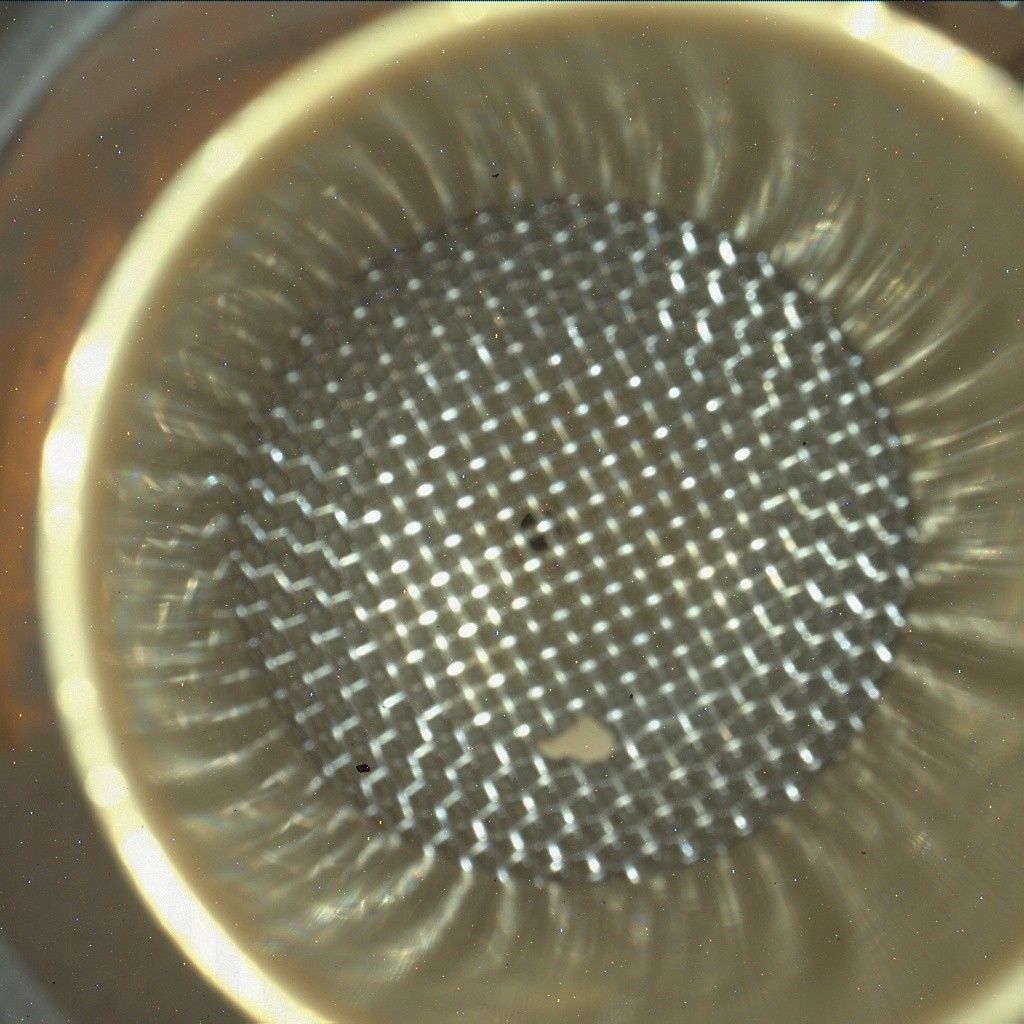
By Susanne P. Schwenzer, Professor of Planetary Mineralogy at The Open University, UK
Earth planning date: Friday, May 29, 2026
Drilling always keeps the rover in place for a little while, and our 47th successful drill, “Campo Marte,” was no exception. The team used the time wisely and on top of the drilling, we also have many observations. Thinking for a long time about a workspace always gets me attached to the area — some more than others; at the shorter stops, especially — when I am on shift several times during this time. I was Science Operations Working Group chair three times while we were here, so it’s a real “Goodbye” for me today as we are driving onward to reach the next area up the hill on Mount Sharp.
The Campo Marte drill was successful, as my colleague Abigail Fraeman reported last week. This week was spent investigating the aftermath of the drilling, which means running the CheMin instrument to get mineralogical data and the SAM instrument to inspect the volatile releases. ChemCam, APXS, MAHLI and Mastcam were also busy documenting the drill hole and the drill fines, as well as how much sample there was available overall.
Of course, Curiosity also had a very good look at the other interesting targets in the area! Besides all the work on the drill hole, ChemCam carried out an expert’s targeting exercise by setting two targets up to aim at two different layers on adjacent spots on the finely laminated sediments. That involves aiming at millimeter-sized targets, named “Corcovado” and “Junakas,” respectively, about 3 meters away (about 10 feet)! We are curious if the layers are chemically different, which would tell us about different formation conditions, or if they are similar and the conditions when those layers formed were more similar. ChemCam is also looking at the target “Palcaya” to get more data on the chemistry of the layered bedrock, and will investigate the target “Alcamachi,” which is a float rock that looks intriguingly dark. Maybe that tells us it’s got a different chemistry? We will find out when we get the data!
In addition to the chemistry measurements, ChemCam will also carry out a spectral investigation on the target “Magallanas,” which was a little too far away to also point the laser at it, but is intriguingly dark. This last week, ChemCam also planned three long-distance RMIs to document the sedimentary structures — younger and older ones — in the surrounding area. One of them drew the suspicion that it might break a record: it might be the longest strip of RMI images we have taken in one mosaic! The jury is out, it’s 24 frames and this way links up with an earlier, shorter set of images. The reason the mosaic is so long is because it images a small ridge with sedimentary textures that could tell us about the depositional conditions when the rock layers formed. But how cool is that — at 13+ years to still break our own records?
Since our arrival, Mastcam has been very busy getting the entire region around us imaged. In addition, some higher-resolution mosaics have been taken, most notably one of the locations where the remaining sample was dropped, and then of the workspace to see again how much sample might — or might not — have been left in the drill stem and fallen out when Curiosity did the motions that are designed to shake any remaining sample out of the drill, to leave it prepared for the next time. Another imaging task, but for MAHLI, is to always image the sample inlets, also, to see if they are clean and prepared for the next sample. I included the MAHLI image of the CheMin inlet — don’t worry about the little rock, it’s with us for a while, and the CheMin team now calls it “our pet rock.”
APXS joined the drill-hole investigations and has been focused on it even more than usual. The team decided that this is a very good opportunity to increase counting statistics beyond the usual and well-tested levels by significantly increasing the measurement time. To achieve that, it measured the Campo Marte drill fines in all plans of this week. And on the last night of that, MAHLI gets out its LED lights to finish the experiment with a sparkling nighttime MAHLI experiment to document it all.
Our environmental team has kept the rover busy by looking at atmospheric opacity, dust activity, dust-devil activity and, of course, also monitoring the environment in general. With all this finished, the rover will continue its way up the hill to the next interesting area. I heard something like “cross-bedding” during the discussions, but as a mineralogist, I just note that that decision was taken by people who know more about sediments than I do, while I am itching to see the CheMin mineralogy results!
-
Want to read more posts from the Curiosity team?
-
Want to learn more about Curiosity’s science instruments?
Article
6 days ago
3 min read Curiosity Blog, Sols 4893-4899: Drilling at Campo Marte and a Visit From the Psyche Spacecraft
Article
2 weeks ago
3 min read Curiosity Blog, Sols 4886-4892: Ingenuity and Perseverance, Curiosity Style
Article
3 weeks ago
Keep Exploring Discover More Topics From NASA Mars
Mars is the fourth planet from the Sun, and the seventh largest. It’s the only planet we know of inhabited…
All Mars Resources
Explore this collection of Mars images, videos, resources, PDFs, and toolkits. Discover valuable content designed to inform, educate, and inspire,…
Rover Basics
Each robotic explorer sent to the Red Planet has its own unique capabilities driven by science. Many attributes of a…
Mars Exploration: Science Goals
The key to understanding the past, present or future potential for life on Mars can be found in NASA’s four…
Curiosity Blog, Sols 4908-4912: Goodbye Campo Marte, It’s Been Fun!
- Curiosity Home
- Science
- News and Features
- Multimedia
- Mars Missions
- Mars Home
5 min read
Curiosity Blog, Sols 4908-4912: Goodbye Campo Marte, It’s Been Fun! NASA’s Mars rover Curiosity acquired this image of the inlet on its Chemistry & Mineralogy X-Ray Diffraction instrument (CheMin), which is about the size of a laptop computer and sits inside rover’s body, where it analyzes the chemical composition of rocks and soil. Curiosity captured the image using its Mars Hand Lens Imager (MAHLI), a close-up camera located on the turret at the end of the rover’s robotic arm, on May 28, 2026 — Sol 4908, or Martian day 4,908 of the Mars Science Laboratory Mission — at 11:14:14 UTC. NASA/JPL-Caltech/MSSSBy Susanne P. Schwenzer, Professor of Planetary Mineralogy at The Open University, UK
Earth planning date: Friday, May 29, 2026
Drilling always keeps the rover in place for a little while, and our 47th successful drill, “Campo Marte,” was no exception. The team used the time wisely and on top of the drilling, we also have many observations. Thinking for a long time about a workspace always gets me attached to the area — some more than others; at the shorter stops, especially — when I am on shift several times during this time. I was Science Operations Working Group chair three times while we were here, so it’s a real “Goodbye” for me today as we are driving onward to reach the next area up the hill on Mount Sharp.
The Campo Marte drill was successful, as my colleague Abigail Fraeman reported last week. This week was spent investigating the aftermath of the drilling, which means running the CheMin instrument to get mineralogical data and the SAM instrument to inspect the volatile releases. ChemCam, APXS, MAHLI and Mastcam were also busy documenting the drill hole and the drill fines, as well as how much sample there was available overall.
Of course, Curiosity also had a very good look at the other interesting targets in the area! Besides all the work on the drill hole, ChemCam carried out an expert’s targeting exercise by setting two targets up to aim at two different layers on adjacent spots on the finely laminated sediments. That involves aiming at millimeter-sized targets, named “Corcovado” and “Junakas,” respectively, about 3 meters away (about 10 feet)! We are curious if the layers are chemically different, which would tell us about different formation conditions, or if they are similar and the conditions when those layers formed were more similar. ChemCam is also looking at the target “Palcaya” to get more data on the chemistry of the layered bedrock, and will investigate the target “Alcamachi,” which is a float rock that looks intriguingly dark. Maybe that tells us it’s got a different chemistry? We will find out when we get the data!
In addition to the chemistry measurements, ChemCam will also carry out a spectral investigation on the target “Magallanas,” which was a little too far away to also point the laser at it, but is intriguingly dark. This last week, ChemCam also planned three long-distance RMIs to document the sedimentary structures — younger and older ones — in the surrounding area. One of them drew the suspicion that it might break a record: it might be the longest strip of RMI images we have taken in one mosaic! The jury is out, it’s 24 frames and this way links up with an earlier, shorter set of images. The reason the mosaic is so long is because it images a small ridge with sedimentary textures that could tell us about the depositional conditions when the rock layers formed. But how cool is that — at 13+ years to still break our own records?
Since our arrival, Mastcam has been very busy getting the entire region around us imaged. In addition, some higher-resolution mosaics have been taken, most notably one of the locations where the remaining sample was dropped, and then of the workspace to see again how much sample might — or might not — have been left in the drill stem and fallen out when Curiosity did the motions that are designed to shake any remaining sample out of the drill, to leave it prepared for the next time. Another imaging task, but for MAHLI, is to always image the sample inlets, also, to see if they are clean and prepared for the next sample. I included the MAHLI image of the CheMin inlet — don’t worry about the little rock, it’s with us for a while, and the CheMin team now calls it “our pet rock.”
APXS joined the drill-hole investigations and has been focused on it even more than usual. The team decided that this is a very good opportunity to increase counting statistics beyond the usual and well-tested levels by significantly increasing the measurement time. To achieve that, it measured the Campo Marte drill fines in all plans of this week. And on the last night of that, MAHLI gets out its LED lights to finish the experiment with a sparkling nighttime MAHLI experiment to document it all.
Our environmental team has kept the rover busy by looking at atmospheric opacity, dust activity, dust-devil activity and, of course, also monitoring the environment in general. With all this finished, the rover will continue its way up the hill to the next interesting area. I heard something like “cross-bedding” during the discussions, but as a mineralogist, I just note that that decision was taken by people who know more about sediments than I do, while I am itching to see the CheMin mineralogy results!
-
Want to read more posts from the Curiosity team?
-
Want to learn more about Curiosity’s science instruments?
Article
6 days ago
3 min read Curiosity Blog, Sols 4893-4899: Drilling at Campo Marte and a Visit From the Psyche Spacecraft
Article
2 weeks ago
3 min read Curiosity Blog, Sols 4886-4892: Ingenuity and Perseverance, Curiosity Style
Article
3 weeks ago
Keep Exploring Discover More Topics From NASA Mars
Mars is the fourth planet from the Sun, and the seventh largest. It’s the only planet we know of inhabited…
All Mars Resources
Explore this collection of Mars images, videos, resources, PDFs, and toolkits. Discover valuable content designed to inform, educate, and inspire,…
Rover Basics
Each robotic explorer sent to the Red Planet has its own unique capabilities driven by science. Many attributes of a…
Mars Exploration: Science Goals
The key to understanding the past, present or future potential for life on Mars can be found in NASA’s four…
A Brief-ish History of SETI. Part IX: What Have We Found?
In our final installment in the series, we'll examine all the close calls, possible candidates, and instances in which extraterrestrial signals could not be ruled out
White House reclassifies federal epidemiologists and other scientists from civil servants to ‘at-will’ hires
The long-anticipated “Schedule F” order strips job protections meant to safeguard federal employees from political interference
NASA Finds New Way Earth May Have Received Elements Needed for Life
Illustration: ESO
NASA-supported scientists have provided new information about how the early Earth may have acquired some elements necessary for the planet to become habitable. They also suggest a new role for Jupiter in the distribution of these elements throughout the young solar system. The study, published today in Science Advances, examines this history by looking at the ratio of phosphorus to nitrogen in iron meteorites and in younger objects known as chondrites.
The study suggests that Earth acquired its inventory of the life-essential elements phosphorous and nitrogen primarily from the inner solar system, without requiring a significant contribution from outer solar system chondritesDebjeet Pathak
Rice University
Planetary system formationOur solar system formed from gas and dust that swirled around the proto-Sun more than 4.5 billion years ago. This gas contained the raw materials needed to form planets, moons, and ultimately life as we know it. Two elements of particular importance for life are nitrogen and phosphorus.
All life on Earth needs the same elements: carbon, hydrogen, nitrogen, oxygen, phosphorus, and sulfur (CHNOPS). These elements came from space, born inside stars and spread in clouds of gas and dust. Gravity then caused this material to gather together, forming new stars and smaller objects like planets. NASA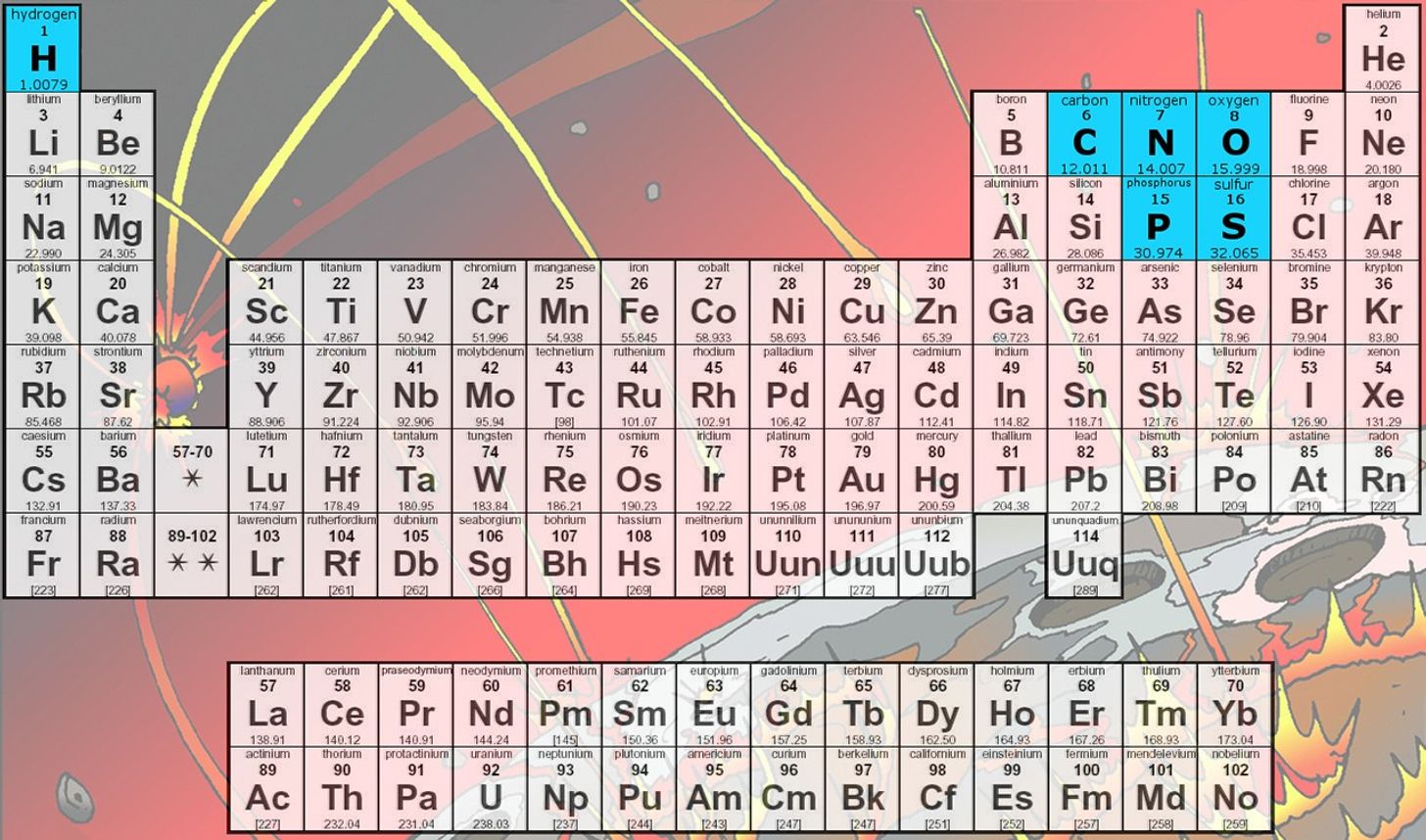
In the earliest stages of the solar system, gas and dust coalesced into bodies known as planetesimals. As these objects orbited the young Sun in this chaotic environment, planetesimals collided, leaving shattered remnants throughout the system. Eventually, many of these pieces were incorporated into planets and moons. Other pieces survive today as asteroids, still orbiting the Sun, and – if they have impacted the Earth and been recovered – as meteorites. These meteorites provide a window into the early solar system at a time before the Earth existed. Chondrites and iron meteorites are two different classes of these meteorites.
As their name suggests, iron meteorites are dense, metallic objects and are primarily made of iron-nickel alloy. Chondrites, on the other hand, are stony objects and they are responsible for most of the meteorites that have been found on Earth.
Each type of meteorite originates from planetesimals that formed at different times in our system. The oldest generation of planetesimals are the source of iron meteorites. Chondrites came from a second generation of planetesimals that formed 2-3 million years later.
Habitable planet buildingUnderstanding how the Earth was made and the timing of its formation is important for astrobiologists who study how and when our planet became habitable for life as we know it. The young Earth needed to have a supply of life’s ingredients, including nitrogen and phosphorus, for the first living cells to form.
There is debate between scientists over where Earth’s stock of life-essential elements came from. Some evidence points to chondrites in the outer solar system traveling inward to arrive at Earth late in our planet’s formation process. However, the new study tells a different story.
Using laboratory experiments and geochemical models, the team reconstructed a map of phosphorus-nitrogen (P/N) ratios across the early solar system and found differences between the first (iron meteorites) and second (chondrites) generations of planetesimals.
An illustration of our solar system. The asteroid belt is located between Mars and Jupiter, separating our system into what we refer to as the inner and outer regions. NASA/JPL-Caltech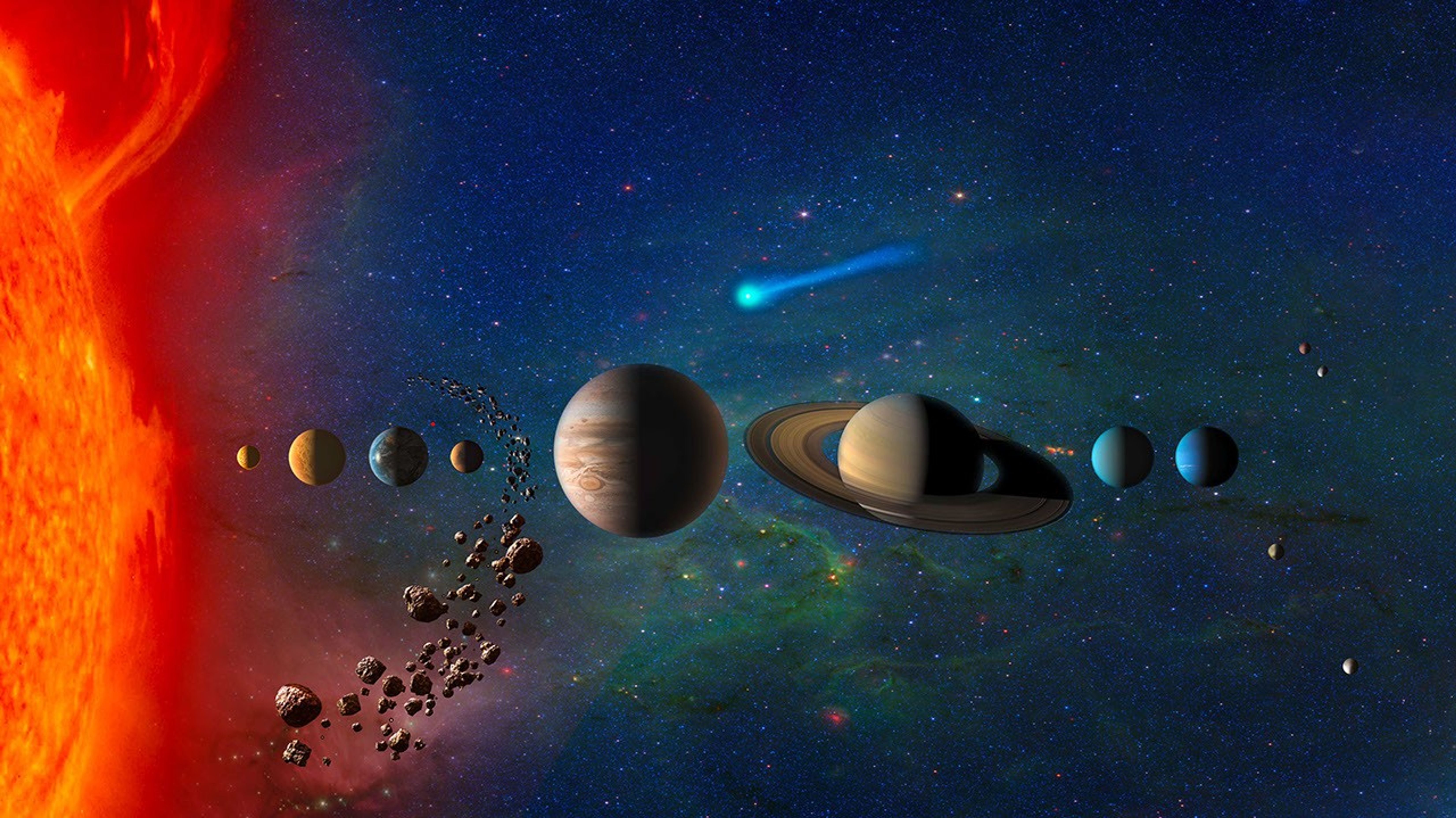
The experiments and subsequent geochemical modeling showed that the first generation had a higher ratio of P/N in the outer solar system, with that ratio decreasing toward the inner solar system. This trend was reversed in the second generation of planetesimals, with higher P/N ratios in the inner solar system.
The thought is that during the formation of the first generation of planetesimals, there was an outward flow of material that raised the P/N ratio in the outer solar system. Then came Jupiter.
For our own solar system, Jupiter’s presence and growth history, indeed, seem to have played a critical role in determining the distribution of the basic chemical ingredients necessary for habitable worlds.Rajdeep Dasgupta
Rice University
As Jupiter formed and grew to a tremendous size (and gravitational influence), the planet restricted the movement of phosphorus and nitrogen from the inner to outer solar system. This meant that when the second generation of planetesimals appeared, those in the inner solar system were left with a higher P/N ratio than their cousins further out.
“For our own solar system, Jupiter’s presence and growth history, indeed, seem to have played a critical role in determining the distribution of the basic chemical ingredients necessary for habitable worlds,” said Rajdeep Dasgupta of Rice University in Houston and senior author on the study. “It remains an open question whether a life-essential element budget similar to Earth’s can be established without a Jupiter-like planet in the population.”
Geochemical accretion modeling further shows that Earth’s present-day P/N signature is best reproduced by the inner solar system planetesimals, either those related to iron meteorites or those related to chondrites.
“The study suggests that Earth acquired its inventory of the life-essential elements phosphorous and nitrogen primarily from the inner solar system, without requiring a significant contribution from outer solar system chondrites,” said study lead author Debjeet Pathak, graduate student at Rice University.
For more information on astrobiology at NASA, visit:
https://science.nasa.gov/astrobiology
Karen Fox / Molly Wasser
Headquarters, Washington
202-358-1600
karen.c.fox@nasa.gov / molly.l.wasser@nasa.gov
Share
Details Last Updated Jun 03, 2026 Related Terms Explore More 5 min read NASA Uses Mineralogical Marker to Understand Ancient Martian ClimateScientists analyzed 20 Martian samples collected by NASA’s Curiosity Rover and found that differences in…
Article
6 days ago
5 min read NASA Research Shows Early Life Relied on Rare Metal
Article
4 weeks ago
8 min read Optical Vortex Phase Masks for the Detection of Habitable Worlds
A team of NASA researchers is developing new types of optical masks that could help…
Article
2 months ago
Keep Exploring Discover More Astrobiology Topics From NASA
Astrobiology Program Overview
Astrobiology Multimedia
Astrobiology Publications
Funded Astrobiology Research at NASA
NASA Finds New Way Earth May Have Received Elements Needed for Life
Illustration: ESO
NASA-supported scientists have provided new information about how the early Earth may have acquired some elements necessary for the planet to become habitable. They also suggest a new role for Jupiter in the distribution of these elements throughout the young solar system. The study, published today in Science Advances, examines this history by looking at the ratio of phosphorus to nitrogen in iron meteorites and in younger objects known as chondrites.
The study suggests that Earth acquired its inventory of the life-essential elements phosphorous and nitrogen primarily from the inner solar system, without requiring a significant contribution from outer solar system chondritesDebjeet Pathak
Rice University
Planetary system formationOur solar system formed from gas and dust that swirled around the proto-Sun more than 4.5 billion years ago. This gas contained the raw materials needed to form planets, moons, and ultimately life as we know it. Two elements of particular importance for life are nitrogen and phosphorus.
All life on Earth needs the same elements: carbon, hydrogen, nitrogen, oxygen, phosphorus, and sulfur (CHNOPS). These elements came from space, born inside stars and spread in clouds of gas and dust. Gravity then caused this material to gather together, forming new stars and smaller objects like planets. NASAIn the earliest stages of the solar system, gas and dust coalesced into bodies known as planetesimals. As these objects orbited the young Sun in this chaotic environment, planetesimals collided, leaving shattered remnants throughout the system. Eventually, many of these pieces were incorporated into planets and moons. Other pieces survive today as asteroids, still orbiting the Sun, and – if they have impacted the Earth and been recovered – as meteorites. These meteorites provide a window into the early solar system at a time before the Earth existed. Chondrites and iron meteorites are two different classes of these meteorites.
As their name suggests, iron meteorites are dense, metallic objects and are primarily made of iron-nickel alloy. Chondrites, on the other hand, are stony objects and they are responsible for most of the meteorites that have been found on Earth.
Each type of meteorite originates from planetesimals that formed at different times in our system. The oldest generation of planetesimals are the source of iron meteorites. Chondrites came from a second generation of planetesimals that formed 2-3 million years later.
Habitable planet buildingUnderstanding how the Earth was made and the timing of its formation is important for astrobiologists who study how and when our planet became habitable for life as we know it. The young Earth needed to have a supply of life’s ingredients, including nitrogen and phosphorus, for the first living cells to form.
There is debate between scientists over where Earth’s stock of life-essential elements came from. Some evidence points to chondrites in the outer solar system traveling inward to arrive at Earth late in our planet’s formation process. However, the new study tells a different story.
Using laboratory experiments and geochemical models, the team reconstructed a map of phosphorus-nitrogen (P/N) ratios across the early solar system and found differences between the first (iron meteorites) and second (chondrites) generations of planetesimals.
An illustration of our solar system. The asteroid belt is located between Mars and Jupiter, separating our system into what we refer to as the inner and outer regions. NASA/JPL-CaltechThe experiments and subsequent geochemical modeling showed that the first generation had a higher ratio of P/N in the outer solar system, with that ratio decreasing toward the inner solar system. This trend was reversed in the second generation of planetesimals, with higher P/N ratios in the inner solar system.
The thought is that during the formation of the first generation of planetesimals, there was an outward flow of material that raised the P/N ratio in the outer solar system. Then came Jupiter.
For our own solar system, Jupiter’s presence and growth history, indeed, seem to have played a critical role in determining the distribution of the basic chemical ingredients necessary for habitable worlds.Rajdeep Dasgupta
Rice University
As Jupiter formed and grew to a tremendous size (and gravitational influence), the planet restricted the movement of phosphorus and nitrogen from the inner to outer solar system. This meant that when the second generation of planetesimals appeared, those in the inner solar system were left with a higher P/N ratio than their cousins further out.
“For our own solar system, Jupiter’s presence and growth history, indeed, seem to have played a critical role in determining the distribution of the basic chemical ingredients necessary for habitable worlds,” said Rajdeep Dasgupta of Rice University in Houston and senior author on the study. “It remains an open question whether a life-essential element budget similar to Earth’s can be established without a Jupiter-like planet in the population.”
Geochemical accretion modeling further shows that Earth’s present-day P/N signature is best reproduced by the inner solar system planetesimals, either those related to iron meteorites or those related to chondrites.
“The study suggests that Earth acquired its inventory of the life-essential elements phosphorous and nitrogen primarily from the inner solar system, without requiring a significant contribution from outer solar system chondrites,” said study lead author Debjeet Pathak, graduate student at Rice University.
For more information on astrobiology at NASA, visit:
https://science.nasa.gov/astrobiology
Karen Fox / Molly Wasser
Headquarters, Washington
202-358-1600
karen.c.fox@nasa.gov / molly.l.wasser@nasa.gov
Share
Details Last Updated Jun 03, 2026 Related Terms Explore More 5 min read NASA Uses Mineralogical Marker to Understand Ancient Martian ClimateScientists analyzed 20 Martian samples collected by NASA’s Curiosity Rover and found that differences in…
Article
6 days ago
5 min read NASA Research Shows Early Life Relied on Rare Metal
Article
4 weeks ago
8 min read Optical Vortex Phase Masks for the Detection of Habitable Worlds
A team of NASA researchers is developing new types of optical masks that could help…
Article
2 months ago
Keep Exploring Discover More Astrobiology Topics From NASA
Astrobiology Program Overview
Astrobiology Multimedia
Astrobiology Publications
Funded Astrobiology Research at NASA