
Feed aggregator
How a huge fleet of 17 spacecraft discovered something surprising about solar eruptions
A misbehaving coronal mass ejection (CME) that blew out a hidden cloud of charged particles aimed at Earth has been tracked by a record 17 spacecraft spread throughout the solar system, revealing the CME to be surprisingly lopsided.
CMEs are "burps" from the sun – huge clouds of magnetized plasma belched out from the sun's hot outer atmosphere, the corona, by the energy resulting from a solar flare. The magnetized CME cloud then expands out into the solar system, and the charged particles that the cloud contains are a significant radiation hazard to astronauts, spacecraft and even passengers on jet liners, but they also have a beautiful side as they can trigger the beautiful lights of the aurora when they intercept Earth.
CMEs occur on a regular basis, but one that erupted from the sun at 00:48 UT (7:48 p.m. ET) on Dec. 15, 2024 proved to be rather special.
"We used observations from 17 spacecraft to track and characterize this CME," Adrienn Luspay-Kuti of Johns Hopkins University Applied Physics Laboratory, who led the research that drew all the observations together, told Space.com. "This was a record number of spacecraft for tracking and characterizing a single CME, and gave us an exceptionally detailed view of how the CME evolved."
The previous record had been 10 spacecraft, but they had mostly been in a rough line from the sun through to the Earth and beyond, meaning that their measurements were somewhat one-dimensional. This time, for the December 2024 CME, the spacecraft were spread far and wide, not just at different distances from the sun, but also substantially wide of the Earth–sun line.
They revealed that the CME had two asymmetric lobes, one moving faster than the other. One of those lobes, which headed for Earth and Mars, would have gone unseen, obscured by the larger but slower lobe that left the sun at a tangent, were it not for the wide spread of the spacecraft.
"Our observations showed a fast lobe propagating through the Earth–Mars sector and a much slower lobe farther west toward STEREO-A," said Luspay-Kuti. STEREO-A is one half of NASA's two-spacecraft space weather monitoring system known as the Solar Terrestrial Relations Observatory.
The onset of the CME was seen by the joint NASA–ESA Solar and Heliospheric Observer (SOHO), which has been constantly monitoring the sun for more than 30 years. Yet it only saw the slower lobe that erupted at an angle to Earth; the faster lobe heading for our planet was missed, obscured by the slower, larger lobe.
A schematic of the CME has its two lobes progressing through the solar system and encountered various spacecraft and satellites. (Image credit: Johns Hopkins Applied Physics Lab)The CME was next detected at a distance from the sun of 0.35 astronomical units (AU; 1 AU is the distance of Earth from the sun) on Dec. 16 moving through space near Mercury and the European Space Agency's BepiColombo mission (which finally arrives into orbit around the innermost planet in November 2026).
The next detection, on Dec. 17, was of the "hidden" component arriving at Earth, where a multitude of spacecraft picked it up. The CME was not strong enough to produce significant aurorae. Intriguingly Europe's Solar Orbiter mission, on an elongated orbit around the sun and at the time 0.94 AU from the sun and just 10 degrees off the Earth–sun line, did not detect the CME. This non-detection was actually vital since it helped to constrain the shape of the CME.
Then on Dec. 18, the slower moving lobe reached NASA's STEREO-A spacecraft, which orbits the sun at the same distance as Earth — 1 AU —- but substantially ahead of Earth in its orbit. The lobe that intersected the Earth had an average velocity of 522 miles (840 kilometers) per second, but the other lobe dragged its feet, moving at an average of 332 miles (534 km) per second from the sun and past BepiColombo and STEREO-A. In fact, by the time it reached STEREO-A, it had slowed to about 248.5 miles (400 km) per second. Both lobes decelerated as a result of friction with the regular solar wind that the CME was overtaking, and the range of velocities measured in the CME told researchers that the solar eruption was not traveling as a single, unified front.
Beyond Earth NASA's Europa Clipper mission, on which Luspay-Kuti is the Principal Investigator for the spacecraft's Plasma Instrument for Magnetic Sounding (PIMS) experiment, detected the faster moving lobe at 1.19 AU as the spacecraft was cruising to Mars for a gravity assist to help it on its journey to Jupiter. At the red planet, the now-defunct MAVEN mission also detected the CME on Dec. 19 to Dec. 20.
To have not only so many spacecraft follow the progress of a CME but also enough spacecraft off the Earth–sun line to measure the shape of the CME, at least in two dimensions, is a significant step forward in understanding and forecasting the propagation of CMEs.
The CME seen by the Solar Dynamics Observatory (top left), SOHO (top right) and STEREO-A (bottom left and right). The fast moving Earth-directed lobe was obscured by the southward-directed slower lobe. (Image credit: Luspay-Kuti et al.)"This matters for future human exploration because a missed CME can mean losing valuable warning time," said Luspay-Kuti. "Fast CMEs can drive shocks that accelerate high-energy particles, which can pose a radiation hazard to astronauts outside Earth's protective magnetic field. This is why observations from multiple viewpoints, including spacecraft away from the sun–Earth line and planetary missions operating during their cruise phase, will become increasingly important for space-weather forecasting as human exploration moves further from Earth."
The asymmetrical double-lobed structure of this particular CME was certainly a surprise. The cause of the asymmetry remains unclear at present, though Luspay-Kuti told Space.com that researchers are investigating. The main question is, how frequent are asymmetric CMEs?
"In the context of previous observations, this event is at the most extreme end of observed CME variability," said Luspay-Kuti. "Are highly asymmetric CMEs actually fairly common but we fail to recognize them because we don't have enough observational coverage, or are they genuinely rare?"
The 17 spacecraft that detected or imaged the CME across some or all of its various stages – the bow shock and turbulent sheath ahead of the magnetic cloud, the CME itself and the turbulent wake left in the solar wind after its passing – were the following: SOHO (initial imaging), BepiColombo, NASA's Solar Dynamics Observatory, STEREO-A, the four spacecraft of the Magnetospheric Multiscale (MMS) mission, the two spacecraft of the ARTEMIS (Acceleration, Reconnection, Turbulence, and Electrodynamics of the Moon's Interaction with the sun) mission, NASA's Wind, ACE (Advanced Composition Explorer), GOES (Geostationary Operational Environmental Satellite) and DSCOVR (Deep Space Climate Observatory) missions, Europa Clipper, MAVEN and Solar Orbiter, the latter of which made measurements but did not detect the CME.
In the future, these missions will be joined by the European Space Agency's Vigil mission that will watch for space weather when it launches in 2031 for the sun–Earth L5 Lagrange point, 60 degrees behind Earth in its orbit and therefore providing additional off-axis monitoring.
The findings were published on Aug. 19 in the journal Science Advances.
Bad weather delays launch of China's historic Chang'e 7 mission to moon's south pole
Poor weather has delayed the launch of China's latest moon mission.
According to reports, the growth of Tropical Depression Narra in the Gulf of Tonkin has prompted China's space agency to delay the liftoff of Chang'e 7 significantly — possibly until 2027.
"China's Chang'e 7 lunar probe does not meet launch conditions, and its launch therefore cannot take place during the planned window this year," the state-run Xinhua news agency reported today (Aug. 23), citing the China Manned Space Agency.
Chang'e 7 had originally been scheduled to launch today from the Wenchang Space Launch Site on the island of Hainan. But then Narra started brewing in the Gulf of Tonkin, just to the island's west.
Launching a rocket into a howling gale is less than ideal. Chinese space officials initially pushed the launch back a day, to Monday (Aug. 24), before concluding that the new target was unattainable as well.
It's now unclear when Chang'e 7 might lift off; messaging on the topic has been characteristically murky. (China is fairly tight-lipped about its space activities, revealing far less publicly than, say, NASA or the European Space Agency does. For example, China announces who's flying on its crewed missions just one day before liftoff.)
The Chang'e 7 launch requires a certain lineup of Earth and the moon, so it cannot simply occur as soon as the skies around Wenchang clear. Some online reports suggest that Chang'e 7 could lift off as soon as September, while others — including today's Xinua story — have it launching sometime in 2027.
Artist's illustration of China's Chang'e 7 mission orbiting the moon. (Image credit: China Media Group)Whenever it occurs, the liftoff will draw a lot of attention. Chang'e 7 is an ambitious and exciting mission, and it could have serious implications for lunar exploration down the road.
Chang'e 7 consists of an orbiter and a lander, which will likely touch down on the rim of Shackleton Crater, near the moon's south pole (though China has not announced an official landing site).
This region is thought to harbor lots of water ice, most of it on crater floors that have not seen the sun for billions of years. Chang'e 7's lander will deploy a rover and a hopping robot to hunt for this precious resource, which could help support human settlements in the area.
China aims to build such an outpost in the coming years, as does the United States, via NASA's Artemis program. U.S. officials have stressed the need for the nation to win this new space race so that it can establish the norms for living and working on Earth's nearest neighbor.
NASA Highlights Next-Gen Cargo Landers Paving the Way for a Moon Base
NASA and its commercial partners are making progress on their way to a permanent human presence on the Moon. As part of that, a recent press release and accompanying YouTube video hints they may be looking to provide regular updates to the progress of those efforts - and, at least for this first one, that progress looks pretty good.
Launching 10,000 tiny 'femtosats' to Saturn? NASA funds 18 futuristic spaceflight ideas
NASA is giving a financial boost to nearly 20 technology investigations to help fuel the incubation of tomorrow's spaceflight research capabilities.
The NASA Innovative Advanced Concepts (NIAC) program has selected 18 projects for this year's Phase I awards, which will each split a total of $3.2 million in development funding. NIAC is designed to bolster technology breakthroughs that NASA could use on future space missions.
This year's awards include an array of mission concepts and research proposals NASA views as having "transformative potential," according to a July 29 announcement of winners. Among them are ideas for hardening spacecraft to explore and withstand the harsh conditions of Venus, radioisotope-heated lunar spacesuits and using space dust to partially block out the sun to reduce solar radiation.
The selected projects aren't actual NASA missions, but serve as a sampling of technologies the agency sees as potentially contributing to projects like establishing a moon base as part of the Artemis program.
"Achieving that will require more than incremental technological advancement. It means we need great leaps," Greg Stover, director of the Advanced Research and Technology division in NASA's Research and Technology Mission Directorate, said in the awards announcement. "These awards are the kinds of innovation the world needs NASA to help foster."
Each of the 18 award winners will receive up to $175,000 to complete a nine-month investigation of their proposals to determine their feasibility and determine the next steps in maturing their technologies.
Graphic depiction of the LUX concept. (Image credit: Stone Aerospace, Inc.)As NASA's plans for long-term lunar habitation evolve, underground dwellings that are naturally shielded from the harsh solar radiation are a serious consideration for habitation spaces. One of the NIAC winning ideas includes the Lunar Underground eXplorer (LUX), from Gilly Elor, at Texas-based Stone Aerospace, Inc. LUX would send hovering robots to map the potentially miles-long lava tubes beneath the moon's Mare Tranquilitatitis. These drones, obscured from sunlight in the depths of these lunar labyrinths, would each be tethered by an extra lightweight fiber-optic cable spooled out from a lander or rover on the moon's surface, which would shoot the line with a laser to supply the cave-diving probe's power and communications link.
Graphic depiction of the LUX concept. (Image credit: Stone Aerospace, Inc.)Another NIAC winner aims to map the continents of Earth-like exoplanets orbiting nearby stars. Today, we can determine the size and makeup of exoplanets, but discerning their physical features isn't something that's been attempted on a large scale.
Paul Stankus, from Brookhaven Science Associates in New York, proposes designing a new type of "nulling interferometer," which uses data from different telescopes to cancel out a star's light, via a technique called "dynamic hierarchical nulling." His idea would merge data from a pair of "nuller" space telescopes positioned about 60 miles (100 kilometers) apart to achieve a resolution fine enough to detect the contrast of surface features on exoplanets 10 billion times dimmer than their star.
Another award-winning concept comes from Michael Rubenstein and Northwestern University. They propose exploring Saturn's rings by throwing thousands of "femtosats" (small satellite probes weighing less than 100 grams) into the gas giant's orbit.
According to the project's page on NASA's website, "Conducting in-situ surveys of Saturn's rings with a single flagship mission, such as Cassini, would carry an unacceptably high risk of mission failure due to particle collisions." Instead, the femtosat fleet proposal suggests flying 10,000 spacecraft into Saturn's rings, knowing a significant portion could be lost. "The distributed nature of the proposed mission means it can accept a risk that could destroy many of [the] femtosats in the constellation, making in-situ survey of the ring possible."
"Every innovation, every leap in technology, starts with a seed of an idea," Phillip Williams, NIAC's acting program executive, said in NASA's statement. "The NIAC program allows NASA to germinate those seeds and determine if there's something that could be grown to benefit future space missions and our nation's aerospace economy."
How “thunderquakes” could help reveal hidden structures inside the Earth
When that energy reaches the ground, some of it is converted into seismic waves that ripple through the soil and rock beneath—“thunderquakes”
60 years ago NASA took the first ever photo of Earth from the moon—and began a legacy
Snapped on August 23, 1966, by the uncrewed Lunar Orbiter 1, the photo’s legacy lives on in the breathtaking images of Earth taken by the Artemis II crew
Curiosity Blog, Sols 4982–4987: Back to Our Regularly Scheduled Programming
- Curiosity Home
- Science
- News and Features
- Multimedia
- Mars Missions
- Mars Home
3 min read
Curiosity Blog, Sols 4982–4987: Back to Our Regularly Scheduled Programming NASA’s Mars rover Curiosity acquired this image, of thin, ledge-like layers at target “Los Toldos,” using its Right Mast Camera (Mastcam). Curiosity captured the image on Aug. 12, 2026 — Sol 4982, or Martian day 4,982 of the Mars Science Laboratory mission — at 01:05:04 UTC. NASA/JPL-Caltech/MSSS
By Allison Dries-Padilla, Missions Operations Specialist at Malin Space Science Systems
Earth planning date: Friday, Aug. 14, 2026
This week of Curiosity Mars rover operations takes us back to our “regularly scheduled programming.” After taking a slight detour to investigate the “erosional surface” we are back on course to ascend Mount Sharp. As we transition into fall in Gale Crater, temperatures and the likelihood of dust storms begins to drop, but Curiosity is still on the lookout for the last gasp of late-season local and regional dust storms.
Monday’s plan for Sols 4982 to 4985 began with Curiosity standing face to face with a unique geologic feature just above the erosional supersurface contact. As you might have read in the previous blog, the team was fortunate enough to spend two planning cycles at this amazing location. MAHLI used this opportunity to reacquire selected images for the mosaic of target “Tres Morros.” This will allow the science team to have a detailed and focused view of the underside of this feature. APXS took measurements of the bedrock target “El Motacusal” after it had been brushed with the DRT. APXS took a second measurement on the “as is” bedrock target “Alto de Carmen.” Both of these APXS targets were documented with high-resolution images taken by MAHLI. ChemCam activities include LIBS spectroscopy on bedrock targets “Lagunas Bravas” and “Parququcha” and ChemCam Remote Micro-Imaging on Mishe Mokwa. I had the pleasure to be on the Mastcam uplink shift for this plan. Mastcam took a near-field mosaic of the erosional ridge, dubbed “Los Toldos,” as well as a mosaic on further away bedrock exposure above the erosional surface, named “Los Ladrillos.” In addition to these mosaics, Mastcam also provided color documentation of the previous plan’s ChemCam Remote Micro-Imaging on Cordillera and the ChemCam LIBS activities taken in this plan.
Curiosity then drove 100 feet (30 meters) to take us to our location for Friday’s plan for Sols 4985 to 4987. Although we had plenty of flat and tasty bedrock in this new location, we could not place the robotic arm in a safe position to DRT the bedrock. The left-front wheel was perched on a small rock, and we had to account for a risk the rover could slip off this rock as we move the arm around. MAHLI and APXS were still able to safely perform contact science on two bedrock targets, “Mamorecillo” and “Aguas Claras.” MAHLI had an additional housekeeping activity to image the calibration target. ChemCam plans to use its laser spectrometer to gather geochemistry on three targets in this vicinity, followed by Mastcam documentation. Today’s ChemCam LIBS targets include a dark-toned resistant layer in the bedrock “Yura Kasa.” Mastcam is planning a series of mosaics to continue imaging the stratigraphy in the unit above the erosional contact.
Today’s plan was packed with environmental monitoring activities to monitor for dust storms. Mastcam took a flurry of dust-imaging observations to measure optical depth, or “tau,” of the atmosphere. A higher tau value is associated with an increased amount of dust in the atmosphere. APXS joined in on the action by planning an overnight atmospheric measurement. Navcam took on most of the heavy lifting to monitor for dust storms. These activities include multiple large dust-devil surveys, zenith observation, in-crater line-of-sight observations, and suprahorizon cloud movies.
Curiosity will then continue to climb Mount Sharp; the planned drive distance of 150 feet (47 meters) will take the rover southwest of our current location. We will return Monday to start a new week full of contact science, remote sensing, and driving on Mars.
-
Want to read more posts from the Curiosity team?
-
Want to learn more about Curiosity’s science instruments?
Article
5 days ago
3 min read Curiosity Blog, Sols 4968-4974: Rock Climbing Towards the Discontinuity
Article
2 weeks ago
3 min read Curiosity Blog, Sols 4961-4967: Approaching a Break in the Rock Record?
Article
3 weeks ago
Keep Exploring Discover More Topics From NASA Mars
Mars is the fourth planet from the Sun, and the seventh largest. It’s the only planet we know of inhabited…
All Mars Resources
Explore this collection of Mars images, videos, resources, PDFs, and toolkits. Discover valuable content designed to inform, educate, and inspire,…
Rover Basics
Each robotic explorer sent to the Red Planet has its own unique capabilities driven by science. Many attributes of a…
Mars Exploration: Science Goals
The key to understanding the past, present or future potential for life on Mars can be found in NASA’s four…
Curiosity Blog, Sols 4982–4987: Back to Our Regularly Scheduled Programming
- Curiosity Home
- Science
- News and Features
- Multimedia
- Mars Missions
- Mars Home
3 min read
Curiosity Blog, Sols 4982–4987: Back to Our Regularly Scheduled Programming NASA’s Mars rover Curiosity acquired this image, of thin, ledge-like layers at target “Los Toldos,” using its Right Mast Camera (Mastcam). Curiosity captured the image on Aug. 12, 2026 — Sol 4982, or Martian day 4,982 of the Mars Science Laboratory mission — at 01:05:04 UTC. NASA/JPL-Caltech/MSSSBy Allison Dries-Padilla, Missions Operations Specialist at Malin Space Science Systems
Earth planning date: Friday, Aug. 14, 2026
This week of Curiosity Mars rover operations takes us back to our “regularly scheduled programming.” After taking a slight detour to investigate the “erosional surface” we are back on course to ascend Mount Sharp. As we transition into fall in Gale Crater, temperatures and the likelihood of dust storms begins to drop, but Curiosity is still on the lookout for the last gasp of late-season local and regional dust storms.
Monday’s plan for Sols 4982 to 4985 began with Curiosity standing face to face with a unique geologic feature just above the erosional supersurface contact. As you might have read in the previous blog, the team was fortunate enough to spend two planning cycles at this amazing location. MAHLI used this opportunity to reacquire selected images for the mosaic of target “Tres Morros.” This will allow the science team to have a detailed and focused view of the underside of this feature. APXS took measurements of the bedrock target “El Motacusal” after it had been brushed with the DRT. APXS took a second measurement on the “as is” bedrock target “Alto de Carmen.” Both of these APXS targets were documented with high-resolution images taken by MAHLI. ChemCam activities include LIBS spectroscopy on bedrock targets “Lagunas Bravas” and “Parququcha” and ChemCam Remote Micro-Imaging on Mishe Mokwa. I had the pleasure to be on the Mastcam uplink shift for this plan. Mastcam took a near-field mosaic of the erosional ridge, dubbed “Los Toldos,” as well as a mosaic on further away bedrock exposure above the erosional surface, named “Los Ladrillos.” In addition to these mosaics, Mastcam also provided color documentation of the previous plan’s ChemCam Remote Micro-Imaging on Cordillera and the ChemCam LIBS activities taken in this plan.
Curiosity then drove 100 feet (30 meters) to take us to our location for Friday’s plan for Sols 4985 to 4987. Although we had plenty of flat and tasty bedrock in this new location, we could not place the robotic arm in a safe position to DRT the bedrock. The left-front wheel was perched on a small rock, and we had to account for a risk the rover could slip off this rock as we move the arm around. MAHLI and APXS were still able to safely perform contact science on two bedrock targets, “Mamorecillo” and “Aguas Claras.” MAHLI had an additional housekeeping activity to image the calibration target. ChemCam plans to use its laser spectrometer to gather geochemistry on three targets in this vicinity, followed by Mastcam documentation. Today’s ChemCam LIBS targets include a dark-toned resistant layer in the bedrock “Yura Kasa.” Mastcam is planning a series of mosaics to continue imaging the stratigraphy in the unit above the erosional contact.
Today’s plan was packed with environmental monitoring activities to monitor for dust storms. Mastcam took a flurry of dust-imaging observations to measure optical depth, or “tau,” of the atmosphere. A higher tau value is associated with an increased amount of dust in the atmosphere. APXS joined in on the action by planning an overnight atmospheric measurement. Navcam took on most of the heavy lifting to monitor for dust storms. These activities include multiple large dust-devil surveys, zenith observation, in-crater line-of-sight observations, and suprahorizon cloud movies.
Curiosity will then continue to climb Mount Sharp; the planned drive distance of 150 feet (47 meters) will take the rover southwest of our current location. We will return Monday to start a new week full of contact science, remote sensing, and driving on Mars.
-
Want to read more posts from the Curiosity team?
-
Want to learn more about Curiosity’s science instruments?
Article
5 days ago
3 min read Curiosity Blog, Sols 4968-4974: Rock Climbing Towards the Discontinuity
Article
2 weeks ago
3 min read Curiosity Blog, Sols 4961-4967: Approaching a Break in the Rock Record?
Article
3 weeks ago
Keep Exploring Discover More Topics From NASA Mars
Mars is the fourth planet from the Sun, and the seventh largest. It’s the only planet we know of inhabited…
All Mars Resources
Explore this collection of Mars images, videos, resources, PDFs, and toolkits. Discover valuable content designed to inform, educate, and inspire,…
Rover Basics
Each robotic explorer sent to the Red Planet has its own unique capabilities driven by science. Many attributes of a…
Mars Exploration: Science Goals
The key to understanding the past, present or future potential for life on Mars can be found in NASA’s four…
White Dwarf-Red Dwarf Binaries Power Cosmic Lasers
Researchers have helped unravel the mystery of why certain pairs of stars pulse with regular, long-period bursts of radio waves. The particular class of objects they observed come in pairs that always include a compact dead star, called a white dwarf, locked in orbit with an M dwarf, a red star smaller than our Sun.
How will NASA's astronaut training hub change with commercial space stations?
HOUSTON — What does NASA's astronaut training hub look like these days, as the agency aims to bring more commercial space stations into the fold?
It's an interesting mix of government and private companies, of space agency personnel and of contractors, all working together to keep U.S. and international astronauts flying through the end of the ISS — currently expected around 2030 — and the new breed of commercial space stations expected to take its place.
Canadian reporters like myself were invited on a tour of Johnson Space Center (JSC) on Aug. 4 ahead of the launch of SpaceX Crew-13, which launches no earlier than Sept. 12. Canadian Space Agency astronaut Josh Kutryk is a mission specialist on the Crew Dragon spacecraft, which also includes NASA commander Jessica Watkins, NASA pilot Luke Delaney and Roscosmos mission specialist Teteryatnikov.
The ISS remains an active program for at least a few years; NASA managers reiterated in a press conference here on Aug. 3 that they are still targeting an end-of-operations in about 2030 — but they are prepared to extend the lifetime of the station if directed by Congress (which wants to keep going at least another two years).
The space station has had a leak on the Russian side for several years, and astronauts recently and briefly sheltered in a Crew Dragon during discussions of a fix. At the press conference, NASA added the situation is under control as Roscosmos agreed to essentially seal off that area. Major station systems, they added, are otherwise in good health.
But as spaceflight takes planning, teams are already thinking about "lessons learned" when the ISS retires for a new generation of mission planners, which would include an even greater focus on companies. NASA's Commercial LEO (Low Earth Orbit) Destinations or CLD program aims to have private space stations for astronauts by the time the ISS retires, and handed out early-stage contracts valued at about $415 million in 2021 to three teams led by Nanoracks, Blue Origin and Northrop Grumman. After NASA briefly considered changing the program's scope, after input from industry a new request for proposals advancing CLD should be out soon.
Meanwhile, companies like Vast Space have their own self-funded modules almost ready to fly, while Bigelow Aerospace has an inflatable module on ISS that is being tested, long-duration wise, to make sure the concept holds up for a future free-flying destination. No matter who hosts astronauts, however, NASA officials on the tour said they are prepared to offer expertise and help — and there is no other visible demonstration of that expertise to the public than the ISS Mission Control, which is often shown live on NASA+ during a selection of space station operations.
Mission Control: 'We have all of those disciplines'The mission control room at Johnson Space Center in Houston. (Image credit: Elizabeth Howell/Future)The Mission Control building holds several dedicated control rooms for different mission purposes, including an historic Apollo control center and another room alternately used for Boeing Starliner and Artemis missions. I've been lucky enough to visit all of these in the past. Our only stop in the building Aug. 4, however, was the iconic ISS mission control.
On screen at the front of the room, the Expedition 75 astronauts were awake and active, occasionally zooming by a camera mounted inside the Destiny U.S. lab sandwiched between two station "nodes" leading to other modules. Flight director Diane Dailey told us the controllers are watching for things like if the astronauts are loaded down with equipment, which indicates that would not be a good time to call unless urgent. "We usually have that live camera view just up for awareness. It just helps us understand," she said.
Speaking of calls, an open laptop screen, deliberately positioned within view of the camera, showed all "green" on the comms channels—which helps ground controllers figure out if the crew can hear them, as the station flies in and out of satellite and ground station views all the time. (A flight map, also at the front of the room, also allows for tracking the station and its communications capabilities as it flies around the world.)
While it was hard not to keep gazing at these screens, what was almost as mesmerizing was watching the quiet group of ISS controllers positioned in front of their own laptops and occasionally holding side conversations about their systems. SpaceX now has its own Mission Control in California for its spacecraft, while Boeing chose to integrate theirs with NASA's. Whatever pathway companies choose, however, Mission Control will remain an important example of "division of labor" for future space stations.
"You're going to see different consoles that specialize in different aspects of spacecraft operations," Dailey said. "I like to kind of think of it in terms of, 'What are all the capabilities you'd need on any given spacecraft', right? You'd need propulsion. You'd need communications. You'd need computers. All of those things. So, we have all of those disciplines and all those areas in the spacecraft represented here."
Building 9: What to do 'when you no longer have gravity assisting you'The Space Vehicle Mockup Facility — known to JSC workers as Building 9 — is constantly in flux, because modules constantly shift in and out of the facility for different missions. The facility's goal these days is not only to support NASA missions, but also private industry, by providing the physical space and hardware to simulate problems in space if they arise.
When it comes to astronaut training, one example is learning how to do CPR: "CPR is hard enough when you have gravity. When you no longer have gravity assisting you, they [astronauts] have to learn to 'strap in'," said Mathieu Caron, the CSA's director of astronauts, life sciences and space medicine, who accompanied reporters on the tour of Building 9.
That's only one example of an emergency, of course. Another one is fire alarms—in which the astronauts learn how to quickly gather their team in a "safe haven" with communications and computers available to talk with Earth, then to make sure everyone is there before assessing the situation and figuring out how to deal with it (which could mean fighting the fire, or heading to an escape vehicle.)
When astronauts are training for fire alarms in Building 9, Caron said, there's an extra step involved: letting nearby personnel know that the simulated fire alarm in the ISS area is not the actual fire alarm for the building. "Like, if you hear this specific bell, it's because they're just practicing that training," he explained.
The emphasis of our visit was on ISS operations, given that we were visiting in association with Crew-13, but the facility's website also mentions "commercial space flight companies and exploration programs" among the customers.
While walking the perimeter of the building alongside NASA and CSA, we could see some distant glimpses of other companies' hardware — from SpaceX and Blue Origin, for example, as well as the Starlab Space consortium's multi-floor space station mockup. As NASA very much intends to be the customer on future CLD destinations, surely more of these companies will be occupying the floor of Building 9 after the ISS retires.
A view inside Building 9 at NASA's Johnson Space Center in Houston. (Image credit: Elizabeth Howell/Future)Neutral Buoyancy Laboratory: 'The better they get, the more we treat it like the real world'Our last stop on the Gilligan-like three-hour tour was the Neutral Buoyancy Laboratory, which is part of JSC's Sonny Carter Training Facility and about a 15-minute drive from the heart of the NASA campus. Most space people would easily recognize this place as the spot where astronauts rehearse spacewalks, clad in adapted spacesuits simulating what they'll feel for real the moment they step out the hatch.
I spent much of my childhood in community center pools, learning how to swim, and when I walked beside the football-field-sized pool for the first time the humidity — and the echoes on the ceiling and walls from noises — felt somewhat like old times. The scale, however, was strange. The echoes were happening much further away from me, while the humidity was less intense given the expanse of the huge facility. It was hard for my mind to settle, as the setting felt both familiar and unfamiliar.
We only spent a few moments poolside, however, as getting up on the catwalks allowed a much better view of the scene. In one zone were the ISS module mockups inside the pool, through which a couple of astronauts were training while surrounded by divers. (You could track the team's progress by watching the bubbles and hoses on the surface.)
"When they [astronaut candidates] first start, we help them a lot," the NBL's Tim Hall told our media group. "The more mature they get in their training, and the better they get, the more we treat it like the real world — and let them execute on their own."
NASA's Neutral Buoyancy Laboratory at Johnson Space Center in Houston. (Image credit: Elizabeth Howell/Future)In another was an area where the Orion spacecraft for the Artemis 2 moon mission was put through its paces during training: Could the arriving divers handle waves? What if the spacecraft landed upside-down? All of these things were simulated repeatedly to ease recovery operations.
"Have you ever watched 'Apollo 13'?" Hall asked us. (It's the movie that sparked my interest in space when I saw it on VHS in 1996, so yes.) "If you're a fan, at the end of the movie, you'll see them at 'Stable 1'," he continued — that means the spacecraft is upright in the water.
"We have Stable 1, 2, 3, 4. Those are all the positions of the vehicle when it's laying in the water. So, this thing is actually training for the crew. … we can rotate [the spacecraft], so they train the crew how to get in and out of it in the different stable conditions."
The deep-ocean capabilities are not only useful for spacecraft, but for applications like the oil industry: the pool has been used in past years to simulate offshore work and fire training for the engineers on distant rigs, for example. Private space companies also have had their own time in the pool for spacesuit applications, such as what Axiom Space advertised in 2025 to test the Axiom Extravehicular Mobility Unit (AxEMU) spacesuit that NASA astronauts are expected to use on the lunar surface.
Could more companies come in as the ISS program winds down? Hall says right now a lot of the spare capacity is taken up by the U.S. Navy, but the NBL does expect to offer more of these commercial services in future — as it's already advertised on their website.
"We're open to that for sure," Hall said. "We haven't had anybody out here yet for, like, a recovery or anything on training like that from a private space [company], but that's definitely something we'll address."
'We Want to Believe' book explores the reality of UFOs: 'It's always going to be more likely that someone is wrong about what they saw' (interview)
After all these years, we still want to believe.
Whether you're a bona fide believer or a staunch skeptic, we can all agree that UFO legends and lore is a fascinating subject that continues to fuel endless debate. And with pop culture feeding our lizard brains lurid tales of flying saucers and alien invasions, it’s no wonder humanity is always up for a good story of inexplicable aerial sightings or various uncanny encounters of the third kind.
In "We Want To Believe: How Aliens Went Mainstream And Why It Matters" (Aug. 25, Columbia Global Reports), acclaimed literary critic and Senior Editor at The Atlantic Adam Kirsch explores this insatiable drive to wonder at unidentified phenomena. For Kirsch, the topic asks many of the same questions that human religions do. "For me, humanity's way into the subject is that UFOs are a way of thinking about a lot of the same questions we might also think about in religious or philosophical terms," Kirsch told Space in an interview. "Questions like what is unique about humanity, are we alone in the universe, are there other minds, what's our destiny as a species?"
Kirsch says the recent wave of alleged whistleblowers helped push him towards studying UFOs, or UAP, as they're now known.
"The real start of my interest in the subject was in 2017 when there was this sudden reporting in the mainstream media about the Pentagon UFO videos and the so-called secret program to collect UFO reports. For the first time, it seemed like maybe there was some legitimate news or evidence."
"We Want To Believe" touches down in bookstores on Aug. 25, 2026. (Image credit: Columbia Global Reports)Kirsch recognized that monumental occasion as a pivotal moment that truly altered the way that American culture and media talked about the titillating topic.
"I got more into the history and the lore of UFOs and partly out of just that basic idea that it would be really cool if there were other minds in the universe. It would be amazing if we could find proof of that. Over the years it's happened repeatedly in this history of UFOs. There's a lot of public excitement and then it peters out because there is no evidence and there isn't anything concrete to point to. And that's definitely what's happened over this last cycle."
Using grounded scientific logic and basic common sense, Kirsch brings a calm measured approach to the UAP hysteria that's been gripping the whole country.
"One of the interesting things about testimony that people like David Fravor and Ryan Graves gave about this is, 'When the camera sees something, the person doesn't see it. And when the person sees something, the camera doesn't see it.' It's always one or the other, it's never both at the same time. Even as long ago as the 1950s, people were saying that UFOs for some reason are not photogenic. No one ever seems to be able to get a real clear image of a UFO the way you’d think you'd be able to if they actually exist in the atmosphere."
Senior Editor for The Atlantic and literary critic Adam Kirsch. (Image credit: Columbia Global Reports)"The obvious and logical explanation is that there's nothing to take a picture of. But it does get to this basic question of how do we go from, 'I had an experience' to 'This is what the experience tells me about the world.' I talk in the book about the difference between evidence and testimony. When they're talking about UFOs, people often blur that distinction. Testimony is an account and people are often wrong or misinterpret about what happened to them."
After all the smoke clears, the test that Kirsch declares must be applied to these reports is the same test that 18th-century philosopher David Hume said when talking about religious miracles.
"You don't have to prove that a miracle didn't happen, all you have to do is prove that it's more likely that someone was wrong, than that the laws of nature were suspended," Kirsch adds. "The same is true of UFOs. They're not supernatural or miraculous. If they really existed they'd exist in time and space and three dimensions like everything else. Based on the way we understand the universe and space travel, makes the odds very small that a UFO report would really be an actual extraterrestrial spacecraft. It's always going to be more likely that someone is wrong about what they saw.
"Modern science and scientific education is all about learning to not trust your instincts. It's about learning to say that the way that I spontaneously understand the world is wrong and there's a better way to understand it. UFOs are a perfect example of this because there's no evidence for them, but there's lots of people that see things in the sky they don't understand.
"With these released UAP videos, we might not be getting the whole truth, but that doesn't mean the whole truth is as interesting as I want it to be, and that there's some cosmic secret."
U.S. Deputy Director of Naval Intelligence Scott Bray explains a UAP video before a House Intelligence Committee subcommittee hearing on May 17, 2022. (Image credit: Kevin Dietsch/Getty Images)"We Want To Believe" is available at bookstores and online outlets Aug. 25, 2026.
We Want to Believe: How Aliens Went Mainstream and Why It Matters: was $18.00 now $14.00
In "We Want to Believe," Adam Kirsch traces the intellectual history behind UFOs. The book draws on declassified documents, military encounters, and a wide literature of belief and skepticism to examine why some questions endure and what it means for modern societies when certainty fails and curiosity persists.View Deal
This Week In Space podcast: Episode 224 — The Science of Artemis
On Episode 224 of This Week In Space, Rod Pyle and guest co-host Rick Jenet are joined by Dr. David Kring to discuss the where, whys, and hows of the Artemis Program's lunar exploration plans.
It has been said that the Moon is a harsh mistress, and nowhere is this more apparent than at the lunar south pole. That is, however, where the Artemis program is headed, and we need to figure out how to best explore the region.
Kring of the Universities Space Research Association's Lunar and Planetary Institute joins us to explore the answers — and risks — that await us.
Download or subscribe to this show at: https://twit.tv/shows/this-week-in-space.
Get episodes ad-free with Club TWiT at https://twit.tv/clubtwit
Looking for a telescope to see planets and comets? We recommend the Celestron Astro Fi 102 as the top pick in our best beginner's telescope guide.
Finally, did you know you can launch your own SpaceX rocket? Model rocket maker Estes' stunning scale model of a Falcon 9 rocket that you can pick up now. The launchable model is a detailed recreation of the Falcon 9 and retails for $149.99. You can save 10% by using the code IN-COLLECTSPACE at checkout, courtesy of our partners collectSPACE.com.
About This Week In SpaceThis Week in Space covers the new space age. Every Friday we take a deep dive into a fascinating topic. What's happening with the new race to the moon and other planets? When will SpaceX really send people to Mars?
Join Rod Pyle and Tariq Malik from Space.com as they tackle those questions and more each week on Friday afternoons. You can subscribe today on your favorite podcatcher.
SpaceX sends 27 Starlink satellites to orbit on 100th Falcon rocket launch of the year (video, photos)
SpaceX launched another batch of its Starlink internet satellites this morning (Aug. 22) on a milestone mission for the company's Falcon rocket family.
A Falcon 9 carrying 27 Starlink spacecraft lifted off from Vandenberg Space Force Base in California today at 3:25 a.m. EDT (0725 GMT; 12:25 a.m. local California time).
It was the 99th Falcon 9 liftoff of the year, and the 100th Falcon mission of 2026 overall. The other flight was performed by a Falcon Heavy, which lofted the telecom satellite Viasat-3 F3 in April.
A SpaceX Falcon 9 rocket launches 27 Starlink internet satellites from California's Vandenberg Space Force Base on Aug. 22, 2026. (Image credit: SpaceX)Hitting the century mark at this point in the year is impressive. But SpaceX has a ways to go to equal its single-year Falcon launch record of 165, which was set in 2025. All of those were Falcon 9 missions.
The Falcon 9's first stage came back to Earth today as planned. It touched down about 8.5 minutes after launch in the Pacific Ocean, atop the SpaceX droneship "Of Course I Still Love You." It was the ninth flight for this particular booster, which carries the designation B1100.
The 27 Starlink satellites, meanwhile, kept traveling to low Earth orbit aboard the Falcon 9's upper stage, deploying on schedule just under 62 minutes after launch.
Today's launch makes the largest-ever satellite constellation even bigger: Starlink already consists of more than 11,000 operational spacecraft.
A stack of 27 SpaceX Starlink satellites are seen aboard the upper stage of their Falcon 9 rocket before deployment on Aug. 22, 2026. (Image credit: SpaceX)Previous Booster B1100 launchesNROL-105 | 7 Starlink missions
As you might expect, Starlink satellites are SpaceX's most common payload; 76 of this year's 99 Falcon 9 flights have been dedicated Starlink missions.
And the number of SpaceX satellites is expected to rise considerably in the coming years. The company has said it wants to launch 100,000 of its next-gen Starlink V3 satellites and operate a constellation of one million data centers in Earth orbit. These spacecraft will fly atop SpaceX's Starship megarocket, which remains in development.
On this day in space! Aug. 22, 1963: X-15 sets world altitude record
On Aug. 22, 1963, U.S. Air Force Captain Joe Walker flew an X-15 rocket plane higher than any pilot had ever flown before.
Walker reached an altitude of over 67 miles (108 kilometers). That's about 5 miles (8 km) above the edge of space! Walker experienced about five minutes of weightlessness over the course of the 11-minute flight.
This was the second and final suborbital spaceflight of the X-15 program. Walker piloted both flights and became the first person to go to space twice. For both flights, he flew in the space plane X-15 #3, which also became the first reused spacecraft to return to space.
Photos: X-15 Rocket Plane Reaches Space in Test Flights
A rocket-powered X-15 flies over the western U.S. during a NASA/U.S. Air Force research mission in the 1960s. (Image credit: U.S. Air Force)Why it matteredWalker's flight was part of an X-15 program that helped aerospace engineers learn how humans and vehicles operate at hypersonic speeds and transition between the atmosphere and the vacuum of space. The rocket planes tested reaction-control systems for maneuvering where the air was too thin for normal aerodynamic controls, while gathering data on heating, stability, structural loads, human performance and piloting techniques during reentry. Those lessons contributed to NASA's Mercury, Gemini and Apollo programs and, later, the development of the Space Shuttle.
Walker's Aug. 22 flight also highlighted an idea that would become increasingly important decades later: reusability. The same X-15 #3 had already carried Walker beyond the Kármán line a month earlier, making it one of the earliest demonstrations that a spacecraft could fly to space, return safely and then fly again. NASA's space shuttle became the central example of spacecraft reuse when it was introduced in the 1980s. Today, SpaceX's Falcon 9 rocket is the leader in reusable space vehicles, with nearly 600 launches of boosters that have lifted off at least once before, and counting.
Partial lunar eclipse August 2026: Where will it be visible from?
Earth's shadow will swallow 96% of the lunar surface overnight on Aug. 27-28, potentially turning the moon a gorgeous shade of crimson as it bathes in light filtered and refracted by our planet's atmosphere.
The partial lunar eclipse will occur as Earth passes between the sun and moon during the monthly full moon phase. Around this time, Earth's curved inner shadow will appear to creep across the lunar surface while leaving a thin crescent exposed to direct sunlight at the point of maximum eclipse.
But who will actually get to see it? As usual, it's all a matter of location.
Where is the August 2026 partial lunar eclipse visible?The Aug. 27-28 partial lunar eclipse will be visible to roughly 3.3 billion people spread across North America, South America and parts of Europe and Africa. Each phase will occur simultaneously for everyone watching from Earth, through the local timings for each eclipse phase will vary depending on your location.
A map of the lunar eclipse on Aug. 27-28, 2026. Click the arrows in the bottom left corner to expand to full screen. (Image credit: F. Espenak, NASA's GSFC)For stargazers on the West Coast of America in cities like Los Angeles, California and Portland, Oregon, the point of maximum eclipse will arrive just a few hours after sunset. While anyone watching from East Coast cities including New York and Jacksonville will see the lunar spectacle peak around midnight local time.
For the United Kingdom, Europe and Africa, the eclipse will be an early morning affair, occurring shortly before sunrise as the moon arcs low towards the western horizon. You can check the exact timings and altitude of the moon during key phases of the Aug. 27-28 eclipse on TimeandDate.com.
The full extent of a partial lunar eclipse can be enjoyed by anyone who happens to be on the night side of Earth at the time that it occurs. You also won't need safety glasses or specialized equipment to view a lunar eclipse. It'll look magnificent to the naked eye, though binoculars, or even a telescope can heighten the experience by granting a magnified view of the moon as Earth's shadow slowly marches across its cratered surface!
Sadly, the moon will be out of sight below the horizon for anyone on the day side of Earth as the eclipse unfolds, making it impossible to view with the naked eye from a host of countries including Australia, India, China and Japan to name but a few.
But we've got you covered.
Space.com will be sharing details on how to watch the partial lunar eclipse live online closer to the time, along with all the latest news via our live blog. Why not also read up our expert tips on how to photograph the moon using a DSLR or mirrorless camera to ensure that you're ready to immortalize the deepest lunar eclipse until New Years Eve 2028-2029?
Editor's Note: If you capture a photo of the partial lunar eclipse and want to share it with Space.com's readers, then please send your photo(s), comments, name and location to spacephotos@space.com.
Why trauma changes how our memory engages with our conscious experience
Trauma can distort how memories are stored and retrieved in the brain
Dry Martian Meteorite Reveals Early Water in Mars's Crust
Billions of years ago, Mars was hypothesized to have been a habitable world with flowing liquid water and the potential for life. But directly studying its ancient past is currently limited to orbiters and rovers, as scientists have yet to obtain direct samples from Mars. However, meteorites have been found on Earth to have potentially originated from Mars during large impacts that flung chunks of the Red Planet into space, eventually being grabbed by Earth’s gravity and crashing into the Earth’s surface.
APOD: 2026 August 22 – Mostly Perseids
APOD
Astronomy Picture of the Day
Discover the cosmos! Each day a different image or photograph of our fascinating universe is featured, along with a brief explanation written by a professional astronomer.
Mostly Perseids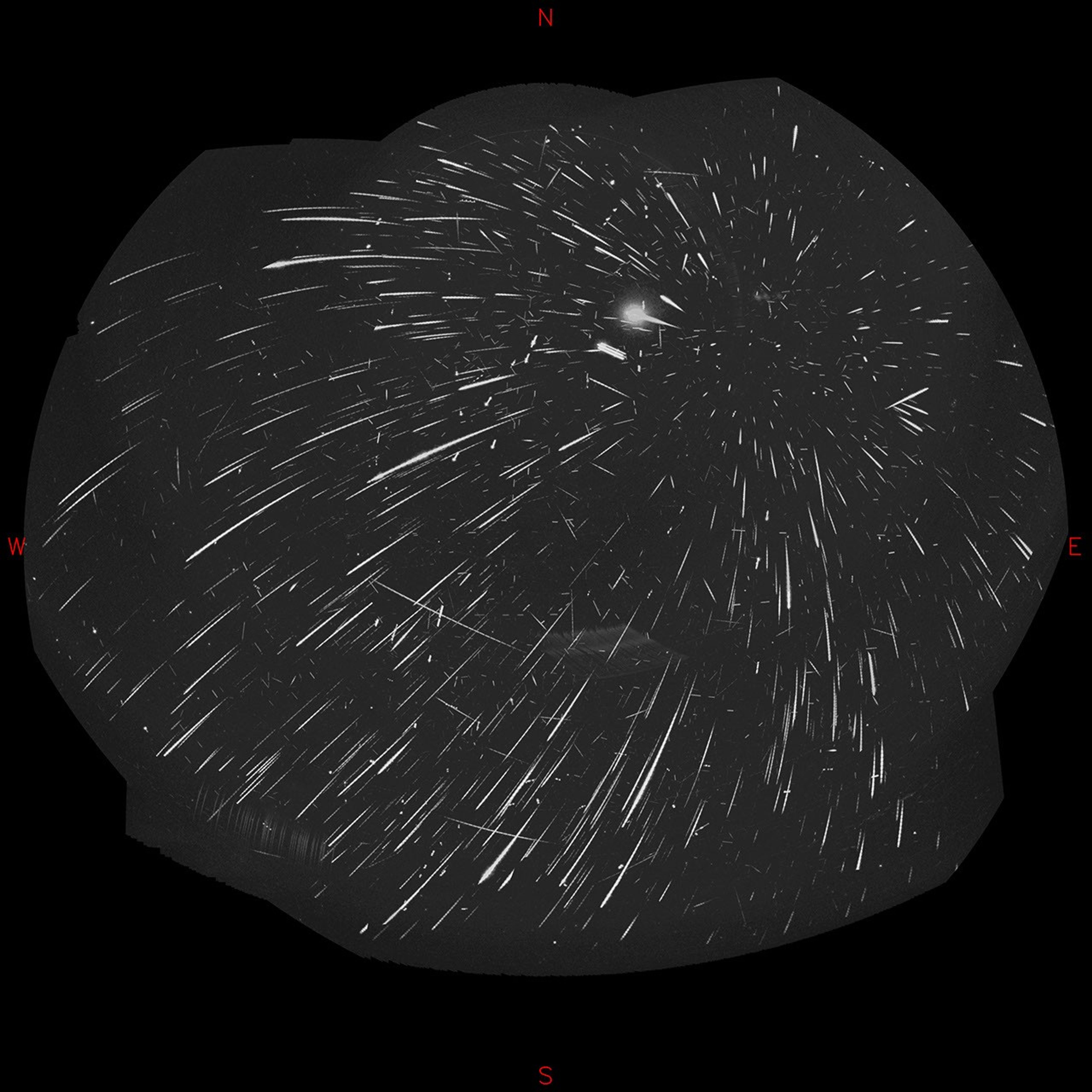
Explanation: Recorded the night of August 12-13, images from four dedicated meteor-monitoring cameras at an astronomical observatory in Czechia were aligned and combined to create this all-night, all-sky view. On that night, the total count came to 1,706 meteors. And since that coincided with the peak activity of the 2026 Perseid Meteor Shower, most are perseids. Their overwhelming numbers make them easy to spot. Quite convincingly, perseid trails all trace back to a single radiant on the sky at the upper right, a region in the annual shower’s eponymous constellation Perseus. But meteors belonging to other much less active showers can be revealed by finding their radiants too. For example, seen crossing the perseid trails are meteors from a shower whose radiant lies in Cygnus, known as Kappa Cygnids. The antihelion complex, a general region near Aquarius and opposite the Sun in the sky, is also identifiable as a weak source for meteors.
Tomorrow’s picture: interplanetary road trip
Date August 22, 2026 Credit & Copyright: Jakub Koukal (Valašské Meziříčí Observatory) Authors & editors: Jerry Bonnell, Cecilia Chirenti, Robert Nemiroff, Keighley Rockcliffe A service of: ASD at NASA / GSFC,NASA Science Activation & Michigan Tech. U.
Random APOD Generator
Yesterday’s Image APOD: 2026 August 21 – Time-Lapse of the Star S301 Orbiting the Black Hole in the Center of the Galaxy
Tomorrow’s Image
APOD: 2026 August 22 – Mostly Perseids
APOD
Astronomy Picture of the Day
Discover the cosmos! Each day a different image or photograph of our fascinating universe is featured, along with a brief explanation written by a professional astronomer.
Mostly PerseidsExplanation: Recorded the night of August 12-13, images from four dedicated meteor-monitoring cameras at an astronomical observatory in Czechia were aligned and combined to create this all-night, all-sky view. On that night, the total count came to 1,706 meteors. And since that coincided with the peak activity of the 2026 Perseid Meteor Shower, most are perseids. Their overwhelming numbers make them easy to spot. Quite convincingly, perseid trails all trace back to a single radiant on the sky at the upper right, a region in the annual shower’s eponymous constellation Perseus. But meteors belonging to other much less active showers can be revealed by finding their radiants too. For example, seen crossing the perseid trails are meteors from a shower whose radiant lies in Cygnus, known as Kappa Cygnids. The antihelion complex, a general region near Aquarius and opposite the Sun in the sky, is also identifiable as a weak source for meteors.
Tomorrow’s picture: interplanetary road trip
Date August 22, 2026 Credit & Copyright: Jakub Koukal (Valašské Meziříčí Observatory) Authors & editors: Jerry Bonnell, Cecilia Chirenti, Robert Nemiroff, Keighley Rockcliffe A service of: ASD at NASA / GSFC,NASA Science Activation & Michigan Tech. U.
Random APOD Generator
Yesterday’s Image APOD: 2026 August 21 – Time-Lapse of the Star S301 Orbiting the Black Hole in the Center of the Galaxy
Tomorrow’s Image