
Feed aggregator
The U.S. just recorded its first two deaths from measles for 2026
Both of the deceased were unvaccinated against measles. The deaths are the first fatalities caused by the preventable disease in the state of Pennsylvania in 35 years
Galactic Gems Glisten in New Gallery From NASA’s Chandra
Galaxies are like cosmic gems, each with characteristics including size and shape that make them distinct. A new gallery released today from NASA’s Chandra X-ray Observatory and other telescopes displays a collection of galactic images that showcase this variety.
Astronomers put galaxies into three main categories: spirals like our own Milky Way with arms emanating from their cores, ellipticals that are older and likely the results of mergers, and irregulars that can encompass a wide range of galactic phenomena.
This gallery displays a collection of 16 galactic images from Chandra and other telescopes. Astronomers put galaxies into three main categories: spirals like our own Milky Way, ellipticals that are older and likely the results of mergers, and irregulars that can encompass a wide range of galactic phenomena. All types are represented in this collection. Each galactic image contains X-ray data from Chandra combined with data from telescopes such as NASA’s Webb, Hubble, IXPE, Swift, and NuSTAR, and others both in space and on the ground.Credit: NASA/CXC/SAO
Just as gems reveal the history of Earth through how they were forged over billions of years, these galactic gems are a way to study Earth’s place in our home galaxy of the Milky Way. By looking outward to other galaxies, we learn more about our own – including clues to its past and future.
There are 16 new images in this galactic gallery. Each one contains X-ray data from Chandra that has been collected across Chandra’s decades in space. This high-energy data has been combined with data from telescopes such as NASA’s James Webb and Hubble Space Telescopes, IXPE (Imaging X-ray Polarimetry Explorer), Neil Gehrels Swift Observatory, NuSTAR (Nuclear Spectroscopic Telescope Array), and others both on the ground and in space.
NGC 1672A barred spiral galaxy featuring a prominent central bar or bridge of stars that channels gas toward its core. Chandra X-rays (purple) highlight growing black holes along the bar and core, merged with Hubble optical light (white, yellow and soft blue) and JWST infrared dust filaments (red). Studying barred spirals in action can help reveal how gas in our own Milky Way, which is also a barred spiral, feeds its central black hole and forms new stars.X-ray: NASA/CXC/SAO; Optical: NASA/ESA/STScI/Hubble Heritage Team; Infrared: NASA/ESA/CSA/STScI/J. Lee and T. Williams; Image Processing: NASA/CXC/SAO/L. Frattare, J. Major, K. Arcand II Zw 096A chaotic, dust-shrouded system of merging galaxies forming stars at a furious rate. Chandra X-ray data (magenta) pinpoint powerful black hole activity and hot gas, while Hubble optical (blue and white) and Webb infrared (red and grey) data illuminate vast stellar nurseries hidden behind interstellar dust. Systems like II Zw 096 show us how powerful galaxy collisions shaped the early universe.X-ray: NASA/CXC/SAO; Optical: NASA/ESA/STScI; Infrared: NASA/ESA/CSA/STScI; Image Processing: NASA/CXC/SAO/L. Frattare and J. Major M33A nearby, face-on spiral galaxy whose clear spiral arms offer an unhindered view of its stellar engine. X-ray data from Chandra (purple) highlights point sources like neutron stars and stellar-mass black holes pulling material off companion stars (systems called X-ray binaries), while optical data from the Very Large Telescope’s MUSE instrument (pink and grey) maps glowing pockets of hydrogen gas. Ultraviolet data from NASA’s Swift telescope (blue) reveals populations of young, massive stars sizzling across the spiral arms. M33’s proximity to us allows astronomers to audit individual high-energy objects and map how stellar feedback affects a galaxy’s ecosystem.X-ray: NASA/CXC/SAO; Optical: ESO/VLT; UV: NASA/Swift; Image Processing: NASA/CXC/SAO/L. Frattare NGC 4258A spiral galaxy famous for having two extra, “anomalous” spiral arms composed of hot gas. Chandra’s X-rays (royal blue) show superheated shockwaves created by central black hole jets, combined with optical light from Hubble (red, yellow and pale blue) and infrared dust filaments from Webb (bright orange). M106 helps show how supermassive black holes can create structural features that mimic star-bearing spiral arms, influencing a galaxy’s evolution.X-ray: NASA/CXC/SAO; Optical: NASA/ESA/STScI; Infrared: NASA/ESA/CSA/STScI; Image Processing: NASA/CXC/SAO/L. Frattare NGC 1569A compact dwarf irregular galaxy undergoing a violent, compact burst of star formation. Chandra and XMM-Newton observations (blue and purple) reveal massive bubbles of million-degree gas inflated by stellar winds, set against a backdrop of optical light (magenta, orange and white) imaged by Adam Block. Dwarf starburst galaxies can serve as local laboratories for studying the conditions of the early universe, where small, primitive galaxies formed stars at frantic rates.X-ray: (XMM):ESA/XMM-Newton, (Chandra): NASA/CXC/SAO; Optical: Univ.of Arizona/Mt Lemmon SkyCenter/Adam Block/Josep Drudis; Image Processing: NASA?CXC/SAO/L. Frattare M90A large spiral galaxy that is being stripped of its gas as it plunges at high speed through hot gas in the Virgo Cluster of galaxies. Chandra’s X-ray data (magenta) pinpoints high-energy point sources—such as X-ray binaries and supernova remnants—and diffuse hot gas nestled within the spiral disk imaged by Hubble (blue, brown and gold). A ground-based optical light image taken from New Mexico by Timothy Martin reveals red filaments of hydrogen gas streaming over 300,000 light-years behind the galaxy as it falls into the Virgo Cluster.X-ray: NASA/CXC/SAO; Optical: NASA/ESA/D. Thilker/J. Lee/PHANGS-HST Team; Full-field: Tim Martin; Image Processing: NASA/CXC/SAO/L. Frattare Centaurus AA giant elliptical galaxy undergoing a dusty merger, featuring a powerful jet of particles blasting tens of thousands of light-years into space. Chandra’s X-rays (blue) showcase the high-energy jet, with additional X-rays from IXPE (orange), while Webb infrared (magenta) and optical light (amber and white) from the European Southern Observatory expose a dark, churning dust lane. As one of the closest active galaxies to Earth, Cen A allows astronomers to study the effects of supermassive black hole jets in extraordinary detail.X-ray: (Chandra) NASA/CXC/SAO, X-ray (IXPE): NASA/MSFC; Optical: ESO; Infrared: NASA/ESA/CSA/STScI; Image Processing: NASA/CXC/SAO/L. Frattare, K. Arcand, and J. Major M104Famous for its broad central bulge and dark outer dust ring, this galaxy sits at a nearly edge-on tilt to Earth. Chandra X-rays (cyan and orange) isolate compact point sources and hot gas in the galaxy’s sprawling halo, merged with Hubble optical light (warm white) and Webb infrared vision (purple-red dust lane). Studying M104 may help bridge the gap between spirals and ellipticals, helping astronomers better understand how a galaxy’s giant outer cloud of stars grows and ages alongside its inner disk.X-ray: NASA/CXC/SAO; Optical:NASA/Hubble Heritage Team/AURA/STScI; Infrared: NASA/ESA/CSA/STScI; Image Processing: NASA/CXC/SAO/L. Frattare Arp 143This ring galaxy system formed when a smaller companion galaxy punched straight through its center like a bullseye, creating a powerful cosmic shockwave. Chandra X-rays (purple) uncover bright X-ray binary systems scattered along the collision shock wave, laid over Hubble’s optical image (blue and white) of expanding stellar rings. Such head-on collisions can trigger vast ripple effects, sparking huge waves of star birth across entire galaxies.X-ray: NASA/CXC/SAO; Optical: NASA/ESA/STScI/J. Dalcanton; Image Processing: NASA/CXC/SAO/L. Frattare NGC 4725A “one-armed” barred spiral galaxy surrounded by a prominent star-forming ring. Chandra’s X-ray data (magenta) pinpoints several bright X-ray sources, likely caused by growing black holes, embedded within the sweeping optical disk (soft blue and white) captured with the Mt. Lemmon Observatory. Galaxies with unusual single arms can offer a window into how the gravity from a passing galaxy can trigger bursts of star formation.X-ray: NASA/CXC/SAO; Optical: NASA/ESA/STScI/NAOJ/R. Gendler; Image Processing: NASA/CXC/SAO/L. Frattare NGC 1385A barred spiral galaxy packed with regions where stars are actively forming. Chandra X-ray data (magenta) highlights stellar nurseries and X-ray binaries scattered along dusty spiral structures brought to life by Hubble optical (white and grey) and Webb infrared (orange and red) observations. Comparing multiwavelength data of barred spirals containing active star formation helps scientists map how local starbursts build up galactic mass over time.X-ray: NASA/CXC/SAO; Optical: NASA/ESA/STScI; Infrared: NASA/ESA/CSA/STScI; Image Processing: NASA/CXC/SAO/L. Frattare NGC 660A rare “polar ring” galaxy where a tilted outer ring of stars and dust rotates over the galaxy’s poles, an unusual structure likely caused by a collision with another galaxy about a billion years ago. Chandra’s X-rays (purple) reveal a possible growing supermassive black hole in the center of the galaxy, plus X-ray binaries nestled within the stars and dust captured by the Gemini Observatory in optical light (gold, blue and white). Studying polar rings teaches us about the diverse effects of stellar collisions on the shapes of galaxies.X-ray: NASA/CXC/SAO; Optical:NSF/International Gemini Observatory/AURA; Image Processing: NASA/CXC/SAO/L. Frattare M82An irregular galaxy undergoing intense star formation because of a gravitational interaction with a neighboring galaxy hundreds of millions of years ago. Chandra X-rays (blue), supplemented by NuSTAR data, show towering superwinds of million-degree gas blowing thousands of light-years out of the galactic disk, with Hubble optical light (yellow, orange and white) showing the galaxy shape, and Webb and Spitzer detailing infrared dust emission (red). M82 was nicknamed the Cigar Galaxy mostly because of its edge-on angle to Earth, which makes its central disk look like an elongated, cigar-shaped oval with small optical telescopes. The galaxy illustrates how violent galactic “exhaust systems” can regulate a galaxy’s growth by venting gas outwards.X-ray: NASA/CXC/SAO; Optical: NASA/ESA/STScI; Infrared: NASA/ESA/CSA/STScI; Image Processing: NASA/CXC/SAO/L. Frattare, J. Major, and K. Arcand NGC 3256A pair of colliding, gas-rich spiral galaxies merging into a single massive system. Chandra’s X-ray data (pink) isolates point sources and shock-heated gas, Hubble’s optical light (blue and white) captures tidal tails of stars, and Webb’s infrared vision (red and orange) cuts through the dust to show hidden star formation. Galaxy collisions like this offer a preview of our far future, showing what might happen if our own Milky Way collides and merges with the nearby Andromeda Galaxy.X-ray: NASA/CXC/SAO; Optical: NASA/ESA/STScI; Infrared: NASA/ESA/CSA/STScI; Image Processing: NASA/CXC/SAO/L. Frattare NGC 3938A face-on spiral galaxy whose orientation gives us an unobstructed view of its disk. X-ray emissions from Chandra (magenta) detail energetic X-ray binaries and supernova remnants scattered across dust lanes in an optical image (white, blue and gold) from Adam Block with Mt. Lemmon Observatory. Face-on orientations are important for galactic studies because they provide the most unobstructed views of a galaxy’s stars and gas.X-ray: NASA/CXC/SAO; Optical: Adam Block/Mount Lemmon SkyCenter/University of Arizona; Image Processing: NASA/CXC/SAO/L. Frattare NGC 4631A spiral galaxy viewed from its side, featuring a giant halo of hot gas blowing out of its stellar disk. X-rays from Chandra and ESA’s XMM-Newton (purple and royal blue) trace hot gas driven out by supernovas and black holes and neutron stars pulling gas from their companions, while optical light (light blue, gold and white) from ground-based observer R. Jay GaBany showcases dense dust lanes. Edge-on views of galaxies allow astronomers to study how flat their stellar disks are and provide the clearest views of material located above or below the disk.X-ray: NASA/CXC/SAO; Optical: ©2011-2015 by R Jay GaBany, Cosmotography.com; Image Processing: NASA/CXC/SAO/L. FrattareX-rays are critical for the study of galaxies, revealing unique and important information about these cosmic building blocks. For example, Chandra exposes gas that has been superheated to millions of degrees by winds from massive stars, the outflows from supermassive black holes, and the debris from exploded stars. These are key sources of elements in our bodies, in the air we breathe, and the planet we live on. Chandra also sees some of the hottest and most energetic galactic phenomena in the universe, forming a more complete picture of how galaxies live, interact, and evolve when combined with data from other types of light and telescopes.
Spiral and star-forming enginesFace-on spiral galaxies like Messier 33 and NGC 3938 offer unobstructed views of places where energetic pairs of stars and cosmic explosions live along spiral arms. Barred spirals like NGC 1672 and NGC 1385 show how central bar-shaped collections of stars, gas, and dust funnel fuel inward to ignite bursts of star formation. NGC 4725 reveals how star formation can be triggered by a previous collision with another galaxy. Meanwhile, edge-on views of NGC 4631 (the Whale Galaxy) and the starburst Messier 82 (the Cigar Galaxy) showcase giant halos and superwinds of million-degree gas driven thousands of light-years into space by intense explosions of stars, enriching surrounding intergalactic space with vital elements.
Active galactic nuclei, black hole outflowsPowerful, growing black holes in the cores of their host galaxies, known as active galactic nuclei, send energy outward in outbursts and jets that impact entire galaxies. In Centaurus A, Chandra and IXPE data expose a high-energy particle jet blasting tens of thousands of light-years into space from its central engine. In Messier 106, jets from the supermassive black hole heat surrounding gas to create spiral arms that are different from those typically found in spiral galaxies. Meanwhile, the iconic Sombrero Galaxy (Messier 104) highlights a supermassive black hole embedded in a colossal stellar bulge, where Chandra’s X-rays map a diffuse halo of million-degree gas and hot stellar remnants surrounding its sweeping dust lanes.
Collisions, mergers, cosmic disruptionsThe gallery also showcases galaxies undergoing extreme gravitational transformations. A direct impact in Arp 143 acts like a cosmic bullseye, creating an expanding ring galaxy and triggering waves of star birth. Violent mergers, such as NGC 3256 and the dust-shrouded starburst II Zw 096, reveal the kind of chaotic galaxy collisions that dominated the early universe and offer a preview of the Milky Way’s distant future merger with nearby galaxy Andromeda. NGC 1569 acts as a local laboratory for studying early universe starbursts, NGC 660 showcases a rare “polar ring” galaxy where a ring of stars orbits over its poles, and Messier 90 shows a spiral galaxy plowing through the Virgo Cluster, having its star-forming gas violently stripped away.
NASA’s Marshall Space Flight Center manages the Chandra program. The Smithsonian Astrophysical Observatory’s Chandra X-ray Center controls science operations from Cambridge, Massachusetts, and flight operations from Burlington, Massachusetts.
Read more from NASA’s Chandra X-ray Observatory
To learn more about Chandra, visit
About the AuthorMegan Watzke Share Details Last Updated Aug 25, 2026 EditorLee MohonContactMegan Watzkemwatzke@cfa.harvard.eduJoel Wallacejoel.w.wallace@nasa.govLocationMarshall Space Flight Center Related Terms Explore More 4 min read NASA Telescopes Create Colorful ‘Craft’ From Nearby Nebula Article 2 weeks ago 4 min read NASA Space Telescope Maps Magnetic Fields of ‘Lighthouse’ Pulsar Article 2 months ago 5 min read NASA’s Chandra Examines Milky Way at Arms’ Length Article 2 months ago Keep Exploring Discover More Topics From NASAChandra X-ray Observatory
Hubble Space TelescopeSince its 1990 launch, the Hubble Space Telescope has changed our fundamental understanding of the universe.
James Webb Space TelescopeWebb is the premier observatory of the next decade, serving thousands of astronomers worldwide. It studies every phase in the…
IXPEThe Imaging X-ray Polarimetry Explorer (IXPE) is NASA’s first mission to study the polarization of X-rays.
Galactic Gems Glisten in New Gallery From NASA’s Chandra
Galaxies are like cosmic gems, each with characteristics including size and shape that make them distinct. A new gallery released today from NASA’s Chandra X-ray Observatory and other telescopes displays a collection of galactic images that showcase this variety.
Astronomers put galaxies into three main categories: spirals like our own Milky Way with arms emanating from their cores, ellipticals that are older and likely the results of mergers, and irregulars that can encompass a wide range of galactic phenomena.
This gallery displays a collection of 16 galactic images from Chandra and other telescopes. Astronomers put galaxies into three main categories: spirals like our own Milky Way, ellipticals that are older and likely the results of mergers, and irregulars that can encompass a wide range of galactic phenomena. All types are represented in this collection. Each galactic image contains X-ray data from Chandra combined with data from telescopes such as NASA’s Webb, Hubble, IXPE, Swift, and NuSTAR, and others both in space and on the ground.Credit: NASA/CXC/SAOJust as gems reveal the history of Earth through how they were forged over billions of years, these galactic gems are a way to study Earth’s place in our home galaxy of the Milky Way. By looking outward to other galaxies, we learn more about our own – including clues to its past and future.
There are 16 new images in this galactic gallery. Each one contains X-ray data from Chandra that has been collected across Chandra’s decades in space. This high-energy data has been combined with data from telescopes such as NASA’s James Webb and Hubble Space Telescopes, IXPE (Imaging X-ray Polarimetry Explorer), Neil Gehrels Swift Observatory, NuSTAR (Nuclear Spectroscopic Telescope Array), and others both on the ground and in space.
NGC 1672A barred spiral galaxy featuring a prominent central bar or bridge of stars that channels gas toward its core. Chandra X-rays (purple) highlight growing black holes along the bar and core, merged with Hubble optical light (white, yellow and soft blue) and JWST infrared dust filaments (red). Studying barred spirals in action can help reveal how gas in our own Milky Way, which is also a barred spiral, feeds its central black hole and forms new stars.X-ray: NASA/CXC/SAO; Optical: NASA/ESA/STScI/Hubble Heritage Team; Infrared: NASA/ESA/CSA/STScI/J. Lee and T. Williams; Image Processing: NASA/CXC/SAO/L. Frattare, J. Major, K. Arcand II Zw 096A chaotic, dust-shrouded system of merging galaxies forming stars at a furious rate. Chandra X-ray data (magenta) pinpoint powerful black hole activity and hot gas, while Hubble optical (blue and white) and Webb infrared (red and grey) data illuminate vast stellar nurseries hidden behind interstellar dust. Systems like II Zw 096 show us how powerful galaxy collisions shaped the early universe.X-ray: NASA/CXC/SAO; Optical: NASA/ESA/STScI; Infrared: NASA/ESA/CSA/STScI; Image Processing: NASA/CXC/SAO/L. Frattare and J. Major M33A nearby, face-on spiral galaxy whose clear spiral arms offer an unhindered view of its stellar engine. X-ray data from Chandra (purple) highlights point sources like neutron stars and stellar-mass black holes pulling material off companion stars (systems called X-ray binaries), while optical data from the Very Large Telescope’s MUSE instrument (pink and grey) maps glowing pockets of hydrogen gas. Ultraviolet data from NASA’s Swift telescope (blue) reveals populations of young, massive stars sizzling across the spiral arms. M33’s proximity to us allows astronomers to audit individual high-energy objects and map how stellar feedback affects a galaxy’s ecosystem.X-ray: NASA/CXC/SAO; Optical: ESO/VLT; UV: NASA/Swift; Image Processing: NASA/CXC/SAO/L. Frattare NGC 4258A spiral galaxy famous for having two extra, “anomalous” spiral arms composed of hot gas. Chandra’s X-rays (royal blue) show superheated shockwaves created by central black hole jets, combined with optical light from Hubble (red, yellow and pale blue) and infrared dust filaments from Webb (bright orange). M106 helps show how supermassive black holes can create structural features that mimic star-bearing spiral arms, influencing a galaxy’s evolution.X-ray: NASA/CXC/SAO; Optical: NASA/ESA/STScI; Infrared: NASA/ESA/CSA/STScI; Image Processing: NASA/CXC/SAO/L. Frattare NGC 1569A compact dwarf irregular galaxy undergoing a violent, compact burst of star formation. Chandra and XMM-Newton observations (blue and purple) reveal massive bubbles of million-degree gas inflated by stellar winds, set against a backdrop of optical light (magenta, orange and white) imaged by Adam Block. Dwarf starburst galaxies can serve as local laboratories for studying the conditions of the early universe, where small, primitive galaxies formed stars at frantic rates.X-ray: (XMM):ESA/XMM-Newton, (Chandra): NASA/CXC/SAO; Optical: Univ.of Arizona/Mt Lemmon SkyCenter/Adam Block/Josep Drudis; Image Processing: NASA?CXC/SAO/L. Frattare M90A large spiral galaxy that is being stripped of its gas as it plunges at high speed through hot gas in the Virgo Cluster of galaxies. Chandra’s X-ray data (magenta) pinpoints high-energy point sources—such as X-ray binaries and supernova remnants—and diffuse hot gas nestled within the spiral disk imaged by Hubble (blue, brown and gold). A ground-based optical light image taken from New Mexico by Timothy Martin reveals red filaments of hydrogen gas streaming over 300,000 light-years behind the galaxy as it falls into the Virgo Cluster.X-ray: NASA/CXC/SAO; Optical: NASA/ESA/D. Thilker/J. Lee/PHANGS-HST Team; Full-field: Tim Martin; Image Processing: NASA/CXC/SAO/L. Frattare Centaurus AA giant elliptical galaxy undergoing a dusty merger, featuring a powerful jet of particles blasting tens of thousands of light-years into space. Chandra’s X-rays (blue) showcase the high-energy jet, with additional X-rays from IXPE (orange), while Webb infrared (magenta) and optical light (amber and white) from the European Southern Observatory expose a dark, churning dust lane. As one of the closest active galaxies to Earth, Cen A allows astronomers to study the effects of supermassive black hole jets in extraordinary detail.X-ray: (Chandra) NASA/CXC/SAO, X-ray (IXPE): NASA/MSFC; Optical: ESO; Infrared: NASA/ESA/CSA/STScI; Image Processing: NASA/CXC/SAO/L. Frattare, K. Arcand, and J. Major M104Famous for its broad central bulge and dark outer dust ring, this galaxy sits at a nearly edge-on tilt to Earth. Chandra X-rays (cyan and orange) isolate compact point sources and hot gas in the galaxy’s sprawling halo, merged with Hubble optical light (warm white) and Webb infrared vision (purple-red dust lane). Studying M104 may help bridge the gap between spirals and ellipticals, helping astronomers better understand how a galaxy’s giant outer cloud of stars grows and ages alongside its inner disk.X-ray: NASA/CXC/SAO; Optical:NASA/Hubble Heritage Team/AURA/STScI; Infrared: NASA/ESA/CSA/STScI; Image Processing: NASA/CXC/SAO/L. Frattare Arp 143This ring galaxy system formed when a smaller companion galaxy punched straight through its center like a bullseye, creating a powerful cosmic shockwave. Chandra X-rays (purple) uncover bright X-ray binary systems scattered along the collision shock wave, laid over Hubble’s optical image (blue and white) of expanding stellar rings. Such head-on collisions can trigger vast ripple effects, sparking huge waves of star birth across entire galaxies.X-ray: NASA/CXC/SAO; Optical: NASA/ESA/STScI/J. Dalcanton; Image Processing: NASA/CXC/SAO/L. Frattare NGC 4725A “one-armed” barred spiral galaxy surrounded by a prominent star-forming ring. Chandra’s X-ray data (magenta) pinpoints several bright X-ray sources, likely caused by growing black holes, embedded within the sweeping optical disk (soft blue and white) captured with the Mt. Lemmon Observatory. Galaxies with unusual single arms can offer a window into how the gravity from a passing galaxy can trigger bursts of star formation.X-ray: NASA/CXC/SAO; Optical: NASA/ESA/STScI/NAOJ/R. Gendler; Image Processing: NASA/CXC/SAO/L. Frattare NGC 1385A barred spiral galaxy packed with regions where stars are actively forming. Chandra X-ray data (magenta) highlights stellar nurseries and X-ray binaries scattered along dusty spiral structures brought to life by Hubble optical (white and grey) and Webb infrared (orange and red) observations. Comparing multiwavelength data of barred spirals containing active star formation helps scientists map how local starbursts build up galactic mass over time.X-ray: NASA/CXC/SAO; Optical: NASA/ESA/STScI; Infrared: NASA/ESA/CSA/STScI; Image Processing: NASA/CXC/SAO/L. Frattare NGC 660A rare “polar ring” galaxy where a tilted outer ring of stars and dust rotates over the galaxy’s poles, an unusual structure likely caused by a collision with another galaxy about a billion years ago. Chandra’s X-rays (purple) reveal a possible growing supermassive black hole in the center of the galaxy, plus X-ray binaries nestled within the stars and dust captured by the Gemini Observatory in optical light (gold, blue and white). Studying polar rings teaches us about the diverse effects of stellar collisions on the shapes of galaxies.X-ray: NASA/CXC/SAO; Optical:NSF/International Gemini Observatory/AURA; Image Processing: NASA/CXC/SAO/L. Frattare M82An irregular galaxy undergoing intense star formation because of a gravitational interaction with a neighboring galaxy hundreds of millions of years ago. Chandra X-rays (blue), supplemented by NuSTAR data, show towering superwinds of million-degree gas blowing thousands of light-years out of the galactic disk, with Hubble optical light (yellow, orange and white) showing the galaxy shape, and Webb and Spitzer detailing infrared dust emission (red). M82 was nicknamed the Cigar Galaxy mostly because of its edge-on angle to Earth, which makes its central disk look like an elongated, cigar-shaped oval with small optical telescopes. The galaxy illustrates how violent galactic “exhaust systems” can regulate a galaxy’s growth by venting gas outwards.X-ray: NASA/CXC/SAO; Optical: NASA/ESA/STScI; Infrared: NASA/ESA/CSA/STScI; Image Processing: NASA/CXC/SAO/L. Frattare, J. Major, and K. Arcand NGC 3256A pair of colliding, gas-rich spiral galaxies merging into a single massive system. Chandra’s X-ray data (pink) isolates point sources and shock-heated gas, Hubble’s optical light (blue and white) captures tidal tails of stars, and Webb’s infrared vision (red and orange) cuts through the dust to show hidden star formation. Galaxy collisions like this offer a preview of our far future, showing what might happen if our own Milky Way collides and merges with the nearby Andromeda Galaxy.X-ray: NASA/CXC/SAO; Optical: NASA/ESA/STScI; Infrared: NASA/ESA/CSA/STScI; Image Processing: NASA/CXC/SAO/L. Frattare NGC 3938A face-on spiral galaxy whose orientation gives us an unobstructed view of its disk. X-ray emissions from Chandra (magenta) detail energetic X-ray binaries and supernova remnants scattered across dust lanes in an optical image (white, blue and gold) from Adam Block with Mt. Lemmon Observatory. Face-on orientations are important for galactic studies because they provide the most unobstructed views of a galaxy’s stars and gas.X-ray: NASA/CXC/SAO; Optical: Adam Block/Mount Lemmon SkyCenter/University of Arizona; Image Processing: NASA/CXC/SAO/L. Frattare NGC 4631A spiral galaxy viewed from its side, featuring a giant halo of hot gas blowing out of its stellar disk. X-rays from Chandra and ESA’s XMM-Newton (purple and royal blue) trace hot gas driven out by supernovas and black holes and neutron stars pulling gas from their companions, while optical light (light blue, gold and white) from ground-based observer R. Jay GaBany showcases dense dust lanes. Edge-on views of galaxies allow astronomers to study how flat their stellar disks are and provide the clearest views of material located above or below the disk.X-ray: NASA/CXC/SAO; Optical: ©2011-2015 by R Jay GaBany, Cosmotography.com; Image Processing: NASA/CXC/SAO/L. FrattareX-rays are critical for the study of galaxies, revealing unique and important information about these cosmic building blocks. For example, Chandra exposes gas that has been superheated to millions of degrees by winds from massive stars, the outflows from supermassive black holes, and the debris from exploded stars. These are key sources of elements in our bodies, in the air we breathe, and the planet we live on. Chandra also sees some of the hottest and most energetic galactic phenomena in the universe, forming a more complete picture of how galaxies live, interact, and evolve when combined with data from other types of light and telescopes.
Spiral and star-forming enginesFace-on spiral galaxies like Messier 33 and NGC 3938 offer unobstructed views of places where energetic pairs of stars and cosmic explosions live along spiral arms. Barred spirals like NGC 1672 and NGC 1385 show how central bar-shaped collections of stars, gas, and dust funnel fuel inward to ignite bursts of star formation. NGC 4725 reveals how star formation can be triggered by a previous collision with another galaxy. Meanwhile, edge-on views of NGC 4631 (the Whale Galaxy) and the starburst Messier 82 (the Cigar Galaxy) showcase giant halos and superwinds of million-degree gas driven thousands of light-years into space by intense explosions of stars, enriching surrounding intergalactic space with vital elements.
Active galactic nuclei, black hole outflowsPowerful, growing black holes in the cores of their host galaxies, known as active galactic nuclei, send energy outward in outbursts and jets that impact entire galaxies. In Centaurus A, Chandra and IXPE data expose a high-energy particle jet blasting tens of thousands of light-years into space from its central engine. In Messier 106, jets from the supermassive black hole heat surrounding gas to create spiral arms that are different from those typically found in spiral galaxies. Meanwhile, the iconic Sombrero Galaxy (Messier 104) highlights a supermassive black hole embedded in a colossal stellar bulge, where Chandra’s X-rays map a diffuse halo of million-degree gas and hot stellar remnants surrounding its sweeping dust lanes.
Collisions, mergers, cosmic disruptionsThe gallery also showcases galaxies undergoing extreme gravitational transformations. A direct impact in Arp 143 acts like a cosmic bullseye, creating an expanding ring galaxy and triggering waves of star birth. Violent mergers, such as NGC 3256 and the dust-shrouded starburst II Zw 096, reveal the kind of chaotic galaxy collisions that dominated the early universe and offer a preview of the Milky Way’s distant future merger with nearby galaxy Andromeda. NGC 1569 acts as a local laboratory for studying early universe starbursts, NGC 660 showcases a rare “polar ring” galaxy where a ring of stars orbits over its poles, and Messier 90 shows a spiral galaxy plowing through the Virgo Cluster, having its star-forming gas violently stripped away.
NASA’s Marshall Space Flight Center manages the Chandra program. The Smithsonian Astrophysical Observatory’s Chandra X-ray Center controls science operations from Cambridge, Massachusetts, and flight operations from Burlington, Massachusetts.
Read more from NASA’s Chandra X-ray Observatory
To learn more about Chandra, visit
About the AuthorMegan Watzke Share Details Last Updated Aug 25, 2026 EditorLee MohonContactMegan Watzkemwatzke@cfa.harvard.eduJoel Wallacejoel.w.wallace@nasa.govLocationMarshall Space Flight Center Related Terms Explore More 4 min read NASA Telescopes Create Colorful ‘Craft’ From Nearby Nebula Article 2 weeks ago 4 min read NASA Space Telescope Maps Magnetic Fields of ‘Lighthouse’ Pulsar Article 2 months ago 5 min read NASA’s Chandra Examines Milky Way at Arms’ Length Article 2 months ago Keep Exploring Discover More Topics From NASAChandra X-ray Observatory
Hubble Space TelescopeSince its 1990 launch, the Hubble Space Telescope has changed our fundamental understanding of the universe.
James Webb Space TelescopeWebb is the premier observatory of the next decade, serving thousands of astronomers worldwide. It studies every phase in the…
IXPEThe Imaging X-ray Polarimetry Explorer (IXPE) is NASA’s first mission to study the polarization of X-rays.
How to see the 2026 ‘blood moon’ eclipse this week
This near-total eclipse will be visible from the Americas, Africa and Europe—here’s how to see it
Scientists just unleashed an army of 130,000 baby octopuses to fight off a blue crab invasion
When fully grown, the octopuses that survive could eat up to four blue crabs per day in the Mediterranean Sea
Astronauts Anil Menon and Sophie Adenot on Spacewalk
Astronauts Anil Menon and Sophie Adenot on Spacewalk
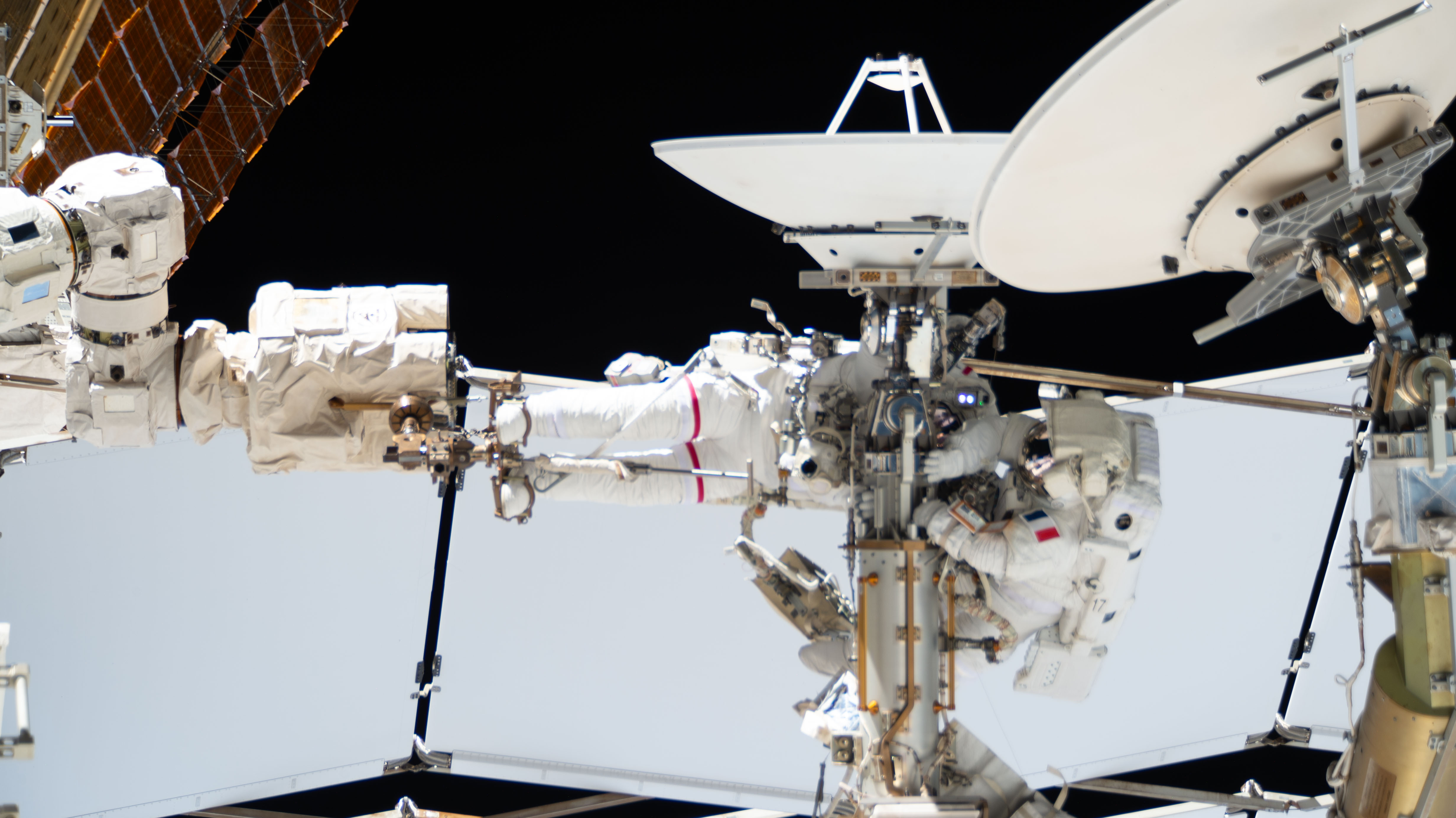
From left, Expedition 75 flight engineers Anil Menon of NASA (partially obscured and wearing the spacesuit with a red stripe on the legs) and Sophie Adenot of ESA (European Space Agency) work together during a six‑hour and 23‑minute spacewalk outside the International Space Station on Aug. 18, 2026. The pair will finish installing a high-speed communications antenna on Aug. 25, 2026.
Image credit: NASA
Astronauts Anil Menon and Sophie Adenot on Spacewalk
From left, Expedition 75 flight engineers Anil Menon of NASA (partially obscured and wearing the spacesuit with a red stripe on the legs) and Sophie Adenot of ESA (European Space Agency) work together during a six‑hour and 23‑minute spacewalk outside the International Space Station on Aug. 18, 2026. The pair will finish installing a high-speed communications antenna on Aug. 25, 2026.
Image credit: NASA
NOAA issues geomagnetic storm watch as CMEs head toward Earth — northern lights possible Aug. 27-28
Aurora chasers are on alert after NOAA's Space Weather Prediction Center (SWPC) issued a moderate (G2) geomagnetic storm watch for Friday (Aug. 28), as coronal mass ejections (CMEs) launched from the sun yesterday (Aug. 25) head toward Earth.
The CME arrival follows a powerful M6.9 solar flare from restless sunspot region 4513 on Aug. 25. NOAA's SWPC has also issued a minor (G1) geomagnetic storm watch for Thursday (Aug. 27), as a stream of fast solar wind from a coronal hole is expected to buffet Earth ahead of the incoming CMEs
The M6.98 solar flare erupted from the active sunspot region 4513 and peaked at 6 a.m. EDT (1000 GMT), according to SpaceWeatherLive. 4513 has been particularly active over the previous 24 hours, firing off a barrage of solar flares including five powerful M-class eruptions. Solar flares are ranked by strength into five classes — A, B, C, M and X — with each class 10 times more powerful than the one before it. M-class flares are the second-strongest category, sitting just below the most powerful X-class eruptions.
The eruption also triggered a moderate (R2) radio blackout across the sunlit side of Earth, affecting high-frequency radio communications over parts of Africa, Europe and the Arctic.
High-frequency radio blackouts from the M-class solar flare on Aug. 25. (Image credit: NOAA Space Weather Prediction Center)CME incoming and possible northern lights?The M6.9 flare wasn't the only eruption to launch material into space on Aug. 25. Several CMEs left the sun that day and NOAA's SWPC now anticipates their arrival at Earth.
NOAA's SWPC has issued a moderate (G2) geomagnetic storm watch for Aug. 28.
Before then, a coronal hole high-speed stream is forecast to reach Earth, prompting a minor (G1) geomagnetic storm watch for Aug. 27. NOAA forecasts isolated G1 to G2 conditions across Aug. 27-28 due to the combined influence of the high-speed solar wind stream and the incoming CME activity.
During G2 geomagnetic storm conditions, the northern lights can push farther south than usual, potentially becoming visible across parts of the northern U.S. and northern Europe.
NOAA's Space Weather Prediction Center has issued a geomagnetic storm watch for Aug. 27-28. (Image credit: NOAA's Space Weather Prediction Center)If the glancing CME arrival coincides with the high-speed solar wind stream, the two influences could work together to ramp up geomagnetic activity and potentially enhance aurora activity.
How much of an impact the CME ultimately has will depend on its exact arrival time and, crucially, the orientation of its magnetic field when it reaches Earth. A strong southward magnetic field would interact more effectively with Earth's magnetic field, increasing the chances of stronger geomagnetic activity.
We'll be keeping a close eye on the latest models and space weather forecasts as Friday approaches and will update this story as more information becomes available.
Editor's note: This story was updated on Aug. 26 at 4:00 a.m. EDT (0800 GMT) to include NOAA's latest forecast and geomagnetic storm watches for Aug. 27 and Aug. 28.
On this day in space! Aug. 25, 1997: NASA launches Advanced Composition Explorer to track solar wind and so much more
On Aug. 25, 1997, NASA launched the Advanced Composition Explorer, or ACE satellite to study energetic particles traveling through space.
It lifted off from Kennedy Space Center in Florida on a Delta II rocket and spent the next three and a half months making its way to its orbital post near the L1 Lagrangian point, a point of gravitational equilibrium between Earth and the sun. There, the spacecraft is monitoring the stream of accelerated particles coming from the sun known as the solar wind.
ACE provides 24/7 continuous coverage of the solar wind, which lets scientists know when to expect geomagnetic storms that can disrupt communication satellites and power grids on Earth.
Why it matteredA Boeing Delta II rocket launches NASA's Advanced Composition Explorer satellite from Launch Complex 17A at the Cape Canaveral Air Force Station in Florida on Aug. 25, 1997. (Image credit: NASA)The ACE satellite is a NASA sentinel survivor.
When it launched in 1997, NASA hoped the ACE satellite mission would last up to five years as it monitored solar wind speeds and conditions, as well as the flow of other critical charged particles through space, such as galactic cosmic rays, as well as interplanetary and interstellar particles.
As of today, ACE has been hard at work for 29 years and shows no signs of stopping. It's one of NASA's oldest still-operating sun-monitoring spacecraft (the Solar and Heliospheric Observatory, or SOHO, is two years older, as it launched in 1995).
ACE serves as a core part of NASA's early-warning system for incoming space weather. It's nine primary instruments were between 10 and 10,000 times better than any sensors flown in space when the satellite launched in 1997. In 2005, one of those instruments — the Solar Energetic Particle Ionic Charge Analyzer — stopped sending data, but it is the only instrument to be lost during ACE's lifetime, NASA has said.
Want more space history? Check out our full On This Day In Space Story archive and watch our On This Day In Space videos on YouTube.
Astronauts make history repairing the ISS | Space photo of the day for Aug. 25, 2026
Intensely focused and tethered to a floating laboratory in the vacuum of space, two astronauts spent over 6 hours working on the International Space Station during a historic spacewalk.
What is it?Two astronauts aboard the ISS set out on a spacewalk recently (Aug. 18). European Space Agency astronaut Sophie Adenot and NASA astronaut Anil Menon set out recently a historic spacewalk.
This was Adenot's first spacewalk and, in journeying out into the darkness of space she became the first French woman to conduct a spacewalk (or, formally, an extravehicular activity, or EVA).
In this snapshot from the space station, you can see Adenot on the left and Menon on the right, both hard at work on their mission.
On this spacewalk, which took the pair 6 hours and 23 minutes, the astronauts were tasked with removing a failed antenna from the space station. However, while it was a successful outing, the pair didn't have enough time to replace the old antenna with a new, working one.
Why is it incredible?Getting to space is hard enough. And then once you're there, venturing out of an orbiting laboratory into the darkness of space to do a physically demanding but technically complex repair job on that laboratory is certainly no picnic.
But these two astronauts pushed through almost six-and-a-half hours of grueling space work to remove the broken antenna before running out of time. And this big step forward in this fix is critical, as these antennae help to connect the space station to Earth, which is of the utmost importance.
The antenna, a "Space-to-Ground" antenna, started malfunctioning months ago and a second antenna has temporarily taken over. But this solution was temporary and a more permanent replacement was needed as this antenna ensures that astronauts on the space station can quickly transmit critical information back down to Mission Control back on Earth.
In a 2023 interview, Trump’s new FDA pick laid out a vision for ‘conservative-based’ science
In a 2023 podcast interview, Heidi Overton called for the creation of “alternate systems” for publishing research that would back conservative policy
Integrating Model-Based Systems Engineering and Fault Management to Enable Autonomous Space Missions
Fully autonomous space mission operations require the ability to detect faults and compensate for them without human intervention. To address this challenge and provide model-based support for system design and operations, it is important to connect fault management (FM) and model-based systems engineering (MBSE). This approach was successfully demonstrated with the model-based generation of a failure modes and effects analysis and fault trees using NASA’s HelioSwarm mission early design information.

As NASA strives to push the boundaries of space travel with the Artemis program and the agency’s upcoming deep-space science missions, increased system autonomy and resiliency have inevitably become key technology needs. Autonomous operations require fault management (FM) software to detect issues that occur in space so they can be mitigated automatically without human intervention. Designing autonomous missions requires a multi-disciplinary approach that connects FM with the model-based systems engineering (MBSE) approach used in mission design to ensure that resilient, fault-tolerant systems are architected, modeled, and integrated during the design phase.
To address this need, NASA awarded a Phase II Small Business Innovation Research (SBIR) contract to Qualtech Systems Inc. (QSI) for development of FM capabilities and enhancements to its commercially available toolset, TEAMS® (a product that resulted from commercialization of the company’s earlier NASA-sponsored SBIR work), to support HelioSwarm and other NASA heliophysics missions.
The QSI ApproachOne of the most important tasks in this effort was to connect system health management (SHM) and FM to the systems engineering (SE) process. Together, SHM/FM consists of a set of mechanisms that ensure that mission goals are achieved by preventing failures from occurring, or detecting and then mitigating them if they do occur. The SE process coordinates, cross-checks, and integrates system elements to achieve mission goals and is integral during the design, specification, and verification and validation (V&V) of systems. NASA often employs a model-based approach for its SE process, using Systems Modeling Language (SysML) as the framework.
Despite their inherently close relationship to SE in practice, SHM/FM practices have typically not been tightly integrated with SE. Often, SHM/FM is incorporated only after a nominal system is designed, which essentially makes SHM/FM a bandage fix for problems after they occur, without considering how issues might have been prevented. In addition, SE and SHM/FM often involve separate sets of subject matter experts with stove-piped knowledge repositories. This situation can lead to use of modeling methodologies and analyses processes that yield inconsistent results, and can potentially result in inefficiencies throughout the mission life cycle.
This NASA-funded QSI team’s approach integrates SHM/FM directly within the MBSE process from the beginning of a project. This method enables the FM design to be evaluated in an operational context by showing how the SHM/FM schemes mitigate the effects of simulated component-level physical and functional failures. This technique also facilitates trade studies to evaluate the merits of various FM architectures during the design phase.
Under this SBIR effort, QSI worked with the SysML v2 Submission Team (SST) — an assorted group of end users, vendors, academics, and government liaisons involved in the development of specifications for SysML v2, which is the latest iteration of SysML. The QSI team incorporated FM concepts and modeling standards into SysML v2, then they demonstrated how SysML v2 models could translate to the failure space models produced by the QSI toolset.
This capability enables systems engineers to use QSI’s commercial modeling tool set andanalyze the FM aspects of a system design captured in SysML v2. By capturing the causes and impacts of failures, QSI’s toolset enables mission designers to perform Fault Modes, Effects, and Criticality Analyses (FMECAs) and Fault Tree Analyses (FTAs) to analyze, quantify, and improve the diagnostics and availability of the system. Furthermore, the toolset recommends design improvements (e.g., optimal location of sensors onboard the spacecraft) based on the results from such analyses, and it provides these recommendations in industry-standard formats that can be easily understood and incorporated into the design.
During this SBIR effort, theQSI toolset was also enhanced to interface with an MBSE framework and facilitate the creation, evaluation, and selection of FM concepts for a mission design. The toolset now enables FM concepts to be tested early in the design process so that adequate detection and diagnosis can be built into the system design, which could potentially lower the total cost of development, facilitate enhanced communication and coordination among mission team members, and reduce development risks (cost and schedule).
The HelioSwarm DemonstrationHelioSwarm will transform our understanding of turbulence in the solar wind and the connected Sun–Earth system. The mission uses a constellation, or “swarm,” of one hub and eight co-orbiting small satellites to make the first simultaneous, multiscale measurements of magnetic-field fluctuations and proton flows in the dynamic cislunar space environment. Because plasma turbulence transfers energy across many scales, from fluid-scale motions to kinetic-scale particle dynamics, it cannot be fully understood from a single measurement point, or from measurements at only a single scale. HelioSwarm’s spacecraft will fly with separations ranging from tens to thousands of kilometers, allowing scientists to reconstruct the three-dimensional structure and dynamics of turbulent space plasma. These observations will reveal how energy moves through the solar wind, transforming our understanding of fundamental plasma processes that operate near Earth, around the Sun, and throughout the universe.
Plasma turbulence is the process by which energy contained in fluctuating magnetic fields and plasma motion cascades from large to smaller spatial scales. When the cascade approaches small spatial scales associated with kinetic dissipation, the energy transfers into particle heat. Without turbulent cascades in space plasmas, most of the universe would be far colder than observed. Because of the fundamental thermodynamic role it plays in fluids, including space plasmas, many contend that turbulent fluids are the most important unsolved problem in classical physics.
The QSI team created a SysML v2 design model of HelioSwarm subsystems and top-level mission requirements, capturing the flowdown from mission goals to the design. The team then used its enhanced toolset to translate the HelioSwarm SysML v2 model into an FM model. The HelioSwarm models consist of key subsystems of the hub spacecraft and eight node satellites, including subsystems for command and data handling; electric power; attitude control; propulsion, thermal, and separation hardware payload sensors; and ground and space communications. Using the QSI toolset, mission designers then generated FMECAs and FTAs that were translated into a standardized SysML report. Furthermore, these FM analyses generated recommendations (e.g., for sensor placement) that were provided as proposed updates to the system design. This process will support the design of small spacecraft swarms with inherent redundancy to enhance science observations and other NASA goals, such as providing mission support for lunar surface operations.
Relevance to future NASA missions and non-NASA applicationsThe technology developed via this latest SBIR effort could be of high value for future NASA missions — especially those that require autonomous operation. The QSI TEAMS® toolset was baselined for Vehicle Systems Management functions on NASA’s Gateway project and retains applicability to future human-rated spacecraft. System design engineers could use this technology to incorporate fault mitigation strategies to improve design with additional insight into the overall system resilience — right at the beginning of the design phase.
This technology may also have applications outside of NASA. Comprehensive and efficient FM analyses and architecture trade studies are of critical importance to complex and high-value military systems such as aircraft, surface ships, submarines, and even modern ground-fighting vehicles. Additionally, this technology could be applicable to emerging commercial space systems, civilian aircraft and maritime systems, transportation, and power generation and distribution equipment.
For additional details about this effort, see the relevant TechPort entries: here, here, and here.
Project Lead(s): Dr. Sudipto Ghoshal, Mr. Deepak Haste, Qualtech Systems, Inc.
Sponsoring Organization(s): NASA Ames Research Center
The Transient Artifact and Continuous Learning System (TACLS) leverages data from continuously operating satellite networks coupled with machine learning models to…
Article 2 months ago 3 min read NASA’s CloudCube Pioneers Miniaturized Radar to Study Clouds, PrecipitationA compact, multifrequency radar built by a team at NASA’s Jet Propulsion Laboratory will make…
Article 3 months agoIntegrating Model-Based Systems Engineering and Fault Management to Enable Autonomous Space Missions
Fully autonomous space mission operations require the ability to detect faults and compensate for them without human intervention. To address this challenge and provide model-based support for system design and operations, it is important to connect fault management (FM) and model-based systems engineering (MBSE). This approach was successfully demonstrated with the model-based generation of a failure modes and effects analysis and fault trees using NASA’s HelioSwarm mission early design information.
As NASA strives to push the boundaries of space travel with the Artemis program and the agency’s upcoming deep-space science missions, increased system autonomy and resiliency have inevitably become key technology needs. Autonomous operations require fault management (FM) software to detect issues that occur in space so they can be mitigated automatically without human intervention. Designing autonomous missions requires a multi-disciplinary approach that connects FM with the model-based systems engineering (MBSE) approach used in mission design to ensure that resilient, fault-tolerant systems are architected, modeled, and integrated during the design phase.
To address this need, NASA awarded a Phase II Small Business Innovation Research (SBIR) contract to Qualtech Systems Inc. (QSI) for development of FM capabilities and enhancements to its commercially available toolset, TEAMS® (a product that resulted from commercialization of the company’s earlier NASA-sponsored SBIR work), to support HelioSwarm and other NASA heliophysics missions.
The QSI ApproachOne of the most important tasks in this effort was to connect system health management (SHM) and FM to the systems engineering (SE) process. Together, SHM/FM consists of a set of mechanisms that ensure that mission goals are achieved by preventing failures from occurring, or detecting and then mitigating them if they do occur. The SE process coordinates, cross-checks, and integrates system elements to achieve mission goals and is integral during the design, specification, and verification and validation (V&V) of systems. NASA often employs a model-based approach for its SE process, using Systems Modeling Language (SysML) as the framework.
Despite their inherently close relationship to SE in practice, SHM/FM practices have typically not been tightly integrated with SE. Often, SHM/FM is incorporated only after a nominal system is designed, which essentially makes SHM/FM a bandage fix for problems after they occur, without considering how issues might have been prevented. In addition, SE and SHM/FM often involve separate sets of subject matter experts with stove-piped knowledge repositories. This situation can lead to use of modeling methodologies and analyses processes that yield inconsistent results, and can potentially result in inefficiencies throughout the mission life cycle.
This NASA-funded QSI team’s approach integrates SHM/FM directly within the MBSE process from the beginning of a project. This method enables the FM design to be evaluated in an operational context by showing how the SHM/FM schemes mitigate the effects of simulated component-level physical and functional failures. This technique also facilitates trade studies to evaluate the merits of various FM architectures during the design phase.
Under this SBIR effort, QSI worked with the SysML v2 Submission Team (SST) — an assorted group of end users, vendors, academics, and government liaisons involved in the development of specifications for SysML v2, which is the latest iteration of SysML. The QSI team incorporated FM concepts and modeling standards into SysML v2, then they demonstrated how SysML v2 models could translate to the failure space models produced by the QSI toolset.
This capability enables systems engineers to use QSI’s commercial modeling tool set andanalyze the FM aspects of a system design captured in SysML v2. By capturing the causes and impacts of failures, QSI’s toolset enables mission designers to perform Fault Modes, Effects, and Criticality Analyses (FMECAs) and Fault Tree Analyses (FTAs) to analyze, quantify, and improve the diagnostics and availability of the system. Furthermore, the toolset recommends design improvements (e.g., optimal location of sensors onboard the spacecraft) based on the results from such analyses, and it provides these recommendations in industry-standard formats that can be easily understood and incorporated into the design.
During this SBIR effort, theQSI toolset was also enhanced to interface with an MBSE framework and facilitate the creation, evaluation, and selection of FM concepts for a mission design. The toolset now enables FM concepts to be tested early in the design process so that adequate detection and diagnosis can be built into the system design, which could potentially lower the total cost of development, facilitate enhanced communication and coordination among mission team members, and reduce development risks (cost and schedule).
The HelioSwarm DemonstrationHelioSwarm will transform our understanding of turbulence in the solar wind and the connected Sun–Earth system. The mission uses a constellation, or “swarm,” of one hub and eight co-orbiting small satellites to make the first simultaneous, multiscale measurements of magnetic-field fluctuations and proton flows in the dynamic cislunar space environment. Because plasma turbulence transfers energy across many scales, from fluid-scale motions to kinetic-scale particle dynamics, it cannot be fully understood from a single measurement point, or from measurements at only a single scale. HelioSwarm’s spacecraft will fly with separations ranging from tens to thousands of kilometers, allowing scientists to reconstruct the three-dimensional structure and dynamics of turbulent space plasma. These observations will reveal how energy moves through the solar wind, transforming our understanding of fundamental plasma processes that operate near Earth, around the Sun, and throughout the universe.
Plasma turbulence is the process by which energy contained in fluctuating magnetic fields and plasma motion cascades from large to smaller spatial scales. When the cascade approaches small spatial scales associated with kinetic dissipation, the energy transfers into particle heat. Without turbulent cascades in space plasmas, most of the universe would be far colder than observed. Because of the fundamental thermodynamic role it plays in fluids, including space plasmas, many contend that turbulent fluids are the most important unsolved problem in classical physics.
The QSI team created a SysML v2 design model of HelioSwarm subsystems and top-level mission requirements, capturing the flowdown from mission goals to the design. The team then used its enhanced toolset to translate the HelioSwarm SysML v2 model into an FM model. The HelioSwarm models consist of key subsystems of the hub spacecraft and eight node satellites, including subsystems for command and data handling; electric power; attitude control; propulsion, thermal, and separation hardware payload sensors; and ground and space communications. Using the QSI toolset, mission designers then generated FMECAs and FTAs that were translated into a standardized SysML report. Furthermore, these FM analyses generated recommendations (e.g., for sensor placement) that were provided as proposed updates to the system design. This process will support the design of small spacecraft swarms with inherent redundancy to enhance science observations and other NASA goals, such as providing mission support for lunar surface operations.
Relevance to future NASA missions and non-NASA applicationsThe technology developed via this latest SBIR effort could be of high value for future NASA missions — especially those that require autonomous operation. The QSI TEAMS® toolset was baselined for Vehicle Systems Management functions on NASA’s Gateway project and retains applicability to future human-rated spacecraft. System design engineers could use this technology to incorporate fault mitigation strategies to improve design with additional insight into the overall system resilience — right at the beginning of the design phase.
This technology may also have applications outside of NASA. Comprehensive and efficient FM analyses and architecture trade studies are of critical importance to complex and high-value military systems such as aircraft, surface ships, submarines, and even modern ground-fighting vehicles. Additionally, this technology could be applicable to emerging commercial space systems, civilian aircraft and maritime systems, transportation, and power generation and distribution equipment.
For additional details about this effort, see the relevant TechPort entries: here, here, and here.
Project Lead(s): Dr. Sudipto Ghoshal, Mr. Deepak Haste, Qualtech Systems, Inc.
Sponsoring Organization(s): NASA Ames Research Center
The Transient Artifact and Continuous Learning System (TACLS) leverages data from continuously operating satellite networks coupled with machine learning models to…
Article 2 months ago 3 min read NASA’s CloudCube Pioneers Miniaturized Radar to Study Clouds, PrecipitationA compact, multifrequency radar built by a team at NASA’s Jet Propulsion Laboratory will make…
Article 3 months agoPolish startup Ares Shield hired to protect data center satellites with high-power microwave weapons
The final frontier is getting more and more contested, so satellite companies are investing in some self-defense.
At least one of them is, anyway. Florida-based Lonestar Data Holdings announced today (Aug. 25) that it has contracted Polish startup Ares Shield to provide protection for its off-Earth data centers, in a deal worth up to $6 million.
"Our clients entrust us with mission-critical data, which is why we treat the security of our orbital infrastructure as the foundation of our entire service," Lonestar CEO Stephen Eisele said in a statement today. "Ares Shield technology offers a unique solution that allows us to further protect our satellites without the risk of generating space debris. For a company whose product is data security, it is a compelling option."
Lonestar has already tested its data-storage tech on four space missions, including two that went to the moon.
For example, one of the company's devices hit the gray dirt aboard Intuitive Machines' Athena lander in March 2025. Athena toppled over shortly after touchdown, but Lonestar's mini data center achieved its desired milestones regardless, according to the company.
Such work has helped inform the development of Lonestar's first commercial space-based offering — a platform called StarVault, which will store customer data at a healthy remove from natural disasters and other issues that could crop up here on terra firma.
"StarVault combines Lonestar's advanced cryptographic key escrow capabilities with space-based data storage infrastructure, creating a new class of digital resilience — extending secure data beyond Earth," the company said in a statement in April.
The first StarVault payload is currently scheduled to fly aboard Sidus Space's LizzieSat-4, which is manifested on SpaceX's Transporter 18 rideshare mission. That flight is expected to launch from California's Vandenberg Space Force Base in late October.
Other StarVault missions will follow, as Lonestar builds a data-storage network in low Earth orbit and, perhaps, more far-flung locales.
NASA satellites ace world's 1st 'lost-in-space' GPS-free navigation experiment
No GPS available in space? A satellite experiment may have a solution for that.
NASA's Starling mission — made up of a swarm of four cubesats in low Earth orbit (LEO) — is testing out navigation by using other satellites as moving landmarks. The hope is that this tech will allow future missions to navigate if GPS is not available.
The three-year-old tech demo will be extended beyond its previous expiration date this year until at least 2028, NASA announced on Monday (Aug. 17). The aim is to get the most out of the onboard experiment, a collaboration with industry partner EraDrive called FALCON (short for "Fast Autonomous Lost-in-space Catalog-based Optical Navigation").
"As NASA prepares for more missions beyond Earth's orbit, technologies like FALCON can support lunar satellite swarms, distributed science missions and human exploration," NASA officials said in Monday's statement.
While NASA's applications are civilian, alternative GPS solutions are also being investigated by the U.S. Department of Defense (DoD) out of concern that the limited number of GPS satellites could be vulnerable to adversaries. Earlier this year, for example, Space Force entities SpaceWERX and Space Systems Command jointly launched an initiative aiming for new ideas for "positioning, navigation and timing" (PNT) capabilities in space.
The aim of FALCON, however, is to deal with sheer distance. While satellites in Earth orbit have ample access to purpose-built navigational markers such as GPS, that access rapidly thins out as missions go farther afield. And this isn't just an abstract concern; NASA aims to send astronauts to the surface of the moon again as soon as 2028 on the Artemis IV mission, as part of a larger effort to build a moon base.
Industry and the military are also very interested in the moon and the area around it, known as cislunar space — and how best to navigate in the new environment. The moon's orbit also introduces complications to navigation; in 2025, for example, Canada's Outer Space Institute reported that "mass concentrations," or mascons, pull down on orbiting satellites and may affect their pathway, in some cases even inducing crashes into the lunar surface.
But before testing at the moon, NASA wants to learn more closer to home. It partnered with EraDrive, an autonomous spacecraft navigation company that originated with a group at Stanford University, which provided flight software and algorithms for FALCON. The experiment uses data from Starling's cameras, as well as a catalog on the spacecraft that charts thousands of known satellites and space objects around it.
The mission not only is trying out "GPS-independent navigation" but is also showcasing space situational awareness, or SSA — that is, the ability to understand the environment around the spacecraft (including other satellites). Some other spacecraft, like SpaceX's Starlink broadband satellites, use SSA to automatically dodge threats of space debris in LEO.
Starling's team is hoping to bring even more capabilities for navigation and SSA. "The results from FALCON can have far-reaching implications for on-orbit space-traffic monitoring, collision avoidance and alternative navigation," Roger Hunter, program manager for NASA's small spacecraft and distributed systems program, said in the statement.
NASA plans a to build a permanent base on the moon over the next decade or so, via a step-by-step approach. (Image credit: NASA)FALCON notched two major milestones in its first three years. For PNT, the spacecraft used its cameras to observe other satellites and objects — and to match their information with the onboard database, which includes roughly 20,000 objects from publicly available DoD records. "FALCON then used the observed and verified objects as reference points to determine Starling's orbit," NASA stated.
FALCON's in-orbit observations also helped mission managers better understand the pathways of 200 individual objects, beyond the orbital estimates in the DoD catalog. The estimating work was performed over just three days and autonomously, meaning ground operators did not participate.
"The self-orbit determination capability made possible through FALCON is a first for spacecraft using optical cameras, to navigate by their relative position to other objects in space," NASA stated. "Separately, the catalog-update experiments produced better object position predictions onboard Starling than those provided by ground stations."
Starling's four spacecraft operate at an altitude of about 350 miles (565 km), which is about 6 miles (10 km) higher than originally planned. That's because SpaceX advised mission managers that Starling's mission plan put it at risk of coming close to Starlink satellites already operating in an orbital shell at 340 miles (555 km), according to Space News. By comparison, the International Space Station typically orbits slightly lower than Starling or Starlink, at 250 miles (400 km).
All of which is to say that the Starling mission demonstrates operations in crowded conditions. But in the future, NASA is hoping to port the lessons learned to the moon and Mars for science applications — meaning, to improve measurements from spacecraft — as well as for interplanetary traffic management.
The humanoid robot ‘Olympics’ is as ridiculous as it is impressive
Two robots beat Usain Bolt’s 100-meter-dash record—but likely couldn’t survive in the real world
Stream 'Star Trek: Strange New Worlds' and 'Silo' securely from anywhere with 87% off Surfshark VPN
Star Trek: Strange New Worlds' fourth season is well underway, and if you're determined not to miss an episode, this Surfshark VPN deal is for you. At just $2.39 a month with this deal, Surfshark One will let you view it and other sci-fi shows and movies wherever you are.
Save an astonishing $464 on 28 months of Surfshark VPN, making it just $2.39 a month
Aside from letting you watch and rewatch Strange New Worlds' puppet episode from anywhere in the world, Surfshark One effectively guarantees your safety online. It's your shield against the Orion pirates of the internet.
On top of protecting you from hackers (who have no idea where you really are), Surfshark One squashes adverts, pop-ups and viruses, and will alert you to credit card and personal data leaks. If you value your online security (and who doesn't), this is an absolute steal.
One Plan: was $531 now $67
Save 87% on Surfshark One, making it just $67 for 28 months. That works out at $2.39 a month, a steal for everything Surfshark One offers. On top of being able to stream your favorite shows anywhere, you get protection from hackers, advert and pop-up blocking, antivirus and much, much more. View Deal
- We've got you covered with reviews and rankings of the best telescopes, binoculars, star projectors, cameras, drones, Lego, streaming and more.
Have you ever been traveling and sat down to watch your favorite show, only to discover it's geo-blocked because you're away from home? That's where Surfshark VPN's Surfshark One service comes in.
Whatever streaming service you're with, it enables you to alter your apparent location, letting you watch Star Trek, Silo, For All Mankind and a host of other sci-fi series anywhere. And, since this is a high-speed VPN, you don't have to worry about your show turning into a blocky mess.
Aside from unlocking geo-blocks, Surfshark One offers a raft of safety measures to keep you safe online, whether you're streaming, browsing, chatting or so on.
It includes an ad and pop-up blocker, anti-malware measures, data leak alerts, antivirus, scam protection and more. Even better, that's across unlimited devices so you can protect your whole household, whether they're home or away. And if you're not satisfied, Surfshark offers a 30-day money-back guarantee.
Key features: Stream anywhere, advert and pop-up blocking, malware and virus protection, credit card and personal data breach alerts.
Price history: Even factoring in previous Surfshark offers, this is the biggest Surfshark One discount we've seen in a couple of years.
✅ Buy it if: You want to stream your favorite shows wherever you are, and browse the internet safely, without viruses, adverts, or and pop-ups.
❌ Don't buy it if: You already have a VPN service, though if you can switch this is a superb offer.
Check out our other guides to the best telescopes, binoculars, cameras, star projectors, drones, lego and much more.
We test and review VPN services in the context of legal recreational uses. For example: 1. Accessing a service from another country (subject to the terms and conditions of that service). 2. Protecting your online security and strengthening your online privacy when abroad. We do not support or condone the illegal or malicious use of VPN services. Consuming pirated content that is paid-for is neither endorsed nor approved by Future Publishing.
What time is the partial lunar eclipse tonight? Here's when to see the 96% 'blood moon'
August's 96% partial lunar eclipse has been and gone, putting on a mesmerizing show for stargazers across the night side of Earth as out planet's shadow slipped silently across the face of the moon, forcing it to adopt a striking crimson hue at the point of maximum eclipse.
Check out our partial lunar eclipse photo roundup for striking views of the event captured from around the world.
A dramatic partial lunar eclipse will occur tonight (Aug. 27-28), with almost the entire moon slipping into Earth's shadow.
At its peak, at 12:12 a.m. EDT (0412 GMT) on Aug. 28, 96.2% of the lunar surface will be covered by Earth's dark umbral shadow, leaving only a slender portion of the moon directly illuminated by the sun. The rest of the lunar surface may take on an eerie reddish-orange hue, creating an impressive 'almost blood moon'. The eclipse will be visible from North and South America, Europe and Africa, though exactly how much you'll see will depend on your location (and clouds!).
You can follow along with all the action with our lunar eclipse live blog, and watch the eclipse online with these lunar eclipse livestreams.
Lunar eclipse timings- The eclipse begins when the moon enters Earth's faint outer shadow at 9:23 p.m. EDT on Aug. 27 (0123 GMT on Aug. 28).
- Things get much more interesting at 10:33 p.m. EDT (0233 GMT), when the partial eclipse begins and Earth's dark umbral shadow starts to creep across the lunar surface.
- Maximum eclipse occurs at 12:12 a.m. EDT (0412 GMT) on Aug. 28, when 96.2% of the moon will be immersed in Earth's umbra.
- The partial phase ends at 1:51 a.m. EDT (0551 GMT), with the penumbral eclipse concluding at 3:01 a.m. EDT (0701 GMT).
North and South America are particularly well-placed for the entire eclipse.
For European skywatchers, the eclipse takes place during the early morning of Aug. 28, with the moon setting while the partial eclipse is still underway. From London, maximum eclipse occurs at 5:12 a.m. BST, just over an hour before moonset.
How to view the lunar eclipseUnlike a solar eclipse, you don't need any special equipment to view a lunar eclipse. Simply head outside and look up. If you own binoculars or a telescope, take a look through them for an even better view of Earth's shadow sweeping across the lunar surface.
If you're interested in trying to capture an impressive photograph of the lunar eclipse, check out our expert's guide on how to photograph a lunar eclipse, along with a roundup of the best cameras and lenses for astrophotography.
Editor's Note: If you capture a photo of the August lunar eclipse and want to share it with Space.com's readers, then please send your photo(s), comments, name and location to spacephotos@space.com.
Watch 2 astronauts replace failed ISS antenna during spacewalk today
Two astronauts will do some repair work outside the International Space Station today (Aug. 25), and you can watch the action live.
NASA's Anil Menon and Sophie Adenot of the European Space Agency will conduct a spacewalk today (Aug. 25) to replace a space-to-ground-antenna. The extravehicular activity (EVA) is expected to start around 8:35 a.m. EDT (1235 GMT) and last 6.5 hours.
You can watch it live here at Space.com, courtesy of NASA, or directly via the space agency. Coverage will start at 7:00 a.m. EDT (1100 GMT).
NASA astronauts Jessica Meir (at right) and Anil Menon (facing away from camera) completed a 6.5-hour spacewalk to install solar array mounting hardware outside of the International Space Station on Thursday, Aug. 6, 2026. (Image credit: NASA)This will be the third spacewalk for Menon and the second for Adenot, the first French woman ever to conduct an EVA. Her history-making first excursion occurred on Aug. 18, when she and Menon removed a failed space-to-ground antenna, a relay link that enables high-speed communications between the International Space Station (ISS) and Mission Control at Johnson Space Center in Houston.
The duo ran out of time before they could install a replacement antenna, however. They'll finish the job today, if all goes to plan.
"If time allows, Menon and Adenot also will attempt a get‑ahead task to replace a retroreflector on the forward port of the space station's Harmony module, which will improve navigation data for visiting spacecraft," NASA officials wrote in a spacewalk preview.
Adenot arrived at the ISS in February as part of SpaceX's Crew-12 mission, which also includes NASA astronauts Jack Hathaway and Jessica Meir and cosmonaut Andrey Fedyaev.
Menon came aboard on July 14, making the trip on a Russian Soyuz spacecraft along with cosmonauts Pyotr Dubrov and Anna Kikina. Menon performed his first-ever spacewalk on Aug. 6, with Meir.
Menon will be "crewmember 1" on today's spacewalk, and Adenot will be "crewmember 2." The EVA will be the 283rd in the history of the ISS, which has been continuously occupied by rotating astronaut crews since November 2000.