
Feed aggregator
'You just saved the video dish': Two astronauts complete spacewalk to replace ISS antenna
"Houston, we have a working comm link again."
Thanks to the efforts of two astronauts, such a call is possible again using one of two Space-to-Ground antennas outside the International Space Station (ISS). The pair finished the replacement of a faulty dish assembly during a spacewalk on Tuesday (Aug. 25).
Anil Menon of NASA and Sophie Adenot of the European Space Agency (ESA), who previously removed a faulty dish during a spacewalk on Aug. 18, installed a spare in its place and moved the broken assembly from a temporary to more permanent storage location along the station's backbone truss.
As seen from a camera mounted on ESA astronaut Sophie Adenot's helmet, fellow Expedition 75 crew member Anil Menon of NASA works to mount a replacement Space-to-Ground antenna during a spacewalk outside of the International Space Station on Tuesday, Aug. 25, 2026. (Image credit: NASA)With Menon positioned at the end of the Canadarm2 robotic arm and Adenot traversing by handrails to join him, the two Expedition 75 crewmates first retrieved a spare Space-to-Ground Antenna (SGANT) from an external stowage position. Menon and the spare dish were then maneuvered to the Z-1 truss, where it was mounted and connected to the station's power and data systems.
Menon and Adenot then retrieved the faulty antenna, which they had stowed on the Z-1 truss during the prior spacewalk. Menon (on the arm) moved it to external stowage platform-3 (ESP-3) on the starboard side of the truss.
The replacement work became necessary after the SGANT ceased being able to track NASA's data and relay satellites, rendering it unusable, beginning last November. A second antenna has been in use since, continuing the transmission of voice and critical data, but this repair re-established redundancy to the system.
"On behalf of CAPCOM and I, we're going to count down like a bolt: '3, 2, 1… You just saved the video dish, you just saved the video dish,'" sang astronaut Anne McClain from Mission Control at NASA's Johnson Space Center in Houston, parodying the The Buggles' 1979 hit "Video Killed the Radio Star."
"Oh my god, it is hard to top that," replied Menon, who could be heard laughing along with Adenot. "I want to thank the entire team on executing this complex, time-critical operation successfully."
Tuesday's spacewalk began at 8:27 a.m. EDT (1227 GMT) and was completed exactly 6.5 hours later, at 2:57 p.m. EDT (1857 GMT).
The extravehicular activity (EVA) was the 283rd in support of ISS assembly, maintenance and upgrades. It was Menon's third EVA, increasing his total spacewalking time to 19 hours and 20 minutes. It was the second time that Adenot worked in the vacuum of space, raising her time on EVA to 12 hours and 53 minutes after becoming the first woman and fifth citizen of France to perform a spacewalk.
This was the sixth outing from the International Space Station this year, the third EVA for Expedition 75 and the 98th spacewalk using U.S. extravehicular mobility unit (EMU) spacesuits at the station.
NASA Invites Media to LunaRecycle Challenge Finale Event in Alabama
NASA will announce the winners of the final phase of its LunaRecycle Challenge on Friday, Aug. 28, at The University of Alabama (UA) Lee Styslinger College of Engineering in Tuscaloosa, Alabama. Launched in 2024, the challenge incentivizes the invention of new recycling systems that could support non-metabolic waste management efforts for future lunar missions.
Media and the public are invited to the challenge’s Technology Showcase and Winners Announcement, where up to 14 finalist teams will showcase their solutions and hear from NASA and UA leadership about the future of lunar innovation. Opening remarks will begin at 8:30 a.m. CDT on Aug. 28, in Room 1026 of H.M. Comer Hall on the UA campus.
Media interested in covering the event should confirm their attendance with the NASA Marshall newsroom by 3 p.m., Wednesday, Aug. 27, at: joel.w.wallace@nasa.gov.
The LunaRecycle Challenge is a $3 million, two-phase competition focused on the design and development of recycling solutions that can reduce non-metabolic waste and improve the sustainability of longer-term lunar missions. In the Final Round of Phase 2, invited teams were tasked with refining their prototype and digital twin concepts in preparation for live testing at McAbee Construction in Tuscaloosa earlier this month.
After this event, up to 11 teams will receive a portion of the $1.325 million prize purse from NASA for their prototype and digital twin solutions. The top two prototypes will earn $500,00 and $225,000, while top two digital twins will receive $275,000 and $125,000. Up to six Technical Achievement Prizes will be awarded to teams who excel in categories determined by the judging panel during final deliberations. Additionally, a $25,000 People’s Choice Award will be presented to the team who receives the most votes from the public and stakeholders throughout the Technology Showcase.
Winners will be announced live during the Technology Showcase closing ceremony, which begins at 12 p.m.
The LunaRecycle Challenge is managed at NASA’s Marshall Space Flight Center by Centennial Challenges, part of the Prizes, Challenges, and Crowdsourcing Program within NASA’s Research and Technology Mission Directorate. NASA’s Centennial Challenges have a legacy of more than 20 years engaging the public to solve complex problems that benefit NASA’s broader initiatives. Past challenges have spurred advances in robotics, additive manufacturing, power and energy, textiles, chemistry, and biology.
Phase 1 of the competition received record-breaking interest from the global innovator community. The challenge received more than 1,200 registrations – more than any competition in the 20-year history of Centennial Challenges – and a panel of 50 judges evaluated nearly 200 submissions. Seventeen teams were selected as Phase 1 winners, representing five countries and nine U.S. states, announced via livestream on NASA Marshall’s YouTube channel.
The LunaRecycle Challenge also is supported by recycling subject matter experts at NASA’s Kennedy Space Center in Florida and NASA’s Ames Research Center in California’s Silicon Valley. The University of Alabama Lee J. Styslinger Jr. College of Engineering executes the challenge in partnership with NASA.
To learn more about the LunaRecycle Challenge visit:
https://www.nasa.gov/lunarecycle
Share Details Last Updated Aug 25, 2026 EditorLee MohonContactJoel Wallacejoel.w.wallace@nasa.govLocationMarshall Space Flight Center Related TermsNASA Invites Media to LunaRecycle Challenge Finale Event in Alabama
NASA will announce the winners of the final phase of its LunaRecycle Challenge on Friday, Aug. 28, at The University of Alabama (UA) Lee Styslinger College of Engineering in Tuscaloosa, Alabama. Launched in 2024, the challenge incentivizes the invention of new recycling systems that could support non-metabolic waste management efforts for future lunar missions.
Media and the public are invited to the challenge’s Technology Showcase and Winners Announcement, where up to 14 finalist teams will showcase their solutions and hear from NASA and UA leadership about the future of lunar innovation. Opening remarks will begin at 8:30 a.m. CDT on Aug. 28, in Room 1026 of H.M. Comer Hall on the UA campus.
Media interested in covering the event should confirm their attendance with the NASA Marshall newsroom by 3 p.m., Wednesday, Aug. 27, at: joel.w.wallace@nasa.gov.
The LunaRecycle Challenge is a $3 million, two-phase competition focused on the design and development of recycling solutions that can reduce non-metabolic waste and improve the sustainability of longer-term lunar missions. In the Final Round of Phase 2, invited teams were tasked with refining their prototype and digital twin concepts in preparation for live testing at McAbee Construction in Tuscaloosa earlier this month.
After this event, up to 11 teams will receive a portion of the $1.325 million prize purse from NASA for their prototype and digital twin solutions. The top two prototypes will earn $500,00 and $225,000, while top two digital twins will receive $275,000 and $125,000. Up to six Technical Achievement Prizes will be awarded to teams who excel in categories determined by the judging panel during final deliberations. Additionally, a $25,000 People’s Choice Award will be presented to the team who receives the most votes from the public and stakeholders throughout the Technology Showcase.
Winners will be announced live during the Technology Showcase closing ceremony, which begins at 12 p.m.
The LunaRecycle Challenge is managed at NASA’s Marshall Space Flight Center by Centennial Challenges, part of the Prizes, Challenges, and Crowdsourcing Program within NASA’s Research and Technology Mission Directorate. NASA’s Centennial Challenges have a legacy of more than 20 years engaging the public to solve complex problems that benefit NASA’s broader initiatives. Past challenges have spurred advances in robotics, additive manufacturing, power and energy, textiles, chemistry, and biology.
Phase 1 of the competition received record-breaking interest from the global innovator community. The challenge received more than 1,200 registrations – more than any competition in the 20-year history of Centennial Challenges – and a panel of 50 judges evaluated nearly 200 submissions. Seventeen teams were selected as Phase 1 winners, representing five countries and nine U.S. states, announced via livestream on NASA Marshall’s YouTube channel.
The LunaRecycle Challenge also is supported by recycling subject matter experts at NASA’s Kennedy Space Center in Florida and NASA’s Ames Research Center in California’s Silicon Valley. The University of Alabama Lee J. Styslinger Jr. College of Engineering executes the challenge in partnership with NASA.
To learn more about the LunaRecycle Challenge visit:
https://www.nasa.gov/lunarecycle
Share Details Last Updated Aug 25, 2026 EditorLee MohonContactJoel Wallacejoel.w.wallace@nasa.govLocationMarshall Space Flight Center Related TermsElon Musk’s SpaceX to expand beyond Texas Starbase with new Louisiana spaceport dedicated to Starship
The new spaceport will support thousands of launches each year, according to SpaceX
'Aliens: The Video Games' author Mike Diver on overlooked Alien games, tracking down retro game developers, and the future of the Xenomorph (interview)
The history of Alien video games is long and twisty, but Mike Diver — veteran writer, editor, critic, and journalist — decided a few years ago to make a complete chronicle of Xenomorph-filled games his next big adventure. Ahead of Aliens: The Video Games' August 30 release, we sat down with him and discussed the franchise's past, present, and future in games.
The following interview has been edited for better flow.
"I played a lot of Alien 3 on Mega Drive," Diver recalls when asked about his first few contacts with Alien. "I was slightly too young to be watching those movies... I was also quite taken with a book that a friend of mine's dad owned – it was a book with stills of the film in it... I saw the chestbursters in those stills before I saw it moving on-screen, and in a way that was more striking." He believes that left an impression on him, which likely helped his fascination with the franchise over time.
Diver worked in games media for a long time, which afforded him opportunities such as covering the first Alien: Isolation, going into Creative Assembly and playing before it came out. This led to Diver researching Alien games for "on and off over, let's say, five to ten years".
It was actually the Nintendo DS exclusive Aliens: Infestation — a gorgeous 2D sidescroller with a permadeath mechanic for squad members — that made him realize maybe there was a cool opportunity in trying to chronicle the entire history of Alien video games, including the overlooked ones.
(Image credit: SEGA)"There's no book about Alien games. There was one about Doom, Nintendo, Star Trek... So why not Alien? I pitched it around, got a commission, wrote a book. It sounds easy when you say it like that." While he admits being a fan of the franchise helped, it wasn't easy, especially as he had to chase developers from disbanded studios for research.
"I was speaking to Dave Dorman, who's a comic book artist, and he was working on the cancelled CDI game Aliens Interactive, so he's quoted from archive material, but he and I were exchanging emails, and he was going to send me some concept work and answer some questions, but that never came off, unfortunately," he reveals. "I spoke to a couple of people for Alien: Isolation, but I didn't speak to [director] Al Hope. Sega were quite positive about it, and then they said 'actually no, you can't', and that may be because of the new Isolation game."
While those were notable misses for Diver, he also landed plenty of big shots too. "It was really cool to get someone like Tony Beckwith [producer on Alien 3 for SNES], who's retired, in there, and John Heap, who programmed the original Alien on ZX Spectrum, or Mark Eyles, who worked on Aliens: The Computer Game... There's 24 new interviews across the book in total, so yeah, happy with it."
(Image credit: Sega)After reading through the book myself, I must say it's a proper deep dive that, despite being full of illustrations and screenshots, still feels like a rather breezy read at under 200 pages.
It was a balancing act, Diver admits: "You gotta think about where the audience's interests are gonna lie. I could definitely write a lot more on the MSX Aliens, for example, but the reality is that not many people will know that game. It's nice to include, but I'm not that worried it's a smaller chapter next to something like Colonial Marines. It made sense to go deeper into the games that people played, but I wanted even the smallest chapters to have some sort of substance."
(Image credit: EA)Diver and I also got to gush about weirder, more overlooked experiments like Aliens vs. Predator: Extinction for PS2 and Xbox, an off-beat real-time strategy game that wasn't released on PC. "I managed to get in touch with someone on that game; Jason Hough, a designer at Zono... They had totally worked on multiplayer for ages, and then it was all removed." The reason? Probably deadlines and the fact that "online play wasn't really a thing" in the console space back in 2003. (It wouldn't be long before it took off with titles like SOCOM and the Halo sequels.)
Speaking about the future of Alien video games, we have Fireteam Elite 2 right around the corner and Isolation 2 already being shown off. Diver admits he knows "quite a lot about the Isolation sequel" since "devs talk to devs", but the actual chapter in the book only quotes other people about what they think it'll be like. "It's a little bit annoying to sit on that because I thought there'd be more about that game out by the time this book's out... There are things about that game that I'm excited for people to see."
With all the movement around the IP right now — especially after Alien: Romulus and Earth revived a lot of interest in it — Diver wants to return and do more work on upcoming games. "It's quite a rich, fertile period for Alien games, and I'd really like to do more about them in the future."
(Image credit: LJN / SNES A Day)When asked about his favorite part of the book to put together, Diver returns to Alien 3: "That came really quickly, the combination of the Mega Drive and SNES ones, and then being able to speak to Jas Austin, who did the Game Boy version. I wasn't expecting to get anyone for the Game Boy one because credits back then weren't great. I had to dig around a bit."
The AvP (Atari Jaguar) chapter also came together fast according to Diver: "James Hampton was pretty cool as well... He was very responsive. It's lovely when an interviewee is sending you stuff and like really happy to talk more if I had any follow-ups."
I had to ask Diver about the 'ideal' way to go through his guide, which will no doubt push curious gamers to check out some forgotten Alien games one way or another. "It doesn't go from the early '80s through the 2000s in a straight linear, chronological way... Let's say Alien or Alien 3 is your favorite movie. You can go straight to that," explains Diver. "I'd love it if anyone who picks this up sees an Alien game and they go 'Maybe I'll go check that out' and find a way to play them."
(Image credit: Capcom)Before logging off, I also asked for his top three Alien games of all time. Diver went with Capcom's AvP (1994) for arcade machines, Aliens: Infestation, and Alien 3 on the SNES. "The Mega Drive one is quite punishing with its time limits... The SNES one is just a lot more methodical, and you can take your time, and the environment art is great. The game ends like Alien 3, so credit for that as well, 'cause the other ones didn't."
We don't get movie tie-ins like those anymore, but looking at what's next for Xenomorphs in video games, I'd say we mostly can't complain… mostly.
Aliens: The Video Games will be available where books are sold starting on August 30. You can pre-order it through Amazon right now.
Aliens: The Video Games: An Unofficial Guide releases on August 30 (UK) and November 2 (US). It's available for pre-order now on both Amazon US and Amazon UK.
Aliens: The Video Games is the first complete history of interactive adventures based on the stunning sci-fi universe of the hit movie series and global multimedia franchise. View Deal
NASA Ames’ Contributions to Roman’s Mission
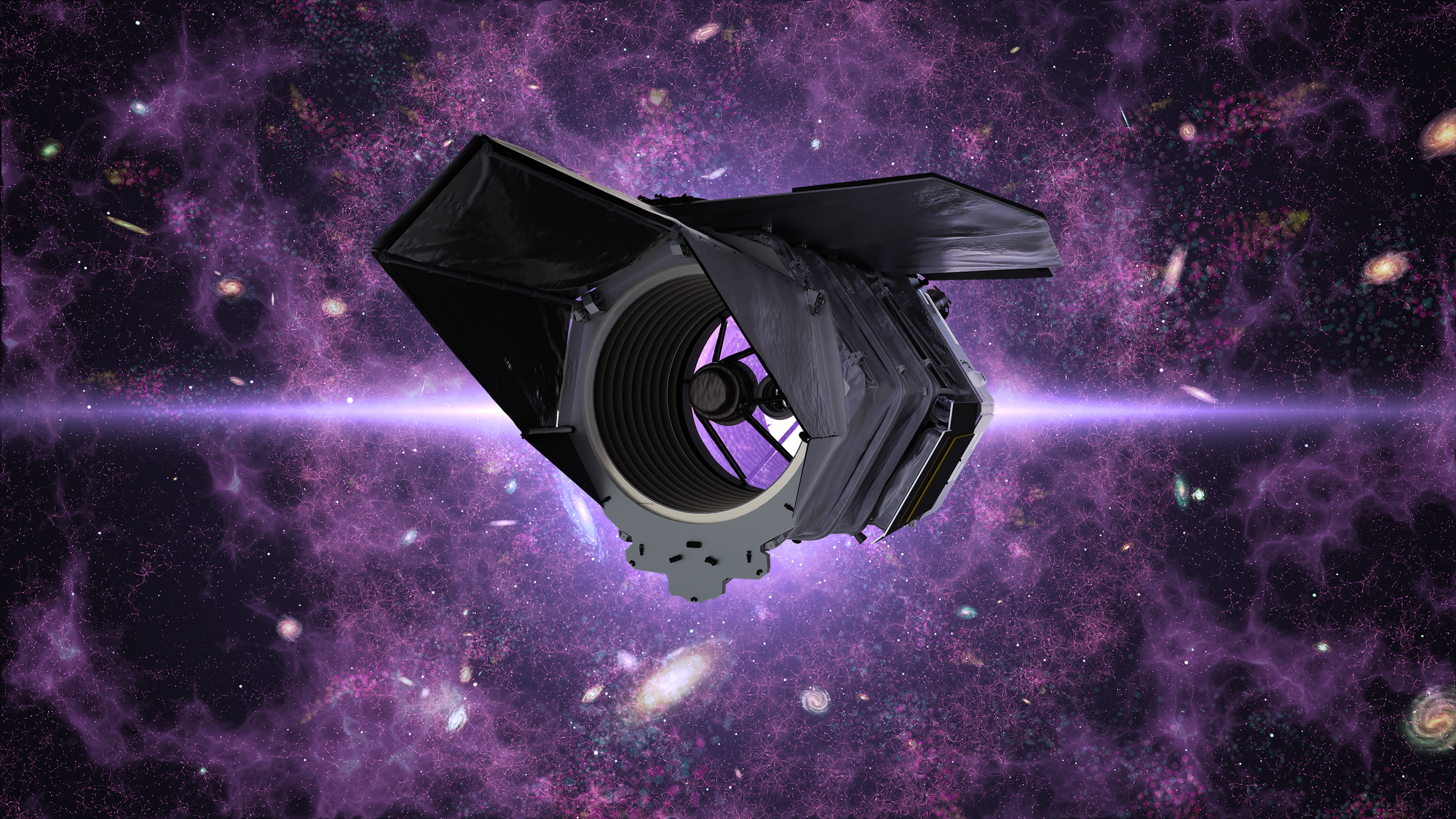
Set to launch on Sunday, Aug. 30, NASA’s Nancy Grace Roman Space Telescope will empower astronomers to explore vast regions of the cosmos and settle essential questions in the areas of dark energy, dark matter, planets outside our solar system, and the formation and growth of galaxies over cosmic time. Key contributions to Roman’s mission made by researchers at NASA’s Ames Research Center in California’s Silicon Valley will advance Roman’s science using the center’s facilities, expertise, and innovations.
Tools to predict, remove glare
Roman’s main camera, the Wide Field Instrument, will capture expansive high-resolution pictures of the universe in optical and near-infrared light. These unprecedented images will enable astronomers to decode some of the deepest mysteries of the cosmos.
Forms of glare that Roman’s camera collects diminish image quality and thereby reduce the ability of astronomers to characterize certain cosmic structures. Innovative software developed by a team at NASA Ames, with collaborators at NASA’s Goddard Space Flight Center in Greenbelt, Maryland, and IPAC/Caltech in Pasadena, California, will improve Roman’s images and optimize observing plans. Called ROSALIA (Roman Sky Analyst for Low Surface Brightness Imaging and Astronomy), the software predicts and removes unwanted light from astronomical images captured by Roman’s Wide Field Instrument.
Contaminating stray light occurs when photons scatter inside the telescope’s optical system. Resulting light glints can produce deceptive image artifacts that mimic the appearance of real planets or nebulae. The ROSALIA software will allow astronomers to adjust their observation plans to limit glints from contaminating science targets in Roman’s images.
In addition to bright glints, stray light can also appear as a diffuse background. This form of stray light interferes with observations of the darkest regions of the universe, which is critical to understanding how large structures in the universe were formed.
Another major contributor to obscuring background light is produced by nature itself: zodiacal light. Zodiacal emission originates from the scattering of sunlight by interplanetary dust particles in our solar system. The ROSALIA software predicts and strips away background contamination, including zodiacal and stray light from images, exposing the faint, diffuse emissions at galaxy edges where cosmic evolutionary histories are hidden.
Simulated, unprocessed Simulated, processed Simulated unprocessed image, as it would be captured by the Roman Space Telescope’s Wide Field Instrument, showing two interacting galaxiesNASA Simulated image, as it would be captured by the Roman Space Telescope’s Wide Field Instrument and then processed using NASA’s Roman Sky Analyst for Low Surface Brightness Imaging and Astronomy tools to remove glare, showing two interacting galaxies. NASA Simulated, unprocessedSimulated, processed Simulated unprocessed image, as it would be captured by the Roman Space Telescope’s Wide Field Instrument, showing two interacting galaxiesNASA Simulated image, as it would be captured by the Roman Space Telescope’s Wide Field Instrument and then processed using NASA’s Roman Sky Analyst for Low Surface Brightness Imaging and Astronomy tools to remove glare, showing two interacting galaxies. NASA Simulated, unprocessed Simulated, processedBEFORE AND AFTER PROCESSING
Simulated View From Roman’s Wide Field Instrument CurtainToggle2-Up Image Details Left: Simulated unprocessed image, as it would be captured by the Roman Space Telescope’s Wide Field Instrument, showing two interacting galaxies. Right: Simulated image of the same view after stepwise processing, using NASA’s Roman Sky Analyst for Low Surface Brightness Imaging and Astronomy (ROSALIA) tools, to remove four types of glare: zodiacal light, thermal background, stray-light, and stellar emission. The result is cleaner, sharper images where galaxies can be detected in greater detail. Image credits: NASA/Borlaff, Sanchez-Alarcon, Nickerson, Marcum and ROSALIA team/STScI/FIRE/DREAMNew ‘multi-star’ tech to see exoplanets
The Roman Coronagraph Instrument is one of two instruments flying on Roman. It will demonstrate the most advanced technologies ever flown in space for directly imaging planets around other stars. The Roman Coronagraph uses a series of masks and mirrors, including two deformable mirrors, to suppress starlight. By precisely controlling the shape of the deformable mirrors, it creates a “dark zone” around the star where observers can see the faint reflected light from orbiting planets.
The baseline operating mode of the Roman Coronagraph Instrument supports observation of exoplanets only in single star systems, as current coronagraph instruments cannot typically suppress the additional contaminating starlight in multi-star systems, such as binary star systems.
Our solar system has a single star, the Sun. But roughly half of Sun-like stars are in multi-star systems. Having the ability to directly image exoplanets in multi-star systems will increase the likelihood of detecting life beyond our solar system and will expand our knowledge about how exoplanets form and evolve, since there are major differences in how those processes unfold in single star versus multi-star systems. Eliminating overlapping glares from multiple stars is the key challenge that must be overcome to image planets in such systems.
Researchers at NASA Ames are meeting that challenge with an innovative technology called Multi-Star Wavefront Control (MSWC). This technology includes custom light-blocking masks and accompanying software designed to suppress the light from multiple stars and reveal hidden exoplanets. Through a collaboration with NASA’s Jet Propulsion Laboratory in Southern California, the MSWC masks are included on the Roman Coronagraph’s flight instrument as an added capability beyond Roman’s baseline observation modes. They could be used if additional observation time is granted to the coronagraph team after the primary technology demonstration phase is completed.
The nearest star system to our solar system, Alpha Centauri, is one of the nearest multi-star systems to Earth, at only four light-years away. This triple-star system contains a binary of Sun-like stars – Alpha Centauri AB – orbited by a much smaller and dimmer star – Proxima Centauri. Although no exoplanets are confirmed around the Sun-like stars in this system, a planet candidate has been identified by NASA’s James Webb Space Telescope in the habitable zone of Alpha Centauri A. Researchers, including the Ames MSWC team, are working to develop the capabilities needed to observe this system.
NASA Ames also provides leadership and support for the hardware working group as part of the Roman Coronagraph Participation Program. This program allows international teams of researchers to enable additional capabilities to the Roman Coronagraph beyond its baseline modes; this includes the multi-star modes being developed at NASA Ames that use different masks beyond the baseline or new wavefront control and sensing algorithms.
Close-up view of four of the Roman Coronagraph’s optical masks. The bottom-right mask, shaped like a six-petaled flower, is designed to suppress the light from multiple stars and reveal hidden exoplanets.NASA JPL/Chris Gunn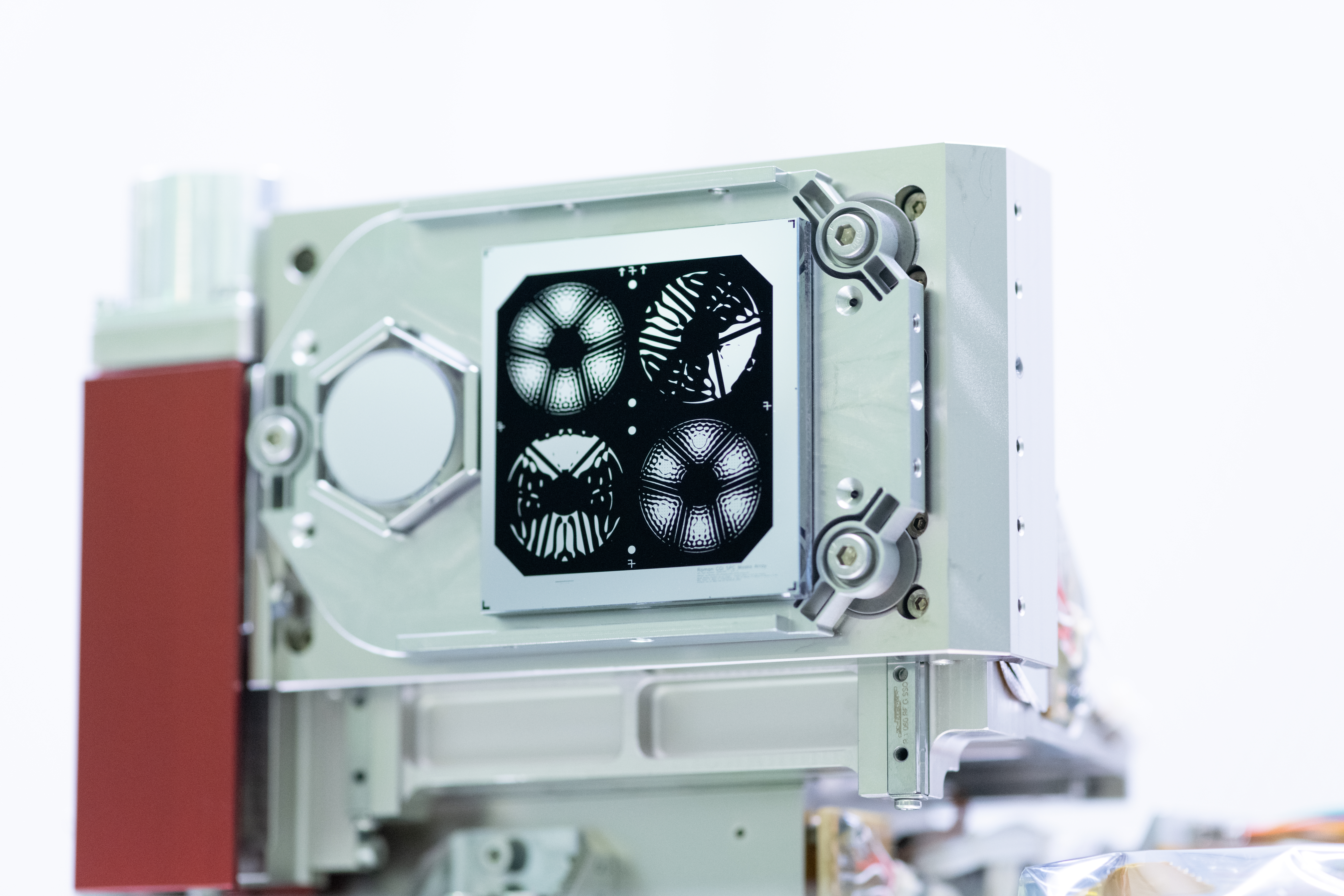
Advanced supercomputing
Experts at NASA’s Advanced Supercomputing Division at Ames are advancing Roman’s science by bringing extensive experience in data pipelines and mission operations to provide advice and guidance to the Roman project through key mission development phases. This ensures reliable performance of ground-based systems and operations so that science data processing is efficient and the quality and integrity of the resulting science data products is high.
NASA Advanced Supercomputing researchers collaborated with the Ames MSWC team to develop high-performance computing tools for multi-star wavefront control simulations and to conduct studies to assess the feasibility of the MSWC technique.
Learn more about the Nancy Grace Roman Space Telescope mission:
https://science.nasa.gov/mission/roman-space-telescope/
For news media:
Roman media resources: https://science.nasa.gov/mission/roman-space-telescope/roman-media-resources/
Members of the news media interested in covering this topic should reach out to the NASA Ames newsroom.
NASA Ames’ Contributions to Roman’s Mission
Set to launch on Sunday, Aug. 30, NASA’s Nancy Grace Roman Space Telescope will empower astronomers to explore vast regions of the cosmos and settle essential questions in the areas of dark energy, dark matter, planets outside our solar system, and the formation and growth of galaxies over cosmic time. Key contributions to Roman’s mission made by researchers at NASA’s Ames Research Center in California’s Silicon Valley will advance Roman’s science using the center’s facilities, expertise, and innovations.
Tools to predict, remove glare
Roman’s main camera, the Wide Field Instrument, will capture expansive high-resolution pictures of the universe in optical and near-infrared light. These unprecedented images will enable astronomers to decode some of the deepest mysteries of the cosmos.
Forms of glare that Roman’s camera collects diminish image quality and thereby reduce the ability of astronomers to characterize certain cosmic structures. Innovative software developed by a team at NASA Ames, with collaborators at NASA’s Goddard Space Flight Center in Greenbelt, Maryland, and IPAC/Caltech in Pasadena, California, will improve Roman’s images and optimize observing plans. Called ROSALIA (Roman Sky Analyst for Low Surface Brightness Imaging and Astronomy), the software predicts and removes unwanted light from astronomical images captured by Roman’s Wide Field Instrument.
Contaminating stray light occurs when photons scatter inside the telescope’s optical system. Resulting light glints can produce deceptive image artifacts that mimic the appearance of real planets or nebulae. The ROSALIA software will allow astronomers to adjust their observation plans to limit glints from contaminating science targets in Roman’s images.
In addition to bright glints, stray light can also appear as a diffuse background. This form of stray light interferes with observations of the darkest regions of the universe, which is critical to understanding how large structures in the universe were formed.
Another major contributor to obscuring background light is produced by nature itself: zodiacal light. Zodiacal emission originates from the scattering of sunlight by interplanetary dust particles in our solar system. The ROSALIA software predicts and strips away background contamination, including zodiacal and stray light from images, exposing the faint, diffuse emissions at galaxy edges where cosmic evolutionary histories are hidden.
Simulated, unprocessed Simulated, processed Simulated unprocessed image, as it would be captured by the Roman Space Telescope’s Wide Field Instrument, showing two interacting galaxiesNASA Simulated image, as it would be captured by the Roman Space Telescope’s Wide Field Instrument and then processed using NASA’s Roman Sky Analyst for Low Surface Brightness Imaging and Astronomy tools to remove glare, showing two interacting galaxies. NASA Simulated, unprocessedSimulated, processed Simulated unprocessed image, as it would be captured by the Roman Space Telescope’s Wide Field Instrument, showing two interacting galaxiesNASA Simulated image, as it would be captured by the Roman Space Telescope’s Wide Field Instrument and then processed using NASA’s Roman Sky Analyst for Low Surface Brightness Imaging and Astronomy tools to remove glare, showing two interacting galaxies. NASA Simulated, unprocessed Simulated, processedBEFORE AND AFTER PROCESSING
Simulated View From Roman’s Wide Field Instrument CurtainToggle2-Up Image Details Left: Simulated unprocessed image, as it would be captured by the Roman Space Telescope’s Wide Field Instrument, showing two interacting galaxies. Right: Simulated image of the same view after stepwise processing, using NASA’s Roman Sky Analyst for Low Surface Brightness Imaging and Astronomy (ROSALIA) tools, to remove four types of glare: zodiacal light, thermal background, stray-light, and stellar emission. The result is cleaner, sharper images where galaxies can be detected in greater detail. Image credits: NASA/Borlaff, Sanchez-Alarcon, Nickerson, Marcum and ROSALIA team/STScI/FIRE/DREAMNew ‘multi-star’ tech to see exoplanets
The Roman Coronagraph Instrument is one of two instruments flying on Roman. It will demonstrate the most advanced technologies ever flown in space for directly imaging planets around other stars. The Roman Coronagraph uses a series of masks and mirrors, including two deformable mirrors, to suppress starlight. By precisely controlling the shape of the deformable mirrors, it creates a “dark zone” around the star where observers can see the faint reflected light from orbiting planets.
The baseline operating mode of the Roman Coronagraph Instrument supports observation of exoplanets only in single star systems, as current coronagraph instruments cannot typically suppress the additional contaminating starlight in multi-star systems, such as binary star systems.
Our solar system has a single star, the Sun. But roughly half of Sun-like stars are in multi-star systems. Having the ability to directly image exoplanets in multi-star systems will increase the likelihood of detecting life beyond our solar system and will expand our knowledge about how exoplanets form and evolve, since there are major differences in how those processes unfold in single star versus multi-star systems. Eliminating overlapping glares from multiple stars is the key challenge that must be overcome to image planets in such systems.
Researchers at NASA Ames are meeting that challenge with an innovative technology called Multi-Star Wavefront Control (MSWC). This technology includes custom light-blocking masks and accompanying software designed to suppress the light from multiple stars and reveal hidden exoplanets. Through a collaboration with NASA’s Jet Propulsion Laboratory in Southern California, the MSWC masks are included on the Roman Coronagraph’s flight instrument as an added capability beyond Roman’s baseline observation modes. They could be used if additional observation time is granted to the coronagraph team after the primary technology demonstration phase is completed.
The nearest star system to our solar system, Alpha Centauri, is one of the nearest multi-star systems to Earth, at only four light-years away. This triple-star system contains a binary of Sun-like stars – Alpha Centauri AB – orbited by a much smaller and dimmer star – Proxima Centauri. Although no exoplanets are confirmed around the Sun-like stars in this system, a planet candidate has been identified by NASA’s James Webb Space Telescope in the habitable zone of Alpha Centauri A. Researchers, including the Ames MSWC team, are working to develop the capabilities needed to observe this system.
NASA Ames also provides leadership and support for the hardware working group as part of the Roman Coronagraph Participation Program. This program allows international teams of researchers to enable additional capabilities to the Roman Coronagraph beyond its baseline modes; this includes the multi-star modes being developed at NASA Ames that use different masks beyond the baseline or new wavefront control and sensing algorithms.
Close-up view of four of the Roman Coronagraph’s optical masks. The bottom-right mask, shaped like a six-petaled flower, is designed to suppress the light from multiple stars and reveal hidden exoplanets.NASA JPL/Chris GunnAdvanced supercomputing
Experts at NASA’s Advanced Supercomputing Division at Ames are advancing Roman’s science by bringing extensive experience in data pipelines and mission operations to provide advice and guidance to the Roman project through key mission development phases. This ensures reliable performance of ground-based systems and operations so that science data processing is efficient and the quality and integrity of the resulting science data products is high.
NASA Advanced Supercomputing researchers collaborated with the Ames MSWC team to develop high-performance computing tools for multi-star wavefront control simulations and to conduct studies to assess the feasibility of the MSWC technique.
Learn more about the Nancy Grace Roman Space Telescope mission:
https://science.nasa.gov/mission/roman-space-telescope/
For news media:
Roman media resources: https://science.nasa.gov/mission/roman-space-telescope/roman-media-resources/
Members of the news media interested in covering this topic should reach out to the NASA Ames newsroom.
Surface Chemistry Shows Which Massive Stars Have Gained Mass from Binary Companions
Most stars, including massive ones, are in binary pairs. Astronomers think that about 70% of them have gained mass from their companions, but there's been no way to determine which ones have done so. Now, researchers have found a way.
A Distant Stream of Stars May Offer New Clues to Dark Matter
Dark matter continues to challenge astronomers as they work to solve the mystery of this so-far-unseen material that permeates the Universe. It's not that the stuff doesn't exist. It does, but we just can't see it. The only way it can be detected is by its gravitational effects on ordinary matter. A team of researchers led by University of Copenhagen PhD student Julie Kiel Holm has found a stream of stars stretching out more than 3,000 light-years from a globular cluster that appears to have been shaped by dark matter in a distant galaxy.
NASA Ames Experts Available for Roman Space Telescope Interviews
NASA’s Ames Research Center in California’s Silicon Valley invites media to learn more about NASA’s Nancy Grace Roman Space Telescope, scheduled to launch Sunday, Aug. 30, 2026, from NASA’s Kennedy Space Center in Florida. The Roman telescope will provide a wide, detailed view of the universe, helping scientists study dark energy, exoplanets, and cosmic structures. Roman also will test advanced technology designed to directly image planets around nearby stars — a key step in NASA’s search for life beyond Earth.
Ames subject matter experts will be available for virtual interviews to discuss Roman’s goals and the center’s contributions to the mission on Wednesday, Aug. 26, 2026, 10:00 a.m. – 1:00 p.m. PDT.
NASA Ames contributions to Roman
- Innovative software developed at NASA Ames, with collaborators at NASA’s Goddard Space Flight Center in Greenbelt, Maryland, and IPAC Caltech in Pasadena, California, is designed to improve Roman’s images and optimize observing plans, enhancing the ability of astronomers to capture expansive high-resolution pictures of the universe in optical and near-infrared light.
- Technology called Multi-Star Wavefront Control is designed to suppress excess light and reveal hidden exoplanets by eliminating overlapping glares from multi-star systems.
- NASA’s Advanced Supercomputing Division, based at NASA Ames, brings extensive experience in data pipelines and mission operations to advise the Roman project, helping to ensure the reliable performance of Roman’s ground-based systems and operations so that science data processing is efficient and the quality and integrity of the resulting science data products is high.
To request an interview, media can contact the Ames Office of Communications: arc-dl-newsroom@nasa.gov. Media can also request agency interviews about the Roman mission outside of this window by filling out this online form.
NASA Ames Roman subject matter experts
- Pamela Marcum, research scientist
- Ruslan Belikov, Exoplanet Technologies Group lead
- Jon M. Jenkins, TESS (Transiting Exoplanet Survey Satellite) Science Processing Operations Center manager
For more information about NASA’s Roman mission, visit:
-end-
Jeanne Neal
Ames Research Center, Silicon Valley
650-604-4789
Jeanne.c.neal@nasa.gov
To receive local NASA Ames news, email local-reporters-request@lists.arc.nasa.gov with “subscribe” in the subject line. To unsubscribe, email the same address with “unsubscribe” in the subject line.
NASA Ames Experts Available for Roman Space Telescope Interviews
NASA’s Ames Research Center in California’s Silicon Valley invites media to learn more about NASA’s Nancy Grace Roman Space Telescope, scheduled to launch Sunday, Aug. 30, 2026, from NASA’s Kennedy Space Center in Florida. The Roman telescope will provide a wide, detailed view of the universe, helping scientists study dark energy, exoplanets, and cosmic structures. Roman also will test advanced technology designed to directly image planets around nearby stars — a key step in NASA’s search for life beyond Earth.
Ames subject matter experts will be available for virtual interviews to discuss Roman’s goals and the center’s contributions to the mission on Wednesday, Aug. 26, 2026, 10:00 a.m. – 1:00 p.m. PDT.
NASA Ames contributions to Roman
- Innovative software developed at NASA Ames, with collaborators at NASA’s Goddard Space Flight Center in Greenbelt, Maryland, and IPAC Caltech in Pasadena, California, is designed to improve Roman’s images and optimize observing plans, enhancing the ability of astronomers to capture expansive high-resolution pictures of the universe in optical and near-infrared light.
- Technology called Multi-Star Wavefront Control is designed to suppress excess light and reveal hidden exoplanets by eliminating overlapping glares from multi-star systems.
- NASA’s Advanced Supercomputing Division, based at NASA Ames, brings extensive experience in data pipelines and mission operations to advise the Roman project, helping to ensure the reliable performance of Roman’s ground-based systems and operations so that science data processing is efficient and the quality and integrity of the resulting science data products is high.
To request an interview, media can contact the Ames Office of Communications: arc-dl-newsroom@nasa.gov. Media can also request agency interviews about the Roman mission outside of this window by filling out this online form.
NASA Ames Roman subject matter experts
- Pamela Marcum, research scientist
- Ruslan Belikov, Exoplanet Technologies Group lead
- Jon M. Jenkins, TESS (Transiting Exoplanet Survey Satellite) Science Processing Operations Center manager
For more information about NASA’s Roman mission, visit:
-end-
Jeanne Neal
Ames Research Center, Silicon Valley
650-604-4789
Jeanne.c.neal@nasa.gov
To receive local NASA Ames news, email local-reporters-request@lists.arc.nasa.gov with “subscribe” in the subject line. To unsubscribe, email the same address with “unsubscribe” in the subject line.
Starbase Louisiana: SpaceX announces enormous $100 billion Starbase launch site
A new spaceport will bring 10 launch pads to Louisiana's Gulf Coast and support thousands of Starship launches per year.
SpaceX and Louisiana Governor Jeff Landry announced Tuesday (Aug. 25) a $100 billion investment in the state's Vermilion Parish to build "Starbase Louisiana," a sprawling new manufacturing and launch facility for SpaceX's massive Starship rocket. It will be one of the biggest projects in the state's history, and serve as SpaceX's largest center for spaceflight operations.
Once complete, the new site will feature five complexes that feature two Starship towers each, for a total of 10 launch pads across the facility, each with its own propellant farm. That fuel will also be produced onsite as well.
"We're planning to build a self-sustaining spaceport with its own propellant production, power generation, deep water shipping capabilities, vehicle processing facilities, and probably an airport," SpaceX President Gwynn Shotwell said during the announcement event. "And thanks to the abundant resources here in Louisiana, we have ready access to the natural gas that fuels these rockets to get to orbit."
SpaceX and Louisiana officials say the site will eventually support thousands of launches per year and will be central to SpaceX’s effort to dramatically increase Starship’s flight rate. SpaceX founder and CEO Elon Musk recently estimated that Starship will be launching more than 30 times per day by 2030, which equates to more than 10,000 flights per year.
Landry framed the project in historic terms, saying."This will be the place [from] which America reaches farther than it has ever reached before. In 1803, Louisiana gave America a continent. Today, Louisiana and SpaceX will give America the stars.”
Starship is SpaceX's next-generation, fully reusable launch vehicle. The giant rocket is still under development, but the company is quickly making strides to mature the rocket to operational status. SpaceX is preparing for Starship's 14th test flight in September, and is on a tight timeline to qualify the rocket for operational missions.
Shotwell said SpaceX's existing infrastructure can't support the number or cadence of Starship launches the company anticipates reaching, and tied Starbase Louisiana to SpaceX's long-term goal of using Starship to make human life interplanetary. In the nearer term, Starship is also tasked with returning astronauts to the surface of the moon.
NASA has contracted SpaceX to design a lunar lander version of Starship for the agency's Artemis program. Artemis III is scheduled for mid-2027, and will launch NASA's Orion spacecraft to Earth orbit to practice rendezvous and docking maneuvers with one of SpaceX's current "Version 3" Starship test vehicles. The first moon landing of the program is planned for Artemis IV in 2028, giving SpaceX a fast-approaching deadline to mature Starship from test article to crew-certified lunar lander.
Render of Starship and Orion docked on Artemis III, scheduled for mid-2027. (Image credit: SpaceX)For the Artemis IV Starship to carry out its mission of landing astronauts on the surface of the moon and then launching them back to lunar orbit to rendezvous with Orion, and for any Starship mission beyond low Earth orbit, the spacecraft requires refueling launches of additional "tanker" Starships. Artemis IV's Starship may need up to a dozen such refueling flights. But Starbase Louisiana's 10 launch pads will be for more than propellant delivery.
SpaceX plans to launch its next-generation Starlink internet satellite constellation aboard Starship. To date, SpaceX has launched more than 300 Starlink missions aboard its workhorse Falcon 9 rocket, which has delivered more than 11,000 of the satellites to orbit. Already preparing for the transition to Starship, SpaceX just launched its last Falcon 9 Starlink mission from Florida, and plans to fly the remaining Falcon 9 Starlink launches from Vandenberg Space Force Base in California. SpaceX intends to retire Falcon 9 entirely once Starship is fully operational.
The company is also planning for Starship to launch its huge artificial intelligence network and build out an orbital infrastructure to “move supercomputing to space,” Shotwell said, as artificial intelligence drives greater demand for resources.
Illustration of SpaceX's planned Starbase Louisiana site, which the company says will support thousands of Starship launches per year. (Image credit: SpaceX)“Put all of this together, and these tasks will require thousands of launches,” Shotwell said. “Starbase Louisiana is being designed from day one to support this dramatic increase in launch cadence.”
Construction on the new Starbase is expected to begin in 2027, with the first launch from the site targeted for 2029, SpaceX said. According to an outline of the plan from Louisiana Economic Development, the state agency overseeing the project’s economic development efforts, the project is expected to create 3,000 direct jobs over the next decade, and thousands of additional jobs indirectly tied to its development.
Already having gone through the processes in Texas and Florida, SpaceX has also already begun working with Louisiana wildlife and coastal agencies to assess the impacts of such a large industrial complex along the Gulf Coast.
"We are committed to doing our part to ensure that this land doesn't disappear," Shotwell said, viewing the area as a unique opportunity to fly the world's most powerful rocket, while supporting Louisiana's coastal resilience. "SpaceX is partnering with state and federal agencies to expand Louisiana's coastal master plan, including shoreline protection, marsh restoration, and wildlife conservation," she said.
Starbase Louisiana will be SpaceX's biggest undertaking ever, and likely the eventual hub of the company's launch operations. "This will be a project like no other," Shotwell said, "another piece of science fiction transported into reality."
The bubbling surface of doomed supergiant star Betelgeuse has been revealed like never before
Betelgeuse may be a well-known and often-studied stellar object, but that doesn't mean astronomers aren't capable of capturing this doomed star in a completely new light.
A team of scientists examined the doomed red supergiant star with the Atacama Large Millimeter/submillimeter Array (ALMA), gaining new, highly detailed insights into its turbulent surface.
Betelgeuse, located around 600 light-years away, captured the public's attention a few years ago when the rapid and dramatic dimming of the infamous highly evolved star led some scientists to hypothesize that it was about to explode in a spectacular supernova. That hasn't happened, and scientists are now less convinced that this explosion is immediately imminent, but Betelgeuse remains the subject of intense scientific scrutiny.
"Its eventual fate as a supernova makes it fascinating to know what it actually looks like now," team leader Bill Dent, an astronomer at the European Southern Observatory (ESO), said in a statement.
The newly released ALMA images of Betelgeuse, captured in 2023, show bright hotspots on the star's surface and an almost corrugated texture arising from vast amounts of plasma shifting through the star, which has around 20 times the mass of our sun, but is puffed out to around 800 times the size of our star.
The observations show the red supergiant has an atmosphere with a temperature of around 3,680 degrees Fahrenheit (2,030 degrees Celsius), but possesses at least two regions even hotter than this. One of these areas is 980 degrees Fahrenheit (530 degrees Celsius) hotter than the plasma surrounding it.
ALMA image revealing irregular shape and regions of hotter gas on Betelgeuse. The brightest hotspot, toward the northeast, appears at the same location in ALMA observations separated by more than seven years, meaning some structures can survive longer than predicted (Image credit: ALMA (ESO/NAOJ/NRAO)/W. Dent et al.)The uneven nature seen by ALMA is likely the result of massive convective movements in the star, hot plasma rising through the star and generating shockwaves that erupt in the star's atmosphere, creating bright and hot regions.
The familiarity of Betelgeuse to astronomers doesn't mean the star isn't capable of delivering surprises too. When the team compared images collected in 2023 to observations from 2015, they were surprised to see a hotspot in the northeast of the stellar disk has persisted for at least seven years, that is much longer than predicted by current stellar models.
The orientation of the hotspots of Betelgeuse also added support to the idea that the red supergiant star is orbited by an elusive companion star.
Astronomers will continue to monitor the hotspots of Betelgeuse with ALMA to determine how fixed they are and how their evolution relates to things like mass loss, and the structure of the star's atmosphere.
That investigation will likely continue until Betelgeuse finally ends its life in a supernova explosion.
The team's research has been accepted for publication in the journal Astronomy & Astrophysics and is available on the paper repository site arXiv.
These math tricks can make rare Pokémon appear out of nowhere
A technique that manipulates the video game's random number generator makes rare Pokemón appear, showing how it's not so random after all
NASA’s Pandora Mission Begins Study of Exoplanets, Host Stars
5 min read
NASA’s Pandora Mission Begins Study of Exoplanets, Host StarsPandora, NASA’s newest exoplanet mission and the first satellite to launch through the agency’s Astrophysics Pioneers program, is now making unique observations of worlds beyond our solar system and the stars they orbit. The mission will determine the atmospheric make-up of at least 20 exoplanets, including the presence of hazes, clouds, and water.
“Pandora’s data will help close a major gap in our knowledge about planets and their host stars because, right now, we can’t be entirely sure how the star’s light affects measurements of what makes up exoplanet atmospheres,” said Elisa Quintana, Pandora’s principal investigator at NASA’s Goddard Space Flight Center in Greenbelt, Maryland. “We designed the Pandora spacecraft and its in-depth observing program to better understand this vexing issue.”
Artist’s concept of NASA’s Pandora mission, which will help scientists untangle the signals from exoplanets’ atmospheres and their stars.NASA’s Goddard Space Flight Center/Conceptual Image Lab Download high-resolution video and images from NASA’s Scientific Visualization Studio
The results of the mission will lay a firm foundation for interpreting measurements by NASA’s James Webb Space Telescope, as well as future observatories focused on finding habitable worlds. In fact, Pandora’s near-infrared detector is a spare originally developed for Webb.
“The spacecraft is healthy and all of the instruments are performing as well as we could have hoped,” said Jordan Karburn, Pandora’s deputy project manager at Lawrence Livermore National Laboratory in California. “Our team’s hard work throughout the commissioning process has paid off, and we can now confidently start science.”
This artist’s concept summarizes NASA’s Pandora mission and its science goals. Pandora will repeatedly observe multiple planets and their host stars in both visible and near-infrared light. These measurements will enable astronomers to separate chemical fingerprints detected in a planet’s atmosphere from potentially misleading signals originating from its host star.NASA/Sophia Roberts Download high-resolution video and images from NASA’s Scientific Visualization Studio
Launched into low Earth orbit on Jan. 11, Pandora is an ambitious small satellite (SmallSat) funded by NASA’s Astrophysics Pioneers program. Pioneers are designed to explore compelling questions about the universe with fast-paced, low-cost missions that require a higher-than-usual tolerance for failure.
Three factors make Pandora unique. It carries a novel all-aluminum telescope about 18 inches (45 centimeters) in diameter, it will study planets and their host stars simultaneously in both visible and infrared light, and it will observe targets for a much longer time than flagship observatories like Webb are able to.
Telescopes can sample a planet’s atmosphere in systems where the planet passes in front of its star as seen from our perspective. During this event, called a transit, some starlight skims the planet’s atmosphere before making its way to us. As this light interacts with atmospheric molecules, their chemical fingerprints become embedded in it. For each molecule, astronomers see brightness dips at characteristic wavelengths.
But our instruments also see light from the whole star, not just what grazes the planet. Stellar surfaces aren’t uniform. They sport hotter, brighter areas called faculae and cooler, darker regions similar to sunspots. Both can grow, shrink, and change position as the star rotates.
“Water is one of the most important molecules we can measure to understand the composition and physical conditions of an exoplanet atmosphere,” said Benjamin Rackham, a team member at the Massachusetts Institute of Technology in Cambridge. “But features on the star can distort the water signal we’re searching for. Pandora is designed to disentangle the signals from the planet and the star, helping us to understand the planets more accurately and laying the groundwork for the eventual study of planets that could harbor life.”
Watch to learn more about NASA’s Pandora mission, which will revolutionize the study of exoplanet atmospheres.NASA’s Goddard Space Flight Center Download high-resolution video and images from NASA’s Scientific Visualization Studio
Pandora’s telescope, jointly developed by Livermore and Corning Specialty Materials in Keene, New Hampshire, and its detectors make up the mission’s heart. The detectors will capture the star’s brightness in visible light and its near-infrared spectrum at the same time, while also obtaining a near-infrared spectrum from the planet when it transits the star. Over the course of its year-long primary mission, Pandora will observe at least 20 exoplanets 10 times with a long-duration stare covering 24 hours, with a transit included in each observation.
“Pandora’s advantage is its ability to observe targets for extended periods at multiple wavelengths, something high-demand flagship missions like Webb cannot regularly do,” said Knicole Colón, the mission’s project scientist at NASA Goddard. “Combining Pandora and Webb data will uniquely enable scientists to determine the properties of stellar surfaces and cleanly separate star and planetary signals.”
Pandora is led by NASA’s Goddard Space Flight Center. Lawrence Livermore National Laboratory provides the mission’s project management and engineering. Pandora’s telescope was manufactured by Corning and developed collaboratively with Livermore, which also developed the imaging detector assemblies, the mission’s control electronics, and all supporting thermal and mechanical subsystems. The infrared sensor was provided by NASA Goddard. Blue Canyon Technologies provided the bus, performed spacecraft assembly, integration and environmental testing, and is providing mission operations support. NASA’s Ames Research Center in California’s Silicon Valley performs the mission’s data processing. Pandora’s science data is available at the NASA Exoplanet Archive, which is operated by IPAC at the California Institute of Technology in Pasadena. The University of Arizona leads mission operations for Pandora and contributes to its science program. Many additional universities also support the science team.
To learn more about the Pandora mission, please visit:
https://science.nasa.gov/mission/pandora/
Facebook logo @NASAUniverse @NASAUniverse Instagram logo @NASAUniverse Share Details Last Updated Aug 25, 2026 EditorFrancis ReddyContactAlise Fisheralise.m.fisher@nasa.gov Related TermsNASA’s Pandora Mission Begins Study of Exoplanets, Host Stars
5 min read
NASA’s Pandora Mission Begins Study of Exoplanets, Host StarsPandora, NASA’s newest exoplanet mission and the first satellite to launch through the agency’s Astrophysics Pioneers program, is now making unique observations of worlds beyond our solar system and the stars they orbit. The mission will determine the atmospheric make-up of at least 20 exoplanets, including the presence of hazes, clouds, and water.
“Pandora’s data will help close a major gap in our knowledge about planets and their host stars because, right now, we can’t be entirely sure how the star’s light affects measurements of what makes up exoplanet atmospheres,” said Elisa Quintana, Pandora’s principal investigator at NASA’s Goddard Space Flight Center in Greenbelt, Maryland. “We designed the Pandora spacecraft and its in-depth observing program to better understand this vexing issue.”
Artist’s concept of NASA’s Pandora mission, which will help scientists untangle the signals from exoplanets’ atmospheres and their stars.NASA’s Goddard Space Flight Center/Conceptual Image Lab Download high-resolution video and images from NASA’s Scientific Visualization StudioThe results of the mission will lay a firm foundation for interpreting measurements by NASA’s James Webb Space Telescope, as well as future observatories focused on finding habitable worlds. In fact, Pandora’s near-infrared detector is a spare originally developed for Webb.
“The spacecraft is healthy and all of the instruments are performing as well as we could have hoped,” said Jordan Karburn, Pandora’s deputy project manager at Lawrence Livermore National Laboratory in California. “Our team’s hard work throughout the commissioning process has paid off, and we can now confidently start science.”
This artist’s concept summarizes NASA’s Pandora mission and its science goals. Pandora will repeatedly observe multiple planets and their host stars in both visible and near-infrared light. These measurements will enable astronomers to separate chemical fingerprints detected in a planet’s atmosphere from potentially misleading signals originating from its host star.NASA/Sophia Roberts Download high-resolution video and images from NASA’s Scientific Visualization StudioLaunched into low Earth orbit on Jan. 11, Pandora is an ambitious small satellite (SmallSat) funded by NASA’s Astrophysics Pioneers program. Pioneers are designed to explore compelling questions about the universe with fast-paced, low-cost missions that require a higher-than-usual tolerance for failure.
Three factors make Pandora unique. It carries a novel all-aluminum telescope about 18 inches (45 centimeters) in diameter, it will study planets and their host stars simultaneously in both visible and infrared light, and it will observe targets for a much longer time than flagship observatories like Webb are able to.
Telescopes can sample a planet’s atmosphere in systems where the planet passes in front of its star as seen from our perspective. During this event, called a transit, some starlight skims the planet’s atmosphere before making its way to us. As this light interacts with atmospheric molecules, their chemical fingerprints become embedded in it. For each molecule, astronomers see brightness dips at characteristic wavelengths.
But our instruments also see light from the whole star, not just what grazes the planet. Stellar surfaces aren’t uniform. They sport hotter, brighter areas called faculae and cooler, darker regions similar to sunspots. Both can grow, shrink, and change position as the star rotates.
“Water is one of the most important molecules we can measure to understand the composition and physical conditions of an exoplanet atmosphere,” said Benjamin Rackham, a team member at the Massachusetts Institute of Technology in Cambridge. “But features on the star can distort the water signal we’re searching for. Pandora is designed to disentangle the signals from the planet and the star, helping us to understand the planets more accurately and laying the groundwork for the eventual study of planets that could harbor life.”
Watch to learn more about NASA’s Pandora mission, which will revolutionize the study of exoplanet atmospheres.NASA’s Goddard Space Flight Center Download high-resolution video and images from NASA’s Scientific Visualization Studio
Pandora’s telescope, jointly developed by Livermore and Corning Specialty Materials in Keene, New Hampshire, and its detectors make up the mission’s heart. The detectors will capture the star’s brightness in visible light and its near-infrared spectrum at the same time, while also obtaining a near-infrared spectrum from the planet when it transits the star. Over the course of its year-long primary mission, Pandora will observe at least 20 exoplanets 10 times with a long-duration stare covering 24 hours, with a transit included in each observation.
“Pandora’s advantage is its ability to observe targets for extended periods at multiple wavelengths, something high-demand flagship missions like Webb cannot regularly do,” said Knicole Colón, the mission’s project scientist at NASA Goddard. “Combining Pandora and Webb data will uniquely enable scientists to determine the properties of stellar surfaces and cleanly separate star and planetary signals.”
Pandora is led by NASA’s Goddard Space Flight Center. Lawrence Livermore National Laboratory provides the mission’s project management and engineering. Pandora’s telescope was manufactured by Corning and developed collaboratively with Livermore, which also developed the imaging detector assemblies, the mission’s control electronics, and all supporting thermal and mechanical subsystems. The infrared sensor was provided by NASA Goddard. Blue Canyon Technologies provided the bus, performed spacecraft assembly, integration and environmental testing, and is providing mission operations support. NASA’s Ames Research Center in California’s Silicon Valley performs the mission’s data processing. Pandora’s science data is available at the NASA Exoplanet Archive, which is operated by IPAC at the California Institute of Technology in Pasadena. The University of Arizona leads mission operations for Pandora and contributes to its science program. Many additional universities also support the science team.
To learn more about the Pandora mission, please visit:
https://science.nasa.gov/mission/pandora/
Facebook logo @NASAUniverse @NASAUniverse Instagram logo @NASAUniverse Share Details Last Updated Aug 25, 2026 EditorFrancis ReddyContactAlise Fisheralise.m.fisher@nasa.gov Related TermsScience with Astrophotography
Your pretty pictures can contain valuable information.
The post Science with Astrophotography appeared first on Sky & Telescope.
Comet 220P McNaught Puts On An Encore Performance
It has been a busy month for astronomy. In the midst of an eclipse season bookended by the total solar eclipse on August 12th and the deep partial lunar eclipse coming right up this week on August 28th, an outbound comet hanging high in the dawn sky just refuses to die: 220P/McNaught.
NASA's Roman Space Telescope will reveal the universe in a way the JWST and Hubble cannot
Even if you aren't the kind of person who often looks up the latest space images, it's hard to navigate life (especially on the internet) without running into a few. Try choosing a new iPhone background and you'll have your pick of sharp, gray moon portraits. Watch an old "Star Trek" episode and you may not realize how many of those translucent nebulas outside the spaceship's windows were based on real, hard data.
When it comes to space, we're spoiled. Mind-bending objects light-years away from us have managed to become integrated into our everyday lives — and though we're still a ways away from understanding the true nature of the universe, we're also the closest we've ever been. It's in large part thanks to how impeccable our fleet of space telescopes is. In seconds, you can find a Hubble Space Telescope Deep Field with luminescent galaxies warped along the curvature of spacetime and James Webb Space Telescope images of strange hazy red objects from just after the dawn of time.
Moreover, what's tremendously exciting is this fleet is constantly growing. Indeed, very soon, a new space telescope will launch from NASA's Kennedy Space Center in Florida. It's called the Nancy Grace Roman Space Telescope, and it should be able to unlock a new level in the astronomy layer of our lives. It will show us new types of images, reveal new types of data and lead us in directions we may not yet know are possible.
What is Roman?To put it succinctly, the Nancy Grace Roman Space Telescope is an approximately 42-foot-long (12.7-meter-long), cylindrical metal observatory scheduled to lift off from our planet on Aug. 30 aboard a SpaceX Falcon Heavy rocket.
Across a five-year-long mission (a 10-year-long one if everything goes well), Roman is meant to use two powerful instruments — the Wide-Field Instrument (WFI) and Coronagraph Instrument — to image huge swaths of the cosmos and tackle some crucial questions. It will help scientists probe the mysteries of dark matter and dark energy, directly image exoplanets near and far, witness an extensive amount of stars exploding in colossal supernovas and more.
But whether or not it's a fair thought, it's hard not to want to compare the specifications of this space telescope to some of the others that have brought the cosmos down into our daily lives. This is particularly true for two of the major players right now: the James Webb Space Telescope and the Hubble Space Telescope.
What can Roman do that these two cannot?
The multiple-image effect seen in this Hubble picture is produced by a process called gravitational lensing, a quirk of warped spacetime in which the gravitational field of a massive object bends and amplifies light from a background object. (Image credit: ESA, NASA, K. Sharon (Tel Aviv University) and E. Ofek (Caltech))Roman vs. HubbleTo start, one of the biggest benefits of Roman over Hubble is its processing power.
By numbers, that means Hubble has managed to gather about 400 terabytes of data over its approximately 35 years of service so far. Roman is expected to be able to create 500 terabytes of data every single year.
"Its surveying capabilities are over 1,000 times faster than Hubble, and can chart 200 times more sky in a single image," NASA administrator Jared Isaacman said during a press conference about Roman in April. "What would take Hubble 2,000 years to process, Roman can do in a year — the images it captures will be so large there is not a screen in existence large enough to show them."
Roman's primary mirror is about 7.9 feet (2.4 meters) wide, which is actually the same as Hubble's. Primary mirrors are arguably the most important aspect of a space telescope, because it's how an observatory manages to gather light coming from the universe. Bigger mirrors can collect more light, which allows them to see dimmer or more distant objects. Interestingly, Roman's primary mirror is also about 80% lighter than Hubble's. Roman has a secondary mirror as well; it's just under 2 feet (0.5 meters) wide. Hubble's secondary mirror is very similar at exactly 12.2 inches (0.3 m) in width.
On the left, the Roman Space Telescope. On the right, Hubble. (Image credit: NASA’s Goddard Space Flight Center)Yet even though Roman's mirrors are so comparable to Hubble's, because of Roman's processing power as well as the capabilities of its WFI, it will be able to image a far wider stretch of sky than Hubble can.
Though Roman does have some visible light capabilities like Hubble, WFI specializes in infrared light — actually the kind of light the JWST works with, but we'll get to that telescope comparison shortly — so we should compare it to Hubble's infrared instrument. The WFI's field of view is about 100 times greater than the Hubble infrared instrument's field of view.
According to NASA, this view will allow Roman to measure light emanating from a billion galaxies and billions more cosmic phenomena over its years of service.
"Both observatories will perform spectroscopy," NASA explains, "which involves splitting light into individual colors to study patterns that reveal detailed information. But Roman's spectral studies will have lower resolution over a large area, while Hubble's has higher resolution over a small area."
This concept really sums up the difference between the two telescopes, and in fact foreshadows what we'll soon discuss about the JWST.
NASA's Nancy Grace Roman Space Telescope is encapsulated in the payload fairing of its SpaceX Falcon Heavy rocket. (Image credit: SpaceX)Roman vs. the JWSTThe main similarity between the Roman Space Telescope and the JWST is those infrared light goggles.
Infrared light, unlike visible light, is invisible to human eyes. You can think of it more like a heat signature. Firefighters, for instance, use infrared trackers on burning buildings from the outside to see where the source of the fire might lie within. And when it comes to astronomy, infrared light is priceless — that's why the JWST's strong infrared capabilities give it an advantage over Hubble.
Infrared light's role in astronomy observations has to do with the way light moves throughout the universe. As light from a distant region of space moves toward us — through a continuously expanding universe, no less — those light wavelengths stretch out from tight, bluer ones into long, redder ones. Eventually, the wavelengths stretch out into the infrared region of the electromagnetic spectrum, which is the part of the spectrum we cannot see with our own eyes. Plus, any objects in our line of sight that are hidden behind dense clouds of interstellar dust or gas can only be seen via their infrared emissions.
What this means is that very, very distant objects as well as concealed objects in space are pretty much invisible to us, hiding in the infrared part of the spectrum. We therefore need infrared decoders, like the JWST's suite of tools or Hubble's infrared instrument, to reveal them.
The JWST has already made absolute strides in this regard, revealing to us peculiar objects from the early years of the universe, consistently breaking its own record while finding the most distant galaxies we've ever seen and revamping Hubble portraits like the spectacular Pillars of Creation with its infrared filter. It's even reintroduced us to our own solar system with crisp views of Neptune's frail, oft-forgotten rings and Saturn's big, bright ones.
The JWST's view of Neptune and its rings. The world looks so small when seen this way. (Image credit: ESA/NASA)When it comes to mirrors, the JWST's iconic golden primary mirror made of 18 hexagonal segments is a beautiful 21 feet and 4 inches (6.5 meters) across, which is much larger than Roman's. This means the JWST can collect tons more light than Roman can, which makes a lot of sense because it was built to see as deep into the ancient universe as possible.
But where the JWST lacks is, you guessed it, its field of view. This is on purpose. The whole point of JWST is to pierce into the universe with a highly narrow view in order to get great resolution on whatever it's looking at. Roman definitely won't be getting that same resolution, as its images will be shallower than the JWST's, but its WFI will see a region 50 times wider than what the JWST can see.
A view of the James Webb Space Telescope's giant mirror. (Image credit: NASA)The Roman Space Telescope's mirror. (Image credit: NASA/Sydney Rohde)To be clear, there are indeed other survey telescopes that are able to image huge amounts of the sky at once, but Roman's version of doing this is expected to be with higher clarity. For example, the ground-based Rubin Observatory is revolutionary for the vast amounts of data it's able to collect while scanning a new section of the sky every 40 seconds. However, Rubin is on the ground. A space telescope sits above Earth's atmosphere, and therefore has less atmospheric interference to sift through. This makes the observations way better.
Okay, you've probably figured out the moral of the story at this point: Roman's reach is shallower than Hubble's and the JWST's, but extremely wide. So, what's the benefit of this enormity?
Simulated views of what a section of space would look like from the Rubin Observatory and the Roman Space Telescope. Because it has to peer through Earth’s atmosphere, Rubin’s images won’t always be sharp enough to distinguish multiple, close sources as separate objects. (Image credit: J. Chiang (SLAC), C. Hirata (OSU), and NASA’s Goddard Space Flight Center)The promise of RomanImaging huge amounts of the universe in one go is of foremost importance because things in the universe happen simultaneously. A supernova on one end might be worth checking out, but a fleeting fast radio burst buzzing on the other end of the cosmos could be just as vital to study. Yet, with a narrow field of view, you'd have to select which target to zoom in on. And if you aren't sure which targets are even options, while perusing an ancient black hole with immense resolution you will most definitely miss an even older one that lurks 50 frames or so away.
With Roman, scientists won't have to be as selective about which parts of the sky they scan. Roman is designed to be able to capture the supernovas, fast radio bursts, black hole emissions and warped galaxy candidates all at once. For example, NASA explains how Roman will be able to spot colliding neutron stars — stellar corpses so dense a tablespoon of one is equal to the weight of Mount Everest — with its infrared view. The JWST would likely never even come across such an event due to its tunnel vision.
Of course, Roman won't be able to image these objects with as much depth as the JWST or Hubble — or several other telescopes for that matter, like maybe SPHEREx or Euclid — but it will be able to notice that these objects exist.
The next step would be to have one of those other telescopes follow up on the targets. You can think of Roman as creating the Google Maps of hotspot locations in the universe that the JWST, Hubble or another telescope may want to examine someday.
Big field of view means big scienceFurthermore, capturing information from billions of objects in such a short period of time will enable specific kinds of research, such as the hunt for the truth about dark matter and dark energy. Despite collectively making up about 95% of the universe's contents, dark matter and dark energy aren't visible to us. However, we know dark energy exists because it appears to be applying a force that accelerates the expansion of our universe and we know dark matter exists because it seems to be the glue around galaxies that prevents them from falling apart like horses on a merry-go-round spinning too fast.
What this means is imaging tons of galaxies at once could allow scientists to have a better picture of how those interactions between the dark universe and our regular universe play out. Roman will also be able to create time-lapse "movies" of the universe in three dimensions and offer scientists the chance to see how other observations fit into that picture.
It would also be remiss not to mention what Roman's other instrument can do: the coronagraph. The telescope's coronagraph is actually one-of-a-kind. You can think of it like a special artificial eclipse that brings objects into view that would otherwise be obscured by bright starlight. No other space observatory in service right now has the ability to directly image exoplanets like Roman will be able to using that coronagraph. It would take an entire other article to explain the awesome complexities of this instrument — an article that you can definitely expect soon — but to go through the basics, this tool will block out the glare of distant stars and then measure the polarization of light around them in order to help scientists tease out exoplanets orbiting those stars.
A side by side view of the Hubble Telescope's view of the Pillars creation and the JWST's. (Image credit: NASA, ESA, CSA, STScI, Hubble Heritage Project (STScI, AURA), Joseph DePasquale (STScI), Anton M. Koekemoer (STScI), Alyssa Pagan (STScI))According to NASA, Roman's coronagraph will be able to detect planets 100 million times fainter than their stars. That capability is about 100 to 1,000 times better than existing space-based coronagraphs. This will give scientists the opportunity to study planets beyond our solar system that are dimmer, colder, farther and more elusive than what we're currently able to see.
With all this in mind, there is an important concept to remember.
When the JWST first entered service in the year 2022, everyone (including me) started comparing it to Hubble and thinking of it as Hubble's upgrade. It's hard not to, especially when the images rolling out of a shiny new telescope are so utterly gorgeous. But "upgrade" couldn't be farther from reality. The JWST is just different. Impressive, sure, but different. The goal is for all of these telescopes to work together, each one giving us a new sheet of the universe to explore. Stack up all the sheets, and you'll get the full picture.
Roman will simply be offering us one breathtaking new sheet.
Trump administration quietly signals possible changes coming to childhood vaccine schedule
A request for information from the Department of Health and Human Services seeks public input as to how vaccines are categorized