

Feed aggregator
Controversial Alzheimer’s surgery is said to reverse symptoms. Here’s what scientists say
Jaw-dropping patient videos and miraculous testimonials ignited a frenzy in China over a technique that aims to improve drainage from the brain in dementia patients. Now it is entering trials worldwide
SpaceX's final Falcon 9 Starlink launch from Florida creates gorgeous 'jellyfish' over New York City (video)
SpaceX's launch from Florida early this morning (Aug. 25) was memorable in more ways than one.
The mission, which sent 29 Starlink internet satellites skyward from Cape Canaveral Space Force Station at 5:33 a.m. EDT (0933 GMT), was the 100th flight of 2026 for SpaceX's workhorse Falcon 9 rocket. It was also the 37th flight for this particular vehicle's first stage, setting a new reuse record for the company.
And we learned a few hours after liftoff that it was also the last-ever Falcon 9 Starlink mission to fly from the Sunshine State.
A SpaceX Falcon 9 rocket on the Starlink Group 10-49 mission passes by lower Manhattan and One World Trade Center just before dawn in New York City after launching from Cape Canaveral, Florida on Aug. 25, 2026, as seen from Hoboken, New Jersey. (Image credit: Getty Images)"From here on, Starlink missions out of Florida will fly on Starship. The West Coast team will continue regularly launching Starlink from Vandenberg [Space Force Base in California]," Kiko Dontchev, SpaceX vice president of launch, said via X this morning.
"In the last seven years, Falcon has flown ~260 Starlink missions from the Cape … can't wait until we launch that and many more with Starship!" he added.
Starship, which stands more than 400 feet (122 meters) tall, is the biggest and most powerful rocket ever built, and it's designed to be fully and rapidly reusable. Starship remains in the testing phase; SpaceX has conducted 13 test flights with the vehicle to date, all of them suborbital.
Starship currently launches only from SpaceX's Starbase site in South Texas. But the company is already building pads for the giant rocket in Florida, and it announced today that it plans to break ground next year on Starbase Louisiana, which it says will be able to support thousands of Starship liftoffs per year.
SpaceX thinks Starship will revolutionize spaceflight when it comes online. The company plans to phase out the Falcon 9 and its heavy-lift cousin, the Falcon Heavy, after that happens, so the final Falcon 9 Starlink launch from the West Coast may be coming relatively soon as well.
The SpaceX Falcon 9 rocket launched from Florida with a batch of Starlink satellite onboard, passing by above New York City at 5:38 am ET. pic.twitter.com/Y8kYykAQK8August 25, 2026
The Falcon 9 made quite an impression on skywatchers during this morning's Starlink swan song from the Space Coast, creating a "jellyfish" in the sky visible to folks as far away as New York City. Indeed, some people in the Big Apple posted video of the Falcon 9 cruising over the city's famous skyline.
The jellyfish effect is a regular feature of Falcon 9 missions that launch shortly before dawn or not long after dusk. During these windows, sunlight illuminates the rocket's expanding exhaust plume while the sky itself remains mostly dark.
The buildout of the Starlink megaconstellation has driven Falcon 9's launch cadence to record highs over the past few years. In 2024 and 2025, for example, the rocket lifted off a total of 297 times, and 211 of those were Starlink flights. Seventy-seven of the 100 Falcon 9 launches this year have been Starlink missions.
SpaceX sends Starlink satellites to orbit on predawn launch from California
SpaceX launched 27 more of its Starlink broadband satellites to orbit today (Aug. 26), in a predawn liftoff from California's central coast.
The spacecraft rode atop a Falcon 9 rocket, which lifted off from Vandenberg Space Force Base at 5:35 a.m. EDT (0935 GMT; 2:35 a.m. local California time).
The rocket's first stage came back to Earth as planned about 8.5 minutes later, landing atop the SpaceX droneship "Of Course I Still Love You" in the Pacific Ocean. It was the 24th flight for this particular booster, which is designated B1082.
A SpaceX Falcon 9 rocket launches the Starlink 15-22 mission from Vandenberg Space Force Station on Aug. 26. (Image credit: SpaceX)The Falcon 9's upper stage, meanwhile, continued powering its way skyward. It's scheduled to deploy the 27 satellites in low Earth orbit 62 minutes after launch.
There are already quite a few of them up there. The Starlink network — by far the largest satellite constellation ever assembled — currently consists of more than 11,000 active spacecraft.
Previous Booster B1082 launchesUSSF-62 | OneWeb Launch 20 | NROL-145 | 20 Starlink missions
The Falcon 9 has now flown 101 times so far in 2026, and 78 of those launches have been Starlink missions. The workhorse rocket is on pace to fly about 155 times this year — quite a number, but a bit shy of its record of 165, which was set in 2025.
Falcon 9 Starlink missions have historically flown out of both Vandenberg and Florida's Space Coast (from NASA's Kennedy Space Center and Cape Canaveral Space Force Station, which are next door to each other). But Vandenberg will be the only Falcon 9 Starlink site from now on: SpaceX announced yesterday (Aug. 25) that it's pausing Florida Starlink launches until they can be performed by the company's Starship megarocket, which remains in development.
MTG-I2 ready for launch
The Meteosat Third Generation-Imager2 (MTG-I2) satellite, is ready for launch on board an Ariane 6 launcher from Europe’s Spaceport in French Guiana. Lift off is scheduled for 27 August 2026 at 22:10 CEST (17:10 local time).
MTG-I2 is part of the MTG constellation for Eumetsat – two are already in orbit. It will produce images for weather forecasting in Europe in unprecedented detail. This mission provides completely new data products and capabilities for European weather services, especially suited to short-term forecasting of severe weather events.
The overlooked role of sperm DNA damage in recurrent miscarriage
New recommendations spotlight sperm’s role in recurrent miscarriage
Inside the Nancy Grace Roman Space Telescope, NASA's next great observatory
NASA is just days away from launching its next major space observatory.
The Nancy Grace Roman Space Telescope is set to lift off Aug. 30 aboard a SpaceX Falcon Heavy rocket from the Kennedy Space Center in Florida, heading for a spot roughly 930,000 miles (1.5 million kilometers) from Earth.
Unlike the James Webb Space Telescope, which trades panoramic views for a narrow field of view to peer deeply into small, specific patches of the sky, Roman is built for scale. Its field of view is 100 times larger than the Hubble Space Telescope's, meaning that in just the five years of its primary scheduled mission, it will capture more than 50 times as much sky as Hubble did in its first 30 years. With that kind of reach, Roman is expected to map roughly 20 billion stars, measure light from more than a billion galaxies, and turn up as many as 200,000 new exoplanets, according to NASA.
The instruments that will make this mission possible are tucked inside the observatory that looks, oddly enough, like a helicopter frozen mid-flight. With a nose-like front end housing the telescope, a pair of flat solar panels stretched out to either side and an antenna perched on top, the resemblance turns out to be a handy way to understand the key instruments that make Roman's mission possible.
The telescopeJust like a helicopter's nose holds critical navigation and visibility instruments, the front of Roman is home to the telescope, which gathers starlight and sends it to the science instruments behind.
At the heart of the telescope is a primary mirror 7.9 feet (2.4 meters) across, the same size as Hubble's, while a smaller secondary mirror that's just under 2 feet (0.5 meters) wide sits in its front. Both mirrors are kept cold, chilled to about 19 degrees Fahrenheit (-7 degrees Celsius), to prevent heat from the telescope itself from interfering with observations, according to NASA.
A diagram showing the Roman Space Telescope and its various instruments. (Image credit: NASA Goddard Space Flight Center Scientific Visualization Studio)The telescope is also kept in optimal optical working condition with the help of the Deployable Aperture Cover, or DAC. Located at the very front of Roman, this hat-like shade pops open once the observatory reaches orbit, blocking stray light from entering the telescope barrel and helping protect the telescope's sensitive optics throughout the mission.
Solar Array Sun ShieldA helicopter's wings would look a lot like the flat panels stretched out on either side of Roman — except these panels are built for power, not lift.
The Solar Array Sun Shield, or SASS, consists of six solar panels. Two remain fixed to the spacecraft, while four more will unfold after Roman reaches orbit. Angled toward the sun, the array generates the electricity needed to power the observatory. It also throws shade over much of the spacecraft, helping keep the sensitive instruments at the low temperatures they need to operate.
The Roman Space Telescope's solar panels. (Image credit: NASA/Jolearra Tshiteya)The Wide Field InstrumentThe workhorse of the mission is the Wide Field Instrument, of WFI, which is essentially a giant infrared camera with so much power and sensitivity that each image it takes captures a slice of sky bigger than the full moon as seen from Earth.
It can do this thanks to a mosaic of 18 detectors arranged in an arc, each packing more than 16 million pixels, which collect light from astronomical sources and convert it into electrical signals that can ultimately be turned into images. Because each image covers such an enormous field of view, scientists expect virtually every exposure to be packed with information.
Principal technician Billy Keim installs a cover plate over the WFI detectors at NASA's Goddard Space Flight Center in Maryland on Feb. 8, 2021. (Image credit: NASA/Chris Gunn)The data will help scientists uncover new insights into planetary systems around other stars and map how matter is structured and distributed throughout the cosmos, offering fresh clues about the elusive nature of dark energy.
The CoronagraphThe coronagraph, nicknamed "Starglasses," is designed to block the glare of stars so that planets orbiting them can come into view — including those far fainter than what scientists can currently see.
The instrument works by using two deformable mirrors equipped with thousands of tiny actuators. As starlight streams through the telescope, those actuators subtly reshape the mirrors in real time, correcting for imperfections in the telescope's optics smaller than the width of a strand of DNA. Specialized masks work alongside the mirrors to suppress the way light bends around internal edges such that together, the system dramatically dims a star's glare while allowing some of the much fainter light from an orbiting planet to shine through.
"I think of this as doing magic with physics," Julie McEnery, Roman senior project scientist, said during a press conference in July. We're taking advantage of the wave properties of light to cancel out the light from a star, so that we can image planets next to it."
In a clean room at NASA’s Jet Propulsion Laboratory in Southern California in Oct. 2023, scientist Vanessa Bailey stands behind the Roman Coronagraph. (Image credit: NASA/JPL-Caltech)Scientists expect this capability to allow Roman to directly image Jupiter-size planets around sun-like stars, as well as capture sharp images of fledgling planetary systems still surrounded by the dusty disks where planets are forming.
As a bonus, the whole instrument also doubles as a proving ground for future missions, including NASA's planned Habitable Worlds Observatory, which aims to directly image Earth-like planets around nearby stars.
High-Gain AntennaStanding in for a helicopter's rotor is the antenna dish on top of Roman. The roughly 6-foot (1.8-meter) dish high gain antenna, or HGA, is the observatory's communications link to Earth, handling routine spacecraft data as well as high-speed science-data downloads. It is meant to transmit information home at speeds of up to 500 megabits per second.
The high-gain antenna for the Nancy Grace Roman Space Telescope during testing. (Image credit: NASA/Chris Gunn)Motorized gimbals allow the dish to swivel and remain locked onto ground stations even as Roman turns to look at different parts of the sky, ensuring that the enormous amounts of data collected by the telescope can make their way back to Earth.
If all goes to plan, once Roman is at its station in space, Lagrange Point 2 (L2) these components together will give the observatory both the breadth and precision needed for its ambitious survey of the universe, from mapping billions of galaxies to hunting for distant planets and probing one of cosmology's biggest mysteries, dark energy.
Second spacewalk completed for Sophie Adenot
ESA astronaut Sophie Adenot and NASA astronaut Anil Menon successfully completed US EVA-98 at 20:57 CEST on Tuesday 25 August. It was Sophie’s second spacewalk, and the 32nd conducted by a European astronaut.
Watch the partial lunar eclipse online tonight with these free livestreams
August's 96% partial lunar eclipse has been and gone, putting on a mesmerizing show for stargazers across the night side of Earth as out planet's shadow slipped silently across the face of the moon, forcing it to adopt a striking crimson hue at the point of maximum eclipse.
Check out our partial lunar eclipse photo roundup for striking views of the event captured from around the world.
A spectacular partial lunar eclipse will darken 96% of the full "Sturgeon Moon" tonight (Aug. 27-28). Here's how you can watch the "almost blood moon eclipse" live online from the comfort of your home.
Each phase of the partial lunar eclipse will occur simultaneously for everyone on the night side of Earth. But if clouds ruin your view — or the moon is below the horizon at the time of the eclipse — there's no need to fret!
Read on to discover a selection of YouTube live streams that'll let you watch each phase of the August partial lunar eclipse online for free. You can also follow along with all the action with our lunar eclipse live blog.
Time and DateTime and Date will host a livestream of the eclipse on its YouTube channel starting at 10 p.m. EDT on Aug. 27 (0200 GMT on Aug. 28). The stream will feature real-time views of the Sturgeon Moon as Earth's shadow darkens its surface in the skies above Portugal and Spain, weather permitting.
Experienced hosts astrophysicist Graham Jones and Journalist Anne Buckle will provide expert commentary and scientific insights on the nature of the eclipse throughout the event.
The Griffith ObservatoryLos Angeles' famous Griffith Observatory will also host a livestream, which will begin at 10:25 p.m. EDT on Aug. 27 (0225 GMT on Aug. 28), providing live views — and public onsite viewing — as the moon turns a deep crimson at the peak of the lunar eclipse.
The Virtual Telescope ProjectThe Virtual Telescope Project YouTube stream of the lunar eclipse starts at 9:30 p.m. EDT on Aug. 27 (1:30 GMT on Aug. 28), featuring live views of the Sturgeon Moon captured by telescopes in Manciano, Italy and Chile. The stream will be accompanied by commentary and insights from astrophysicist and astronomer Gianluca Masi.
Be sure to read our live blog for all the latest eclipse news, along with our articles discussing what to expect from each stage, what time they will occur and where the almost Blood Moon will be visible from.
You can also read up on how to capture the moon using our lunar eclipse photography guide and peruse our picks of the best cameras and lenses available for astrophotography in 2026.
Editor's Note: If you would like to share your astrophotography with Space.com's readers, then please send your photo(s), comments, and your name and location to spacephotos@space.com.
APOD: 2026 August 26 – JWST Images The Lion’s Head Nebula
APOD
Astronomy Picture of the Day
Discover the cosmos! Each day a different image or photograph of our fascinating universe is featured, along with a brief explanation written by a professional astronomer.
JWST Images The Lion’s Head Nebula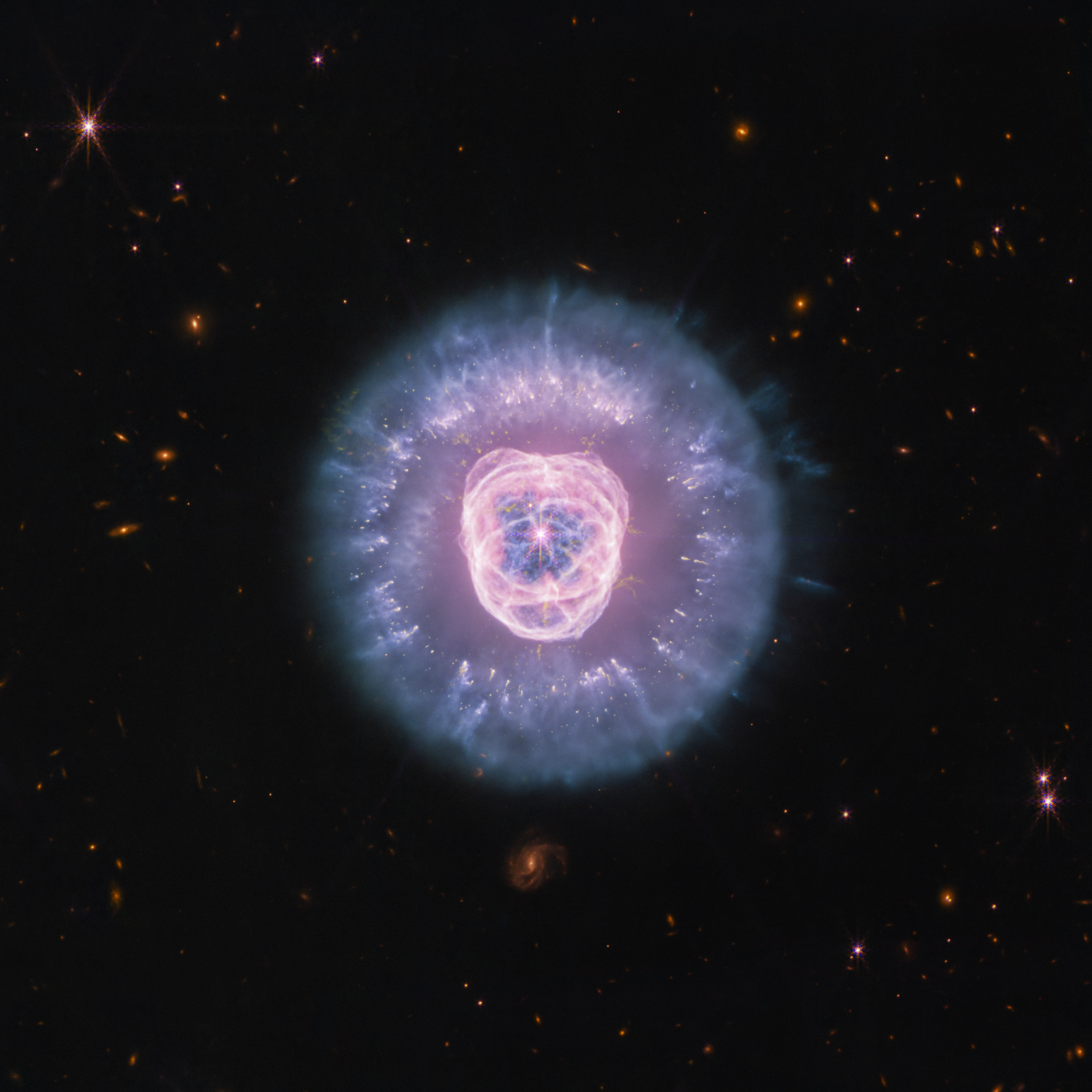
Explanation: Are we looking at the future of our Sun? The James Webb Space Telescope captured today’s composite image of the Lion’s Head Nebula (NGC 2392) with its NIRCam and MIRI instruments. The Lion’s Head Nebula is the remnant of a Sun-like star. This star was unable to sustain the nuclear fusion in its core needed to remain stable. It began to shed layers of gas and dust into space, forming this planetary nebula. A hot stellar core, called a white dwarf, is left behind within the lion’s nose. Do not boop this nose! Intense radiation from the white dwarf is ionizing the gas as it expands, creating the irregular bubble that makes up the lion’s face. Dust clumps that have survived the white dwarf’s radiation and a cloud of ionized gas make up the lion’s mane. This new and more detailed view of the nebula will help humanity learn more about how the gas and dust interact with each other and the white dwarf radiation.
Tomorrow’s picture: a waterfall of light
Date: August 26, 2026 Credit: Image: NASA, ESA, CSA, STScI; Image Processing: Alyssa Pagan (STScI) Authors & editors: Keighley Rockcliffe, Robert Nemiroff, Jerry Bonnell, Cecilia Chirenti A service of: ASD at NASA / GSFC,NASA Science Activation & Michigan Tech. U.
Random APOD Generator
Yesterday’s Image APOD: 2026 August 25 – Earth’s Shadow Visualized with Lunar Eclipses
Tomorrow’s Image
APOD: 2026 August 26 – JWST Images The Lion’s Head Nebula
APOD
Astronomy Picture of the Day
Discover the cosmos! Each day a different image or photograph of our fascinating universe is featured, along with a brief explanation written by a professional astronomer.
JWST Images The Lion’s Head NebulaExplanation: Are we looking at the future of our Sun? The James Webb Space Telescope captured today’s composite image of the Lion’s Head Nebula (NGC 2392) with its NIRCam and MIRI instruments. The Lion’s Head Nebula is the remnant of a Sun-like star. This star was unable to sustain the nuclear fusion in its core needed to remain stable. It began to shed layers of gas and dust into space, forming this planetary nebula. A hot stellar core, called a white dwarf, is left behind within the lion’s nose. Do not boop this nose! Intense radiation from the white dwarf is ionizing the gas as it expands, creating the irregular bubble that makes up the lion’s face. Dust clumps that have survived the white dwarf’s radiation and a cloud of ionized gas make up the lion’s mane. This new and more detailed view of the nebula will help humanity learn more about how the gas and dust interact with each other and the white dwarf radiation.
Tomorrow’s picture: a waterfall of light
Date: August 26, 2026 Credit: Image: NASA, ESA, CSA, STScI; Image Processing: Alyssa Pagan (STScI) Authors & editors: Keighley Rockcliffe, Robert Nemiroff, Jerry Bonnell, Cecilia Chirenti A service of: ASD at NASA / GSFC,NASA Science Activation & Michigan Tech. U.
Random APOD Generator
Yesterday’s Image APOD: 2026 August 25 – Earth’s Shadow Visualized with Lunar Eclipses
Tomorrow’s Image
New Simulations Show How Galactic Centers Grow Together
Using a state-of-the-art galaxy simulation, a team led by scientists from the Leibniz Institute for Astrophysics Potsdam (AIP) gained new insights into the processes shaping galactic centres across the Universe and the formation history of the Milky Way.
New Next-Gen Dish Adds Muscle to NASA’s Deep Space Network
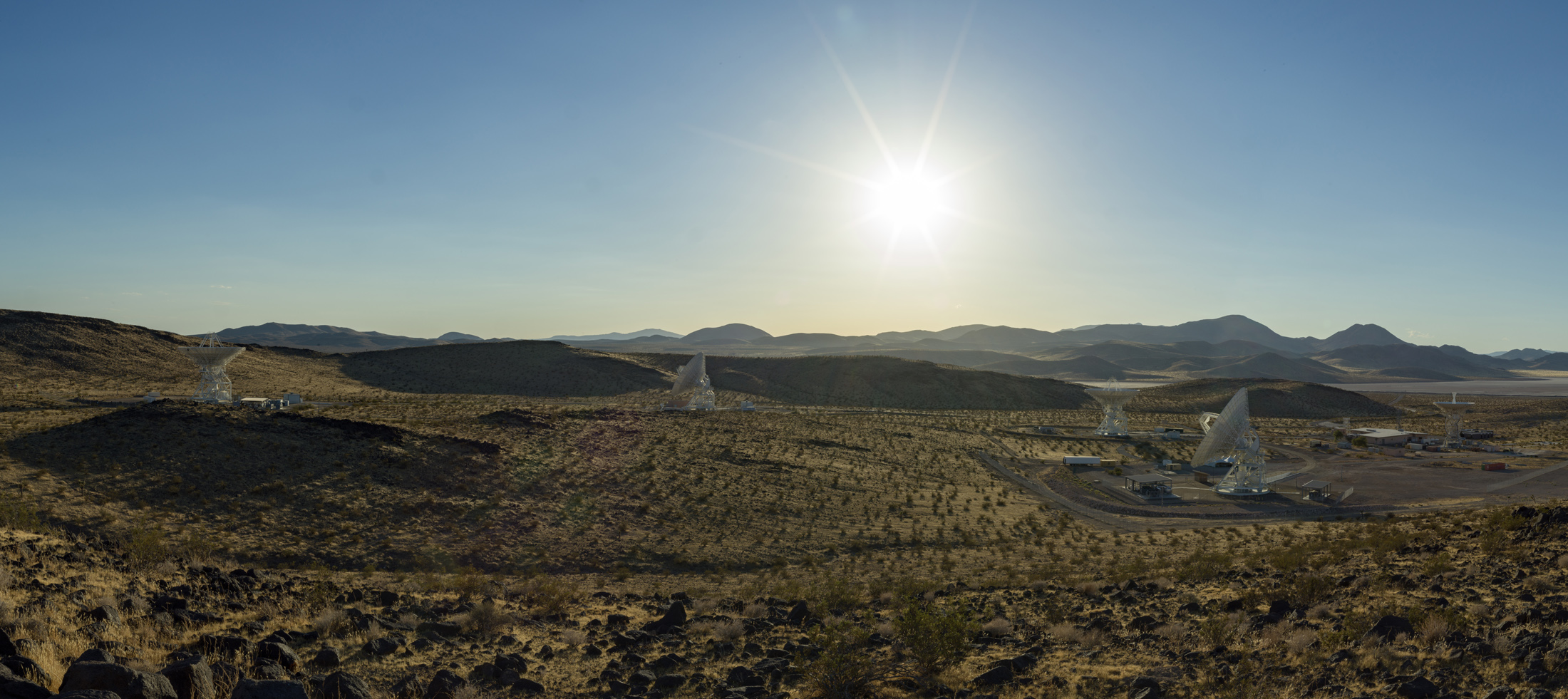
NASA’s Deep Space Network facility in California is marking the addition of a brand new 34-meter-wide (114-foot-wide) radio frequency antenna to the agency’s deep space communications and navigation system. The network uses giant dish antennas located at three global facilities to support more than 40 spacecraft exploring the solar system and interstellar space.
The new Deep Space Station 23 (DSS-23) is located at the Goldstone Deep Space Communications Complex, near Barstow, and is managed by NASA’s Jet Propulsion Laboratory in Southern California.
NASA leadership and personnel as well as dignitaries gathered at the complete DSS-23 antenna for a ceremonial ribbon cutting. It’s the latest to be added as part of the Deep Space Network’s Aperture Enhancement Project, which began in 2009 to upgrade and expand the network by adding six new 34-meter multifrequency beam-waveguide antennas. These versatile dishes can enhance many missions operating over different radio frequencies.
“By expanding the Deep Space Network, we are strengthening the communications foundation NASA needs for the bold missions ahead — from exploring more of the Moon than ever before to peering deeper into the solar system,” said James Kenyon, associate administrator of the Research and Technology Mission Directorate at NASA Headquarters in Washington. “This new antenna will help us deliver on our national goals for space exploration and push beyond the limits of what once seemed impossible.”
After completing a testing campaign from May through July to demonstrate its capabilities, the new DSS-23 began operations on Aug. 3, tracking NASA’s Chandra X-ray Observatory. Since then, it has been communicating with dozens of missions such as NASA’s Mars Reconnaissance Orbiter, Psyche, Juno, Voyager 1, and other robotic spacecraft in deep space.
Long shadows are cast by the recently completed Deep Space Station 23 at the Deep Space Network’s Goldstone complex near Barstow, California. A multifrequency beam waveguide antenna, DSS-23 will boost the DSN’s capacity and enhance NASA’s deep space communications capabilities for decades to come.NASA/JPL-Caltech NASA, Jet Propulsion Laboratory, and Deep Space Network leadership pose in front of the recently completed Deep Space Station 23 (DSS-23) antenna at the Deep Space Network’s Goldstone complex near Barstow, California, on Aug. 25, 2026..NASA/JPL-Caltech“The addition of this next-generation antenna brings us closer to a completely modernized network that embraces advanced technology to ensure NASA’s leadership in deep space communications,” said Dave Gallagher, director of JPL. “After over 60 years of continuous operations supporting consequential missions, these upgrades prime the network for a new era of exploration. The teams that designed, planned, and built DSS-23 should be proud.”
Enhanced capabilitiesConstruction of DSS-23 began in February 2020. After the 133-ton metal reflector framework was placed and bolted atop the antenna’s pedestal in December 2024, engineers installed the panels to the framework that reflect radio frequency signals transmitted to and received from spacecraft. Then came the careful process of calibrating the antenna so it can work in concert with the rest of the network.
It is the fifth antenna at Goldstone (joining three 34-meter antennas and one 70-meter, or 230-foot, antenna) and the fifth enhancement project antenna to join the network, which includes antennas at the DSN’s Goldstone, Madrid, and Canberra, Australia, complexes. Multifrequency beam waveguide antennas direct signals down to a stable, climate-controlled underground room, rather than housing heavy, sensitive electronic equipment on the moving antenna dish. In addition to offering versatility, this design allows easy access for maintenance and upgrades to the system.
“The biggest challenge wasn’t actually constructing the antenna. It was transforming a complex collection of mechanical, electrical, software, radio frequency, and infrastructure systems into a single, mission-ready asset,” said Germaine Aziz, manager of the Deep Space Network Aperture Enhancement Project at JPL. “Every subsystem must be integrated, calibrated, and verified to operate with extraordinary precision and reliability before it can support NASA’s deep space missions.”
The enhancement project will be complete when a sixth enhancement-project antenna, Deep Space Station 33, comes online at the Canberra facility in 2029, bringing the total number of 34-meter antennas across the network to 13. The 34-meter antennas can be arrayed (combined and operated together) to provide an equivalent communications backup for each facility’s single 70-meter antenna, which, after more than 50 years of near-continuous operation, are getting increasingly costly to maintain and repair.
Managed by Caltech for NASA, JPL manages the agency’s Deep Space Network with the oversight of NASA’s SCaN (Space Communications and Navigation) Program within NASA’s Research and Technology Mission Directorate. More than 100 NASA and non-NASA missions rely on the Deep Space Network and Near Space Network. They include missions that support astronauts aboard the International Space Station and future Artemis missions, monitoring Earth, exploring the Moon, and exploring the solar system and beyond.
For more information about the Deep Space Network, visit:
New Next-Gen Dish Adds Muscle to NASA’s Deep Space Network
NASA’s Deep Space Network facility in California is marking the addition of a brand new 34-meter-wide (114-foot-wide) radio frequency antenna to the agency’s deep space communications and navigation system. The network uses giant dish antennas located at three global facilities to support more than 40 spacecraft exploring the solar system and interstellar space.
The new Deep Space Station 23 (DSS-23) is located at the Goldstone Deep Space Communications Complex, near Barstow, and is managed by NASA’s Jet Propulsion Laboratory in Southern California.
NASA leadership and personnel as well as dignitaries gathered at the complete DSS-23 antenna for a ceremonial ribbon cutting. It’s the latest to be added as part of the Deep Space Network’s Aperture Enhancement Project, which began in 2009 to upgrade and expand the network by adding six new 34-meter multifrequency beam-waveguide antennas. These versatile dishes can enhance many missions operating over different radio frequencies.
“By expanding the Deep Space Network, we are strengthening the communications foundation NASA needs for the bold missions ahead — from exploring more of the Moon than ever before to peering deeper into the solar system,” said James Kenyon, associate administrator of the Research and Technology Mission Directorate at NASA Headquarters in Washington. “This new antenna will help us deliver on our national goals for space exploration and push beyond the limits of what once seemed impossible.”
After completing a testing campaign from May through July to demonstrate its capabilities, the new DSS-23 began operations on Aug. 3, tracking NASA’s Chandra X-ray Observatory. Since then, it has been communicating with dozens of missions such as NASA’s Mars Reconnaissance Orbiter, Psyche, Juno, Voyager 1, and other robotic spacecraft in deep space.
Long shadows are cast by the recently completed Deep Space Station 23 at the Deep Space Network’s Goldstone complex near Barstow, California. A multifrequency beam waveguide antenna, DSS-23 will boost the DSN’s capacity and enhance NASA’s deep space communications capabilities for decades to come.NASA/JPL-Caltech NASA, Jet Propulsion Laboratory, and Deep Space Network leadership pose in front of the recently completed Deep Space Station 23 (DSS-23) antenna at the Deep Space Network’s Goldstone complex near Barstow, California, on Aug. 25, 2026..NASA/JPL-Caltech“The addition of this next-generation antenna brings us closer to a completely modernized network that embraces advanced technology to ensure NASA’s leadership in deep space communications,” said Dave Gallagher, director of JPL. “After over 60 years of continuous operations supporting consequential missions, these upgrades prime the network for a new era of exploration. The teams that designed, planned, and built DSS-23 should be proud.”
Enhanced capabilitiesConstruction of DSS-23 began in February 2020. After the 133-ton metal reflector framework was placed and bolted atop the antenna’s pedestal in December 2024, engineers installed the panels to the framework that reflect radio frequency signals transmitted to and received from spacecraft. Then came the careful process of calibrating the antenna so it can work in concert with the rest of the network.
It is the fifth antenna at Goldstone (joining three 34-meter antennas and one 70-meter, or 230-foot, antenna) and the fifth enhancement project antenna to join the network, which includes antennas at the DSN’s Goldstone, Madrid, and Canberra, Australia, complexes. Multifrequency beam waveguide antennas direct signals down to a stable, climate-controlled underground room, rather than housing heavy, sensitive electronic equipment on the moving antenna dish. In addition to offering versatility, this design allows easy access for maintenance and upgrades to the system.
“The biggest challenge wasn’t actually constructing the antenna. It was transforming a complex collection of mechanical, electrical, software, radio frequency, and infrastructure systems into a single, mission-ready asset,” said Germaine Aziz, manager of the Deep Space Network Aperture Enhancement Project at JPL. “Every subsystem must be integrated, calibrated, and verified to operate with extraordinary precision and reliability before it can support NASA’s deep space missions.”
The enhancement project will be complete when a sixth enhancement-project antenna, Deep Space Station 33, comes online at the Canberra facility in 2029, bringing the total number of 34-meter antennas across the network to 13. The 34-meter antennas can be arrayed (combined and operated together) to provide an equivalent communications backup for each facility’s single 70-meter antenna, which, after more than 50 years of near-continuous operation, are getting increasingly costly to maintain and repair.
Managed by Caltech for NASA, JPL manages the agency’s Deep Space Network with the oversight of NASA’s SCaN (Space Communications and Navigation) Program within NASA’s Research and Technology Mission Directorate. More than 100 NASA and non-NASA missions rely on the Deep Space Network and Near Space Network. They include missions that support astronauts aboard the International Space Station and future Artemis missions, monitoring Earth, exploring the Moon, and exploring the solar system and beyond.
For more information about the Deep Space Network, visit: