

Feed aggregator
How to tell a comet from an asteroid and a meteor from a meteorite
A field guide to the space rocks you might see streaking across the night sky
Listening to the One Place That Swallows Everything
The event horizon of a black hole should be impossible to study. It’s the point of no return, the boundary where gravity grows so strong that not even light can escape, so by definition nothing can carry word of it back to us. Yet a team of scientists have found a way to reach it and found a hidden signal, a faint trace, never read before, carrying information from the very edge of the horizon in the instant before it formed. From it they measured the new black hole's spin and surface gravity, and opened a fresh way to test whether Einstein's theory survives in the most extreme gravity there is.
Hot Jupiter CoRoT-2b Rotates Backward to Orbit
Hot Jupiter exoplanets have completely changed how we look at the universe. This is because before the first exoplanet orbiting a Sun-like star was discovered in 1995, 51 Pegasi b, astronomers theorized every solar system looks just like ours: rocky planets orbiting close to the Sun and gas giants orbiting farther away. In contrast, 51 Pegasi b, whose mass is half of Jupiter and radius is about one-quarter larger, was found to orbit its star in just over 4 days.
Deuterium in Comets Tells Interesting Tales
Comets have play an interesting role in astronomy history. From antiquity, many cultures saw them omens or spirits, portending good or bad news for kings, queens, and emperors. Over the past few hundred years, however, astronomers have studied them intently to understand the science behind these visitors to the inner Solar System. Today we know that these ghostly apparitions in the sky are made of dirty balls of ice and rock blasting through space, scattering dust and gases as they go.
Astronomers Spot a Possible Supernova Remnant Near the Milky Way's Supermassive Black Hole
NASA’s Chandra X-ray Observatory and ESA’s XMM-Newton may have found a supernova remnant near the supermassive black hole at the center of the Milky Way galaxy. If confirmed as a supernova remnant, the ejected material is moving at about two million miles per hour and is about 1,700 years old.
How to protect Earth from a deadly asteroid impact
Our solar system is a celestial shooting gallery, chock-full of flying projectiles that one day could threaten Earth—so what can we do about it?
What's best for baking—butter or margarine? A food scientist explains
Key differences in the chemical structure of butter and margarine mean choosing one or the other has a big effect on your baking
#798: Our Summer Media List
Well, we’re just a couple of weeks away from summer hiatus and so it’s time to give you some homework. Here’s our list of stuff we’ve been reading watching and playing. This should fill the Astronomy-Cast-shaped hole in your media landscape. On the plane, on the beach, from the passenger seat in a car, summer is a time for escaping into a good book, video, or game. From classics to the latest releases, here are our recommendations for keeping your brain occupied while your body is renewed.
Show NotesBooks
- The Edge of Space-Time, Particles, Poetry, and the Cosmic Dream Boogie — Chanda Prescod-Weinstein
- Reentry — Eric Berger (the story of SpaceX's reusable rocket revolution)
- The First Law & The Age of Madness series — Joe Abercrombie (start with The Blade Itself)
- Dungeon Crawler Carl series — Matt Dinniman (especially the Jeff Hays audiobooks)
- When the Moon Hits Your Eye — John Scalzi
TV Shows
- Ahsoka
- The Expanse
- Voltron
- Stargate SG-1
- Alien: Earth
Movies
- Badlands
- Prey
- Project Hail Mary
- Frankenstein
- Mickey 17
- Close Encounters of the Third Kind (rewatch discussion)
- Bill & Ted's Excellent Adventure trilogy
Games
- Minecraft
- Slay the Spire (and Slay the Spire 2)
- Path of Exile 2
Other Topics
- Summer weather, heatwaves, thunderstorms, and ongoing earthquake activity in Nicaragua.
- Why Chanda Prescod-Weinstein's work bridges physics, philosophy, and culture.
- The growing Dungeon Crawler Carl franchise, including audiobooks, comics, RPGs, and a TV adaptation.
- Thoughts on recent science fiction, fantasy, and gaming trends to keep astronomy fans entertained over the summer.
Fraser Cain:
AstronomyCast, Episode 798, our summer media list. Welcome to AstronomyCast, our weekly facts-based journey through the Cosmos, where we help you understand not only what we know, but how we know what we know. I'm Fraser Cain, I'm the publisher of Universe Today.
With me as always is Dr. Pamela Gay, a senior scientist for the Planetary Science Institute and the director of CosmoQuest. Alright Pamela, I'm going to ask you the question, how are you?
Dr. Pamela Gay:
I am humid, or at least my room is humid. So are we. It's like 30,000%, I mean, it's actually in this room 88% humidity, and I had to turn the dehumidifier off to record, so yeah.
Fraser Cain:
We got nasty hot yesterday, and then today is cloudy, but then it's like the heat turned into humidity, and so now it's just gross and sticky, but yeah, this is, I mean, El Nino, this is going to be a funny summer.
Dr. Pamela Gay:
Yeah, yeah, although we've been having luck in terms of all the massive thunderstorms hitting the Midwest have been going north of us, so it's like the weather forecast is you're going to die, you're going to die, you're going to die, nothing, and it's just wild.
Fraser Cain:
So it isn't weather, but we have a slow rolling swarm of earthquakes on Nicaragua right now. Okay, yeah, yeah, so we've got some slow slip faults, I forget exactly the geology term for this. It is very safe, yeah, and we haven't felt them at all, but there are near constant earthquakes going on right now here in this sort of, I don't know, two to four magnitude level, but they're constant.
Dr. Pamela Gay:
Yeah, we have that here because of the New Madras fault, and the place that you notice it is retaining walls built with the bricks that stack on top of each other will just slowly- So they're just getting shaken all the time. They just take themselves apart, so yeah, you have to rebuild those every few years.
Fraser Cain:
Yeah, we don't use those, we don't use bricks here because of that. Your houses just explode, like there's no point, you use timber, steel or timber.
Dr. Pamela Gay:
Whereas we have a brick factory in town.
Fraser Cain:
Yeah, yeah, well, we're just a couple of weeks away from summer hiatus, and so it's time to give you some homework. Here's our list of stuff we've been reading, watching, and playing. This should fill the Astronomy Cast shaped hole in your media landscape.
All right, as we always do, and I think we've expanded it wisely to include not just the books from your summer reading list, but also the movies we've been watching, the TV shows we've been watching, the games we've been playing, because we have very lopsided amounts of those various things that we consume. And so this will give us a chance to sort of cover all of our hobbies in one place. But let's start with reading, because I think this is what people are hoping to hear from us.
So, I mean, we should definitely cover some of like, if you just haven't read these, you should read them because we recommend them every six months. And then, and also some new stuff that we're reading that maybe people haven't heard of.
Dr. Pamela Gay:
So to start with new stuff, I just read The Edge of Space-Time, Particles Poetry, and the Cosmic Dream Boogie by Chandra Prescod-Weinstein. And I made the mistake of getting this book in audio. I read audio all the time.
And the reason it was a mistake is this is the kind of book that was just chock full of ideas and phrasings that I just wanted to underline. And so there's just like all these little things in it. I'm trying, my desk is literally covered in post-it notes from reading this book.
Wow. And like, one of my favorites was Black Holes are Melting Pots, and the universe is just as complex today as it was in the beginning. It's evolving, but the complexity isn't changing.
I'm paraphrasing terribly. And there's just these neat things that were just slightly different ways of looking at our universe that I just want to think on. And I think the one that's going to stand with me the most is because she was talking about space and time, one of the things that came up was in the Bantu language, the whole to be or not to be doesn't mean quite the same thing because to them, to be is both a time and spatial thing.
So whenever you say to be, you are defining both. And I just love the implications to physics of starting from a language that has those two things intrinsically tied together. So yeah, I am going to stop gushing.
Just go get the book, people. Go get the book, write all over it, enjoy it.
Fraser Cain:
And what's the book again?
Dr. Pamela Gay:
It is The Edge of Space-Time, Particles Poetry and Cosmic Dream Boogie. It references music, it references literature, it's just good. It's by Chanda Prescod-Weinstein.
Fraser Cain:
Yeah. And she's a treat.
Dr. Pamela Gay:
She is.
Fraser Cain:
I've interviewed her a couple of times and is sort of just a great sort of mix of deep axion knowledge.
Dr. Pamela Gay:
Yeah, particle physics.
Fraser Cain:
Because her specialty is in, yeah, her specialty is in particle physics and specifically the axion as an explanation for dark matter. And then a much wider kind of science communication and cultural awareness. Yeah, absolutely.
Great person to both interview and chat with. So I have, I've read, it's funny, you brought up like a non-fiction book and I've read a ton for my work and now I didn't even think to write any of them down. And so I had interviewed astronauts and interviewed, I interviewed Eric Berger and he did a recent sort of book about SpaceX and sort of what had happened with their sort of push for reusability.
And you know, it really kind of sets the modern state of where we are in reusable rocketry leading up to, but not quite sort of covering what happens with Starship. But more all about the reusability and stuff of Falcon 9. And this was the, this was the sequel, um, right.
Okay. So, so the first book that Eric Berger did was called Liftoff. And this was like the original development of SpaceX.
And then the second book is Reentry, which covers the, the reusable phase of the, of the company's development. And I think, you know, like obviously SpaceX just went IPO, it is a incredibly controversial company, especially with the behavior of the CEO, but it is worth understanding the company, what's going on, what their plans are, what they say their plans are versus the actions that they actually take. And Eric Berger is a wonderful kind of ambivalent journalist about the company.
And so it is definitely not a fan boy coverage of it. And so I think he was horrific. So and now I'm going to talk about a fantasy series and this is by an author named Joe Abercrombie and he's got sort of two main series that he did.
One is called The First Law and the other one's called The Age of Madness, sort of two trilogies. And it's sort of low fantasy, so like Conan the Barbarian type fantasy or like old Jack Vance, which is one of my favorite fantasy authors. Really well written.
And what is really incredible about it is the, is the characters. He is a master of telling characters and the gist is about, it's, it's kind of Games of Thrones-esque where you've got various kingdoms, they're dealing with an ongoing threat and the political machinations and a threat from the North and so on. But the, the individual characters who kind of rise and, and to, to solve this problem are very complicated, very shades of gray in them.
You know, one is a torturer, one is, one is, you know, the veteran of countless battles and he's starting to sort of have a little bit more empathy for his common man. And it's just, they're so good. They're so good.
And this is, this is a recommendation from my son, who is, he's decided this is his absolute favorite. You know, originally it was Dinaman, which we're going to talk about in a second, but this is his new absolutely favorite fantasy series. So this is Joe Abercrombie, The First Law and the Age of Madness trilogies.
The first book is called The Blade Itself and it is just terrific. I'm, I'm, I've almost finished the first book and I'm, I'm just going to be guzzling them all down. So.
Dr. Pamela Gay:
So shall we go to Dinaman?
Fraser Cain:
Let's talk about Dinaman, yeah, yeah, he's, he is the 800 pound gorilla that is now consuming all media.
Dr. Pamela Gay:
So, so his Dungeon Crawler Carl series is the best of the books he's written. He did a, I think it was the Kaiju Surgeon before it. Do not read that unless you're willing to go to a very dark, gruesome place.
It is, it is going, yeah, it, it takes you to not great places. Dungeon Crawler Carl, amazing. Project Bounce House is good.
Fraser Cain:
I haven't read Operation Bounce House.
Dr. Pamela Gay:
The Dungeon Crawler Carl, it exists in standard audio book, full cast audio book, which has additional content, a web tune, which has yet more additional content. They are working on a role playing game that comes out in the fall. They are working on comic books with additional, and a TV show.
Yeah, I keep forgetting about the TV show. That one wasn't on Kickstarter, so I don't get emails.
Fraser Cain:
Yeah, yeah, the TV show is, is Seth MacFarlane is behind it.
Dr. Pamela Gay:
So one of my favorite quotes is part of this. This is another one of those series that is going to force me to buy it in paper so I can underline and dog ear. I, I'm bad to the books I love.
But the quote is, you will not break me. You can hurt me, even kill me, but you will not break me. And, and that idea in our modern world where so many of our freedoms seem to be under threat is just so cogently expressed.
Fraser Cain:
And I think like the Dungeon Crawler Carl books are not high literature. You are not going to feel challenged at your core and cause you to rethink your perspectives on man's inhumanity to man. You are going to be wildly entertained with a level of ramp, ramping up stakes, the likes of which you have never experienced before, and you cannot believe how bonkers this book gets.
And the fact that Seth MacFarlane is trying to turn this into a TV show, the good luck dude. This is like, I don't know how some of the stuff that is covered in these books could ever turn into anything that would be practically possible on screen because it is bananas. And I cannot, I cannot understate how wild.
Dr. Pamela Gay:
Like an anime, I could see it as an anime.
Fraser Cain:
Yeah. Yeah. Anime would work fine.
But live action? But live action. I can't, I cannot, I can't.
Like, how do you cover some of the things with thousands of characters, the set pieces that are in this, the costumes, the, the, the special effects that would be required. It is bonkers, incomprehensible to me that someone is going to try and attempt this, but good luck dude. If you can pull it off, then I'll watch it.
But yeah, they're, they are, they are terrific. And I'm, I've, I haven't read this, the eighth book that just came out. Loved the first seven.
Definitely listen to the audio books if you can. If you, if you, because the, um, Jeff Hayes, the voice actor, Jeff Hayes just does an amazing job. He's so good.
He does different voices. You'll think it's a bunch of different people, but it's not. He's doing all these different voices.
He is phenomenal and it makes it, it just takes it to the next level.
Dr. Pamela Gay:
And there is a full cast recording where Jeff does his best characters. So he's still doing Carl. He's still doing, uh, Princess Donut.
He's still doing the ones that are like, he defined those characters, but then some of the other ones where he's kind of meh, like Hekla, they bring in, um, Katja is another one. Icelandic and him do not get along. Um, so sound booth theater, the books one through four are out in full cast.
Fraser Cain:
That's amazing.
Dr. Pamela Gay:
Yeah.
Fraser Cain:
So, um, it's like bordering on like radio plays and stuff.
Dr. Pamela Gay:
Yeah.
Fraser Cain:
It's such a, it's so good. Yeah. So you really, you know, reading, listening to as an audio book is definitely doing this and this will keep you busy all summer, right?
Eight books at this point, they are, they get better and better and better. Um, they get, the stakes get higher, the, the, the set pieces get wackier. It is just, and, and he never forgets a thing.
It's true. So every single piece has a reason that gets brought into the, that somehow shows up every, he is carting around a Chekhov's dump truck worth of, of things set to go off that he then has, uh, various, uh, payoffs later on in the series. It is.
Yeah. It is incredible. I can't even imagine the, the amount of, you know, the, the red string spaghetti wall of connections that he's got on where, however, however he is plotting out these, these, uh, these books.
Dr. Pamela Gay:
Yeah.
Fraser Cain:
They are absolutely great. And I think perfect summer reading, right? Like just, it is light, it is entertaining.
You will not be able to stop turning the pages. They are so good. All right.
Well, let's shift gears down and let's talk about TV.
Dr. Pamela Gay:
Uh, all right. There are so many books we didn't get to, I'm going to be adding a bunch of stuff to the notes. Um, so, so if, if you liked, uh, uh, clone wars, if you liked rebels, go watch them all.
It, it is in the timeline between those two series. It is really well done. I, it will at the last episode, have you going, no, because now you have to wait for the next episode.
Um, right. It's not and or quality. It is definitely rebels quality.
So keep that in mind.
Fraser Cain:
It's that same, it's that same creator, same voice, same style, same voice actors. Yeah. Yeah.
Very worried. Um, so, so for me, the one that sort of quickly jumped up to one of my top shows of the year was pluribus and it went from, you know, this is by Vince Gilligan, same, same director behind Breaking Bad. He worked on the X-Files, uh, Better Call Saul and, and pluribus is a masterpiece.
It is, it is slow, but the concepts are mind bending and it is really well done. And if you aren't familiar, essentially the world is taken over by an alien hive mind and is told from the perspective of a woman who is somehow immune to this and is trying to, uh, negotiate with the hive mind to remain out of it. Um, and, and it is just, it is so good.
So good. Uh, that's pluribus. Pluribus.
Yeah. Yeah. And that's on Apple, Apple TV.
Dr. Pamela Gay:
I just finished Invasion and it is definitely better in the first season than the other two seasons. And that made me sad.
Fraser Cain:
Yeah. Yeah. Invasion was not great.
Dr. Pamela Gay:
But I, I've decided I need some joy in my life. So I'm going to rewatch Expanse, which has no joy, but it is comfort food.
Fraser Cain:
Yes.
Dr. Pamela Gay:
Um, and I'm going to rewatch Voltron and see if it's still any good all these decades later. So, so those are my comfort foods that get rewatched this summer.
Fraser Cain:
Yeah. We're still doing our Stargate SG-1 rewatch. We're into season eight now and they totally hold up.
There's a hundred percent. Um, and the other TV show that went onto my top 10 of all time that also came out last year was Alien Earth. Yeah.
And this is, this is on Disney plus this was done by the same director. I forget his name, but he's the one, he did, um, was it Mutant X? So it was sort of like a retelling of, of an X-Men story.
And it was weird, but it was good. And this is, this is, but it was sort of like more weird than it was good, which is always like a very delicate, I'm always sort of very skeptical when a person attempts to go weird, but Alien Earth is weird and good.
Dr. Pamela Gay:
Noah Holley.
Fraser Cain:
Yeah. Noah Holley. Yeah.
Yeah. I mean, he, he introduces new terrifying xenomorphs into the canon and they are like a, like a little alien that goes and replaces the eyeball of anything that it is in. Um, so good.
So good.
Dr. Pamela Gay:
And you start to understand the history of the humanoid robots, which is something that I don't think has really been addressed anywhere else.
Fraser Cain:
Yeah. Yeah. And it's like, it's like set on earth.
And I think, you know, when you hear the premise, you're like, oh great, this sounds terrible. Like what is it? Xenomorphs rampaging around on earth.
People are fighting back. No, has, it's none of that. It is a totally different story about evil corporations, games up, you know, sort of having this, this one upping one another corporate malfeasance with this, with, with the potential incursion of, of aliens on earth.
And it is, it's absolutely terrific. Um, and again, in my top 10.
Dr. Pamela Gay:
One of the things that got me about this is it, it introduces this concept probably without even meaning to that mega corporations start to be like that, uh, schism between, uh, I think it was Portugal and England where the Pope divided the world. And so we see these mega corporations of, well, that's my property and you have to pay if you go there. Well, that's fine.
And you, and, and so just this division of, it was just sort of like, oh no, this is actually where we're going.
Fraser Cain:
Yeah. Yeah. I mean, like these ideas were handled quite well in Neuromancer by William Gibson.
And they sort of take this idea of corporations, mega corporations as, as state actors, much more than just as, as corporate, you know, businesses that exist within a nation. They are nation states of their own and yet they, they cross boundaries and they have powers the likes of which even the nation states that they're within cannot match. And, and are at the cutting edge, the bleeding edge of the technology, of the development of artificial intelligence and of, of going out, finding monsters and bringing them back to earth, damn the consequences.
So imagine if you had Elon Musk, Jeff Bezos, all of these various mega corporations, but they literally had no limits and, and we're trying to be better than one at all. Yeah. It's, so that whole layer to it just elevates it into another level of, of art.
I, I loved it so much. Let's talk about movies.
Dr. Pamela Gay:
All right. So if you're going to bring up Alien Earth, Badlands is a completely different look into the aliens predator universe.
Fraser Cain:
Oh, that's the predator Badlands. Yeah.
Dr. Pamela Gay:
It is just a delight. Um, it, it, it shows you a different side of the predators. It shows you, um, basically a kid coming of age and struggling and I mean, one of the predators here and yeah, it's just a delight and I don't know what to say that won't give away plot points, but it has the humanoid robots.
It has essentially kaiju and I'm here for kaiju always. Um, it, it, it was, it was a popcorn thriller.
Fraser Cain:
Yep. Totally. Totally.
If so, it's by the same people that drew God, it was the same people that did like the Clover Field. Anyway. So yeah, yeah. So, so like really good, solid filmmakers and you're exactly right, which is that the predators are, are not believable as villains because they're just like mustache twirling, evil, evil hunters that have, but no, in this they try and focus on sort of explain the society, give you some glimpses about how it works and then, and then sort of explain the hunting as, as, as part of this. And, and that worked really well for me.
And then just the, the action and the, the, the creativity and the monsters.
Dr. Pamela Gay:
Yeah. A hundred percent. I agree with you.
Ella Fanning in it is just fabulous.
Fraser Cain:
Yep. She's perfect.
Dr. Pamela Gay:
Um, so yeah, it's director Dan Trachtenberg, highly recommend, grab yourself a pizza, some soda, kick back and just prepare for a nothing burger of a delight. Yeah.
Fraser Cain:
Yeah. And like, there's no way people haven't watched Project Hail Mary yet, but if you haven't, go watch it.
Dr. Pamela Gay:
Yeah.
Fraser Cain:
And like, it's going to probably leave theaters pretty soon. I mean, if it hasn't already, it's going to switch to streaming, switch to DVDs, but, but go and enjoy it in the, in the theater if you can.
Dr. Pamela Gay:
Have you seen Disclosure Day? I haven't yet, but I'm hearing good things about it.
Fraser Cain:
Sure. So, uh, Karla and I have been watching a lot of, I've been on my DVD buying kick. And so I, I now have about 300 DVDs behind me that I've been picking up at thrift stores over the last year.
And I pick, I got Close Encounters of the Third Kind. And so we watched that and that was an experience. Um, not what I remembered at all.
Uh, I didn't love it.
Dr. Pamela Gay:
You took like four when it came out. Yeah. Yeah.
Yeah.
Fraser Cain:
Um, I didn't love it so much. Like a lot of the ideas and sort of thoughts about aliens have kind of aged. Yeah.
And so apparently like it was Close Encounters, E.T., which I, I refuse to watch again. Like I cannot bring myself to watch E.T. And then, um, Disclosure Day or sort of like a trilogy says Spielberg. Oh, really?
So yeah.
Dr. Pamela Gay:
Yeah.
Fraser Cain:
Yeah. Like E.T. blew my mind, but I want that, I want as a child, but I want that memory to exist in that, in my memory, not for me to watch it as a 54 year old man going, Oh God, cringe. This is terrible.
Um, and then, um, you had a couple more, more movies that you had seen recently.
Dr. Pamela Gay:
Right. So Mickey 17 is one about cloning that is just a, Oh, this is the direction it could go in. Isn't it?
Um, yeah.
Fraser Cain:
So this is the direct same director of Bonjimoon is the same director that did Parasite.
Dr. Pamela Gay:
Right. And, and you can see that. And the basic premise is people can sign up to have their personality dumped from body to body to body, but they're only allowed to be in one body at a time.
And an accident occurs where they think someone has died doing just like these people are assigned to do terrible work, dangerous work, medical research, all that sort of stuff where ideally you want to test on a human being, but really you should not. So they're doing it on clones because that's more ethical. And, and so it raises all of these questions as you go it, including, is it cheating if it's one clone and another, um, so it's, it's a book I wrote, not a book.
It's a movie.
Fraser Cain:
I, it is. Okay. I did not know that.
Yeah. Yeah. It's based on a book.
Dr. Pamela Gay:
So I enjoyed it. And then I also, Frankenstein is super pretty and it is the closest retelling to the actual book that I think I've ever seen. Like it includes the, the going through the ocean, uh, and finding Frankenstein out on the ice that I, I don't think I've seen in a movie ever before.
And it's just so pretty. It's pretty.
Fraser Cain:
So my, um, comfort food was to rewatch the Bill and Ted's Excellent Adventure Trilogy with Carly. And I was super nervous cause I loved it when I was young and they're great. They totally holds up.
Uh, the first one is charming and, and, and fun. The, the second one is fine. It's you know, with a bunch of kind of clever elements and the third one is really good as well.
So watching all three movies, I, they're on my top 100 sci-fi movies of all time or the first one is, and I was, I was like nervous, like, Oh, does it belong there still? And it, yep. It's terrific.
I still loved it. So last but not least, we should talk about video games and you just have like one video game.
Dr. Pamela Gay:
I play Minecraft. I like Minecraft.
Fraser Cain:
I play Minecraft.
Dr. Pamela Gay:
Yeah. Yeah. It's, it's who I am as a person.
Fraser Cain:
So Splay the Spire is one of my all time favorite games and they sort of define this genre, the deck builder genre, where you are making your way through this spire, this castle, and you run into these encounters and then you get cards that drop and then you have to sort of build a deck of cards you can then play. Well, it's everything. Okay.
It's on everything. Yeah. And it's, it is, it is kind of like you're playing Magic the Gathering or Hearthstone, but it is unfolding in real time and you're building the deck from what you find and you're having to make these compromises and the, and the fights get harder as your cards get better.
Dr. Pamela Gay:
Oh man.
Fraser Cain:
But also your card gets kind of, your, your, your deck gets overlooked. It is the greatest game. It is, it is like top five best games ever made.
Dr. Pamela Gay:
One time payment or micro payments?
Fraser Cain:
One time payment.
Dr. Pamela Gay:
Okay.
Fraser Cain:
Um, it came out like maybe five, six years ago. And so Slay the Spire 2 just came out and they sort of went back and, and, and came up with entirely new encounters, but they kept the entirely new classes for you to play. Yeah.
You haven't played Slay the Spire?
Dr. Pamela Gay:
I haven't. I live in fear of games because I'll get addicted and then you won't see me for eight months.
Fraser Cain:
Yeah. This one will destroy you. You know, Slay the Spire, the original one will destroy you, but it is, it is so good.
It is so good. And then Slay the Spire 2, also very good. Um, and, but, but it's, you, you can never recapture the feeling of playing it in the first place.
Like it is, it is great. It is great. And there's UI improvements and the totally new encounters and totally new spells and new dynamics and new, but, but when you play like a, yeah, make sure if you do get Slay the Spire, uh, and it is great cause it'll play on your phone.
It'll play on your Steam Deck. It'll play in your computer. It'll play in your iPad, like whatever device you have, they have a version of it on your switch.
You can play Slay the Spire and it is, it is so great. Um, and like defined a whole genre of these deck builder games.
Dr. Pamela Gay:
I do play Magic the Gathering in real life.
Fraser Cain:
Yeah. So it's like if you just want that same itch where you're opening up booster packs to get booster packs to get new cards and figure out a way to use these in new and interesting ways. Slay the Spire does that except you don't have to invest any money and the, every run is different and you start to build up these, this understanding of the deeper mechanics of the game.
It's yeah. And then there's different classes, different classes operating different, totally different ways. Uh, and yeah, they're so good.
Um, and then the other one is the new season of Path of Exile 2 and they're still in, there's a 0.5 so they hadn't even gone to their full release yet, but we're about a little over a year since they first came out for beta for Path of Exile and the new, uh, 0.5 edition. They redid the entire end game, add a bunch more classes, made the crafting system a lot better. It is starting to approach the complexity and quality of the original Path of Exile, but is, has a much better engine.
And this is kind of Diablo. Like if you've ever played Diablo, running through dungeons, killing monsters, picking up their stuff, improving your character, rinse, repeat, but Path of Exile is just that for spreadsheet nerds. And Path of Exile 2 is trying to sort of make it more of a, more of an interesting, um, accessible game while still having a lot of the deep mechanics and they're, they're starting to kind of get to the point where the Path of Exile 2 is, is as good as Path of Exile 1.
I still like Path of Exile 1 better, but, but, but two, if you want an introduction, if you like want to start playing the game now, it is very polished, uh, definitely on its way and they're hoping to have it released by the end of the year for 1.0. It's, it's amazing. And you know, relatively inexpensive, you can play Path of Exile for free and then you can play Path of Exile 2 for, I think 30 bucks to just get an account for it. Yeah.
It's not bad at all. And it'll give you, I mean, I have two or 3000 hours of time to Path of Exile 1. Yeah.
And it probably 300 hours into Path of Exile 2. So yeah. Yeah.
Bang for your buck. It's literally limitless.
Dr. Pamela Gay:
Yeah.
Fraser Cain:
All right. I think we've reached the end of our episode. So hopefully this will give people some ideas and we tried to give you new stuff that maybe you hadn't heard of before.
So that will keep you busy over the summer.
Dr. Pamela Gay:
There's one book that I need to mention that I didn't get in.
Fraser Cain:
Sure.
Dr. Pamela Gay:
John Scalzi's When the Moon Hits Your Eye is absolutely ridiculous. And if you just need escapism physics, um, Phil Plait, one of our friends was the science advisor on it and it is a delight. Yeah.
Fraser Cain:
He turns the moon into actual cheese.
Dr. Pamela Gay:
Yeah.
Fraser Cain:
Yeah.
Dr. Pamela Gay:
It is. It is a must read at some point.
Fraser Cain:
Yes.
Dr. Pamela Gay:
And we'll bring you silly joy.
Fraser Cain:
That's great. Fantastic. All right.
Thanks pal.
Dr. Pamela Gay:
Thank you, Fraser. And thank you to all of our Patreons. Some of you are realizing you can make me say silly things by having silly Patreon names.
To those of you who make me laugh, I raise a toast. To those of you with names I'm about to mispronounce, I'm just really sorry. Here we go.
This week, I would like to thank a bit of bear, Alex Cohen, Andre Palestra, Arctic Fox, Bore Andra Lovesvall, Benjamin Carrier, Bob Kale, Brian Cook, Buzz Parsec, Cody Rose, Daniel Loosley, David Bogarty, Diane Philippon, Dr. Jeff Collins, Eron Zegra, Father Prax, G. Caleb Sexton, Glenn McDavid, Greg Vylde, Helga Bjorkog, Janelle, Jeanette Wink, Jim Schouler, Joe McTee, John M, Jordan Turner, Caleb Axson, Keith Murray, Christian Golding, Laura Kettleson, Lana Spencer, Mark Schneider, Matt Rucker, MHW1961 Super Symmetrical, Michael Regan, Nala, Noah Albertson, Paul D. Disney, Pauline Middleink, Randall, R3, Robert Hundle, Sergio Sansevero, Sandra Stanz, Scott Briggs, Sergei Monolov, Stephen Coffey, The Big Squish Squash, Triker, Will Field, and Zero Chill.
Thank you all so very much.
Fraser Cain:
All right. We will see you next week for the final episode. Bye, everyone.
Bye-bye.
Live ShowThe Nancy Grace Roman Space Telescope Arrives in Florida Ahead of Launch
NASA’s Nancy Grace Roman Space Telescope arrived June 21st, at the agency’s Kennedy Space Center in Florida, marking the start of final prelaunch preparations before liftoff later this summer.
Will humans one day talk to animals? This scientist is bringing us closer
Julie Elie has been studying zebra finch vocalizations for years. Now, she has won the Coller-Dolittle Prize for progress toward a world where humans can talk to animals
NASA Announces Winners for 2026 Human Lander Challenge
NASA has announced the top student-developed solutions for environmental control and life support systems in future crewed lunar landers from participants in the 2026 Human Lander Challenge. The announcement marks the culmination of months of research by university teams working to advance technologies supporting the agency’s Artemis program that will return American astronauts to the Moon in 2028.
The challenge concluded June 25 following final technical presentations near NASA’s Marshall Space Flight Center in Huntsville, Alabama. Since September 2025, student teams from across the nation have designed systems‑level approaches to enhance the performance and reliability of environmental control and life support technologies essential for astronauts during deep space missions.
University students and advisors from 11 finalist teams gathered in Huntsville, home to NASA’s Marshall Space Flight Center, June 23-25 for the agency’s third annual Human Lander Challenge. This year’s competition challenged students to consider solutions for environmental control and life support systems for long duration spaceflight. These technologies are essential for maintaining breathable air, potable water, and thermal stability for astronauts during deep space missions. NASA/Charles Beason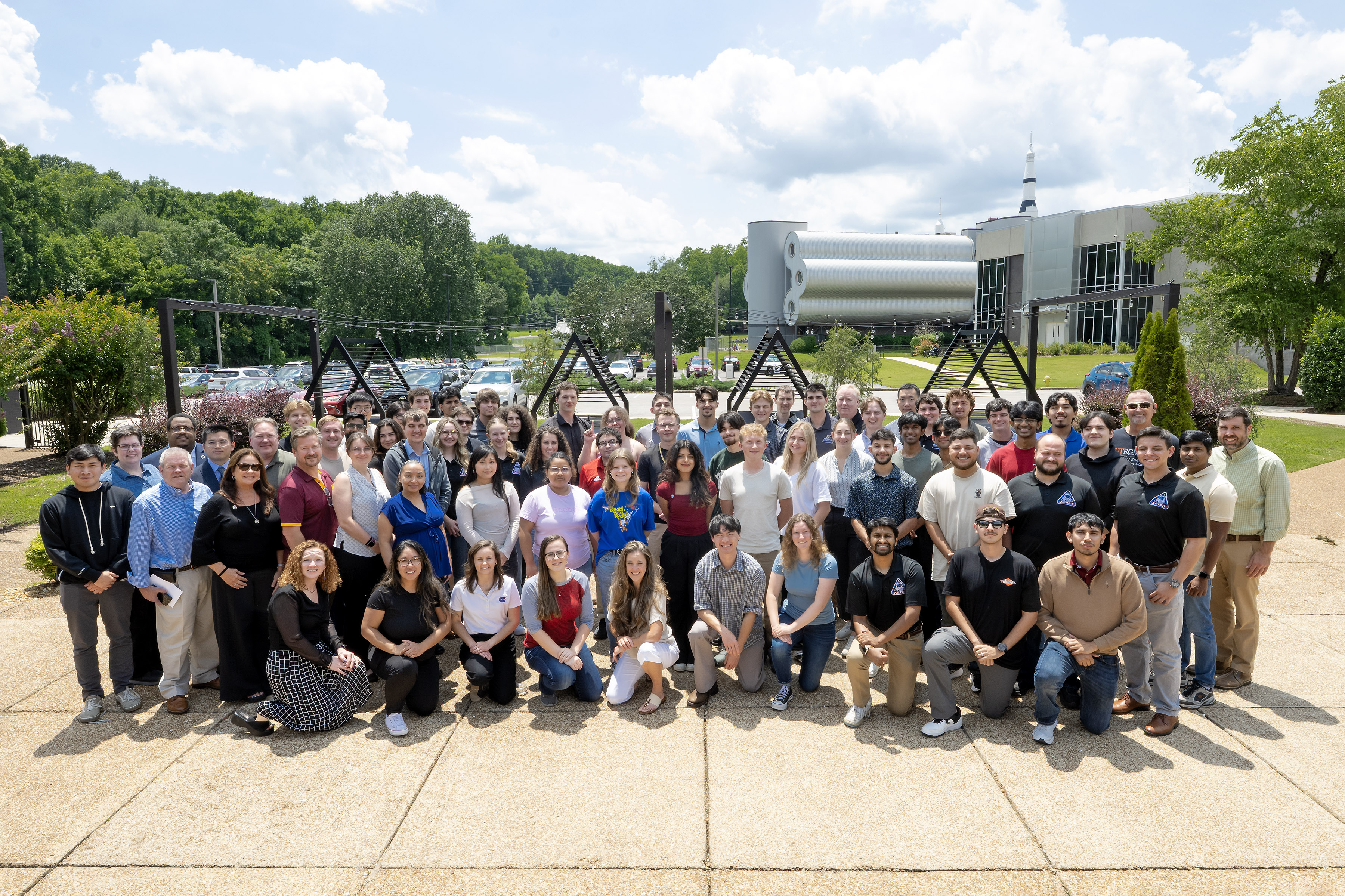
“As NASA continues preparing for sustained lunar exploration and future human missions to Mars, the development of robust, efficient, and reliable life support systems remains a critical focus area,” said Natalie Martinez-Vlasoff, mission capabilities and risk reduction advanced capabilities integration lead at NASA Marshall. “The 2026 student teams demonstrated a strong understanding of the range of design choices for these systems, and how well-considered, systems-level approaches can improve reliability and crew safety for astronauts using future human landing systems. It is encouraging to see students contributing ideas that help make long-duration lunar exploration more achievable.”
The finalist teams gathered at the U.S. Space & Rocket Center in Huntsville on June 22 to present their research to a panel of NASA and aerospace industry experts, as well as to their peers, during a collaborative poster session. The annual competition concluded with an awards ceremony recognizing the top-performing teams out of the 12 finalists.
NASA announced California Polytechnic State University as the overall winner and recipient of the $10,000 top prize award for their Peltier-based Hydration Accumulation Terminal project. Purdue University won second place and a $5,000 award for work on an Enhanced Potable Water Dispenser, followed by Embry-Riddle Aeronautical University, Daytona Beach, in third place with a $3,000 award for their Advanced Quality Orbital Rehydration Assembly project.
The Human Lander Challenge is designed to inspire and engage the next generation of engineers and scientists as NASA and its partners prepare to send astronauts to the Moon in preparation for future missions to Mars. The human landing system is the mode of transportation that will take astronauts to the lunar surface and back to lunar orbit under Artemis.
Through competitions like the Human Lander Challenge, NASA fosters the next generation of engineers and researchers while advancing the technologies needed for astronauts to explore deep space. These initiatives support the agency’s exploration goals while cultivating hands-on, problem-solving and systems thinking among future aerospace professionals. Student solutions from the Human Lander Challenge could be incorporated into current work for the next-generation Artemis landers.
NASA’s Human Landing System Program, managed by NASA Marshall, sponsors the challenge, which is administered by the National Institute of Aerospace.
Through the Artemis program, NASA will send astronauts to explore the Moon for scientific discovery, economic benefits, and to build the foundation for the first crewed missions to Mars – for the benefit of all.
For more information about the Artemis program, visit:
Share Details Last Updated Jun 26, 2026 EditorLee MohonContactCorinne Beckingercorinne.m.beckinger@nasa.govLocationMarshall Space Flight Center Related Terms Explore More 1 min read NASA 2026 Human Lander Challenge Article 10 months ago 3 min read NASA Opens 2026 Human Lander Challenge for Life Support Systems, More Article 9 months ago 3 min read NASA Challenge Seeks ‘Cooler’ Solutions for Deep Space Exploration Article 2 years ago 4 min read NASA Names Finalists to Help Deal with Dust in Human Lander Challenge Article 2 years ago Keep Exploring Discover More Topics From NASAHuman Landing System
Artemis
Marshall Space Flight Center
Space Launch System (SLS)
NASA Announces Winners for 2026 Human Lander Challenge
NASA has announced the top student-developed solutions for environmental control and life support systems in future crewed lunar landers from participants in the 2026 Human Lander Challenge. The announcement marks the culmination of months of research by university teams working to advance technologies supporting the agency’s Artemis program that will return American astronauts to the Moon in 2028.
The challenge concluded June 25 following final technical presentations near NASA’s Marshall Space Flight Center in Huntsville, Alabama. Since September 2025, student teams from across the nation have designed systems‑level approaches to enhance the performance and reliability of environmental control and life support technologies essential for astronauts during deep space missions.
University students and advisors from 11 finalist teams gathered in Huntsville, home to NASA’s Marshall Space Flight Center, June 23-25 for the agency’s third annual Human Lander Challenge. This year’s competition challenged students to consider solutions for environmental control and life support systems for long duration spaceflight. These technologies are essential for maintaining breathable air, potable water, and thermal stability for astronauts during deep space missions. NASA/Charles Beason“As NASA continues preparing for sustained lunar exploration and future human missions to Mars, the development of robust, efficient, and reliable life support systems remains a critical focus area,” said Natalie Martinez-Vlasoff, mission capabilities and risk reduction advanced capabilities integration lead at NASA Marshall. “The 2026 student teams demonstrated a strong understanding of the range of design choices for these systems, and how well-considered, systems-level approaches can improve reliability and crew safety for astronauts using future human landing systems. It is encouraging to see students contributing ideas that help make long-duration lunar exploration more achievable.”
The finalist teams gathered at the U.S. Space & Rocket Center in Huntsville on June 22 to present their research to a panel of NASA and aerospace industry experts, as well as to their peers, during a collaborative poster session. The annual competition concluded with an awards ceremony recognizing the top-performing teams out of the 12 finalists.
NASA announced California Polytechnic State University as the overall winner and recipient of the $10,000 top prize award for their Peltier-based Hydration Accumulation Terminal project. Purdue University won second place and a $5,000 award for work on an Enhanced Potable Water Dispenser, followed by Embry-Riddle Aeronautical University, Daytona Beach, in third place with a $3,000 award for their Advanced Quality Orbital Rehydration Assembly project.
The Human Lander Challenge is designed to inspire and engage the next generation of engineers and scientists as NASA and its partners prepare to send astronauts to the Moon in preparation for future missions to Mars. The human landing system is the mode of transportation that will take astronauts to the lunar surface and back to lunar orbit under Artemis.
Through competitions like the Human Lander Challenge, NASA fosters the next generation of engineers and researchers while advancing the technologies needed for astronauts to explore deep space. These initiatives support the agency’s exploration goals while cultivating hands-on, problem-solving and systems thinking among future aerospace professionals. Student solutions from the Human Lander Challenge could be incorporated into current work for the next-generation Artemis landers.
NASA’s Human Landing System Program, managed by NASA Marshall, sponsors the challenge, which is administered by the National Institute of Aerospace.
Through the Artemis program, NASA will send astronauts to explore the Moon for scientific discovery, economic benefits, and to build the foundation for the first crewed missions to Mars – for the benefit of all.
For more information about the Artemis program, visit:
Share Details Last Updated Jun 26, 2026 EditorLee MohonContactCorinne Beckingercorinne.m.beckinger@nasa.govLocationMarshall Space Flight Center Related Terms Explore More 1 min read NASA 2026 Human Lander Challenge Article 10 months ago 3 min read NASA Opens 2026 Human Lander Challenge for Life Support Systems, More Article 9 months ago 3 min read NASA Challenge Seeks ‘Cooler’ Solutions for Deep Space Exploration Article 2 years ago 4 min read NASA Names Finalists to Help Deal with Dust in Human Lander Challenge Article 2 years ago Keep Exploring Discover More Topics From NASAHuman Landing System
Artemis
Marshall Space Flight Center
Space Launch System (SLS)
Powerful Solar Storms Can Change Precipitation for Parts of North America
For decades, scientists have searched for a clear link between the Sun’s explosive storms and the weather that occurs on Earth. A breakthrough study from the University of New Hampshire reveals that in the hours and days following a solar storm, parts of North America can see sharp changes in the weather — such as declines in precipitation — and the more powerful the storm, the more dramatic the shift. However, the exact mechanism behind the effects is still waiting for an explanation.
NASA Tests New Refuel Device for Future In-Space Refueling Missions
To view this video please enable JavaScript, and consider upgrading to a web browser that supports HTML5 video
Engineers from NASA’s Marshall Space Flight Center in Huntsville, Alabama, and L3Harris conduct operational testing on a developmental cryocoupler, a vital technology for future in-orbit spacecraft refueling.NASA/Tyson EasonFor NASA’s next generation of deep space exploration missions, spacecraft may need to refuel in Earth orbit before pushing farther into the solar system. Similar to how a gas pump needs a nozzle to fit your fuel tank, future spacecraft could require a special device in order to fill up prior to departure, known as a cryocoupler.
Cryocouplers would allow spacecraft to connect to future orbital propellant depots, which would serve as the gas stations of space. The technology comes with the challenge of reliably transferring cryogenic, or super-cold, fluids without losing propellant or performance. Cryogenic propellants like liquid hydrogen and liquid oxygen must stay chilled to hundreds of degrees below zero Fahrenheit, placing strict demands on the materials, seals, and mechanisms that move them.
“In-orbit cryogenic refueling between two spacecraft has yet to be done and remains one of the toughest engineering challenges in spaceflight,” said Travis Belcher, cryocoupler project manager at NASA’s Marshall Space Flight Center in Huntsville, Alabama. “These propellant transfers are essential for the kinds of missions NASA wants to fly in the future, so developing a coupler that can handle ultra-cold propellants is a critical step toward making that capability real.”
Ground-based couplers like those used to fill the SLS (Space Launch System) for Artemis missions are not an option for orbiting propellant transfers. Those couplers release quickly while a rocket is launching and must be manually reconnected for the next flight. They also are not designed to operate in the harsh environment of space and are much larger than what would be used to refill an orbiting spacecraft’s fuel tank.
To meet these challenges, NASA tested a cryocoupler developed by L3Harris.
“The cryocouplers we’re working on can attach and detach multiple times and are fully automated, so astronauts won’t have to perform a spacewalk to transfer propellant,” said Belcher. “They’re rigorously designed to withstand space and sized for the expected tank designs.”
A joint NASA and L3Harris team recently conducted two types of tests at NASA Marshall. To ensure the cryocoupler can handle the extremely cold temperatures it will be exposed to, they ran liquid nitrogen at minus 321 degrees Fahrenheit through multiple connected and disconnected configurations to observe how the coupler reacts to thermal contraction, flow, and significant temperature differences between propellant and materials.
The team also put the cryocoupler through operational tests to determine its performance limits. In this setup, one coupler half was mounted to a robotic table that could move and rotate in any direction, allowing it to simulate misaligned docking with the other half, which remained stationary above the table. The cryocoupler is designed to accommodate some misalignment in case a spacecraft and depot are not perfectly aligned when docking.
“These cryocouplers are very early in development, so the testing is mostly focused on basic functionality,” said Belcher. “Future test campaigns will design them for specific missions and assess them more meticulously based on that mission’s requirements.”
The cryocoupler testing was done as part of a 2022 Announcement of Collaboration Opportunity, a partnership where NASA centers provide select companies with expertise, facilities, hardware, and software at no cost.
The Cryogenic Fluid Management Portfolio project, a cross-agency team based at NASA Marshall and NASA’s Glenn Research Center in Cleveland, oversees cryocoupler development.
To learn more about cryogenic fluid management, visit:
Share Details Last Updated Jun 29, 2026 EditorLee MohonContactJoel Wallacejoel.w.wallace@nasa.govLocationMarshall Space Flight Center Related Terms Explore More 1 min read Novel Recuperator Design for Cryogenic Fluid Management System Article 1 year ago 2 min read NASA, Industry Prepare Cryogenic Fuel Technology Demo Article 2 months ago 5 min read Brr, It’s Cold in Here! NASA’s Cryo Efforts Beyond the Atmosphere Article 2 years ago Keep Exploring Discover More Topics From NASACryogenic Fluid Management (CFM)
Technology Demonstration Missions (TDM)
Space Technology Mission Directorate
Space Nuclear Propulsion
NASA Tests New Refuel Device for Future In-Space Refueling Missions
To view this video please enable JavaScript, and consider upgrading to a web browser that supports HTML5 video
Engineers from NASA’s Marshall Space Flight Center in Huntsville, Alabama, and L3Harris con-duct operational testing on a developmental cryocoupler, a vital technology for future in-orbit spacecraft refueling.NASA/Tyson EasonFor NASA’s next generation of deep space exploration missions, spacecraft may need to refuel in Earth orbit before pushing farther into the solar system. Similar to how a gas pump needs a nozzle to fit your fuel tank, future spacecraft could require a special device in order to fill up prior to departure, known as a cryocoupler.
Cryocouplers would allow spacecraft to connect to future orbital propellant depots, which would serve as the gas stations of space. The technology comes with the challenge of reliably transferring cryogenic, or super-cold, fluids without losing propellant or performance. Cryogenic propellants like liquid hydrogen and liquid oxygen must stay chilled to hundreds of degrees below zero Fahrenheit, placing strict demands on the materials, seals, and mechanisms that move them.
“In-orbit cryogenic refueling between two spacecraft has yet to be done and remains one of the toughest engineering challenges in spaceflight,” said Travis Belcher, cryocoupler project manager at NASA’s Marshall Space Flight Center in Huntsville, Alabama. “These propellant transfers are essential for the kinds of missions NASA wants to fly in the future, so developing a coupler that can handle ultra-cold propellants is a critical step toward making that capability real.”
Ground-based couplers like those used to fill the SLS (Space Launch System) for Artemis missions are not an option for orbiting propellant transfers. Those couplers release quickly while a rocket is launching and must be manually reconnected for the next flight. They also are not designed to operate in the harsh environment of space and are much larger than what would be used to refill an orbiting spacecraft’s fuel tank.
To meet these challenges, NASA tested a cryocoupler developed by L3Harris.
“The cryocouplers we’re working on can attach and detach multiple times and are fully automated, so astronauts won’t have to perform a spacewalk to transfer propellant,” said Belcher. “They’re rigorously designed to withstand space and sized for the expected tank designs.”
A joint NASA and L3Harris team recently conducted two types of tests at NASA Marshall. To ensure the cryocoupler can handle the extremely cold temperatures it will be exposed to, they ran liquid nitrogen at minus 321 degrees Fahrenheit through multiple connected and disconnected configurations to observe how the coupler reacts to thermal contraction, flow, and significant temperature differences between propellant and materials.
The team also put the cryocoupler through operational tests to determine its performance limits. In this setup, one coupler half was mounted to a robotic table that could move and rotate in any direction, allowing it to simulate misaligned docking with the other half, which remained stationary above the table. The cryocoupler is designed to accommodate some misalignment in case a spacecraft and depot are not perfectly aligned when docking.
“These cryocouplers are very early in development, so the testing is mostly focused on basic functionality,” said Belcher. “Future test campaigns will design them for specific missions and assess them more meticulously based on that mission’s requirements.”
The cryocoupler testing was done as part of a 2022 Announcement of Collaboration Opportunity, a partnership where NASA centers provide select companies with expertise, facilities, hardware, and software at no cost.
The Cryogenic Fluid Management Portfolio project, a cross-agency team based at NASA Marshall and NASA’s Glenn Research Center in Cleveland, oversees cryocoupler development.
To learn more about cryogenic fluid management, visit:
Share Details Last Updated Jun 26, 2026 EditorLee MohonContactJoel Wallacejoel.w.wallace@nasa.govLocationMarshall Space Flight Center Related Terms Explore More 1 min read Novel Recuperator Design for Cryogenic Fluid Management System Article 1 year ago 2 min read NASA, Industry Prepare Cryogenic Fuel Technology Demo Article 2 months ago 5 min read Brr, It’s Cold in Here! NASA’s Cryo Efforts Beyond the Atmosphere Article 2 years ago Keep Exploring Discover More Topics From NASACryogenic Fluid Management (CFM)
Technology Demonstration Missions (TDM)
Space Technology Mission Directorate
Space Nuclear Propulsion
Partners, NASA Ready for June Launch of Swift Boost Mission
5 min read
Partners, NASA Ready for June Launch of Swift Boost Mission NASA is on a mission to lift its Neil Gehrels Swift Observatory along with partners Katalyst Space and Northrop Grumman. Watch to get a sneak peek.Credit: NASA’s Goddard Space Flight Center/Katalyst Space/Northrop Grumman
Editor’s note, June 29, 2026: The no-earlier-than launch time for June 30 has shifted from 6:23 a.m. to 6:17 a.m. EDT (10:23 p.m. to 10:17 p.m. local time in Kwajalein).
A mission to raise the orbit of NASA’s Neil Gehrels Swift Observatory is poised for launch no earlier than Tuesday, June 30, 6:23 a.m. EDT (10:23 p.m. UTC+12), from Kwajalein Atoll, part of the Republic of the Marshall Islands in the South Pacific Ocean.
A robotic servicing satellite called LINK, built by Katalyst Space, will blast into orbit on a Northrop Grumman Pegasus XL rocket. LINK will rendezvous with, grapple, and slowly raise Swift’s altitude over several months, preventing it from re-entering Earth’s atmosphere later this year.
“Swift is NASA’s multitool when it comes to studying the cosmos,” said S. Bradley Cenko, principal investigator, Swift, NASA’s Goddard Space Flight Center in Greenbelt, Maryland. “It observes the sky using a wide range of light and rapidly points at short-lived outbursts, alerting other facilities in space and on the ground to help coordinate follow-up observations. For the last two decades, Swift has been a key player in NASA’s efforts to understand how the universe works, and we’re looking forward to getting back to that work after the boost is complete.”
This mosaic of M31 merges 330 individual images taken by the Ultraviolet/Optical Telescope aboard Swift. It is the highest-resolution image of the galaxy ever recorded in the ultraviolet. The image shows a region 200,000 light-years wide and 100,000 light-years high. NASA/Swift/Stefan Immler (GSFC) and Erin Grand (UMCP)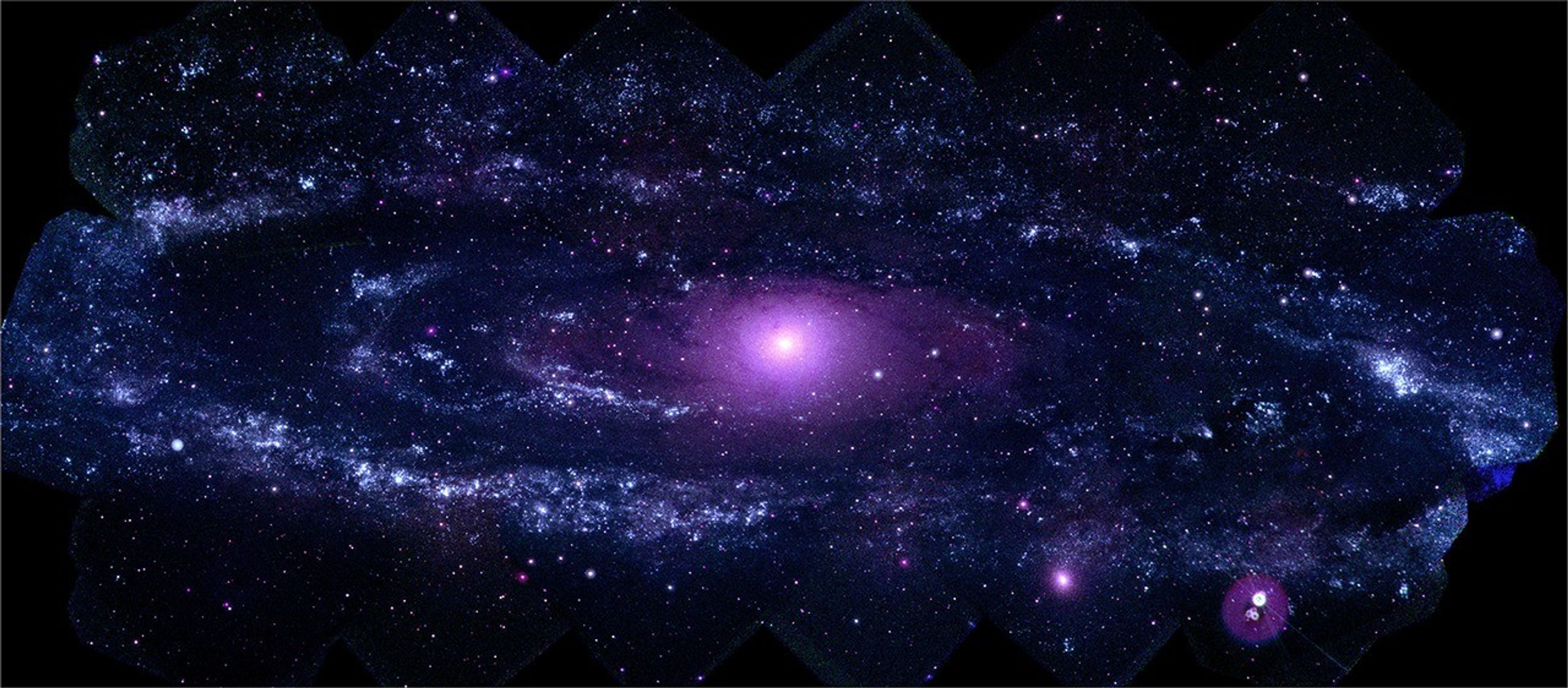
Download high-resolution images and videos related to Swift through NASA’s Scientific Visualization Studio.
Our planet’s atmosphere creates drag on all spacecraft in low Earth orbit, gradually reducing their altitudes if they don’t have propulsion systems to counteract the effect.
A recent bout of increased solar activity magnified this impact on Swift, which launched in November 2004.
Rather than allowing Swift to re-enter the atmosphere as many missions do, NASA is using the opportunity to advance the U.S. commercial satellite servicing industry.
In September, the agency contracted Katalyst to attempt to boost the observatory. The company would have less than one year to design, build, test, and launch a satellite to meet, grab, and lift Swift to nearly its original orbit.
“Swift wasn’t designed to be serviced,” said Ghonhee Lee, CEO of Katalyst. “By demonstrating we can quickly and cost-effectively extend its lifetime, we’re creating a blueprint for servicing spacecraft that were never designed for on-orbit maintenance. If we’re going to build an enduring presence beyond Earth, we need the capability to manipulate our environment in space. That means deploying robotic spacecraft that can reposition, repair, refuel, and refit satellites after launch.”
Katalyst engineers attach LINK to a baseplate inside the Space Environment Simulator at NASA Goddard on Tuesday, April 28, 2026. Once all the air was pumped out of the 27-foot-diameter chamber, the team practiced firing the satellite’s ion thrusters and operated one of the robotic arms while they cycled through space-like hot and cold temperatures. NASA/Sophia Roberts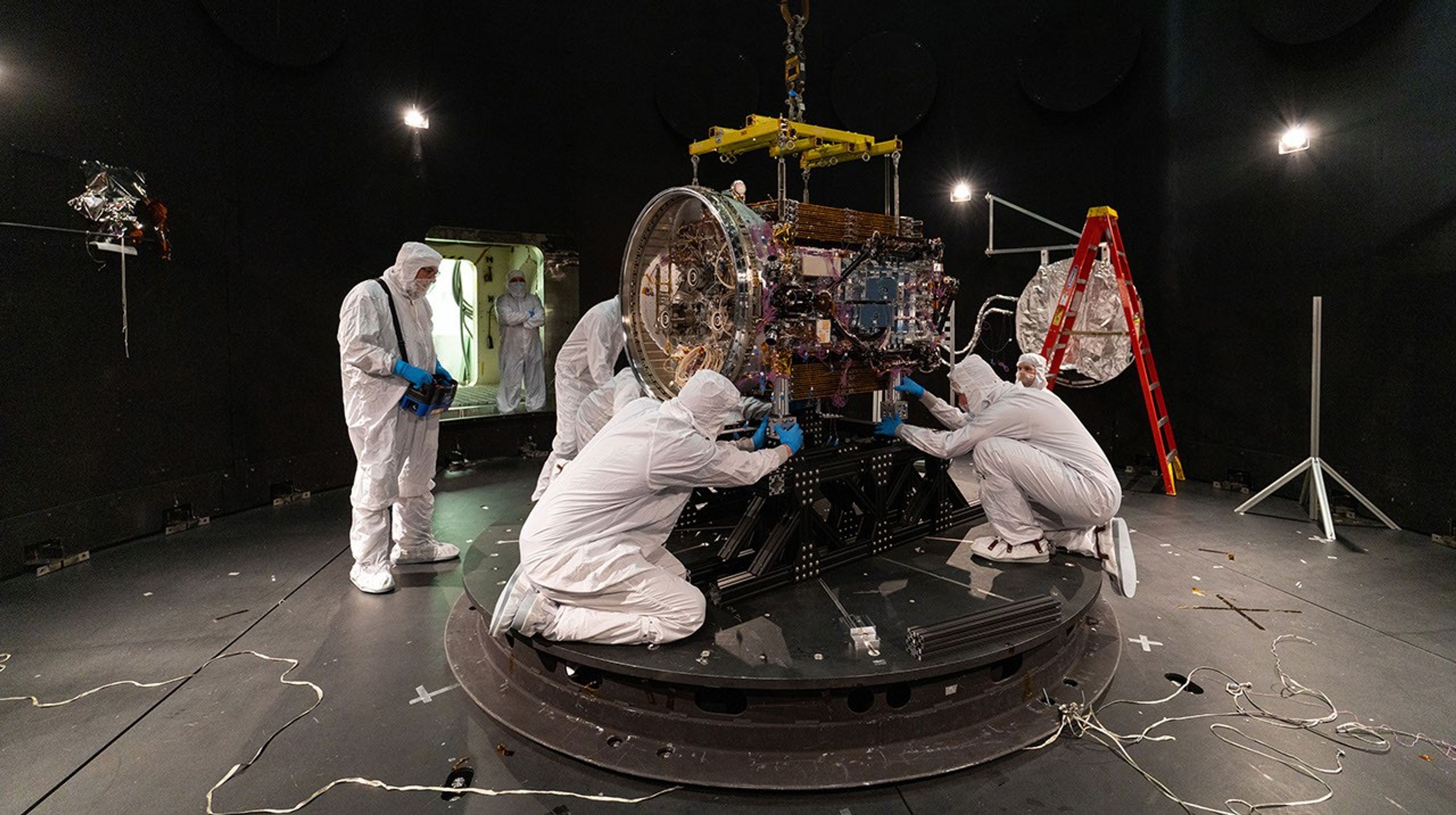
The LINK spacecraft weighs about 880 pounds and stands about 5 feet tall, about a third of Swift’s overall size. Nearly 20 feet of solar panels will power three ion thrusters and a trio of robotic arms.
LINK completed environmental testing that mimicked launch and space-like conditions at NASA Goddard this spring, as well as additional preflight assessments at Katalyst’s facility in Broomfield, Colorado.
For the boost to have its best chance of success, Swift needs to stay above an altitude of about 185 miles.
By the end of last year, however, orbital predictions generated by NASA showed the observatory reaching that threshold as early as July.
To slow Swift’s descent, the operations team at Penn State’s Eberly College of Science altered how they managed and oriented the spacecraft.
Unlike during normal operating procedures, where Swift looks at spots on the sky that are scientifically interesting, the team now selects targets that steer Swift into the most streamlined position. They also reduced power consumption as much as possible to place the satellite’s large solar panels in a more aerodynamic orientation.
Recent orbital predictions show these changes will keep Swift above critical altitude until this fall.
Stargazer, Pegasus XL, and LINK await takeoff on Wednesday, June 17, 2026, at NASA’s Wallops Flight Facility in Virginia. Engineers control the temperature and humidity inside the nose cone of the rocket to keep the satellite and avionics safe from weather and changing environmental conditions during flight. NASA/Ron Beard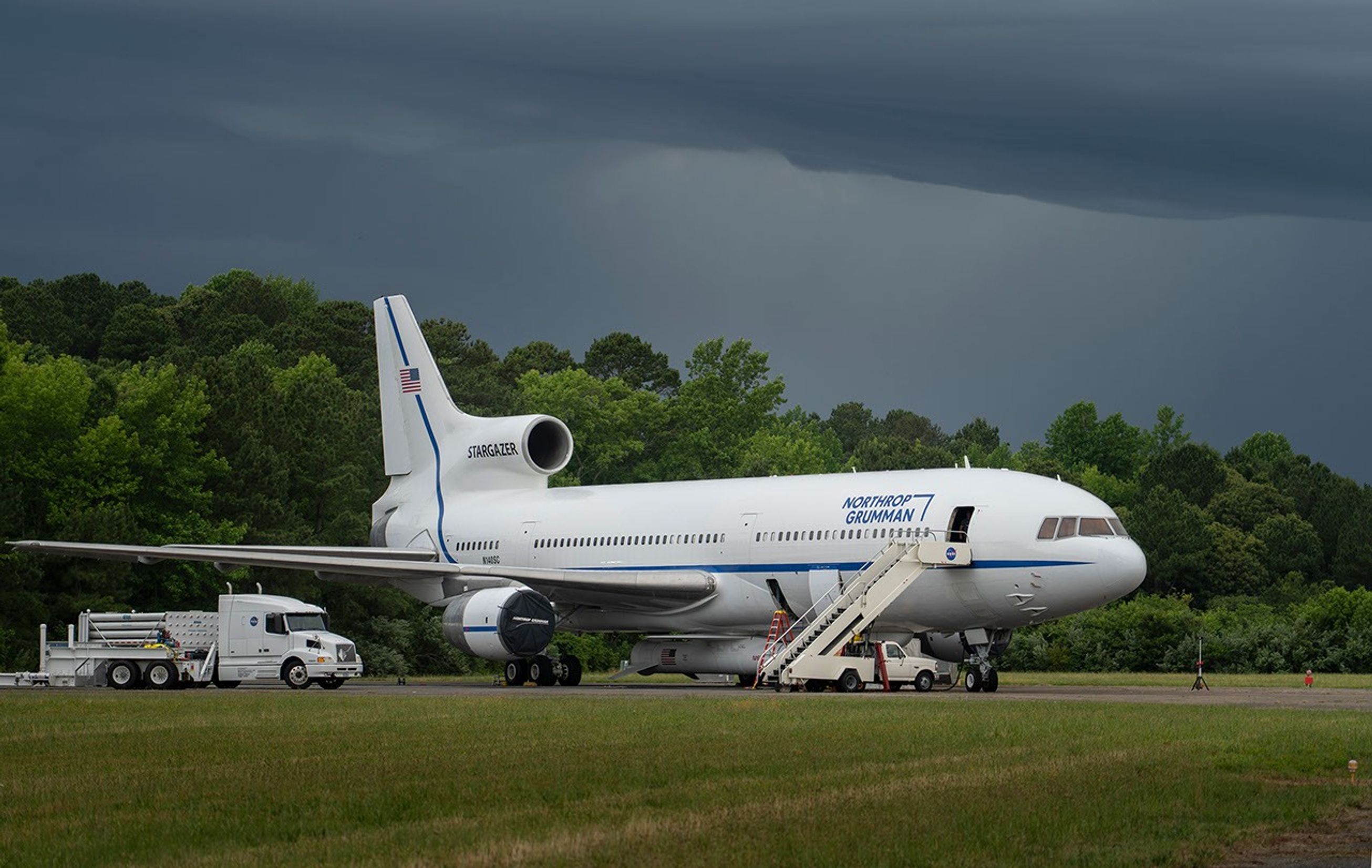
The satellite will launch aboard the Pegasus XL.
“We can deploy Pegasus from almost anywhere in the world using our Stargazer, a modified L-1011 aircraft,” said Wes Collier, vice president of launch systems at Northrop Grumman. “That combination of flexibility and responsive access to space will help LINK quickly reach Swift, giving the teams time to complete the boost.”
Earlier this month, engineers loaded LINK into the Pegasus XL and attached the rocket to Stargazer at NASA’s Wallops Flight Facility in Virginia. The aircraft and its payload departed for Kwajalein Atoll on Thursday, June 18, where it now awaits launch.
Once in orbit, LINK will undergo several weeks of commissioning as Katalyst evaluates the spacecraft’s propulsion, navigation, and sensor systems. It then will slowly approach and survey Swift before grabbing the observatory with its robotic arms and slowly raising the orbit to nearly 370 miles.
“This is a high-risk, high-reward mission,” said Shawn Domagal-Goldman, division director, Astrophysics, NASA Headquarters in Washington. “Swift plays a notable role in our fleet. We have much to gain by attempting this boost, which is more affordable than trying to replace Swift’s capabilities and allows NASA to advance the nation’s satellite servicing industry, for the benefit of all.”
Learn more about the Swift boost at:
https://science.nasa.gov/mission/swift/swift-boost-mission/
By Jeanette Kazmierczak
Goddard Space Flight Center, Greenbelt, Md.
Media contacts:
Alise Fisher
Headquarters, Washington
202-358-2546
Claire Andreoli
Goddard Space Flight Center, Greenbelt, Md.
301-286-1940
Partners, NASA Ready for June Launch of Swift Boost Mission
5 min read
Partners, NASA Ready for June Launch of Swift Boost Mission NASA is on a mission to lift its Neil Gehrels Swift Observatory along with partners Katalyst Space and Northrop Grumman. Watch to get a sneak peek.Credit: NASA’s Goddard Space Flight Center/Katalyst Space/Northrop Grumman
A mission to raise the orbit of NASA’s Neil Gehrels Swift Observatory is poised for launch no earlier than Tuesday, June 30, 6:23 a.m. EDT (10:23 p.m. UTC+12), from Kwajalein Atoll, part of the Republic of the Marshall Islands in the South Pacific Ocean.
A robotic servicing satellite called LINK, built by Katalyst Space, will blast into orbit on a Northrop Grumman Pegasus XL rocket. LINK will rendezvous with, grapple, and slowly raise Swift’s altitude over several months, preventing it from re-entering Earth’s atmosphere later this year.
“Swift is NASA’s multitool when it comes to studying the cosmos,” said S. Bradley Cenko, principal investigator, Swift, NASA’s Goddard Space Flight Center in Greenbelt, Maryland. “It observes the sky using a wide range of light and rapidly points at short-lived outbursts, alerting other facilities in space and on the ground to help coordinate follow-up observations. For the last two decades, Swift has been a key player in NASA’s efforts to understand how the universe works, and we’re looking forward to getting back to that work after the boost is complete.”
This mosaic of M31 merges 330 individual images taken by the Ultraviolet/Optical Telescope aboard Swift. It is the highest-resolution image of the galaxy ever recorded in the ultraviolet. The image shows a region 200,000 light-years wide and 100,000 light-years high. NASA/Swift/Stefan Immler (GSFC) and Erin Grand (UMCP)Download high-resolution images and videos related to Swift through NASA’s Scientific Visualization Studio.
Our planet’s atmosphere creates drag on all spacecraft in low Earth orbit, gradually reducing their altitudes if they don’t have propulsion systems to counteract the effect.
A recent bout of increased solar activity magnified this impact on Swift, which launched in November 2004.
Rather than allowing Swift to re-enter the atmosphere as many missions do, NASA is using the opportunity to advance the U.S. commercial satellite servicing industry.
In September, the agency contracted Katalyst to attempt to boost the observatory. The company would have less than one year to design, build, test, and launch a satellite to meet, grab, and lift Swift to nearly its original orbit.
“Swift wasn’t designed to be serviced,” said Ghonhee Lee, CEO of Katalyst. “By demonstrating we can quickly and cost-effectively extend its lifetime, we’re creating a blueprint for servicing spacecraft that were never designed for on-orbit maintenance. If we’re going to build an enduring presence beyond Earth, we need the capability to manipulate our environment in space. That means deploying robotic spacecraft that can reposition, repair, refuel, and refit satellites after launch.”
Katalyst engineers attach LINK to a baseplate inside the Space Environment Simulator at NASA Goddard on Tuesday, April 28, 2026. Once all the air was pumped out of the 27-foot-diameter chamber, the team practiced firing the satellite’s ion thrusters and operated one of the robotic arms while they cycled through space-like hot and cold temperatures. NASA/Sophia RobertsThe LINK spacecraft weighs about 880 pounds and stands about 5 feet tall, about a third of Swift’s overall size. Nearly 20 feet of solar panels will power three ion thrusters and a trio of robotic arms.
LINK completed environmental testing that mimicked launch and space-like conditions at NASA Goddard this spring, as well as additional preflight assessments at Katalyst’s facility in Broomfield, Colorado.
For the boost to have its best chance of success, Swift needs to stay above an altitude of about 185 miles.
By the end of last year, however, orbital predictions generated by NASA showed the observatory reaching that threshold as early as July.
To slow Swift’s descent, the operations team at Penn State’s Eberly College of Science altered how they managed and oriented the spacecraft.
Unlike during normal operating procedures, where Swift looks at spots on the sky that are scientifically interesting, the team now selects targets that steer Swift into the most streamlined position. They also reduced power consumption as much as possible to place the satellite’s large solar panels in a more aerodynamic orientation.
Recent orbital predictions show these changes will keep Swift above critical altitude until this fall.
Stargazer, Pegasus XL, and LINK await takeoff on Wednesday, June 17, 2026, at NASA’s Wallops Flight Facility in Virginia. Engineers control the temperature and humidity inside the nose cone of the rocket to keep the satellite and avionics safe from weather and changing environmental conditions during flight. NASA/Ron BeardThe satellite will launch aboard the Pegasus XL.
“We can deploy Pegasus from almost anywhere in the world using our Stargazer, a modified L-1011 aircraft,” said Wes Collier, vice president of launch systems at Northrop Grumman. “That combination of flexibility and responsive access to space will help LINK quickly reach Swift, giving the teams time to complete the boost.”
Earlier this month, engineers loaded LINK into the Pegasus XL and attached the rocket to Stargazer at NASA’s Wallops Flight Facility in Virginia. The aircraft and its payload departed for Kwajalein Atoll on Thursday, June 18, where it now awaits launch.
Once in orbit, LINK will undergo several weeks of commissioning as Katalyst evaluates the spacecraft’s propulsion, navigation, and sensor systems. It then will slowly approach and survey Swift before grabbing the observatory with its robotic arms and slowly raising the orbit to nearly 370 miles.
“This is a high-risk, high-reward mission,” said Shawn Domagal-Goldman, division director, Astrophysics, NASA Headquarters in Washington. “Swift plays a notable role in our fleet. We have much to gain by attempting this boost, which is more affordable than trying to replace Swift’s capabilities and allows NASA to advance the nation’s satellite servicing industry, for the benefit of all.”
Learn more about the Swift boost at:
https://science.nasa.gov/mission/swift/swift-boost-mission/
By Jeanette Kazmierczak
Goddard Space Flight Center, Greenbelt, Md.
Media contacts:
Alise Fisher
Headquarters, Washington
202-358-2546
Claire Andreoli
Goddard Space Flight Center, Greenbelt, Md.
301-286-1940
Mars Express Captures Dozens of Dust Devils in Mars Valley
The European Space Agency’s Mars Express has captured part of Mars’s Mamers Valles: a fascinating valley system speckled with brief, tornado-like whirlwinds known as dust devils.