
Feed aggregator
8 things to know about this year’s solar eclipse
From the path of totality and the spectacular Baily's beads to why this eclipse will be especially beautiful at sunset, discover what makes the 12 August 2026 total solar eclipse so special.
Featuring ESA Reserve Astronaut Sara García Alonso and ESA Astronaut Candidate Pablo Álvarez Fernández.
Spanish
Aquí presentamos 9 cosas que debes saber sobre el eclipse solar total de este año.
Desde la franja de totalidad y las espectaculares perlas de Baily hasta qué hará este eclipse aún más especial al atardecer, descubre por qué el eclipse solar total del 12 de Agosto 2026 será tan único!
Con Sara García Alonso, astronauta de reserva de la ESA, y Pablo Álvarez Fernández, astronauta de la ESA en formación.
Week in images: 06-10 July 2026
Week in images: 06-10 July 2026
Discover our week through the lens
Mathematicians put AI to work on Fermat's last theorem
Mathematicians put AI to work on Fermat's last theorem
Why the controversy over de-extinction risks missing the point
Efforts to revive the thylacine and woolly mammoth are forcing conservationists to face a long-overdue debate over what kind of natural world we want to build
Is Earth the only planet with total solar eclipses?
Other planets have moons, too. Do they get eclipses like we do?
The sneaky maths trick for solving problems without answering them
The sneaky maths trick for solving problems without answering them
‘Dark’ comets sprouting tails could help solve interstellar mysteries
A strange class of comet could explain the enigmatic behavior of ‘Oumuamua, the first known interstellar object—and even shed light on how Earth became habitable
This Week's Sky at a Glance, July 10 – 19
The bright, distinctive pattern of Upper Scorpius is on its best display in the south right after nightfall. Telescopic treasures await. In the west, Regulus now departs from Venus.
The post This Week's Sky at a Glance, July 10 – 19 appeared first on Sky & Telescope.
Earth from Space: Great Bear Lake, Canada
2026 eclipse: 5 citizen science projects you can contribute to
2026 eclipse: 5 citizen science projects you can contribute to
Where Venezuela’s Earthquakes Shifted the Ground
- Earth
- Earth Observatory
- Image of the Day
- EO Explorer
- Topics
- More Content
- About
Where Venezuela’s Earthquakes Shifted the Ground
- Earth
- Earth Observatory
- Image of the Day
- EO Explorer
- Topics
- More Content
- About
How 'Star City' Reimagined the Space Race With Soviets as the Stars
How do you capture the mood of the 1960s space race in a fictional universe where the Soviets beat the Americans to the moon? The production team for Apple TV's "Star City" series rose to the challenge.
NASA Sets Coverage for Astronaut Anil Menon Launch to Space Station
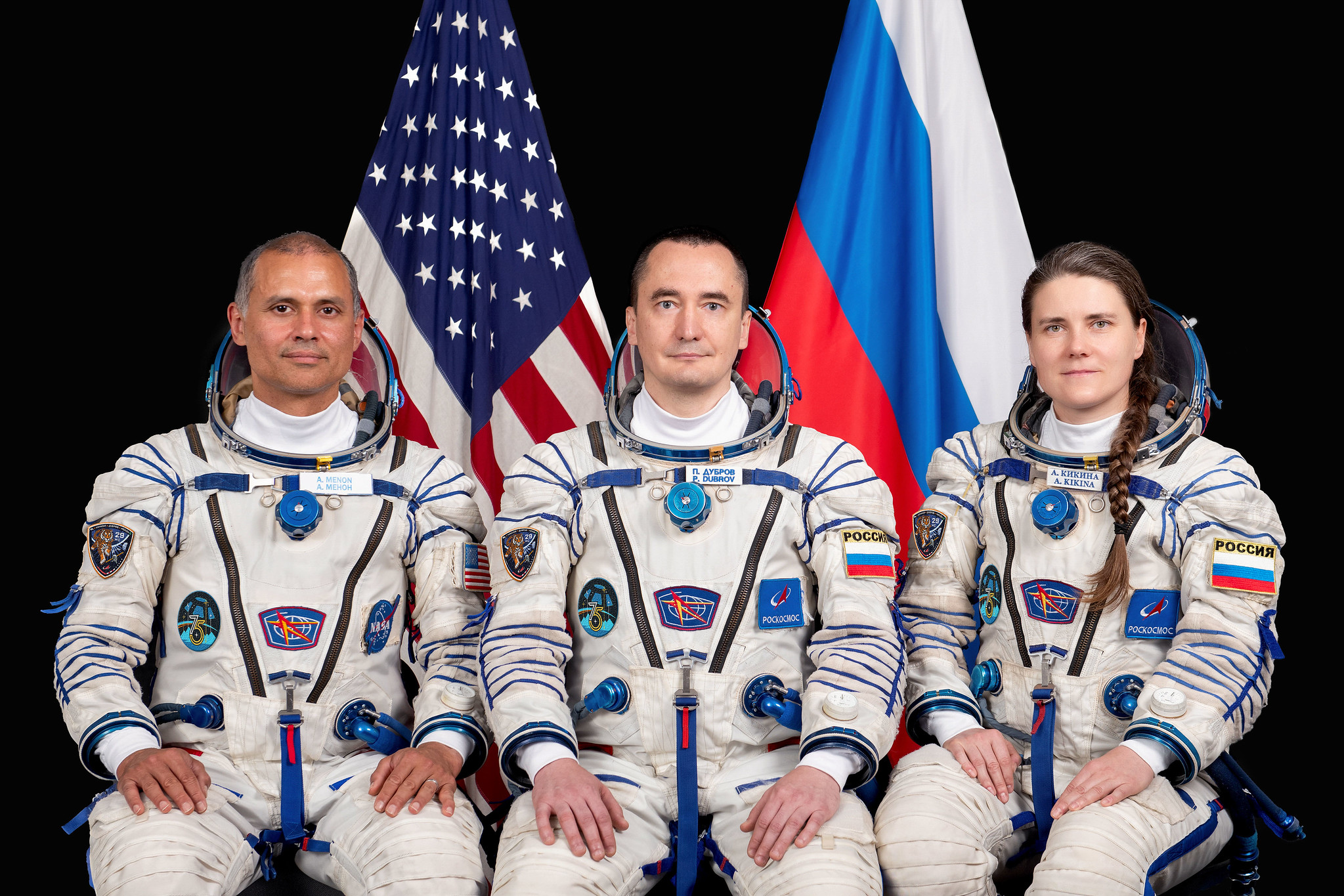
NASA astronaut Anil Menon will launch aboard the Roscosmos Soyuz MS-29 spacecraft to the International Space Station on Tuesday, July 14, accompanied by cosmonauts Pyotr Dubrov and Anna Kikina, where they will join the Expedition 74 crew advancing scientific research.
Menon, Dubrov, and Kikina will lift off at 10:47 a.m. EDT (7:47 p.m. Baikonur time) from the Baikonur Cosmodrome in Kazakhstan. Live launch and docking coverage is available on NASA+, Amazon Prime, and the agency’s YouTube channel. Learn how to watch NASA content through a variety of online platforms, including social media.
After a two-orbit, three-hour trip to the station, the spacecraft will automatically dock at 1:56 p.m. to the Prichal module. Shortly afterward, hatches will open between the Soyuz and the orbiting laboratory.
Once aboard, the trio will join NASA astronauts Jessica Meir, Jack Hathaway, and Chris Williams, ESA (European Space Agency) astronaut Sophie Adenot, and Roscosmos cosmonauts Sergey Kud-Sverchkov, Sergei Mikaev, and Andrey Fedyaev.
NASA’s coverage schedule is as follows (all times Eastern and subject to change based on real-time operations):
Tuesday, July 14
9:45 a.m. – Launch coverage begins on NASA+, Amazon Prime, and YouTube.
10:47 a.m. – Launch
1:10 p.m. – Rendezvous and docking coverage begins on NASA+, Amazon Prime, and YouTube.
1:56 p.m. – Docking
3:30 p.m. – Hatch opening and welcome coverage begins on NASA+, Amazon Prime, and YouTube.
3:55 p.m. – Hatch opening
Menon, Dubrov, and Kikina will spend about eight months aboard the orbital complex as International Space Station Expedition 74/75 crew members before returning to Earth in April 2027. This will be Menon’s first spaceflight and the second for both Dubrov and Kikina.
During his stay on the station, Menon will conduct scientific research and technology demonstrations aimed at advancing human space exploration and benefiting life on Earth. He will continue research to refine in-space production of semiconductor crystals to enable the large-scale manufacturing of components needed for high-performance computers, artificial intelligence, and improved medical devices. Menon also will perform ultrasound using augmented reality and artificial intelligence methods that could eliminate the need for medical support from Earth on future space missions. He will be a test subject helping researchers understand how blood flow is affected in space to protect future astronauts. He also will test bioprinting vascular constructs in microgravity to improve understanding of the aging process to advance therapeutic developments.
For more than 25 years, people have lived and worked continuously aboard the International Space Station, advancing scientific knowledge and making research breakthroughs not possible on Earth. The space station helps NASA understand and overcome the challenges of human spaceflight, expand commercial opportunities in low Earth orbit, and build on the foundation for long-duration missions to the Moon, as part of the Artemis program, and to Mars.
To learn more about International Space Station research, operations, and its crews, visit:
-end-
Joshua Finch / Jimi Russell
Headquarters, Washington
202-358-1100
joshua.a.finch@nasa.gov / james.j.russell@nasa.gov
Sandra Jones
Johnson Space Center, Houston
281-483-5111
sandra.p.jones@nasa.gov
NASA Sets Coverage for Astronaut Anil Menon Launch to Space Station
NASA astronaut Anil Menon will launch aboard the Roscosmos Soyuz MS-29 spacecraft to the International Space Station on Tuesday, July 14, accompanied by cosmonauts Pyotr Dubrov and Anna Kikina, where they will join the Expedition 74 crew advancing scientific research.
Menon, Dubrov, and Kikina will lift off at 10:47 a.m. EDT (7:47 p.m. Baikonur time) from the Baikonur Cosmodrome in Kazakhstan. Live launch and docking coverage is available on NASA+, Amazon Prime, and the agency’s YouTube channel. Learn how to watch NASA content through a variety of online platforms, including social media.
After a two-orbit, three-hour trip to the station, the spacecraft will automatically dock at 1:56 p.m. to the Prichal module. Shortly afterward, hatches will open between the Soyuz and the orbiting laboratory.
Once aboard, the trio will join NASA astronauts Jessica Meir, Jack Hathaway, and Chris Williams, ESA (European Space Agency) astronaut Sophie Adenot, and Roscosmos cosmonauts Sergey Kud-Sverchkov, Sergei Mikaev, and Andrey Fedyaev.
NASA’s coverage schedule is as follows (all times Eastern and subject to change based on real-time operations):
Tuesday, July 14
9:45 a.m. – Launch coverage begins on NASA+, Amazon Prime, and YouTube.
10:47 a.m. – Launch
1:10 p.m. – Rendezvous and docking coverage begins on NASA+, Amazon Prime, and YouTube.
1:56 p.m. – Docking
3:30 p.m. – Hatch opening and welcome coverage begins on NASA+, Amazon Prime, and YouTube.
3:55 p.m. – Hatch opening
Menon, Dubrov, and Kikina will spend about eight months aboard the orbital complex as International Space Station Expedition 74/75 crew members before returning to Earth in April 2027. This will be Menon’s first spaceflight and the second for both Dubrov and Kikina.
During his stay on the station, Menon will conduct scientific research and technology demonstrations aimed at advancing human space exploration and benefiting life on Earth. He will continue research to refine in-space production of semiconductor crystals to enable the large-scale manufacturing of components needed for high-performance computers, artificial intelligence, and improved medical devices. Menon also will perform ultrasound using augmented reality and artificial intelligence methods that could eliminate the need for medical support from Earth on future space missions. He will be a test subject helping researchers understand how blood flow is affected in space to protect future astronauts. He also will test bioprinting vascular constructs in microgravity to improve understanding of the aging process to advance therapeutic developments.
For more than 25 years, people have lived and worked continuously aboard the International Space Station, advancing scientific knowledge and making research breakthroughs not possible on Earth. The space station helps NASA understand and overcome the challenges of human spaceflight, expand commercial opportunities in low Earth orbit, and build on the foundation for long-duration missions to the Moon, as part of the Artemis program, and to Mars.
To learn more about International Space Station research, operations, and its crews, visit:
-end-
Joshua Finch / Jimi Russell
Headquarters, Washington
202-358-1100
joshua.a.finch@nasa.gov / james.j.russell@nasa.gov
Sandra Jones
Johnson Space Center, Houston
281-483-5111
sandra.p.jones@nasa.gov