
Feed aggregator
Earth is home to 20 million insect species—three times more than we thought
Some creative calculations using bug traps, epidemiology and trees suggest there are some 20 million unique insect species on Earth
A Supermassive Black Hole Gets Blamed for Quenching Star Formation
Some of the most massive galaxies in the Universe appear to be missing a lot of stars. That seems unusual, since birthing stars is one of a galaxy's main tasks as it grows. According to Xin "Cindy" Xiang of the University of Michigan, something is suppressing or quenching the births of stars in these and she thinks that black holes might be the culprit.
This thoughtful book will make you look at the wonders of trees anew
This thoughtful book will make you look at the wonders of trees anew
Stunning photos reveal the intricate beauty of fungi
Stunning photos reveal the intricate beauty of fungi
Do you want your underwear with added probiotics?
Do you want your underwear with added probiotics?
NASA Announces Four New Lunar Lander Missions for 2028
NASA has awarded contracts to three aerospace companies for four lunar landers to launch in 2028.
The post NASA Announces Four New Lunar Lander Missions for 2028 appeared first on Sky & Telescope.
The Rubin telescope just began the largest cosmic time-lapse in history
The Vera C. Rubin Observatory in Chile has started a 10-year survey of the changing night sky
NASA Seeks Volunteers for New Yearlong Simulated Moon, Mars Mission
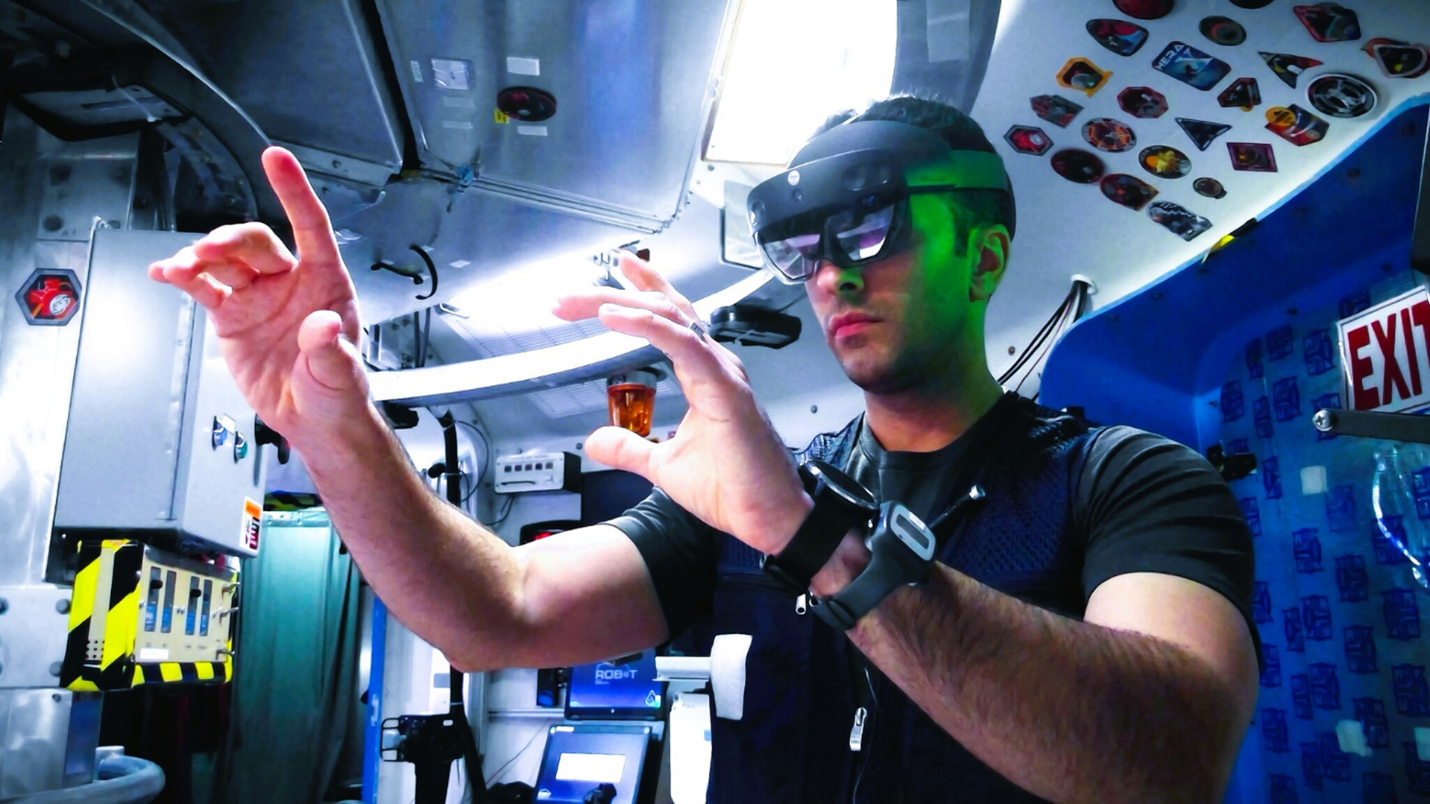
NASA is recruiting research participants for the agency’s next simulated deep space mission. Beginning no earlier than August 2027, research volunteers will spend one year living and working in interplanetary environments at the agency’s Johnson Space Center in Houston, operating under isolated conditions expected during crewed missions to the Moon or Red Planet.
Insights from this new, yearlong experience, called the Moon and Mars Exploration Analog, can be used to help keep astronauts safe and mission-ready during future planetary surface operations. The results also could inform plans for a sustained lunar presence through the agency’s Moon Base and future Artemis missions.
NASA is looking for applicants for the approximately year-long mission simulation, which will take place in two confined habitats. In addition to specific physical and education requirements, volunteers must be willing to take part in a multi-day selection process and pass NASA’s physical and psychological assessments, found on the Moon and Mars Exploration Analog web page. Candidates also should have a strong desire for unique, rewarding experiences, and interest in contributing to NASA’s work to prepare for extended stays on the lunar surface and the first crewed mission to Mars.
The Moon and Mars Exploration Analog evolves elements of the agency’s HERA (Human Exploration Research Analog) and CHAPEA (Crew Health And Performance Exploration Analog) missions into a single, integrated mission to streamline how researchers evaluate astronaut adaptation across the full range of potential mission scenarios. Using the HERA habitat as a spacecraft and the CHAPEA habitat as a base, the volunteers will live and work in confined, isolated environments that simulate months-long flights to and from other planetary surfaces. They also will mimic surface operations, including mock Mars walks and using a rover to travel to exploration sites located beyond the main habitat.
Throughout the Moon and Mars Exploration Analog mission, researchers will study crew health and performance under resource limitations and mission demands. These missions also help NASA assess and validate hardware, technologies, protocols, requirements, and other systems designed to support crew health and performance on long-duration deep space missions, all without leaving Earth. The effort will provide valuable data for NASA’s Human Research Program, which innovates ways to keep astronauts healthy and mission-ready.
To apply, visit:
As part of the Golden Age of innovation and exploration, NASA will send astronauts on increasingly difficult missions to explore more of the Moon for scientific discovery, economic benefits, establish an enduring human presence on the lunar surface, and to build on the foundation for the first crewed missions to Mars.
For more about NASA’s Human Research Program, visit:
NASA Seeks Volunteers for New Yearlong Simulated Moon, Mars Mission
NASA is recruiting research participants for the agency’s next simulated deep space mission. Beginning no earlier than August 2027, research volunteers will spend one year living and working in interplanetary environments at the agency’s Johnson Space Center in Houston, operating under isolated conditions expected during crewed missions to the Moon or Red Planet.
Insights from this new, yearlong experience, called the Moon and Mars Exploration Analog, can be used to help keep astronauts safe and mission-ready during future planetary surface operations. The results also could inform plans for a sustained lunar presence through the agency’s Moon Base and future Artemis missions.
NASA is looking for applicants for the approximately year-long mission simulation, which will take place in two confined habitats. In addition to specific physical and education requirements, volunteers must be willing to take part in a multi-day selection process and pass NASA’s physical and psychological assessments, found on the Moon and Mars Exploration Analog web page. Candidates also should have a strong desire for unique, rewarding experiences, and interest in contributing to NASA’s work to prepare for extended stays on the lunar surface and the first crewed mission to Mars.
The Moon and Mars Exploration Analog evolves elements of the agency’s HERA (Human Exploration Research Analog) and CHAPEA (Crew Health And Performance Exploration Analog) missions into a single, integrated mission to streamline how researchers evaluate astronaut adaptation across the full range of potential mission scenarios. Using the HERA habitat as a spacecraft and the CHAPEA habitat as a base, the volunteers will live and work in confined, isolated environments that simulate months-long flights to and from other planetary surfaces. They also will mimic surface operations, including mock Mars walks and using a rover to travel to exploration sites located beyond the main habitat.
Throughout the Moon and Mars Exploration Analog mission, researchers will study crew health and performance under resource limitations and mission demands. These missions also help NASA assess and validate hardware, technologies, protocols, requirements, and other systems designed to support crew health and performance on long-duration deep space missions, all without leaving Earth. The effort will provide valuable data for NASA’s Human Research Program, which innovates ways to keep astronauts healthy and mission-ready.
To apply, visit:
As part of the Golden Age of innovation and exploration, NASA will send astronauts on increasingly difficult missions to explore more of the Moon for scientific discovery, economic benefits, establish an enduring human presence on the lunar surface, and to build on the foundation for the first crewed missions to Mars.
For more about NASA’s Human Research Program, visit:
LINK Spacecraft Set for Mission to Boost NASA's Swift Observatory
LINK Spacecraft Set for Mission to Boost NASA’s Swift Observatory
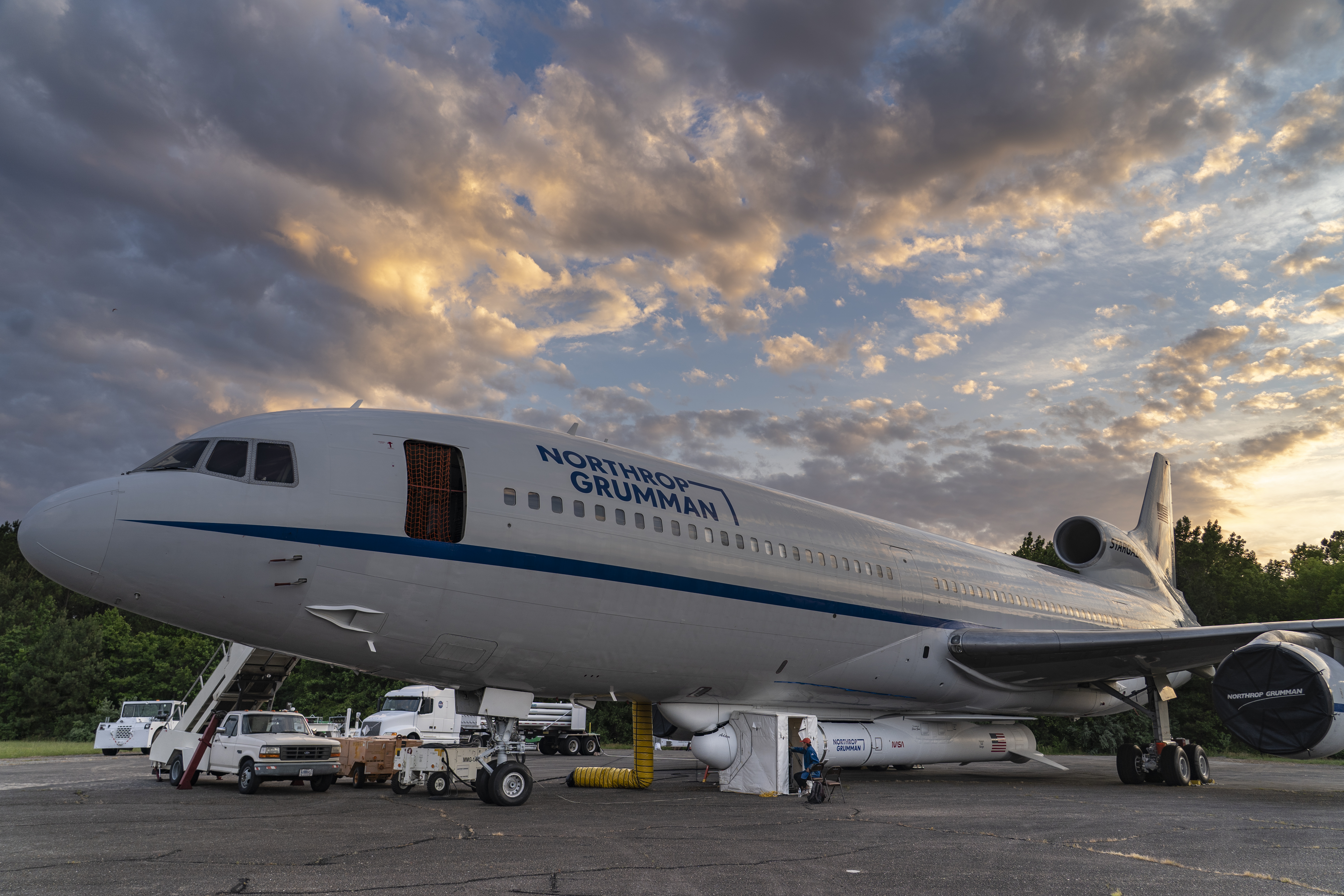
A first-of-its-kind mission to raise the orbit of NASA’s Neil Gehrels Swift Observatory is poised for launch no earlier than Thursday, July 2, 5:09 a.m. EDT (9:09 p.m. UTC+12), from Kwajalein Atoll, part of the Republic of the Marshall Islands in the South Pacific Ocean. A robotic servicing spacecraft called LINK, built by Katalyst Space, will blast into orbit on a Northrop Grumman Pegasus XL rocket attached to the belly of the company’s Stargazer aircraft, shown here in this photograph from the evening of Tuesday, June 16, 2026.
After launch, LINK will attempt to rendezvous with, grapple, and slowly raise Swift’s altitude over several months, preventing it from re-entering Earth’s atmosphere later this year. If this daring mission is successful, it will be the first time a commercial robotic mission has captured a NASA spacecraft that is both uncrewed and not originally designed to be serviced in space.
Follow the Swift blog to learn more about the mission.
Image credit: NASA/Ron Beard
LINK Spacecraft Set for Mission to Boost NASA’s Swift Observatory
A first-of-its-kind mission to raise the orbit of NASA’s Neil Gehrels Swift Observatory is poised for launch no earlier than Thursday, July 2, 5:09 a.m. EDT (9:09 p.m. UTC+12), from Kwajalein Atoll, part of the Republic of the Marshall Islands in the South Pacific Ocean. A robotic servicing spacecraft called LINK, built by Katalyst Space, will blast into orbit on a Northrop Grumman Pegasus XL rocket attached to the belly of the company’s Stargazer aircraft, shown here in this photograph from the evening of Tuesday, June 16, 2026.
After launch, LINK will attempt to rendezvous with, grapple, and slowly raise Swift’s altitude over several months, preventing it from re-entering Earth’s atmosphere later this year. If this daring mission is successful, it will be the first time a commercial robotic mission has captured a NASA spacecraft that is both uncrewed and not originally designed to be serviced in space.
Follow the Swift blog to learn more about the mission.
Image credit: NASA/Ron Beard
The weirdness of neutrinos could completely rewrite particle physics
The weirdness of neutrinos could completely rewrite particle physics
This planet survived the death of its star—and kept its atmosphere
Astronomers have for the first time observed an atmosphere around a giant planet orbiting a white dwarf
Webb studies how a planet survived the death of its star
An international team of astronomers has used the NASA/ESA/CSA James Webb Space Telescope to watch the Jupiter-sized exoplanet WD 1856 b transit its host star, measuring the planet’s mass and temperature and even detecting its atmosphere.
They found that the planet is significantly warmer than expected and determined how it most likely reached its very tight orbit around the star, a white dwarf. The results are our first window into the future of planets like Jupiter after the death of the Sun, billions of years into the future.
NASA’s Webb Studies How Planet Survived Death of its Star
- Webb
- News
- Overview
- Science
- Observatory
- Multimedia
- Team
- More
Artwork: NASA, ESA, CSA, Ralf Crawford (STScI)
NASA’s James Webb Space Telescope is giving us new insight into the far-future of solar systems like our own, as the agency continues to reveal the secrets of the universe and our place in it. Billions of years ago, a Sun-like star nearing the end of its life swelled tremendously in size to become a red giant before ejecting its outer layers, leaving a hot, remnant core known as a white dwarf. As a red giant, the star should have engulfed and destroyed any nearby planets. Yet astronomers have found a Jupiter-sized exoplanet orbiting the white dwarf every 34 hours at a separation of less than 2 million miles (3 million kilometers).
To solve the mystery of how this exoplanet survived, an international team of astronomers used NASA’s James Webb Space Telescope to watch the Jupiter-sized exoplanet WD 1856 b transit its host star, measuring the planet’s temperature and detecting molecules in its atmosphere. They found the planet is significantly warmer than expected and determined how it most likely reached its very tight orbit around the white dwarf star. The results are a window into the future of planets like Jupiter after the death of the Sun, billions of years into the future.
The results published Wednesday in the journal Nature.
WD 1856 b was discovered in 2020 by scientists using NASA’s TESS (Transiting Exoplanet Survey Satellite) and the retired Spitzer Space Telescope. It orbits the white dwarf WD 1856+534, which is located about 80 light-years from Earth. “The planet is about the size of Jupiter, but the white dwarf it orbits is the size of Earth, so the planet is seven times larger than its star,” said lead author Ryan MacDonald of the University of St. Andrews in the United Kingdom.
WD 1856 b orbits extremely close to its host star, a distance 50 times closer than Earth orbits the Sun. If WD 1856 b had originally been orbiting at that distance, it would have been obliterated while the star was a red giant. How did it survive the death of its host star and end up in its current position?
Image: Exoplanet WD 1856 b (Artist’s Concept) Exoplanet WD 1856 b, shown in this artist’s concept, is a gas giant that orbits its star at a distance 50 times closer than Earth orbits the Sun. Observations by NASA’s James Webb Space Telescope determined the planet’s temperature and detected molecules in its atmosphere. Artwork: NASA, ESA, CSA, Ralf Crawford (STScI) How big, how hot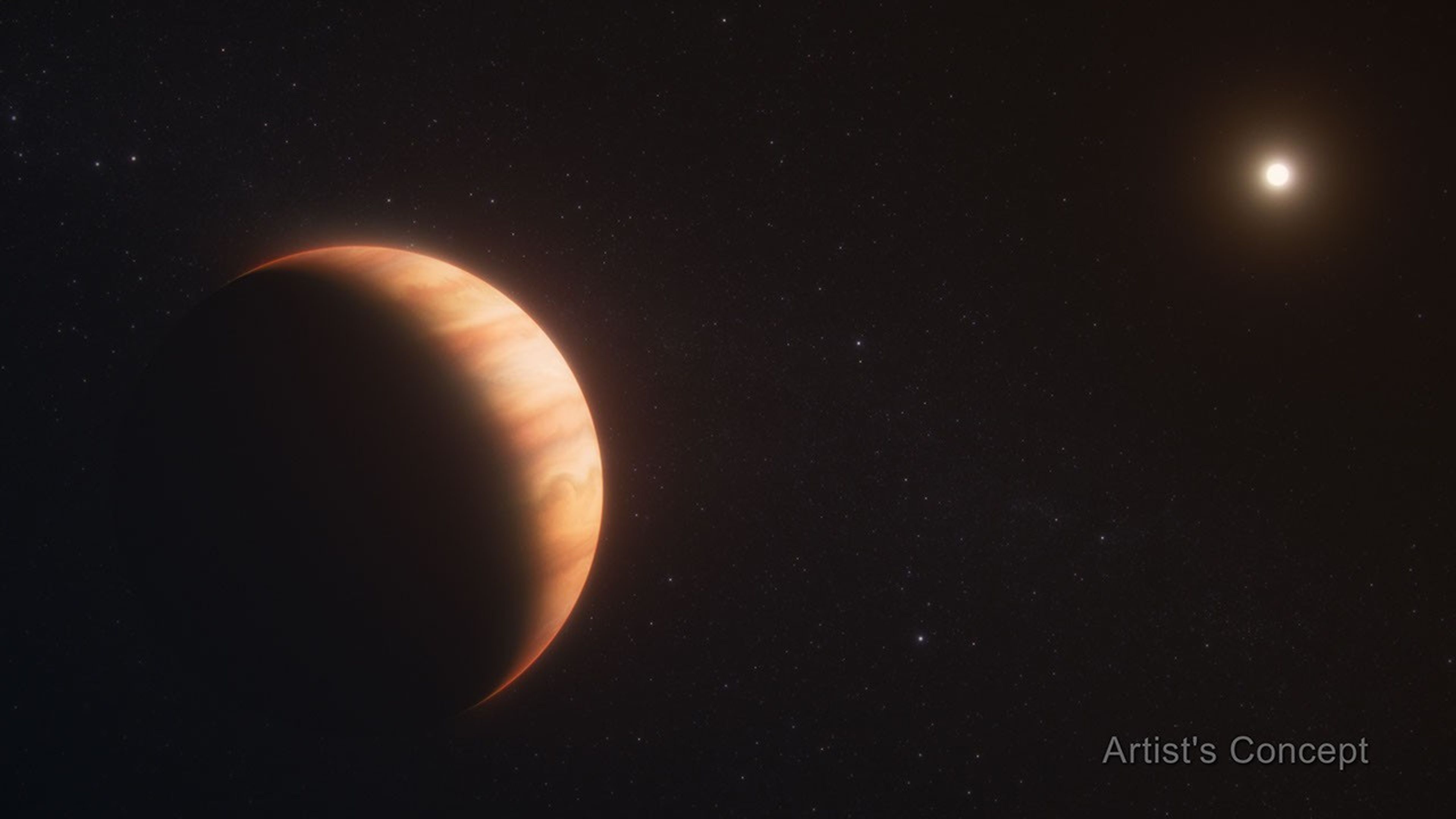
The new study used Webb to watch the planet passing in front of its star. This transit yielded unique information about the planet’s mass, which is between four and eleven times the mass of Jupiter.
The team also was able to determine the planet’s temperature. During the transit, light from the star was partly blocked, but infrared light was reduced less than other wavelengths. The difference was infrared light emitted by the planet from its own heat. The data indicated that the planet has a temperature of about 260 degrees Fahrenheit (126 degrees Celsius) — significantly hotter than it would be if its only source of heat was the light from the white dwarf. This puzzling discovery turned out to be the key fact that proved how the planet must have reached its current orbit.
Christopher O’Connor of Northwestern University in Illinois, a co-author on the paper, was responsible for tracing the temperature of the planet back in time. O’Connor said, “The big question is how WD 1856 b ended up where it is today, and there are two theories. One is that the planet was swallowed by the host star as it was dying, and managed to survive on the inside. The other is that migration took place due to the gravitational effect of other objects in the system. The white dwarf is part of a triple star system, and the companion stars could have influenced WD 1856 b’s orbit.”
The researchers realized that there was no source of energy present to generate that heat today, so it must be residual energy from an earlier time when the planet was heated. Using models of how sub-stellar objects like WD 1856 b cool down over time, coupled with the new data from Webb, the team was able to project its temperature back in time and deduce how long ago the heating must have happened. The timing is key to determining whether the heating was from being engulfed by the red giant or occurred during an inward migration
They concluded that the heating most likely happened between 3 and 5.5 billion years after the star became a white dwarf. In this scenario, the planet was on a wide orbit that kept it safe from the star during its destructive red giant phase, and only migrated to its present location later on. “As the planet moved inward, its interactions with the strong gravity of the white dwarf will have caused it to warm up considerably, and it has been cooling ever since,” said O’Connor.
Light from the star passing through the planet’s atmosphere also picked up information about its chemical composition. “We saw the telltale signatures of small cloud particles and hydrocarbons, most likely methane, which is the first time we have seen an atmosphere on a planet transiting a dead star,” said co-author Victoria Boehm of Cornell University. “We recently observed four more transits of WD 1856 b with Webb to take a deeper look into its atmospheric chemistry and can’t wait to see the results.”
Image: Exoplanet WD 1856 b (Transmission Spectrum) NASA’s James Webb Space Telescope measured the constituents of exoplanet WD 1856 b as it passed in front of its star, finding signs of methane. WD 1856 b orbits a white dwarf star the size of Earth. As a result, the planet blocks more than half of the star’s light. Illustration: NASA, ESA, CSA, Joseph Olmsted (STScI) Solar system’s possible future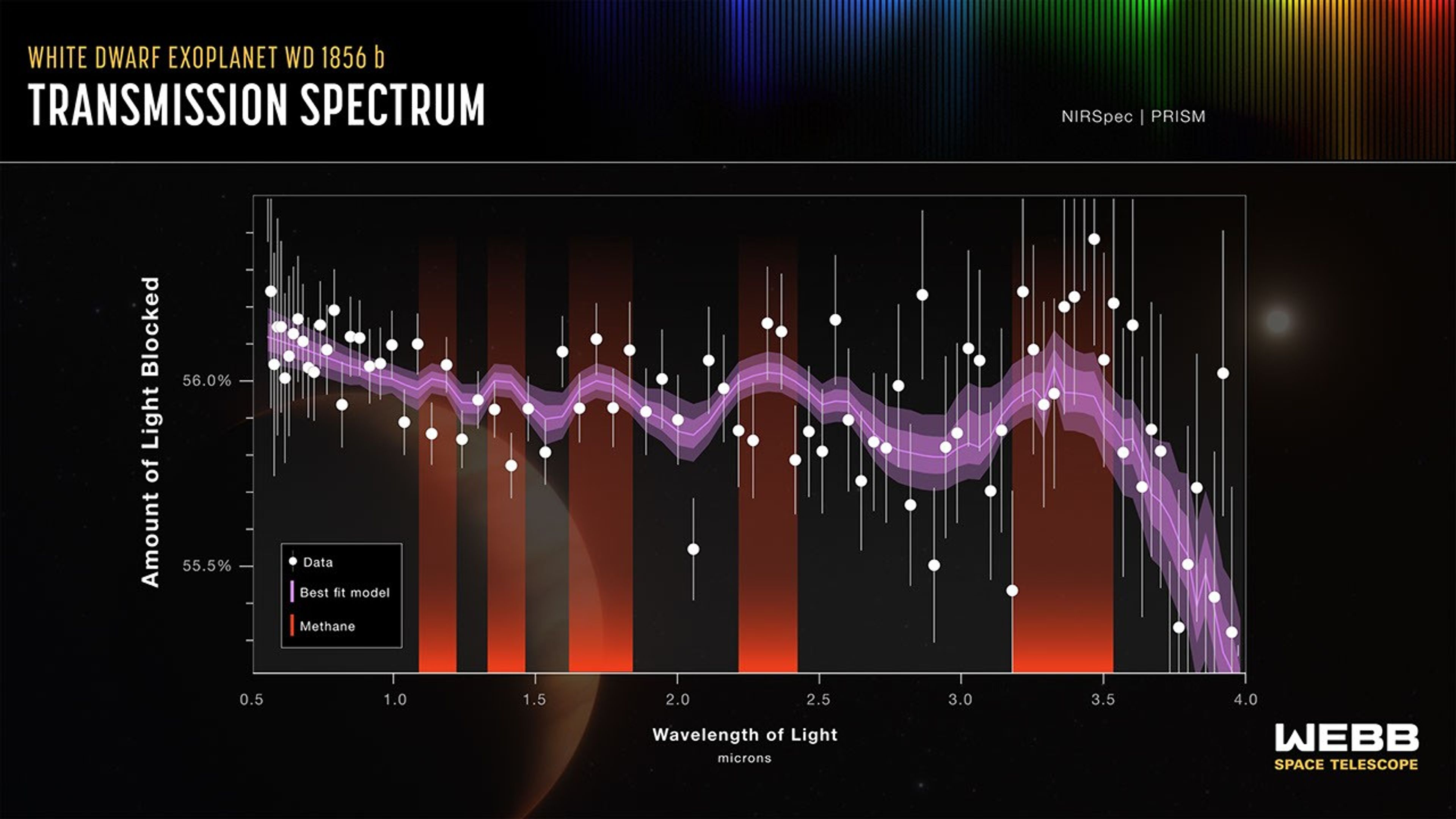
In approximately five billion years, the Sun will run out of hydrogen fuel in its core and swell up more than 100 times larger than it is now into a red giant star. It will then shed its outer layers and end its life as a white dwarf star. Mercury, Venus, and possibly the Earth will be destroyed by the red giant. However, the fate of the more distant planets, particularly the gas giants, is unclear. Finding and studying planets in orbit around the remnants of Sun-like stars after their death is a means of learning what might happen in our own solar system in the far future.
“We’re used to looking back in time when we use telescopes, but this is the first time we have been able to look forward to what might happen to the outer planets around the remnant of a Sun-like star,” said MacDonald. “It’s like using a time machine to peer into the distant future of our solar system.”
The James Webb Space Telescope is the world’s premier space science observatory. Webb is solving mysteries in our solar system, looking beyond to distant worlds around other stars, and probing the mysterious structures and origins of our universe and our place in it. Webb is an international program led by NASA with its partners, ESA (European Space Agency) and CSA (Canadian Space Agency).
To learn more about Webb, visit:
Downloads & Related InformationThe following sections contain links to download this article’s images and videos in all available resolutions followed by related information links, media contacts, and if available, research paper and Spanish translation links.
Related Images & Videos Exoplanet WD 1856 b (Artist’s Concept)Exoplanet WD 1856 b, shown in this artist’s concept, is a gas giant that orbits its star at a distance 50 times closer than Earth orbits the Sun. Observations by NASA’s James Webb Space Telescope determined the planet’s temperature and detected molecules in its atmosphere.
Exoplanet WD 1856 b (Transmission Spectrum)
NASA’s James Webb Space Telescope measured the constituents of exoplanet WD 1856 b as it passed in front of its star, finding signs of methane. WD 1856 b orbits a white dwarf star the size of Earth. As a result, the planet blocks more than half of the star’s light.
Related Links
Read more: Webb’s Impact on Exoplanet Research
Explore more: ViewSpace | Exoplanet Variety: Atmosphere
Explore more: How to Study Exoplanets: Webb and Challenges
Watch: Giant World Circles a Tiny Star
Explore more: ViewSpace | Star Death: Helix Nebula
More Webb: News | Images | Science | Home Page
Laura Betz
NASA’s Goddard Space Flight Center
Greenbelt, Maryland
laura.e.betz@nasa.gov
Bethany Downer
ESA/Webb
Baltimore, Maryland
Christine Pulliam
Space Telescope Science Institute
Baltimore, Maryland
Keep Exploring Related Topics James Webb Space Telescope
Webb is the premier observatory of the next decade, serving thousands of astronomers worldwide. It studies every phase in the…
Exoplanets
Exoplanet Stories
Stars