
Feed aggregator
Eating less protein could help you live longer
While “protein maxxing” is all the rage, reducing your protein intake could add years to your life
Curiosity Blog, Sols 4961-4967: Approaching a Break in the Rock Record?
- Curiosity Home
- Science
- News and Features
- Multimedia
- Mars Missions
- Mars Home
3 min read
Curiosity Blog, Sols 4961-4967: Approaching a Break in the Rock Record? NASA’s Mars rover Curiosity acquired this image showing distant light-colored rocks sitting directly underneath dark-colored rocks, a possible “erosional supersurface” — a geologic term that describes places where layers of sediment have been stripped away by wind or water at a regional scale before newer layers are deposited atop them, marking a break in the rock record. Curiosity captured the image using its Left Navigation Camera on July 23, 2026 — Sol 4963, or Martian day 4,963 of the Mars Science Laboratory mission — at 15:53:13 UTC.NASA/JPL-Caltech
Written by Abigail Fraeman, Deputy Project Scientist, Jet Propulsion Laboratory, California Institute of Technology
Earth planning date: Friday, July 24, 2026
Curiosity spent the week continuing to climb her way up through the layers of Mount Sharp, exploring the sedimentary rock strip chart of Martian history. The rover has reached a layer where the science team had spotted a possible “erosional supersurface” by analyzing orbital data alongside images of the layers in the buttes above us. “Erosional supersurface” is a geologic term that describes places where layers of sediment have been stripped away by wind or water at a regional scale before newer layers are deposited atop them. These surfaces are common in wind-blown sand (aeolian) deposits, and they mark a break in the rock record. After eyeing this unusual section of Mount Sharp for the last few months, it’s exciting to finally be so close to this feature. Curiosity’s science instruments will give us the geologist’s-eye view of this region that we need to really understand this feature, including its composition and centimeter-scale geometry.
Our two plans this week focused on imaging the possible supersurface from a few different locations. This past weekend we backed away from the feature to get a good rover’s-eye view of the feature, which set us up nicely on Monday to collect two massive Mastcam mosaics across the entire layer. ChemCam provided additional support by collecting some long-distance RMI images of the most interesting areas of the supersurface. We also took the time to measure the composition of rocks at the bottom of this surface with a MAHLI and APXS target named “Monte Darwin” and ChemCam LIBS targets named “Patacamaya,” “Tarucachi,” and “Mojoncasa.”
Monday’s drive took us closer to the supersurface, while taking some MAHLI and Mastcam images of our wheels along the way, and the drive we planned today will bring us right up to the base of the layer. The science team was able to use Monday’s image to pick the most scientifically interesting spot to cross this surface, while also juggling constraints made by the reality of where we can drive our rather large rover — there’s some pretty sandy and steeply sloping terrain around here, so we also found a spot that looks like it’ll be one of the easier areas to traverse. Hopefully next week we’ll go up and over the supersurface — stay tuned.
-
Want to read more posts from the Curiosity team?
-
Want to learn more about Curiosity’s science instruments?
Mars is the fourth planet from the Sun, and the seventh largest. It’s the only planet we know of inhabited…
All Mars ResourcesExplore this collection of Mars images, videos, resources, PDFs, and toolkits. Discover valuable content designed to inform, educate, and inspire,…
Rover BasicsEach robotic explorer sent to the Red Planet has its own unique capabilities driven by science. Many attributes of a…
Mars Exploration: Science GoalsThe key to understanding the past, present or future potential for life on Mars can be found in NASA’s four…
Curiosity Blog, Sols 4961-4967: Approaching a Break in the Rock Record?
- Curiosity Home
- Science
- News and Features
- Multimedia
- Mars Missions
- Mars Home
3 min read
Curiosity Blog, Sols 4961-4967: Approaching a Break in the Rock Record? NASA’s Mars rover Curiosity acquired this image showing distant light-colored rocks sitting directly underneath dark-colored rocks, a possible “erosional supersurface” — a geologic term that describes places where layers of sediment have been stripped away by wind or water at a regional scale before newer layers are deposited atop them, marking a break in the rock record. Curiosity captured the image using its Left Navigation Camera on July 23, 2026 — Sol 4963, or Martian day 4,963 of the Mars Science Laboratory mission — at 15:53:13 UTC.NASA/JPL-CaltechWritten by Abigail Fraeman, Deputy Project Scientist, Jet Propulsion Laboratory, California Institute of Technology
Earth planning date: Friday, July 24, 2026
Curiosity spent the week continuing to climb her way up through the layers of Mount Sharp, exploring the sedimentary rock strip chart of Martian history. The rover has reached a layer where the science team had spotted a possible “erosional supersurface” by analyzing orbital data alongside images of the layers in the buttes above us. “Erosional supersurface” is a geologic term that describes places where layers of sediment have been stripped away by wind or water at a regional scale before newer layers are deposited atop them. These surfaces are common in wind-blown sand (aeolian) deposits, and they mark a break in the rock record. After eyeing this unusual section of Mount Sharp for the last few months, it’s exciting to finally be so close to this feature. Curiosity’s science instruments will give us the geologist’s-eye view of this region that we need to really understand this feature, including its composition and centimeter-scale geometry.
Our two plans this week focused on imaging the possible supersurface from a few different locations. This past weekend we backed away from the feature to get a good rover’s-eye view of the feature, which set us up nicely on Monday to collect two massive Mastcam mosaics across the entire layer. ChemCam provided additional support by collecting some long-distance RMI images of the most interesting areas of the supersurface. We also took the time to measure the composition of rocks at the bottom of this surface with a MAHLI and APXS target named “Monte Darwin” and ChemCam LIBS targets named “Patacamaya,” “Tarucachi,” and “Mojoncasa.”
Monday’s drive took us closer to the supersurface, while taking some MAHLI and Mastcam images of our wheels along the way, and the drive we planned today will bring us right up to the base of the layer. The science team was able to use Monday’s image to pick the most scientifically interesting spot to cross this surface, while also juggling constraints made by the reality of where we can drive our rather large rover — there’s some pretty sandy and steeply sloping terrain around here, so we also found a spot that looks like it’ll be one of the easier areas to traverse. Hopefully next week we’ll go up and over the supersurface — stay tuned.
-
Want to read more posts from the Curiosity team?
-
Want to learn more about Curiosity’s science instruments?
Mars is the fourth planet from the Sun, and the seventh largest. It’s the only planet we know of inhabited…
All Mars ResourcesExplore this collection of Mars images, videos, resources, PDFs, and toolkits. Discover valuable content designed to inform, educate, and inspire,…
Rover BasicsEach robotic explorer sent to the Red Planet has its own unique capabilities driven by science. Many attributes of a…
Mars Exploration: Science GoalsThe key to understanding the past, present or future potential for life on Mars can be found in NASA’s four…
NASA’s Roman Telescope to Carry 1.35 Million Names to Deep Space
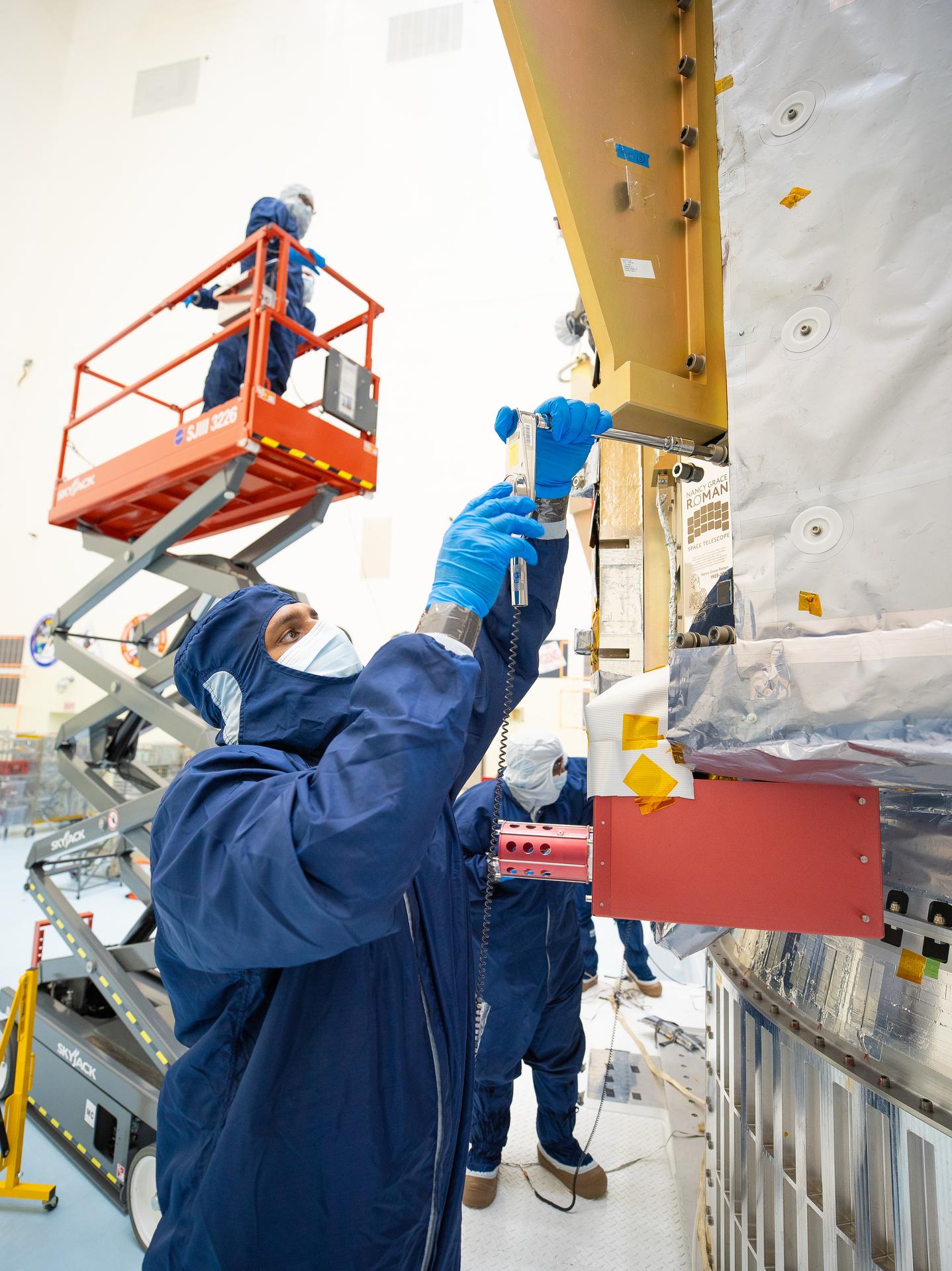
On July 27, technicians at NASA’s Kennedy Space Center in Florida installed a memory card containing 1,350,144 names as part of a commemorative plaque on the Nancy Grace Roman Space Telescope. The names were submitted by people globally, including astronauts from Artemis II and Artemis III. The memory card will travel with the Roman observatory to the Sun-Earth Lagrange point 2, or L2, about one million miles from Earth, where the Sun’s and Earth’s gravity balance out.
Roman is named after Dr. Nancy Grace Roman, NASA’s first chief astronomer and one of the architects of the agency’s modern science program. Roman championed space-based observatories that could study the universe from above Earth’s hazy atmosphere while making their data broadly available to the scientific community.
NASA and SpaceX are targeting launch for no earlier than 7:26 a.m. EDT Sunday, Aug. 30 aboard a SpaceX Falcon Heavy from Launch Complex 39A at Kennedy.
To learn more about the Roman mission, visit:
Image credit: NASA/Jolearra Tshiteya
NASA’s Roman Telescope to Carry 1.35 Million Names to Deep Space
On July 27, technicians at NASA’s Kennedy Space Center in Florida installed a memory card containing 1,350,144 names as part of a commemorative plaque on the Nancy Grace Roman Space Telescope. The names were submitted by people globally, including astronauts from Artemis II and Artemis III. The memory card will travel with the Roman observatory to the Sun-Earth Lagrange point 2, or L2, about one million miles from Earth, where the Sun’s and Earth’s gravity balance out.
Roman is named after Dr. Nancy Grace Roman, NASA’s first chief astronomer and one of the architects of the agency’s modern science program. Roman championed space-based observatories that could study the universe from above Earth’s hazy atmosphere while making their data broadly available to the scientific community.
NASA and SpaceX are targeting launch for no earlier than 7:26 a.m. EDT Sunday, Aug. 30 aboard a SpaceX Falcon Heavy from Launch Complex 39A at Kennedy.
To learn more about the Roman mission, visit:
Image credit: NASA/Jolearra Tshiteya
How to safely watch a solar eclipse
[English]: A solar eclipse is an unforgettable sight, but only if you watch it safely!
ESA reserve astronaut Sara García Alonso shows you how to enjoy this incredible cosmic event using certified eclipse glasses and explains why ordinary sunglasses are not enough.
Learn what happens during the different stages of an eclipse, when it is safe to look up, and how to experience one of the greatest shows in the Solar System without risking your eyes.
[Spanish]: Un eclipse solar es un espectáculo inolvidable, ¡pero solo si lo observas de forma Segura!
El astronauta de reserva de la ESA Pablo Álvarez Fernández te explica cómo disfrutar de este increíble fenómeno cósmico utilizando gafas de eclipse certificadas y por qué unas gafas de sol normales no son suficientes.
Descubre qué ocurre durante las distintas fases de un eclipse, cuándo es seguro mirar al Sol y cómo disfrutar de uno de los mayores espectáculos del Sistema Solar sin poner en Riesgo tu vista.
Week in images: 27-31 July 2026
Week in images: 27-31 July 2026
Discover our week through the lens
This Month at ESA: July 2026
What did space have in store for Europe this July?
The Artemis II crew visited ESA’s technical center in the Netherlands to meet the team behind Orion’s European Service Module, celebrating the colaboration that powered their trip around the Moon. Meanwhile, ESA’s Hera successfully upgraded it’s software fom 140 milliom km away, in preperation for it’s investigation of Dydimos and Dimorphos later this year.
July also saw FLEX and Copernicus Sentinel-3C head to Europe’s Spaceport in French Guiana in preperation for their launch this September. Then, the James Webb Space Telescope celebrates four years of sciency with a spectacular new view of the galaxy Centaurus A.
400 km above Earth, Sophie Adenot inaugurated the European Enhanced Exercise Device with rowing, rope-pulling, strength training and more. She also showed us the ISS veggie chamber, and how the space seedlings have been growing. From the cupola, Sophie captured her most impressive footage of Earth’s auroras yet.
Here’s your monthly roundup of everything happening at the European Space Agency.
How to surf on Saturn’s moon Titan
Lakes of liquid methane on Titan, Saturn’s largest moon, could offer exhilarating—and terrifying—opportunities for otherworldly surfing
Secret eruption offers tantalizing glimpse of underwater volcanoes
Frothy rock floating on the ocean near Papua New Guinea is the sign scientists needed that, hidden from view, an underwater volcano was erupting
The untold science and drama of Lewis and Clark’s expedition
Historian Craig Fehrman unpacks the science, politics and human stories behind one of America’s most famous expeditions
HydroGNSS data open for new insights into Earth’s water
The European Space Agency's two-satellite HydroGNSS Scout mission has completed commissioning and is now in full scientific operations.
Following extensive testing and validation of the satellites, instruments and ground segment, HydroGNSS data are now freely available to users worldwide, opening new opportunities to advance our understanding of water availability and the impacts of climate change on Earth's water cycle.
This Week's Sky at a Glance, July 31 – August 9
Once the bright Moon is out of the evening sky by Monday or so, use Altair high in the southeast to find little Delphinus and Sagitta roughly a fist at arm's length from it.
The post This Week's Sky at a Glance, July 31 – August 9 appeared first on Sky & Telescope.
It Took a Century, but Astronomers Imaged Betelgeuse's Companion
Most of us are familiar with Betelgeuse (also known as alpha Orionis), the bright shoulder star in the constellation Orion. It's a red supergiant star that lies somewhere between 400 and 550 light-years away from us and is quite bright. Betelgeuse contains about 14 times the mass of the Sun and is a fairly young star compared to ours. It appears to be no more than 10 million years old, which means that it evolved rapidly from a protostar to the red giant we see today. That lifecycle means Betelgeuse will explode as a supernova sometime in the relatively near future — say within the next 100,000 years.
Earth from Space: New Orleans and the mighty Mississippi
APOD: 2026 July 31 – NGC 4372 and the Dark Doodad
APOD
Astronomy Picture of the Day
Discover the cosmos! Each day a different image or photograph of our fascinating universe is featured, along with a brief explanation written by a professional astronomer.
NGC 4372 and the Dark Doodad
Explanation: The Dark Doodad Nebula drifts through southern skies, a tantalizing target for binoculars toward the small constellation Musca, The Fly. A dusty interstellar cloud, it’s seen against rich starfields just south of the Coalsack Nebula and the Southern Cross. Stretching for about 3 degrees across this telescopic field of view, the Dark Doodad is punctuated near its southern tip (upper right) by yellowish globular star cluster NGC 4372. Of course NGC 4372 roams the halo of our Milky Way galaxy, a background object some 20,000 light-years away and only by chance along our line-of-sight to the Dark Doodad. About 700 light-years distant and over 30 light-years long, the Dark Doodad’s well defined silhouette belongs to the potentially star-forming Musca molecular cloud. The dusty Dark Doodad’s delightfully alliterative moniker was first coined by astro-imager and writer Dennis di Cicco in 1986 while observing Comet Halley from the Australian outback.
Tomorrow’s picture: buck and belt
NASA Science Activation & Michigan Tech. U. Random APOD Generator Yesterday’s Image APOD: 2026 July 30 – Red Sun trough Wildfire Smoke Tomorrow’s Image
APOD: 2026 July 31 – NGC 4372 and the Dark Doodad
APOD
Astronomy Picture of the Day
Discover the cosmos! Each day a different image or photograph of our fascinating universe is featured, along with a brief explanation written by a professional astronomer.
NGC 4372 and the Dark Doodad
Explanation: The Dark Doodad Nebula drifts through southern skies, a tantalizing target for binoculars toward the small constellation Musca, The Fly. A dusty interstellar cloud, it’s seen against rich starfields just south of the Coalsack Nebula and the Southern Cross. Stretching for about 3 degrees across this telescopic field of view, the Dark Doodad is punctuated near its southern tip (upper right) by yellowish globular star cluster NGC 4372. Of course NGC 4372 roams the halo of our Milky Way galaxy, a background object some 20,000 light-years away and only by chance along our line-of-sight to the Dark Doodad. About 700 light-years distant and over 30 light-years long, the Dark Doodad’s well defined silhouette belongs to the potentially star-forming Musca molecular cloud. The dusty Dark Doodad’s delightfully alliterative moniker was first coined by astro-imager and writer Dennis di Cicco in 1986 while observing Comet Halley from the Australian outback.
Tomorrow’s picture: buck and belt
NASA Science Activation & Michigan Tech. U. Random APOD Generator Yesterday’s Image APOD: 2026 July 30 – Red Sun trough Wildfire Smoke Tomorrow’s Image
Destructive Fires Char Western Europe
- Earth
- Earth Observatory
- Image of the Day
- EO Explorer
- Topics
- More Content
- About
Destructive Fires Char Western Europe
- Earth
- Earth Observatory
- Image of the Day
- EO Explorer
- Topics
- More Content
- About
Mercury's Weak Magnetic Field Periodically Traps Solar Wind
The planet Mercury is the first planet from the Sun but also one shrouded in mystery. This is primarily due to the limited number of spacecrafts that have visited it, but this limited data has provided scientists with new and exciting characteristics previously thought impossible. One fascinating aspect is its magnetic field, which was first discovered in March 1974, which both surprised and puzzled scientists due to the planet’s small size, which is measured at about half the size of the continental United States from coast to coast.