
Feed aggregator
Trump CDC pick Erica Schwartz confirmed to lead nation’s top public health agency
The Centers for Disease Control and Prevention hasn’t had a full-time leader in almost a year
NASA’s IXPE May Have Proven 90-Year-Old Theory
4 min read
NASA’s IXPE May Have Proven 90-Year-Old TheoryA first of its kind measurement of a magnetar may have captured empty space behaving in a way physicists have predicted for 90 years, but never directly observed. The results published Wednesday in Nature.
This artist’s concept depicts magnetar 1E 1547.0-5408, a rapidly rotating neutron star with magnetic fields over a trillion times stronger than Earth’s. Blue curves emanating from the star’s two magnetic poles represent the magnetic field lines. The magnetar is a significant emitter of radio and X-ray radiation, with their peaks offset during its 2.1-second rotation period. This indicates the primary X-ray emitter is a secondary “hot spot” offset from the magnetic axis. These emitters are depicted as conical sections: the lighter blue radio emission peaks at the magnetic field’s symmetry axis, while the darker blue X-ray emission peaks below. The upper and lower emission cones show X-ray polarization degrees of 40% and 80%, respectively. These high values, along with smooth, coherent variations in polarization across the rotation period, provide the most definitive signal to date of vacuum birefringence a long-sought prediction of quantum electrodynamics. NASA/Pablo Garcia Fast facts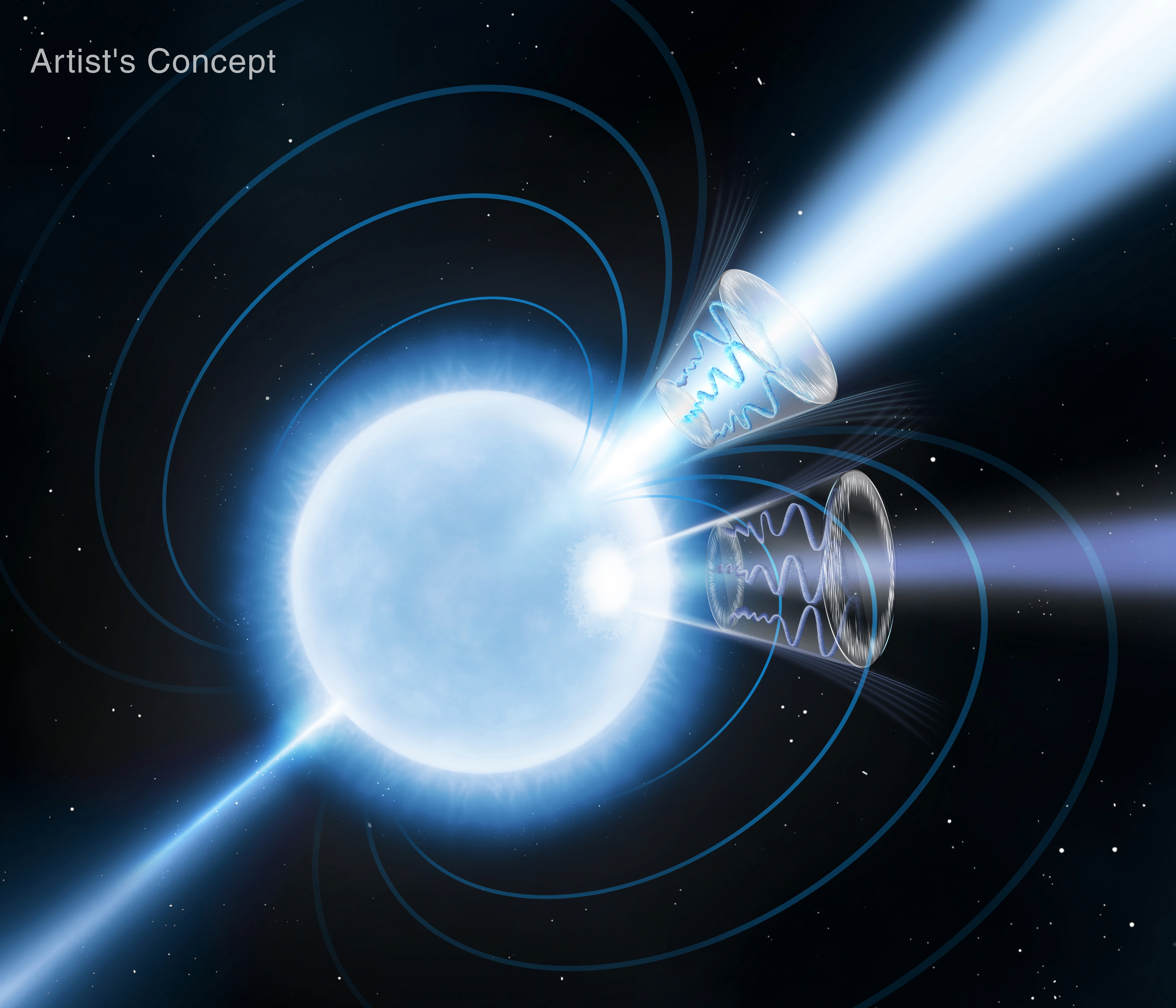
- Magnetars are a special class of neutron stars with ultra-strong magnetic fields, the strongest of any object in the observable universe, around a trillion times stronger than the strongest permanent magnets ever built on Earth. These super magnetic neutron stars offer glimpses into the physics of intense environments that cannot be found anywhere else.
- Neutron stars are the leftover cores of massive stars, formed at the end of their life cycles, that possess more mass than the Sun, condensed down to the size of a city, making them natural laboratories for studying extreme physics.
Scientists using NASA’s IXPE (Imaging X-ray Polarimetry Explorer) conducted more than 140 hours of observations of the magnetar 1E 1547-5408, between March and April 2025, alongside NASA’s NICER (Neutron Star Interior Composition Explorer) and Murriyang, CSIRO’s Parkes radio telescope, owned and operated by Australia’s national science agency. This was the first-ever coordinated radio and X-ray polarization measurement of a magnetar.
1E 1547-5408, spinning in a full rotation every 2 seconds, is a unique magnetar that consistently emits bright radio energy and X-ray light, for reasons scientists are still trying to understand.
Observations showed the polarization, or the orientation and level of alignment of the incoming photons, is nearly three times greater than seen in similar sources. This high level of polarization was surprising, since the geometry of the magnetar’s magnetic fields suggest that the measurements we see should be close to zero at certain points in the star. Standard surface emission models do not explain this large value either, indicating that another effect must be boosting the polarization.
Enter vacuum birefringence, a 90-year-old theory in the realm of quantum electrodynamics. First proposed in 1936, the theory suggests that the vacuum of space can be altered by extreme magnetic fields, far higher than those humans can create on Earth. Under such conditions, the vacuum acts like a lens or a prism, filtering light based on the direction it is traveling, therefore enhancing its total polarization. The IXPE mission’s ability to measure X-ray polarization was essential to test this theory.
Simulations performed by the research team support the possibility of vacuum birefringence causing the distinct signal. Hoa Dinh Thi, a postdoctoral associate at Rice University in Houston and co-lead author of the publication highlighting the results, said, “Our model suggests that reproducing the observed X-ray polarization signatures, while also satisfying the constraints set by radio observations, requires the presence of vacuum birefringence in the neutron star’s environment. This finding exemplifies how neutron stars enable us to test fundamental physics in environments not replicable in labs on Earth.”
The large polarization measurements from the magnetar give strong support to the theoretical prediction, and could be the first time this effect has been directly observed anywhere.
“This result truly highlights the interdisciplinary power of the field of astrophysics,” said Rachael Stewart, a Ph.D. candidate at George Washington University and lead author of the paper published in Nature. “The information we obtained from looking at this distant star core also gives us clues about the nature of the fabric of reality as we know it, and I find that to be incredible.”
Further IXPE observations of this source and other magnetars will confirm this signal and potentially reveal other exotic effects of quantum electrodynamics.
More about IXPE
The IXPE mission, which continues to provide unprecedented data enabling groundbreaking discoveries about celestial objects across the universe, is a joint NASA and Italian Space Agency mission with partners and science collaborators in 12 countries. It is led by NASA’s Marshall Space Flight Center in Huntsville, Alabama. Headquartered in Falls Church, Virginia, BAE Systems, Inc., manages spacecraft operations together with the University of Colorado’s Laboratory for Atmospheric and Space Physics in Boulder. Learn more about IXPE’s ongoing mission here:
About the Author Michael AllenShare
Details Last Updated Aug 05, 2026 Editor Lee Mohon Contact Joel Wallace Location Marshall Space Flight Center Related Terms Explore More 4 min read NASA Space Telescope Maps Magnetic Fields of ‘Lighthouse’ PulsarArticle
4 weeks ago
3 min read NASA’s IXPE Measures White Dwarf Star for First Time
By Michael Allen For the first time, scientists have used NASA’s IXPE (Imaging X-ray Polarimetry…
Article
7 months ago
4 min read NASA IXPE’s Longest Observation Solves Black Hole Jets Mystery
Written by Michael Allen An international team of astronomers using NASA’s IXPE (Imaging X-ray Polarimetry…
Article
8 months ago
Keep Exploring Discover More Topics From NASA
Missions
Humans in Space
Climate Change
Solar System
NASA’s IXPE May Have Proven 90-Year-Old Theory
4 min read
NASA’s IXPE May Have Proven 90-Year-Old TheoryA first-of-its-kind measurement of a magnetar may have captured empty space behaving in a way physicists have predicted for 90 years, but never directly observed. The results published Wednesday in Nature.
This artist’s concept depicts magnetar 1E 1547.0-5408, a rapidly rotating neutron star with magnetic fields over a trillion times stronger than Earth’s. Blue curves emanating from the star’s two magnetic poles represent the magnetic field lines. The magnetar is a significant emitter of radio and X-ray radiation, with their peaks offset during its 2.1-second rotation period. This indicates the primary X-ray emitter is a secondary “hot spot” offset from the magnetic axis. These emitters are depicted as conical sections: the lighter blue radio emission peaks at the magnetic field’s symmetry axis, while the darker blue X-ray emission peaks below. The upper and lower emission cones show X-ray polarization degrees of 40% and 80%, respectively. These high values, along with smooth, coherent variations in polarization across the rotation period, provide the most definitive signal to date of vacuum birefringence, a long-sought prediction of quantum electrodynamics. NASA/Pablo Garcia Fast facts- Magnetars are a special class of neutron stars with ultra-strong magnetic fields, the strongest of any object in the observable universe, around a trillion times stronger than the strongest permanent magnets ever built on Earth. These super magnetic neutron stars offer glimpses into the physics of intense environments that cannot be found anywhere else.
- Neutron stars are the leftover cores of massive stars, formed at the end of their life cycles, that possess more mass than the Sun, condensed down to the size of a city, making them natural laboratories for studying extreme physics.
Scientists using NASA’s IXPE (Imaging X-ray Polarimetry Explorer) conducted more than 140 hours of observations of the magnetar 1E 1547-5408 between March and April 2025 alongside NASA’s NICER (Neutron Star Interior Composition Explorer) and Murriyang, CSIRO’s Parkes radio telescope, owned and operated by Australia’s national science agency. This was the first-ever coordinated radio and X-ray polarization measurement of a magnetar.
1E 1547-5408, spinning in a full rotation every 2 seconds, is a unique magnetar that consistently emits bright radio energy and X-ray light, for reasons scientists are still trying to understand.
Observations showed the polarization, or the orientation and level of alignment of the incoming photons, is nearly three times greater than seen in similar sources. This high level of polarization was surprising, since the geometry of the magnetar’s magnetic fields suggest that the measurements we see should be close to zero at certain points in the star. Standard surface emission models do not explain this large value either, indicating that another effect must be boosting the polarization.
Enter vacuum birefringence, a 90-year-old theory in the realm of quantum electrodynamics. First proposed in 1936, the theory suggests that the vacuum of space can be altered by extreme magnetic fields, far higher than those humans can create on Earth. Under such conditions, the vacuum acts like a lens or a prism, filtering light based on the direction it is traveling, therefore enhancing its total polarization. The IXPE mission’s ability to measure X-ray polarization was essential to test this theory.
Simulations performed by the research team support the possibility of vacuum birefringence causing the distinct signal. Hoa Dinh Thi, a postdoctoral associate at Rice University in Houston and co-lead author of the publication highlighting the results, said, “Our model suggests that reproducing the observed X-ray polarization signatures, while also satisfying the constraints set by radio observations, requires the presence of vacuum birefringence in the neutron star’s environment. This finding exemplifies how neutron stars enable us to test fundamental physics in environments not replicable in labs on Earth.”
The large polarization measurements from the magnetar give strong support to the theoretical prediction and could be the first time this effect has been directly observed anywhere.
“This result truly highlights the interdisciplinary power of the field of astrophysics,” said Rachael Stewart, a Ph.D. candidate at George Washington University and lead author of the paper published in Nature. “The information we obtained from looking at this distant star core also gives us clues about the nature of the fabric of reality as we know it, and I find that to be incredible.”
Further IXPE observations of this source and other magnetars will confirm this signal and potentially reveal other exotic effects of quantum electrodynamics.
More about IXPE
The IXPE mission, which continues to provide unprecedented data enabling groundbreaking discoveries about celestial objects across the universe, is a joint NASA and Italian Space Agency mission with partners and science collaborators in 12 countries. It is led by NASA’s Marshall Space Flight Center in Huntsville, Alabama. Headquartered in Falls Church, Virginia, BAE Systems Inc., manages spacecraft operations together with the University of Colorado’s Laboratory for Atmospheric and Space Physics in Boulder. Learn more about IXPE’s ongoing mission here:
About the Author Michael AllenShare
Details Last Updated Aug 06, 2026 Editor Lee Mohon Contact Joel Wallace Location Marshall Space Flight Center Related Terms Explore More 4 min read NASA Space Telescope Maps Magnetic Fields of ‘Lighthouse’ PulsarArticle
4 weeks ago
3 min read NASA’s IXPE Measures White Dwarf Star for First Time
By Michael Allen For the first time, scientists have used NASA’s IXPE (Imaging X-ray Polarimetry…
Article
7 months ago
4 min read NASA IXPE’s Longest Observation Solves Black Hole Jets Mystery
Written by Michael Allen An international team of astronomers using NASA’s IXPE (Imaging X-ray Polarimetry…
Article
8 months ago
Keep Exploring Discover More Topics From NASA
Missions
Humans in Space
Climate Change
Solar System
Artemis III Orion Crew and Service Modules Joined
Elon Musk reveals SpaceX plans to build satellite factories on the moon
Musk outlined his vision to investors after SpaceX posted a $542-million loss from its space launch sector in its first quarter as a public company
Artemis III Orion Crew and Service Models Joined
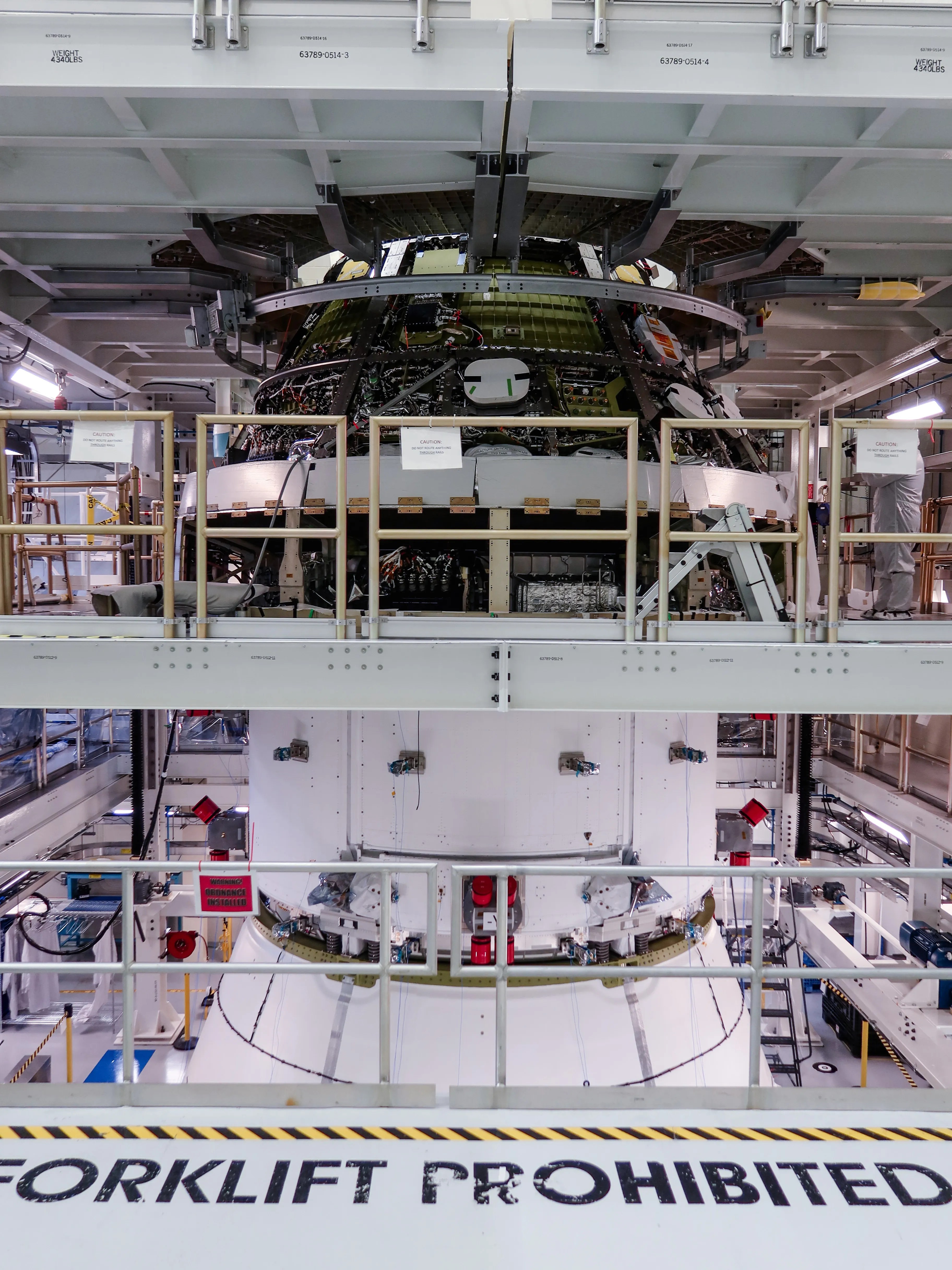
Technicians joined the Orion crew and service modules together on July 30, 2026, inside the Neil Armstrong Operations and Checkout Building at NASA’s Kennedy Space Center in Florida.
The crew module will carry and sustain NASA astronauts Randy Bresnik, Andre Douglas, and Frank Rubio, and ESA (European Space Agency) astronaut Luca Parmitano, while the service module will power and propel Orion during the mission to test rendezvous and docking capabilities with test versions, or test articles, of commercial human landing systems from Blue Origin and SpaceX.
Read more about this milestone.
Image credit: NASA
Artemis III Orion Crew and Service Models Joined
Technicians joined the Orion crew and service modules together on July 30, 2026, inside the Neil Armstrong Operations and Checkout Building at NASA’s Kennedy Space Center in Florida.
The crew module will carry and sustain NASA astronauts Randy Bresnik, Andre Douglas, and Frank Rubio, and ESA (European Space Agency) astronaut Luca Parmitano, while the service module will power and propel Orion during the mission to test rendezvous and docking capabilities with test versions, or test articles, of commercial human landing systems from Blue Origin and SpaceX.
Read more about this milestone.
Image credit: NASA
Neanderthal genes may give modern humans’ muscles a boost
Most of the world’s population carries at least a little Neanderthal DNA
Scientists discover a ‘skinny gene’ mutation that acts like Ozempic
One in 7,000 people carry this gene mutation
NASA’s Perseverance Captures Phobos and Earth
NASA/JPL-Caltech/ASU/MSSS/SSI Photojournal Navigation Downloads NASA’s Perseverance Captures Phobos and Earth
PNG (1,001.21 KB)
PIA26758 Figure A
PNG (4.68 MB)
PIA26758 Figure B
PNG (4.65 MB)
Description
This composite of seven images from the Mastcam-Z instrument aboard NASA’s Perseverance Mars rover shows Earth, visible as a small bright dot moving from upper left to lower right, passing behind the Martian moon Phobos on July 2, 2026, 1,907th Martian day, or sol, of the mission.
The black background is the result of image processing that removed extraneous light in the background to enhance detail.
Figure A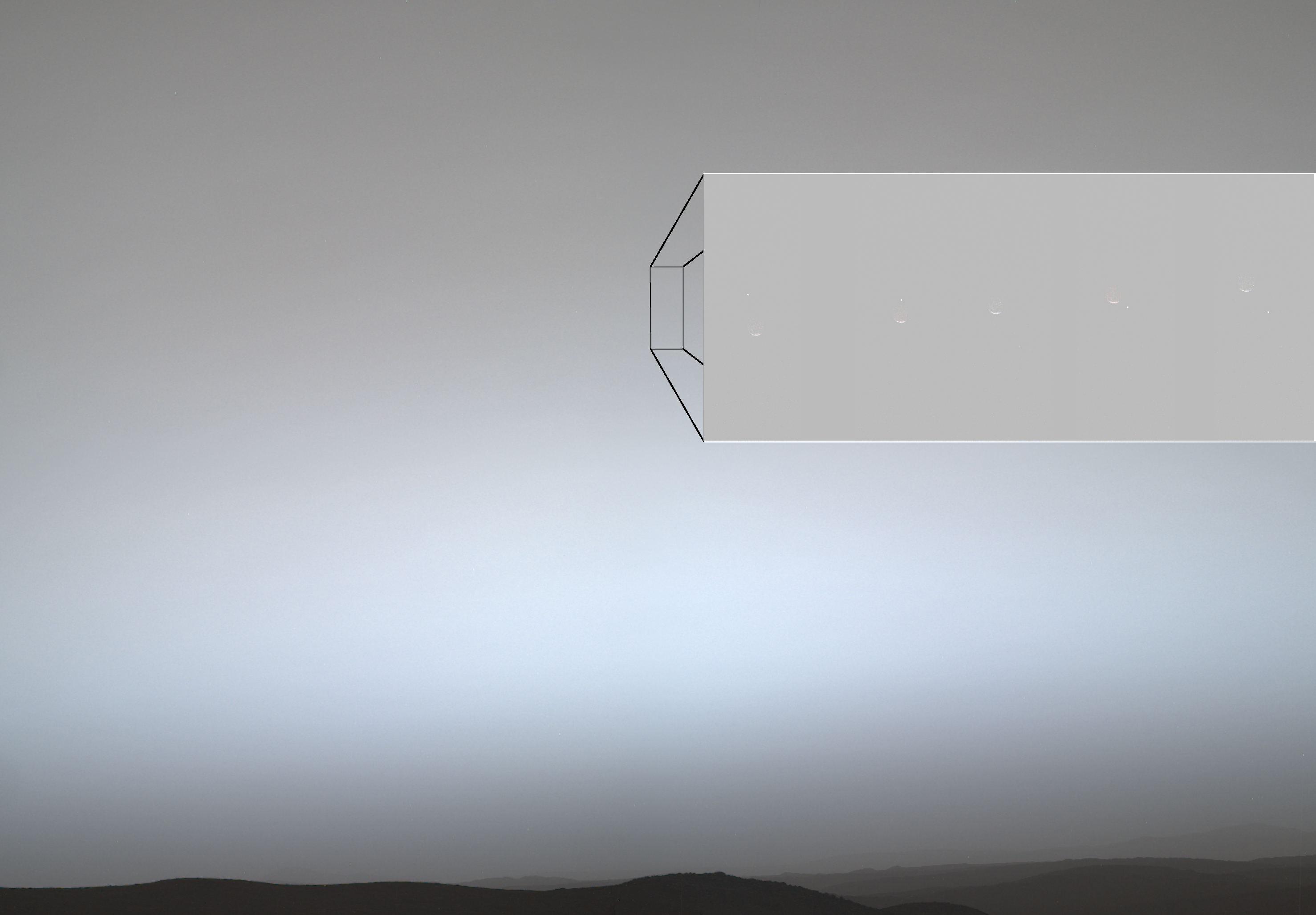
Figure A is an annotated composite of nine images taken by the Mastcam-Z instrument aboard Perseverance on July 2, 2026. The inset on the upper right, comprised of five images, shows Earth — the small bright dot moving from upper left to lower right — passing behind the Martian moon Phobos.
The rectangle outlined at the left in the annotation indicates the patch of sky that was imaged several times to capture Earth passing behind Phobos. In the larger rectangular inset, the images captured from that patch of sky are displayed in time order from left to right, with Phobos moving up and Earth moving down.
The gray of the Martian sky is the approximate true color of the twilight (about 40 minutes after sunset) on that sol. It is blue-gray lower, where it is brighter, and reddish gray above.
Figure B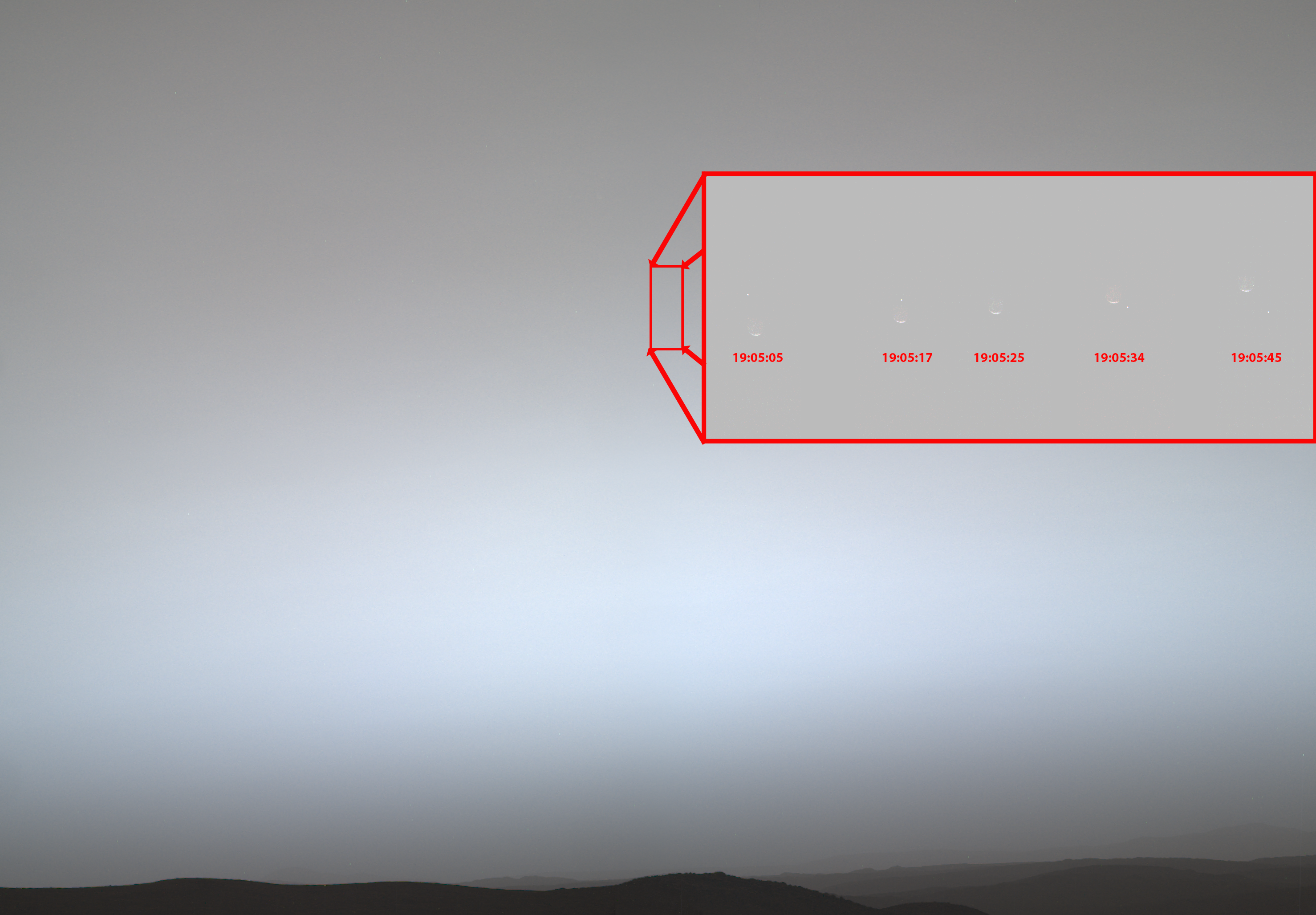
Figure B includes annotations showing the local solar time on Mars during which the five individual images that captured the occultation were taken.
NASA’s Jet Propulsion Laboratory in Southern California, which is managed by Caltech, built and manages operations of the Perseverance rover on behalf of the agency’s Science Mission Directorate in Washington, as part of NASA’s Mars Exploration Program portfolio. Arizona State University leads the operations of the rover’s Mastcam-Z instrument, working in collaboration with Malin Space Science Systems in San Diego, on the design, fabrication, testing, and operation of the cameras.
For more about Perseverance:
science.nasa.gov/mission/mars-2020-perseverance/
Keep Exploring Discover More Topics From Photojournal
Photojournal
Search Photojournal
Photojournal’s Latest Content
Feedback
NASA’s Perseverance Captures Phobos and Earth
NASA/JPL-Caltech/ASU/MSSS/SSI Photojournal Navigation Downloads NASA’s Perseverance Captures Phobos and Earth
PNG (1,001.21 KB)
PIA26758 Figure A
PNG (4.68 MB)
PIA26758 Figure B
PNG (4.65 MB)
Description
This composite of seven images from the Mastcam-Z instrument aboard NASA’s Perseverance Mars rover shows Earth, visible as a small bright dot moving from upper left to lower right, passing behind the Martian moon Phobos on July 2, 2026, 1,907th Martian day, or sol, of the mission.
The black background is the result of image processing that removed extraneous light in the background to enhance detail.
Figure AFigure A is an annotated composite of nine images taken by the Mastcam-Z instrument aboard Perseverance on July 2, 2026. The inset on the upper right, comprised of five images, shows Earth — the small bright dot moving from upper left to lower right — passing behind the Martian moon Phobos.
The rectangle outlined at the left in the annotation indicates the patch of sky that was imaged several times to capture Earth passing behind Phobos. In the larger rectangular inset, the images captured from that patch of sky are displayed in time order from left to right, with Phobos moving up and Earth moving down.
The gray of the Martian sky is the approximate true color of the twilight (about 40 minutes after sunset) on that sol. It is blue-gray lower, where it is brighter, and reddish gray above.
Figure BFigure B includes annotations showing the local solar time on Mars during which the five individual images that captured the occultation were taken.
NASA’s Jet Propulsion Laboratory in Southern California, which is managed by Caltech, built and manages operations of the Perseverance rover on behalf of the agency’s Science Mission Directorate in Washington, as part of NASA’s Mars Exploration Program portfolio. Arizona State University leads the operations of the rover’s Mastcam-Z instrument, working in collaboration with Malin Space Science Systems in San Diego, on the design, fabrication, testing, and operation of the cameras.
For more about Perseverance:
science.nasa.gov/mission/mars-2020-perseverance/
Keep Exploring Discover More Topics From Photojournal
Photojournal
Search Photojournal
Photojournal’s Latest Content
Feedback
NASA’s Perseverance Rover Watches Earth Vanish Behind Martian Moon
3 min read
Preparations for Next Moonwalk Simulations Underway (and Underwater) This annotated composite of nine images taken by Perseverance’s Mastcam-Z on July 2, 2026, shows Earth — the small bright dot moving from upper left to lower right — passing behind the Martian moon Phobos. The images in the inset were captured from the same rectangular patch of sky outlined in black.NASA/JPL-Caltech/ASU/MSSS/SSI The timecode annotations in the inset show the local solar time on Mars during which five individual images of the occultation were captured by NASA’s Perseverance on July 2, 2026. Earth disappears — and then reappears — behind the Martian moon Phobos.NASA/JPL-Caltech/ASU/MSSS/SSIEarth and the Martian moon Phobos dance together in a series of images recently acquired by NASA’s Perseverance Mars rover. Earth appears as a point of light in the Martian sky, disappearing behind the crescent of Phobos, the larger of Mars’ two moons.
This is the first time humanity has captured from the surface of another planet an observation of Earth disappearing behind an object.
The image sequence was taken by the rover’s Mastcam-Z instrument at about 7 p.m. local solar time (the Martian evening time where the rover is located) on July 2, the 1,907th Martian day, or sol, of the mission. In the composite image, Earth travels from the upper left of the frame toward the lower right while Phobos, moving from lower left to upper right, sweeps across its path. In the third frame of the sequence, the two meet, and our planet winks out behind the little moon’s shadowed edge.
“The composite image makes for a unique Earth self-portrait, taken from the surface of another planet, with a Phobos photobomb,” said Justin Maki, the Mastcam-Z deputy principal investigator and imaging scientist for Perseverance at NASA’s Jet Propulsion Laboratory in Southern California.
From where Perseverance sits on the rim of Mars’ Jezero Crater, the two objects could hardly look more different. Phobos, a lumpy, potato-shaped moon about 17 miles (27 kilometers) across at its widest, orbits so close to Mars (4,850 miles, or 7,800 kilometers, away) that when the images were taken, Phobos appears roughly one-third the width of Earth’s Moon as seen from our planet. Some 195 million miles (314 million kilometers) away at the time, Earth is reduced to a single, pixel-size dot.
“Phobos crosses the Martian sky three times a day, and Earth is visible for months at a stretch, but catching one directly behind the other takes planning and a little luck,” said Mark Lemmon, a Mastcam-Z co-investigator at the Space Science Institute in Boulder, Colorado, who planned the observation and assembled the composite.
This composite of seven images of Earth passing behind the Martian moon Phobos was acquired from data taken on July 2, 2026, 1,907th Martian day, or sol, of the mission. The black background is the result of image processing that removed extraneous light in the background to enhance detail.NASA/JPL-Caltech/ASU/MSSS/SSI Transits, occultations, eclipses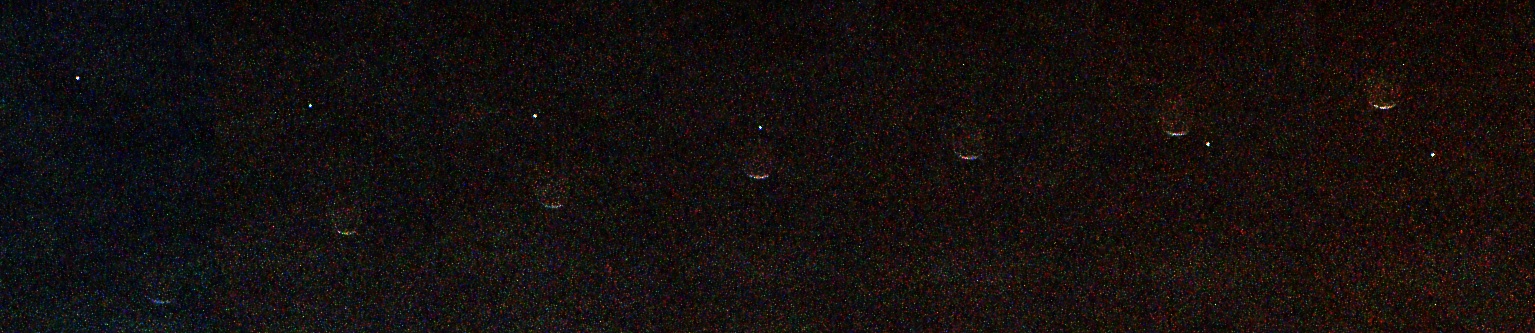
Astronomers call the event captured in this observation an occultation: when a larger-appearing body completely blocks the one behind it from the viewer’s standpoint. By contrast, an eclipse occurs when one object moves into the shadow of another. When the Moon passes through Earth’s shadow, it’s called a lunar eclipse; when one object that appears to be the same size as another blocks it, like when the Moon passes before the Sun, it’s known as a solar eclipse.
When the roles are reversed, with a smaller-looking object crossing the face of a larger-looking one, astronomers call that a transit. Perseverance has observed those, too: when Phobos or Deimos crosses the disk of the Sun as seen from Mars. These are sometimes described informally as “Martian solar eclipses.”
More about PerseveranceNASA’s Jet Propulsion Laboratory in Southern California, which is managed by Caltech, built and manages operations of the Perseverance rover on behalf of the agency’s Science Mission Directorate in Washington, as part of NASA’s Mars Exploration Program portfolio. Arizona State University leads the operations of the rover’s Mastcam-Z instrument, working in collaboration with Malin Space Science Systems in San Diego, on the design, fabrication, testing, and operation of the cameras.
For more about Perseverance:
https://science.nasa.gov/mission/mars-2020-perseverance
News Media Contacts
DC Agle
Jet Propulsion Laboratory, Pasadena, Calif.
818-393-9011
agle@jpl.nasa.gov
Karen Fox / Alana Johnson
NASA Headquarters, Washington
240-285-5155 / 202-672-4780
karen.c.fox@nasa.gov / alana.r.johnson@nasa.gov
2026-054
Share Details Last Updated Aug 05, 2026 Related Terms Explore More 5 min read The Paradox of Lençóis Maranhenses National ParkThe coastal dune field in Brazil looks like a desert but fills with freshwater lagoons…
Article 1 day ago 4 min read NASA’s PUNCH Sharpens Solar Storm Forecasting in First TestUsing continuous imagery from NASA’s PUNCH (Polarimeter to Unify the Corona and Heliosphere) mission, scientists…
Article 2 days ago 2 min read August 2026 Satellite PuzzlerYour challenge is to tell us the location of the satellite image and why it…
Article 2 days ago Keep Exploring Discover Related Topics Mars Perseverance RoverThe Mars Perseverance rover is the first leg the Mars Sample Return Campaign’s interplanetary relay team. Its job is to…
PhobosPhobos is the larger of Mars’ two moons. It orbits Mars three times a day, and is so close to…
Mars ExplorationMars is the only planet we know of inhabited entirely by robots. Learn more about the Mars Missions.
Planetary ScienceNASA’s planetary science program explores the objects in our solar system to better understand its history and the distribution of…
NASA’s Perseverance Rover Watches Earth Vanish Behind Martian Moon
3 min read
Preparations for Next Moonwalk Simulations Underway (and Underwater) This annotated composite of nine images taken by Perseverance’s Mastcam-Z on July 2, 2026, shows Earth — the small bright dot moving from upper left to lower right — passing behind the Martian moon Phobos. The images in the inset were captured from the same rectangular patch of sky outlined in black.NASA/JPL-Caltech/ASU/MSSS/SSI The timecode annotations in the inset show the local solar time on Mars during which five individual images of the occultation were captured by NASA’s Perseverance on July 2, 2026. Earth disappears — and then reappears — behind the Martian moon Phobos.NASA/JPL-Caltech/ASU/MSSS/SSIEarth and the Martian moon Phobos dance together in a series of images recently acquired by NASA’s Perseverance Mars rover. Earth appears as a point of light in the Martian sky, disappearing behind the crescent of Phobos, the larger of Mars’ two moons.
This is the first time humanity has captured from the surface of another planet an observation of Earth disappearing behind an object.
The image sequence was taken by the rover’s Mastcam-Z instrument at about 7 p.m. local solar time (the Martian evening time where the rover is located) on July 2, the 1,907th Martian day, or sol, of the mission. In the composite image, Earth travels from the upper left of the frame toward the lower right while Phobos, moving from lower left to upper right, sweeps across its path. In the third frame of the sequence, the two meet, and our planet winks out behind the little moon’s shadowed edge.
“The composite image makes for a unique Earth self-portrait, taken from the surface of another planet, with a Phobos photobomb,” said Justin Maki, the Mastcam-Z deputy principal investigator and imaging scientist for Perseverance at NASA’s Jet Propulsion Laboratory in Southern California.
From where Perseverance sits on the rim of Mars’ Jezero Crater, the two objects could hardly look more different. Phobos, a lumpy, potato-shaped moon about 17 miles (27 kilometers) across at its widest, orbits so close to Mars (4,850 miles, or 7,800 kilometers, away) that when the images were taken, Phobos appears roughly one-third the width of Earth’s Moon as seen from our planet. Some 195 million miles (314 million kilometers) away at the time, Earth is reduced to a single, pixel-size dot.
“Phobos crosses the Martian sky three times a day, and Earth is visible for months at a stretch, but catching one directly behind the other takes planning and a little luck,” said Mark Lemmon, a Mastcam-Z co-investigator at the Space Science Institute in Boulder, Colorado, who planned the observation and assembled the composite.
This composite of seven images of Earth passing behind the Martian moon Phobos was acquired from data taken on July 2, 2026, 1,907th Martian day, or sol, of the mission. The black background is the result of image processing that removed extraneous light in the background to enhance detail.NASA/JPL-Caltech/ASU/MSSS/SSI Transits, occultations, eclipsesAstronomers call the event captured in this observation an occultation: when a larger-appearing body completely blocks the one behind it from the viewer’s standpoint. By contrast, an eclipse occurs when one object moves into the shadow of another. When the Moon passes through Earth’s shadow, it’s called a lunar eclipse; when one object that appears to be the same size as another blocks it, like when the Moon passes before the Sun, it’s known as a solar eclipse.
When the roles are reversed, with a smaller-looking object crossing the face of a larger-looking one, astronomers call that a transit. Perseverance has observed those, too: when Phobos or Deimos crosses the disk of the Sun as seen from Mars. These are sometimes described informally as “Martian solar eclipses.”
More about PerseveranceNASA’s Jet Propulsion Laboratory in Southern California, which is managed by Caltech, built and manages operations of the Perseverance rover on behalf of the agency’s Science Mission Directorate in Washington, as part of NASA’s Mars Exploration Program portfolio. Arizona State University leads the operations of the rover’s Mastcam-Z instrument, working in collaboration with Malin Space Science Systems in San Diego, on the design, fabrication, testing, and operation of the cameras.
For more about Perseverance:
https://science.nasa.gov/mission/mars-2020-perseverance
News Media Contacts
DC Agle
Jet Propulsion Laboratory, Pasadena, Calif.
818-393-9011
agle@jpl.nasa.gov
Karen Fox / Alana Johnson
NASA Headquarters, Washington
240-285-5155 / 202-672-4780
karen.c.fox@nasa.gov / alana.r.johnson@nasa.gov
2026-054
Share Details Last Updated Aug 05, 2026 Related Terms Explore More 5 min read The Paradox of Lençóis Maranhenses National ParkThe coastal dune field in Brazil looks like a desert but fills with freshwater lagoons…
Article 12 hours ago 4 min read NASA’s PUNCH Sharpens Solar Storm Forecasting in First TestUsing continuous imagery from NASA’s PUNCH (Polarimeter to Unify the Corona and Heliosphere) mission, scientists…
Article 22 hours ago 2 min read August 2026 Satellite PuzzlerYour challenge is to tell us the location of the satellite image and why it…
Article 23 hours ago Keep Exploring Discover Related Topics Mars Perseverance RoverThe Mars Perseverance rover is the first leg the Mars Sample Return Campaign’s interplanetary relay team. Its job is to…
PhobosPhobos is the larger of Mars’ two moons. It orbits Mars three times a day, and is so close to…
Mars ExplorationMars is the only planet we know of inhabited entirely by robots. Learn more about the Mars Missions.
Planetary ScienceNASA’s planetary science program explores the objects in our solar system to better understand its history and the distribution of…
Inouye Solar Telescope Sees the Sun Closer Than Ever
Scientists observing the Sun with the Daniel K. Inouye Solar Telescope have caught a wave-like shape that's never been seen on the Sun's visible surface.
The post Inouye Solar Telescope Sees the Sun Closer Than Ever appeared first on Sky & Telescope.
Spectacular images reveal never-before-seen whirlpools on the sun
Strange whirlpools of plasma seen in the sharpest images ever captured of our star help explain the deep origins of Earth-threatening space weather and more
How living near mountain lions might actually make you safer
Mountain lions (also known as cougars or pumas) make roads safer by scaring deer and elk that can cause collisions with cars into more remote areas
Your chance to run software in deep space on ESA's asteroid mission
The European Space Agency is offering European researchers and companies a rare and exciting opportunity to run their innovative software directly in deep space aboard ESA’s Hera mission, millions of kilometres away.
Advanced Mini-laboratories Automate Space Station Research
The International Space Station hosts hundreds of science experiments at a time. Some experiments can take hours to perform, and researchers need to account for astronauts’ limited time. Fully automated devices, like Redwire’s ADvanced Space Experiment Processors (ADSEPs), have been designed to conduct more space science with less crew time.
Within each ADSEP facility there are three to four “mini-laboratories”, called cassettes, that allow multiple studies with different needs to be performed at the same time. The latest model, ADSEP-4 can accommodate four cassettes and features imagery capabilities. Since 2017, ADSEPs have conducted and supported two dozen investigations aboard space station with new ones on the horizon.
Crystals are grown aboard the International Space Station as part of ADSEP-PIL-02, an investigation that aims to study the effects of microgravity on various types of crystals.Redwire
The latest ADSEP investigations are related to growing seed crystals in space, which can be used to reformulate existing drugs or develop entirely new therapeutics. Previous experiments have shown that the unique microgravity environment allows the growth of larger and higher quality crystals. With Redwire’s Pharmaceutical In-Space Laboratory (PIL-BOX), a cassette-based system that uses the ADSEP facility, researchers can grow improved, space-grown seed crystals.
European Space Agency (ESA) astronaut Sophie Adenot displays a cassette for the ADvanced Space Experiment Processor (ADSEP).NASA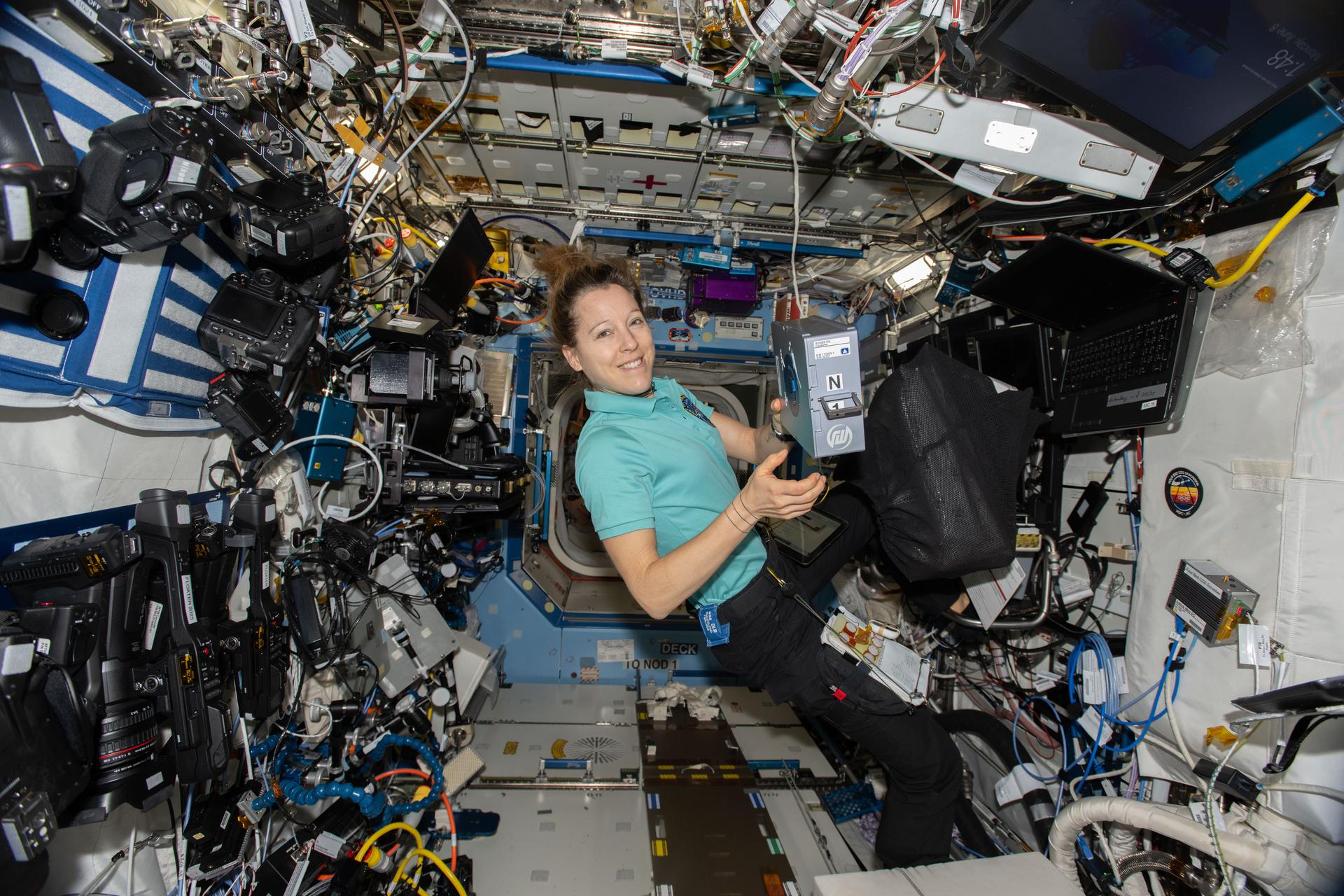
Notable PIL-BOX experiments sponsored by the ISS National Laboratory have focused on cancer research. The ADSEP-PIL-10 investigation, currently being conducted in orbit in collaboration with the Aspera Biomedicines, works to crystallize cancer-blocking and cancer-promoting molecules with the goal of creating an oral cancer medication. ADSEP-PIL-15 crystalized cancer-treating medicines to help refine production, quality, and stability of these cancer drugs. A recent technology demonstration, ADSEP- ICC (Industrial Crystallization Cassette), tested a larger cassette to expand ADSEP function and scale crystallization production for commercial use.
Juvenile bobtail squid swimming in seawater just after hatching as part of the ADSEP-UMAMI investigation.University of Florida
ADSEPs are not limited to crystal growth and can also be used for culturing cells and tissues, studying organisms, and researching materials-sciences. In 2021, ADSEP-UMAMI studied how bobtail squid interacted with beneficial microbes in the space environment. This research found that symbiotic interactions with microbes can lessen a host animal’s stress responses caused by spaceflight and accelerate developmental pathways such as growing neurons and tissues. These findings give insight into the importance of symbiotic relationships in closed ecosystems like spacecraft and have implications for astronauts and their own beneficial bacteria during space missions.
The automation and versatility of ADSEPs permit a wide array of science experiments to be conducted aboard the orbiting laboratory, leading to findings that inform future space missions and are beneficial to people on Earth.
Advanced Mini-laboratories Automate Space Station Research
The International Space Station hosts hundreds of science experiments at a time. Some experiments can take hours to perform, and researchers need to account for astronauts’ limited time. Fully automated devices, like Redwire’s ADvanced Space Experiment Processors (ADSEPs), have been designed to conduct more space science with less crew time.
Within each ADSEP facility there are three to four “mini-laboratories”, called cassettes, that allow multiple studies with different needs to be performed at the same time. The latest model, ADSEP-4 can accommodate four cassettes and features imagery capabilities. Since 2017, ADSEPs have conducted and supported two dozen investigations aboard space station with new ones on the horizon.
Crystals are grown aboard the International Space Station as part of ADSEP-PIL-02, an investigation that aims to study the effects of microgravity on various types of crystals.RedwireThe latest ADSEP investigations are related to growing seed crystals in space, which can be used to reformulate existing drugs or develop entirely new therapeutics. Previous experiments have shown that the unique microgravity environment allows the growth of larger and higher quality crystals. With Redwire’s Pharmaceutical In-Space Laboratory (PIL-BOX), a cassette-based system that uses the ADSEP facility, researchers can grow improved, space-grown seed crystals.
European Space Agency (ESA) astronaut Sophie Adenot displays a cassette for the ADvanced Space Experiment Processor (ADSEP).NASANotable PIL-BOX experiments sponsored by the ISS National Laboratory have focused on cancer research. The ADSEP-PIL-10 investigation, currently being conducted in orbit in collaboration with the Aspera Biomedicines, works to crystallize cancer-blocking and cancer-promoting molecules with the goal of creating an oral cancer medication. ADSEP-PIL-15 crystalized cancer-treating medicines to help refine production, quality, and stability of these cancer drugs. A recent technology demonstration, ADSEP- ICC (Industrial Crystallization Cassette), tested a larger cassette to expand ADSEP function and scale crystallization production for commercial use.
Juvenile bobtail squid swimming in seawater just after hatching as part of the ADSEP-UMAMI investigation.University of FloridaADSEPs are not limited to crystal growth and can also be used for culturing cells and tissues, studying organisms, and researching materials-sciences. In 2021, ADSEP-UMAMI studied how bobtail squid interacted with beneficial microbes in the space environment. This research found that symbiotic interactions with microbes can lessen a host animal’s stress responses caused by spaceflight and accelerate developmental pathways such as growing neurons and tissues. These findings give insight into the importance of symbiotic relationships in closed ecosystems like spacecraft and have implications for astronauts and their own beneficial bacteria during space missions.
The automation and versatility of ADSEPs permit a wide array of science experiments to be conducted aboard the orbiting laboratory, leading to findings that inform future space missions and are beneficial to people on Earth.