
_0.thumbnail.jpg "Image (3).jpg")
Feed aggregator
Galaxy Mergers May Not Stifle Star Formation After All, According to Illustris TNG
In recent years, the idea that galaxy mergers are responsible for quenching galaxies has grown in importance. This paradigm says that galaxies merge, their black holes form a powerful quasar, and that quasar stifles star formation. But new results from the IllustrisTNG simulations shows that this paradigm may not be accurate.
Why Einstein's theories of relativity make time travel possible
Physicists, mathematicians and philosophers have been exploring the possibility of going forward to the future or back to the past
A Distant Primordial Object May Be a Newborn Little Red Dot
Little Red Dots are among the most intriguing discoveries made to date by the infrared-sensitive James Webb Space Telescope (JWST). They are distant, small objects that appear red in the JWST observations and they've only been known since 2024. More than 300 of them have been found as part of JWST's infrared surveys of the early Universe.
Into Totality: Our Guide to the August 12th Total Solar Eclipse
Where will you be on August 12th? Many an eclipse chaser and the ‘eclipse curious’ will make the journey to stand in the Moon’s shadow on that fast-approaching Wednesday date. This unique eclipse sees the pencil-thin shadow of our Moon curl around the Earth’s pole, before arcing across Greenland, Iceland and the Iberian peninsula towards a dramatic sunset over the western Mediterranean.
How mental exhaustion changes the choices you make
Neuroscientists show how the brain weighs effort against reward when we're mentally fatigued
What caused the magnitude 6.8 earthquake in Japan?
This quake, which has caused damage to several roads and buildings, occurred along a strike-slip fault
How Sentinel-1 measured movement of Venezuela quakes
More than one month on from the catastrophic twin earthquakes in northern Venezuela on 24 June 2026, satellite data show the ground displacement was greater than first estimated.
Scientists get best-yet glimpse of Betelgeuse’s companion star
After decades of hints and speculation, scientists have at last unveiled the hidden companion to the iconic star Betelgeuse
Martian Space Suits Will Need To Be 40% Lighter
Long before a human ever sets foot on the Red Planet, we already know how hard the environment is. Once one finally does, the only things protecting them from that harsh environment will be the infrastructure we’ve built up there, and the spacesuit that keeps that in a protective bubble. Unfortunately, modern space suits aren’t built with Martian gravity, which is 3/8ths of Earth’s, in mind. To prove that point, a team of NASA and industry engineers made a presentation at the 55th International Conference on Environmental Systems (ICES) that showed that the newest generation of spacesuits are simply too heavy to use on Mars.
Liftoff as Ariane 6 takes flight for the first time
Solar Photography: Catch the Sun
Learn how to photograph this captivating target.
The post Solar Photography: Catch the Sun appeared first on Sky & Telescope.
JWST Could Spot Volcanic "Exo-Ios" Around Super-Jupiters
Jupiter’s moon, Io, is the most volcanically active planetary body in the solar system, boasting hundreds of active volcanoes spewing molten lava into space. This occurs from a process called tidal heating where Jupiter’s massive gravity constantly stretches and compresses the much smaller moon during the latter’s non-circular orbit. However, a lesser-known fact is that Io’s volcanic gases fuel Jupiter’s aurorae by traveling along Jupiter’s magnetic field lines, resulting in Jupiter’s bright aurorae observed by spacecraft and Earth-based telescopes. But what if this same phenomenon could be used to detect Io-like exomoons, also called exo-Ios, orbiting Jupiter-like exoplanets?
Smoke Blankets Oregon
- Earth
- Earth Observatory
- Image of the Day
- EO Explorer
- Topics
- More Content
- About
Smoke Blankets Oregon
- Earth
- Earth Observatory
- Image of the Day
- EO Explorer
- Topics
- More Content
- About
Chang'e-6 Samples Provide an Ancient Record of the Moon's Far Side.
The samples returned by the Chang'e-6 mission from the far side of the Moon reveal that the two hemispheres have had rather different experiences when it comes to space weather.
Little Red Dots Could Be Ancient Globular Clusters, Each Dominated by a Super-Massive Star
Little Red Dots are one of the mysteries uncovered by the JWST. Astronomers have been trying to figure out what they are, and have come up with multiple possibilities. New research says they could be ancient Globular Clusters with supermassive stars in their centers.
NASA Astronaut Chris Williams to Discuss Space Station Mission
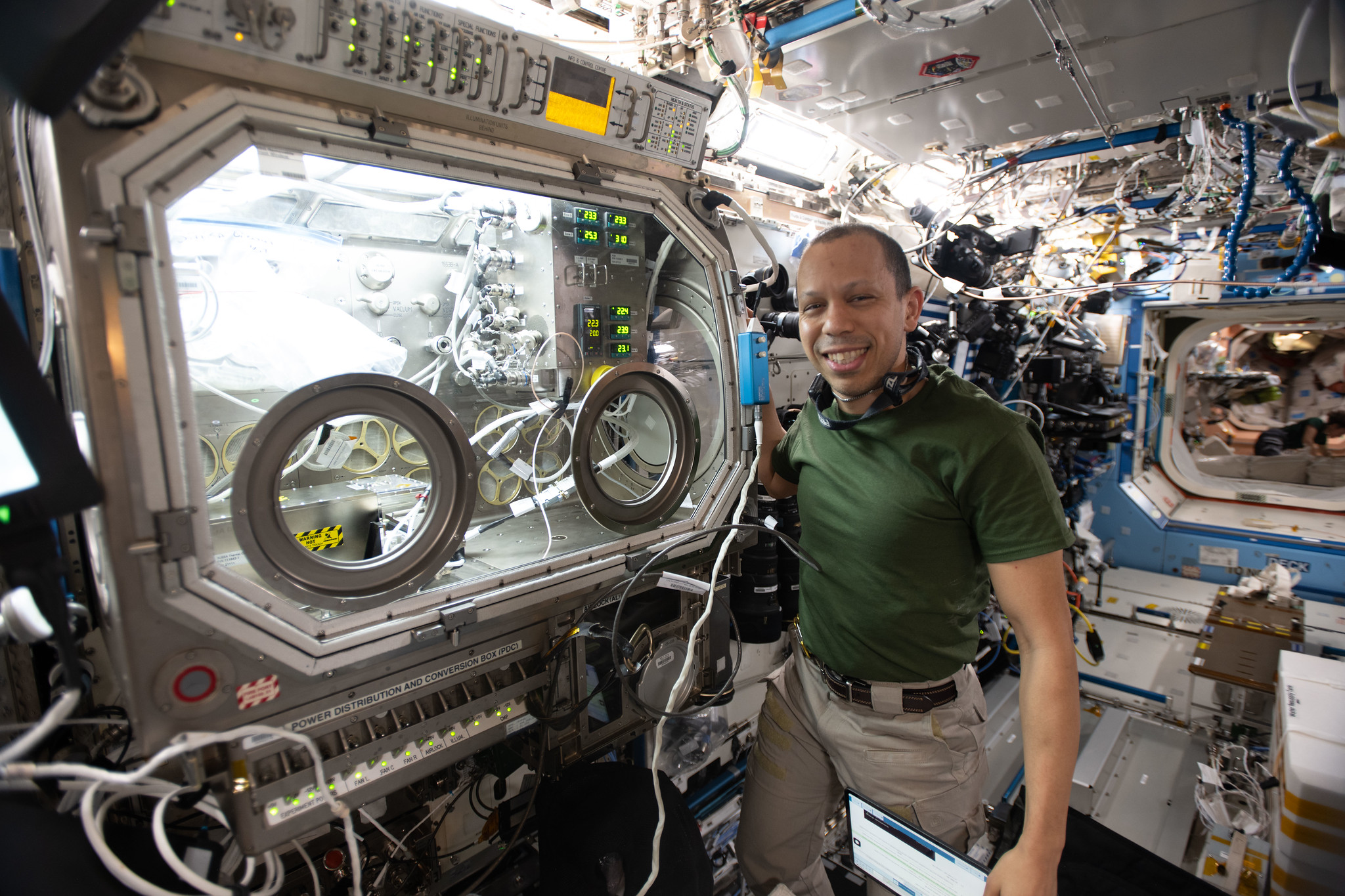
NASA astronaut Chris Williams will recap his recent eight-month mission aboard the International Space Station during a news conference at 2:45 p.m. EDT Tuesday, Aug. 4, from the agency’s Johnson Space Center in Houston.
NASA will stream this event live through a variety of platforms. Learn where to watch online:
United States-based media interested in attending in person must contact the NASA Johnson newsroom no later than 5 p.m., Friday, July 31, at jsccommu@mail.nasa.gov.
Media wishing to participate by phone must contact the Johnson newsroom no later than two hours before the start of the event. To ask a question by phone, media must dial into the news conference no later than 15 minutes prior to the start of the call. NASA’s media accreditation policy is available online.
Williams returned to Earth on July 26, after logging 241 days as an Expedition 73/74 flight engineer during his first spaceflight. He returned along with Roscosmos cosmonauts Sergey Kud-Sverchkov and Sergei Mikaev, completing 3,856 orbits of the Earth over the course of their more than 102-million-mile journey. They also saw the arrival of six visiting spacecraft and the departure of eight.
During his mission, Williams supported a wide range of scientific investigations and technology demonstrations. He helped advance research for new cancer treatments and improved in-space manufacturing of materials used in high-performance computers and electronics. Williams also completed two spacewalks to prep for space station power system upgrades and to replace a faulty joint on the Canadarm2 robotic arm. The crew’s work aboard the space station helps improve life on Earth and prepare for future human missions to the Moon and Mars.
To learn more about International Space Station research, operations, and its crews, visit:
-end-
Joshua Finch
Headquarters, Washington
202-358-1100
joshua.a.finch@nasa.gov
Anna Schneider
Johnson Space Center, Houston
281-483-5111
anna.c.schneider@nasa.gov
NASA Astronaut Chris Williams to Discuss Space Station Mission
NASA astronaut Chris Williams will recap his recent eight-month mission aboard the International Space Station during a news conference at 2:45 p.m. EDT Tuesday, Aug. 4, from the agency’s Johnson Space Center in Houston.
NASA will stream this event live through a variety of platforms. Learn where to watch online:
United States-based media interested in attending in person must contact the NASA Johnson newsroom no later than 5 p.m., Friday, July 31, at jsccommu@mail.nasa.gov.
Media wishing to participate by phone must contact the Johnson newsroom no later than two hours before the start of the event. To ask a question by phone, media must dial into the news conference no later than 15 minutes prior to the start of the call. NASA’s media accreditation policy is available online.
Williams returned to Earth on July 26, after logging 241 days as an Expedition 73/74 flight engineer during his first spaceflight. He returned along with Roscosmos cosmonauts Sergey Kud-Sverchkov and Sergei Mikaev, completing 3,856 orbits of the Earth over the course of their more than 102-million-mile journey. They also saw the arrival of six visiting spacecraft and the departure of eight.
During his mission, Williams supported a wide range of scientific investigations and technology demonstrations. He helped advance research for new cancer treatments and improved in-space manufacturing of materials used in high-performance computers and electronics. Williams also completed two spacewalks to prep for space station power system upgrades and to replace a faulty joint on the Canadarm2 robotic arm. The crew’s work aboard the space station helps improve life on Earth and prepare for future human missions to the Moon and Mars.
To learn more about International Space Station research, operations, and its crews, visit:
-end-
Joshua Finch
Headquarters, Washington
202-358-1100
joshua.a.finch@nasa.gov
Anna Schneider
Johnson Space Center, Houston
281-483-5111
anna.c.schneider@nasa.gov
NASA Science Soars During August Total Solar Eclipse
6 min read
NASA Science Soars During August Total Solar EclipseEach time the Moon covers the Sun during a total solar eclipse — darkening daytime skies and briefly revealing the Sun’s ethereal outer atmosphere, the corona — it presents new opportunities to better understand our star and its influence on Earth.
On Wednesday, Aug. 12, as the next total solar eclipse sweeps over Greenland, Iceland, and Spain, NASA-funded science teams will be chasing the Moon’s shadow with a high-altitude jet and scientific balloons to investigate the Sun’s dynamics and how the temporary darkening of our skies affects our atmosphere.
“From our unique perspective on Earth during a total solar eclipse, scientists can study the Sun’s corona in a way we can’t from anywhere else in the solar system,” said Kelly Korreck, eclipse program manager at NASA Headquarters in Washington. “The Sun impacts our daily life, satellites, and astronauts in space, and we can take advantage of this moment to advance our understanding of that influence.”
High-flying jet to record solar dynamicsSoaring in the nose cone of NASA’s WB-57 high-altitude research aircraft is a suite of four cameras to take high-resolution images of the corona in several different wavelengths of visible and infrared light. Part of an instrument developed by the NASA Scientifically Calibrated In-Flight Imagery (SCIFLI) team at NASA’s Langley Research Center in Hampton, Virginia, the cameras will capture at least 20 images per second, recording structures, outflows, and rapid changes in the corona during the total solar eclipse.
With these images, scientists hope to learn more about the formation of prominences (solar material that gets suspended above the Sun’s surface), better understand the corona and how it gets heated to nearly a million degrees, and investigate how material in the corona and the solar wind are related, which flows out from the Sun across the solar system.
These images of the corona and solar prominences were taken in different wavelengths of visible and infrared light by imagers aboard a NASA’s WB-57 jet during the April 8, 2024, total solar eclipse. The same cameras will fly on a NASA WB-57 jet again during the Aug. 12 eclipse. NASA / SwRI / William Ashfield
By chasing the Moon’s shadow, the jet will extend how long the cameras can observe the corona. On the ground, the longest anyone will be able to see the corona is two minutes and 18 seconds. But flying along the eclipse path at 460 miles per hour, the jet’s view of the corona will last nearly three minutes.
NASA’s WB-57 will fly at 50,000 feet, above any clouds that might obscure the view of the corona from the ground. The altitude also allows the cameras to observe some infrared wavelengths that get absorbed by the lower atmosphere before reaching the ground, and the corona only has been observed in those wavelengths a few times before.
One of NASA’s WB-57 high-altitude jets will carry a suite of cameras up to 50,000 feet to capture images of the solar corona during the Aug. 12 total solar eclipse. NASA
The instrument, called SCIFLI Multispectral Airborne Imager, or SAMI, also flew on a WB-57 during the total solar eclipse on April 8, 2024, providing valuable imagery and information about the corona. However, the study’s principal investigator, Amir Caspi of the Southwest Research Institute in Boulder, Colorado, says each total solar eclipse provides new opportunities to learn more about the corona.
“The Sun is always changing,” Caspi said. “Every eclipse is different. So we could see things we didn’t see before. And we learn from each eclipse how to better observe the next one.”
Caspi’s team also is making some enhancements for the 2026 campaign based on lessons learned in 2024. For example, the team will adjust exposure times to better capture bright features that were overexposed in 2024 imagery. They will also leverage software developed since 2024 to process and analyze the data sooner than before.
The experiment is funded by NASA’s Heliophysics Low Cost Access to Space Program.
As a total solar eclipse crosses Russia, Greenland, Iceland, Spain, and Portugal on Aug. 12, 2026, some of the best views will come from 50,000 feet up, aboard NASA’s WB-57 jet. Credit: NASA’s Goddard Space Flight Center Balloons to watch atmospheric changesWhen a total solar eclipse suddenly turns daytime skies dark, our atmosphere changes in ways we don’t yet fully understand.
The NASA-supported Nationwide Eclipse Ballooning Project, led by Angela Des Jardins at Montana State University, is sending students from several U.S. universities to Iceland and Spain to launch scientific balloons before, during, and after the eclipse to better understand those changes.
A student team from the University of Kentucky prepares to launch a ballon from Bloomington, Indiana, to take atmospheric measurements on April 8, 2024, during the 2024 Nationwide Eclipse Ballooning Project campaign. Sean Bailey (University of Kentucky)
In Iceland, two teams will launch a total of 80 balloons starting 18 hours before the eclipse until eight hours afterward to study how the eclipse affects Earth’s “boundary layer,” the part of the atmosphere that touches the ground. The thickness of the boundary layer changes depending on factors such as surface temperature and moisture in the air.
Previous balloon flights during solar eclipses in October 2023 and April 2024 showed that the boundary layer collapsed, or decreased in thickness, in locations with clear skies but not where there were cloudy skies. Scientists wonder whether that will be different in Iceland in 2026. Changes in the boundary layer are driven by the day-night cycle. However, in Iceland in August, the days are long and nights are short, so the nighttime influences might not be as strong as in 2023 or 2024.
“Will this eclipse be able to collapse the boundary layer?” said Matthew Bernards, a chemical engineering professor at the University of Idaho, who leads one of the Iceland teams.
This image shows the Moon’s shadow on Earth during the total solar eclipse on April 8, 2024, as seen from about 90,000 feet from a camera carried by a scientific balloon. Cameras carried by balloons launched from Spain will capture similar images during the Aug. 12 total solar eclipse. Nationwide Eclipse Ballooning Project/Virginia Tech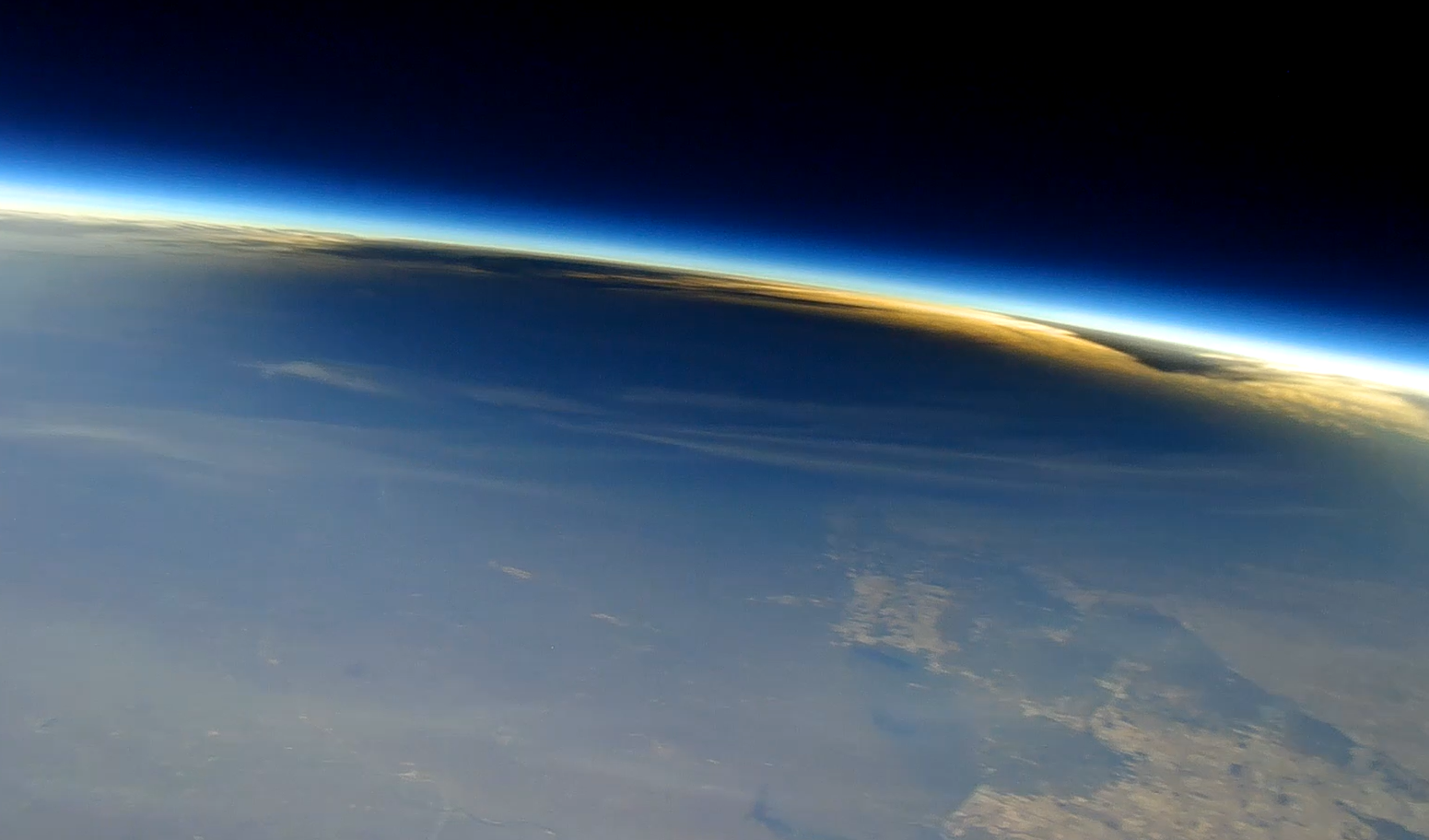
In Spain, three balloon teams will launch a total of six balloons with 360-degree cameras to image the eclipse shadow from above. These balloons also will include instruments designed to measure levels of ozone in the atmosphere, which requires sunlight to form. Similar balloon experiments showed that ozone decreased during totality in April 2024. Scientists wonder whether there will be differences with this eclipse, particularly since it happens at a later time of day and during a different season.
The NASA-funded Nationwide Eclipse Ballooning Project will allow teams of students from across the U.S. to get a unique view of the August total solar eclipse with scientific balloons. Credit: NASA’s Goddard Space Flight Center Follow alongWhile the total solar eclipse won’t be visible in the U.S., some parts of the country will be able to see a partial solar eclipse. Learn more about where to see the eclipse and how to view it safely.
by Vanessa Thomas
NASA’s Goddard Space Flight Center, Greenbelt, Md.
Lee esta historia en español aquí.
Share Details Last Updated Jul 28, 2026 Related Terms Explore More 6 min read NASA’s Swift Sees ‘Wandering’ Mega Black Hole Shredding StarArticle
1 day ago
6 min read NASA’s Hubble Shows Star Formation in Andromeda Galaxy Winding Down
NASA’s Hubble finds that star formation in the Andromeda galaxy has undergone a 500-million-year decline.
Article
1 day ago
3 min read Hubble Spies One-Sided Spiral
This Hubble image features spiral galaxy NGC 4654, located 72 million light-years away in the…
Article
4 days ago
Keep Exploring Discover More Topics From NASA
Missions
Humans in Space
Climate Change
Solar System