
Feed aggregator
Indonesia’s new capital is changing the Borneo rainforest forever. Science is listening to the change
Indonesia is building a new capital city in the heart of Borneo to replace sinking Jakarta. As construction transforms one of the world’s most biodiverse rainforests, scientists and their Indigenous collaborators are racing to record the sounds of the forest—and preserve generations of ecological knowledge before it’s lost.
See the first x-rays of humans taken in space
Equipping spacecraft with x-ray machines could boost safety for long-duration spaceflights—like a crewed mission to Mars
Replay of the online media briefing on the total solar eclipse
ESA experts explain the science of eclipses, including visibility and key opportunities for scientific observation.
Volunteer Measures Record Louisiana Rainfall
“I didn’t sign up to try to measure a new record or anything”, said Matt Carnicle, a volunteer for the NASA-sponsored Community Collaborative Rain, Hail, and Snow Network, or CoCoRaHS, project. Carnicle measured a whopping 29.06 inches of rainfall on June 18th, 2026, breaking an all-time 24-hour record for the state of Louisiana of 22.00 inches. “I’m just a regular guy who likes to track the weather, and I report what I get in my gauge whether it’s zero, two hundredths, or whatever is in there when I read it.”
CoCoRaHS (pronounced KO-ko-rozz) is a network of volunteer weather observers of all ages working together to measure and map rain, hail, and snow by measuring precipitation in their backyards. Together, these thousands of daily precipitation reports – openly available on the project website – are used by scientists and citizens for a wide variety of purposes, to include improving weather forecasting, informing water and land management, driving atmospheric models, and triggering flash flood and severe weather warnings.
Matt joined through a storm-spotter class where he learned how CoCoRaHS is part of a NASA hail research project focused on Gulf States in the Southeast United States. CoCoRaHS reports (and photos) of hail are used for researching the “melt rate” between when the satellite estimates the stone sizes in the clouds and what volunteers measure on the ground. Matt took it a step further and purchased a standardized rain gauge in order to participate with CoCoRaHS by measuring rainfall.
Matt’s June 18, 2026 rain measurement shatters Louisiana’s 1962 state record of 22.00 inches of rain in 24-hours (Hawaii holds the national record with 49.69 inches in 24-hours). Even more remarkably, the 29.06 inches he measured fell in less than 12 hours! According to Louisiana State Climatologist Jay Grymes, who validated Matt’s measurement along with National Weather Service representatives, an event of this magnitude in this area is expected to happen less than once in a thousand years. A National Oceanic and Atmospheric Administration (NOAA) committee will convene in the coming months to verify and document the new record.
You can join Matt and other CoCoRaHS volunteers and submit official rainfall reports to the National Weather Service. They’re also on the lookout for hail in the southeast, where CoCoRaHS and NASA are doing research on how hail melts as it moves from the clouds to the ground. The only requirement for participation is that volunteers use the correct manual gauge, which is precise to the nearest 1/100th of an inch and is approved by the National Weather Service (measurements from automated rain gauges are not accepted). Sign up here, and you might measure the next record precipitation event: https://science.nasa.gov/citizen-science/community-collaborative-rain-hail-and-snow-network/
From left to right: National Weather Service Lake Charles Warning Coordination Meteorologist Doug Cramer, National Weather Service Lake Charles meteorologist Jonathan Brazzell, rain gauge owner/observer Matt Carnicle, and Louisiana State Climatologist Jay Grymes. Carnicle’s arm is around the CoCoRaHS rain gauge. https://www.cocorahs.org/Image credit: Matt Carnicle. Learn More and Get Involved Community Collaborative Rain, Hail, and Snow Network (CoCoRaHS)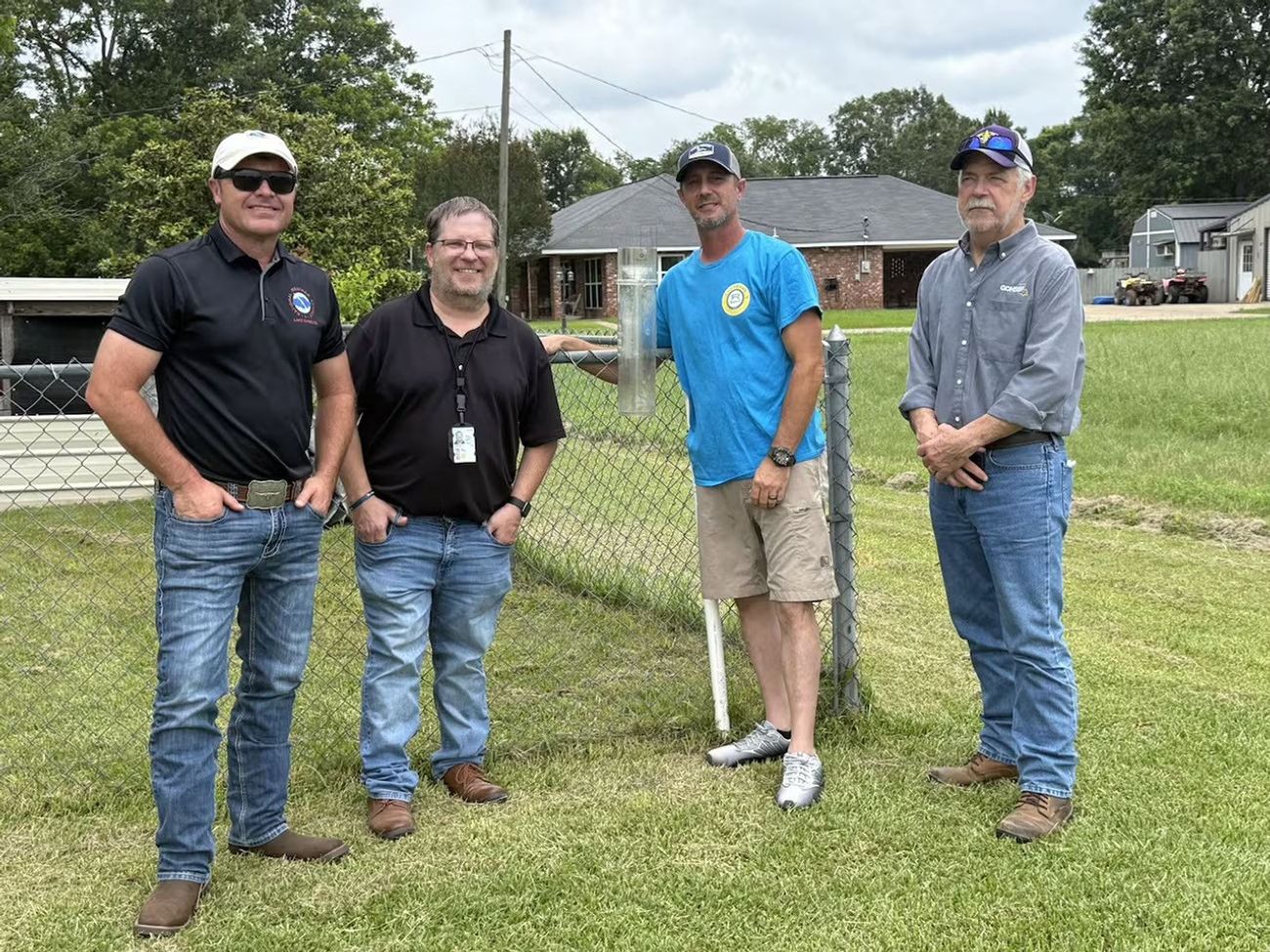
Join a national community of precipitation reporters providing critical data to improve scientific understanding and forecasts.
Facebook logo @nasascience_ @nasascience_ Instagram logo @nasascience_ Linkedin logo @nasascience_Volunteer Measures Record Louisiana Rainfall
“I didn’t sign up to try to measure a new record or anything”, said Matt Carnicle, a volunteer for the NASA-sponsored Community Collaborative Rain, Hail, and Snow Network, or CoCoRaHS, project. Carnicle measured a whopping 29.06 inches of rainfall on June 18th, 2026, breaking an all-time 24-hour record for the state of Louisiana of 22.00 inches. “I’m just a regular guy who likes to track the weather, and I report what I get in my gauge whether it’s zero, two hundredths, or whatever is in there when I read it.”
CoCoRaHS (pronounced KO-ko-rozz) is a network of volunteer weather observers of all ages working together to measure and map rain, hail, and snow by measuring precipitation in their backyards. Together, these thousands of daily precipitation reports – openly available on the project website – are used by scientists and citizens for a wide variety of purposes, to include improving weather forecasting, informing water and land management, driving atmospheric models, and triggering flash flood and severe weather warnings.
Matt joined through a storm-spotter class where he learned how CoCoRaHS is part of a NASA hail research project focused on Gulf States in the Southeast United States. CoCoRaHS reports (and photos) of hail are used for researching the “melt rate” between when the satellite estimates the stone sizes in the clouds and what volunteers measure on the ground. Matt took it a step further and purchased a standardized rain gauge in order to participate with CoCoRaHS by measuring rainfall.
Matt’s June 18, 2026 rain measurement shatters Louisiana’s 1962 state record of 22.00 inches of rain in 24-hours (Hawaii holds the national record with 49.69 inches in 24-hours). Even more remarkably, the 29.06 inches he measured fell in less than 12 hours! According to Louisiana State Climatologist Jay Grymes, who validated Matt’s measurement along with National Weather Service representatives, an event of this magnitude in this area is expected to happen less than once in a thousand years. A National Oceanic and Atmospheric Administration (NOAA) committee will convene in the coming months to verify and document the new record.
You can join Matt and other CoCoRaHS volunteers and submit official rainfall reports to the National Weather Service. They’re also on the lookout for hail in the southeast, where CoCoRaHS and NASA are doing research on how hail melts as it moves from the clouds to the ground. The only requirement for participation is that volunteers use the correct manual gauge, which is precise to the nearest 1/100th of an inch and is approved by the National Weather Service (measurements from automated rain gauges are not accepted). Sign up here, and you might measure the next record precipitation event: https://science.nasa.gov/citizen-science/community-collaborative-rain-hail-and-snow-network/
From left to right: National Weather Service Lake Charles Warning Coordination Meteorologist Doug Cramer, National Weather Service Lake Charles meteorologist Jonathan Brazzell, rain gauge owner/observer Matt Carnicle, and Louisiana State Climatologist Jay Grymes. Carnicle’s arm is around the CoCoRaHS rain gauge. https://www.cocorahs.org/Image credit: Matt Carnicle. Learn More and Get Involved Community Collaborative Rain, Hail, and Snow Network (CoCoRaHS)Join a national community of precipitation reporters providing critical data to improve scientific understanding and forecasts.
Facebook logo @nasascience_ @nasascience_ Instagram logo @nasascience_ Linkedin logo @nasascience_Astronomers just accidentally spotted the faintest exoplanet ever seen from Earth
Beta Pictoris d is more than twice the size of Jupiter, but it is a baby compared to its humongous neighbors
NASA’s Webb Discovers Hidden Planet in Famous Star System
- Webb
- News
- Overview
- Science
- Observatory
- Multimedia
- Team
- More
Astronomers using NASA’s James Webb Space Telescope have discovered a giant planet outside our solar system, called an exoplanet, hiding within one of the most intensely studied planetary systems in our Milky Way galaxy.
The young, nearby star Beta Pictoris was already known to host two giant planets: Beta Pictoris b, one of the first exoplanets ever directly imaged, and Beta Pictoris c. The newly identified Beta Pictoris d makes it only the second planetary system known to contain at least three imaged planets. Unlike Beta Pictoris b and c, however, Beta Pictoris d was discovered not by identifying a bright point of light, but by detecting the unique chemical fingerprint of its atmosphere, a technique that could transform the search for worlds around other stars.
“This discovery adds another piece to an already fascinating planetary system,” said Aidan Gibbs, lead author of a new study published Wednesday in the Astrophysical Journal Letters and a postdoctoral researcher at the University of California, San Diego. “Beta Pictoris has long served as a laboratory for understanding how planetary systems form and evolve, and now we have another planet helping us tell that story.”
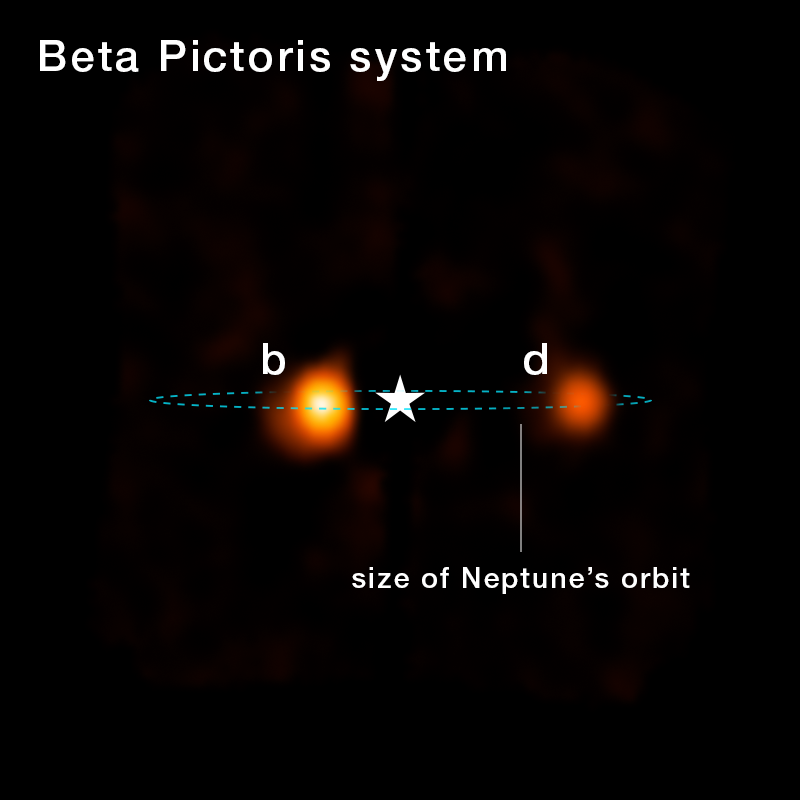
Image: Beta Pictoris System (Artist’s Concept) This artist’s concept shows the Beta Pictoris system with the discovered giant exoplanet Beta Pictoris d at the right. It has the widest orbit of the known three exoplanets within the system.Illustration: NASA, ESA, CSA, STScI, Ralf Crawford (STScI) Familiar system, new surprise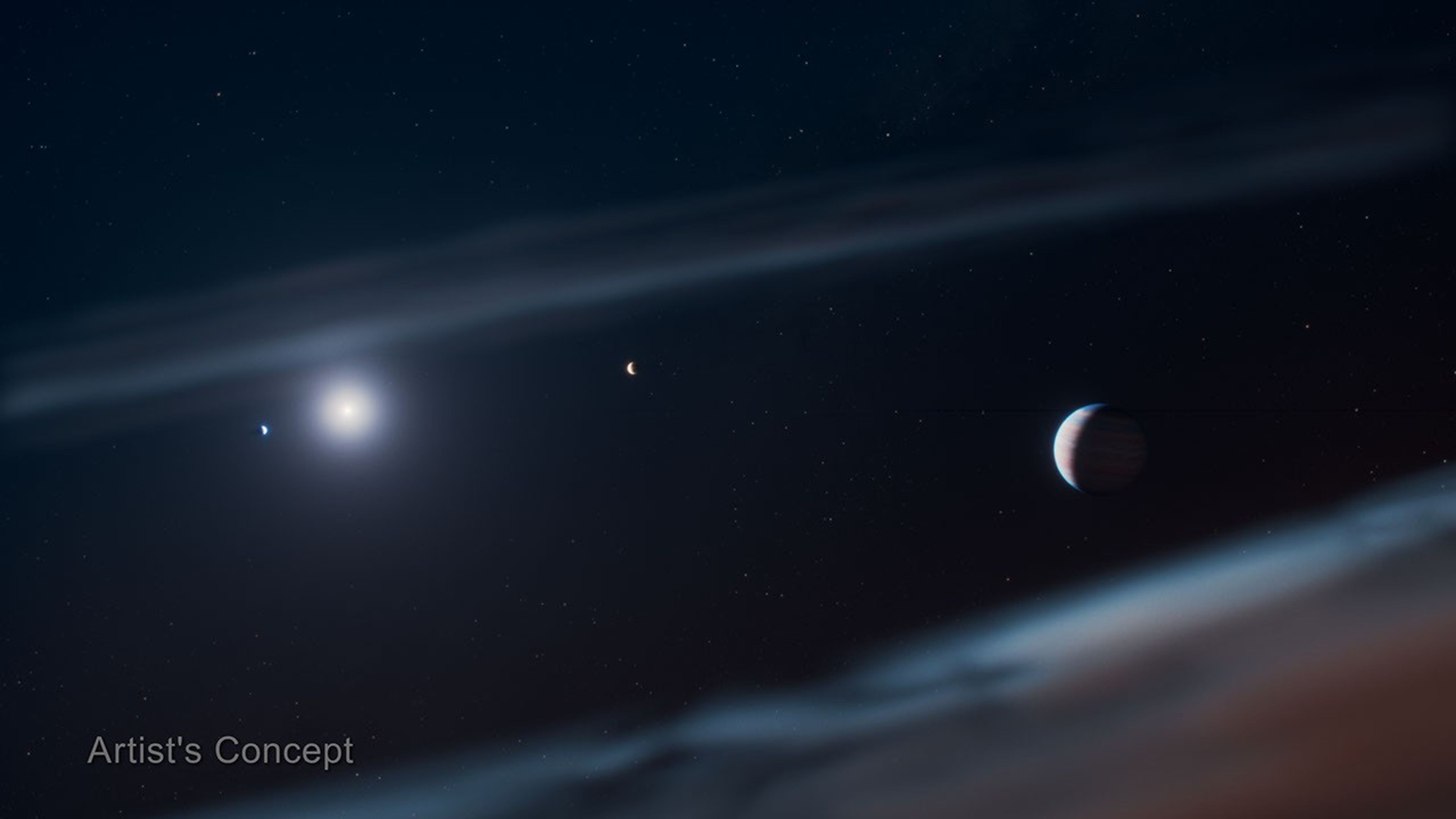
Located 63 light-years from Earth and about 23 million years old, Beta Pictoris is a nearby system in the Milky Way offering a rare glimpse of the interactions between newborn planets and the disk of dust and debris left behind from their formation.
The team estimates that the newfound Beta Pictoris d is likely at least two times the mass of Jupiter, making it the smallest of the three known giant planets in the system. Modeling suggests it likely circles around its star at about 30 astronomical units, comparable to the region occupied by Neptune in our own solar system. It’s the widest orbit of the known three planets, but still located inside the inner edge of the debris disk.
Although astronomers were not searching for another planet with Webb, Beta Pictoris d emerged while the team was using the telescope’s NIRSpec (Near-Infrared Spectrograph) to study the atmosphere of Beta Pictoris b. Specifically, they used NIRSpec’s Integral Field Unit, which obtains both an image and a spectrum from each pixel in an image.
“We weren’t looking for a new planet,” said Gibbs. “We were trying to understand one we already knew existed. Then, this telltale signal appeared in the data where we didn’t expect it.”
This signal was a series of peaks and troughs within the spectroscopic data where the team expected to see a smooth spectrum from light bouncing off dust. It was a distinctive pattern of carbon monoxide absorption lines, spread out like a barcode, an expected feature in giant planet atmospheres.
Because spectroscopy not only reveals chemical composition, but the motion of an object, the team was able to also extract radial velocity from the data. The team determined the planet’s speed, position, and alignment with the debris disk were all consistent with something orbiting Beta Pictoris rather than a background star or brown dwarf with carbon monoxide in its atmosphere.
“There was an unexpected bright source of light within the Integral Field Unit imaging, but we’ve learned not to trust bright blobs in images,” said Jean-Baptiste Ruffio, a research scientist at University of California, San Diego and principal investigator of the first Webb observations where the discovery was made. “They can be instrumental artifacts or other structures in the debris disk. By obtaining a spectrum at the same time as the image, we were able to quickly confirm our suspicions.”
Follow-up observations with Webb’s MIRI (Mid-Infrared Instrument) through a Director’s Discretionary Time request detected water vapor and methane, further confirming the planet’s identity while providing a richer look at the atmosphere of the planet.
Unlike traditional imaging, the spectroscopic approach allowed researchers to identify the planet and begin studying its atmosphere from the very first observation.
“A spectrum contains an incredible amount of information,” Ruffio said. “You don’t just learn that something is a planet; you immediately begin learning about its temperature, chemistry, and motion.”
A separate imaging study led by Ben Sutlieff of the University of Edinburgh and Markus Bonse of the European Southern Observatory complements the team’s findings with data from the European Southern Observatory’s Very Large Telescope and Webb’s NIRCam (Near-Infrared Camera) and independently confirmed the existence of Beta Pictoris d.
Image: Beta Pictoris System (NIRSpec IFU Image and Spectrum) Researchers used the NIRSpec (Near-Infrared Spectrograph) Integral Field Unit on NASA’s James Webb Space Telescope to map chemical contents of the Beta Pictoris system. As a result, they discovered a third planet, Beta Pictoris d, orbiting the young star.Image: NASA, ESA, CSA, STScI, Leah Hustak (STScI); Science: Aidan Gibbs (UC San Diego), Jean-Baptiste Ruffio (UC San Diego), Alexis Bidot (STScI); Image Processing: Alyssa Pagan (STScI) Image: Beta Pictoris System (NIRSpec IFU Image Annotated) The newly discovered third planet orbiting Beta Pictoris, Beta Pictoris d, is seen in reconstructed imagery from NASA’s James Webb Space Telescope’s NIRSpec (Near-Infrared Spectrograph).Image: NASA, ESA, CSA, STScI; Science: Aidan Gibbs (UC San Diego), Jean-Baptiste Ruffio (UC San Diego); Image Processing: Alyssa Pagan (STScI) Seeing through cosmic fog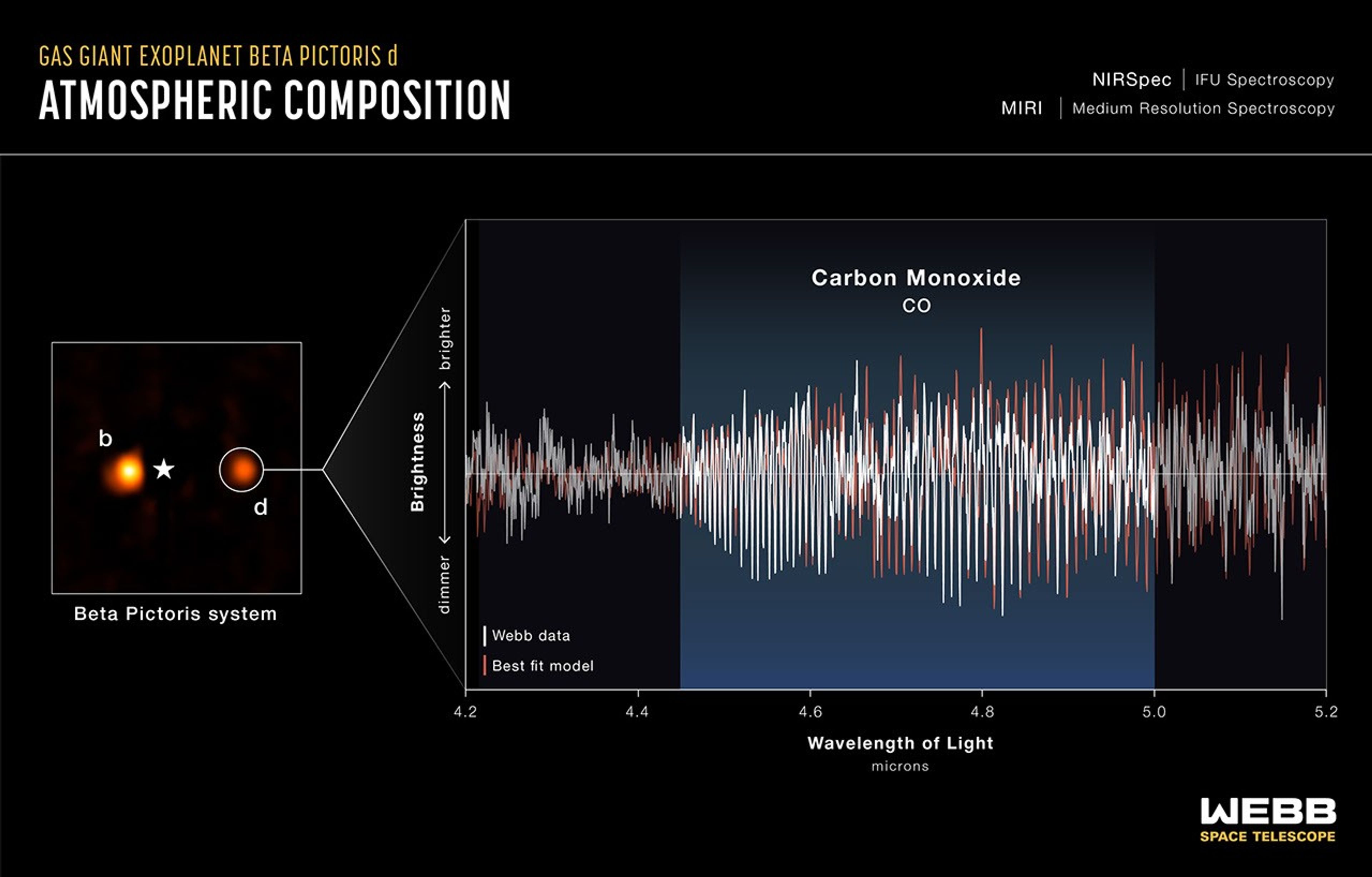
Beta Pictoris d remained hidden for years because it lies within one of the brightest debris disks known.
The dusty disk acts like fog, scattering light from the star, making it difficult for conventional imaging techniques to distinguish planets from surrounding structures. The team’s spectroscopic method with Webb effectively ignored that dust, isolating only the narrow molecular signatures unique to a planetary atmosphere.
Scientists say the planet’s presence may help explain why the famous debris disk has such a sharply defined inner edge and other puzzling structures. In fact, astronomers had already predicted the existence of a planet like Beta Pictoris d to account for the disk’s unusual structure.
Beyond expanding our understanding of Beta Pictoris, the discovery demonstrates a powerful new way to find exoplanets.
This is the first directly imaged planet discovered primarily through moderate-resolution spectroscopy, showing that astronomers can identify worlds in complex environments through their atmospheric fingerprints rather than relying solely on traditional coronagraphic imaging.
The researchers plan to continue analyzing Webb’s observations to better determine the planet’s temperature, atmospheric composition, and orbit, providing an even more detailed view of one of astronomy’s most iconic planetary systems.
The James Webb Space Telescope is the world’s premier space science observatory. Webb is solving mysteries in our solar system, looking beyond to distant worlds around other stars, and probing the mysterious structures and origins of our universe and our place in it. Webb is an international program led by NASA with its partners, ESA (European Space Agency) and CSA (Canadian Space Agency).
To learn more about Webb, visit:
Downloads & Related InformationThe following sections contain links to download this article’s images and videos in all available resolutions followed by related information links, media contacts, and if available, research paper and Spanish translation links.
Related Images & Videos Beta Pictoris System (Artist’s Concept)This artist’s concept shows the Beta Pictoris system with the discovered giant exoplanet Beta Pictoris d at the right. It has the widest orbit of the known three exoplanets within the system.
Beta Pictoris System (NIRSpec IFU Image and Spectrum)Researchers used the NIRSpec (Near-Infrared Spectrograph) Integral Field Unit on NASA’s James Webb Space Telescope to map chemical contents of the Beta Pictoris system. As a result, they discovered a third planet, Beta Pictoris d, orbiting the young star.
Beta Pictoris System (NIRSpec IFU Image Annotated)The newly discovered third planet orbiting Beta Pictoris, Beta Pictoris d, is seen in reconstructed imagery from NASA’s James Webb Space Telescope’s NIRSpec (Near-Infrared Spectrograph).
Related LinksRead more: Webb’s Impact on Exoplanet Research
Read more: NASA’s Webb Discovers Dusty ‘Cat’s Tail’ in Beta Pictoris System
Explore more: Beta Pictoris: Icy Debris Suggests ‘Shepherd’ Planet
Watch: How to Study Exoplanets: Webb and Challenges
Watch: How Do Space Telescopes Break Down Light?
More Webb: News | Images | Science | Home Page
Share Details Last Updated Jul 15, 2026 LocationNASA Goddard Space Flight Center Contact MediaLaura Betz
NASA’s Goddard Space Flight Center
Greenbelt, Maryland
laura.e.betz@nasa.gov
Webb is the premier observatory of the next decade, serving thousands of astronomers worldwide. It studies every phase in the…
Exoplanets
Exoplanet Stories
Universe
NASA’s Webb Discovers Hidden Planet in Famous Star System
- Webb
- News
- Overview
- Science
- Observatory
- Multimedia
- Team
- More
Astronomers using NASA’s James Webb Space Telescope have discovered a giant planet outside our solar system, called an exoplanet, hiding within one of the most intensely studied planetary systems in our Milky Way galaxy.
The young, nearby star Beta Pictoris was already known to host two giant planets: Beta Pictoris b, one of the first exoplanets ever directly imaged, and Beta Pictoris c. The newly identified Beta Pictoris d makes it only the second planetary system known to contain at least three imaged planets. Unlike Beta Pictoris b and c, however, Beta Pictoris d was discovered not by identifying a bright point of light, but by detecting the unique chemical fingerprint of its atmosphere, a technique that could transform the search for worlds around other stars.
“This discovery adds another piece to an already fascinating planetary system,” said Aidan Gibbs, lead author of a new study published Wednesday in the Astrophysical Journal Letters and a postdoctoral researcher at the University of California, San Diego. “Beta Pictoris has long served as a laboratory for understanding how planetary systems form and evolve, and now we have another planet helping us tell that story.”
Image: Beta Pictoris System (Artist’s Concept) This artist’s concept shows the Beta Pictoris system with the discovered giant exoplanet Beta Pictoris d at the right. It has the widest orbit of the known three exoplanets within the system.Illustration: NASA, ESA, CSA, STScI, Ralf Crawford (STScI) Familiar system, new surpriseLocated 63 light-years from Earth and about 23 million years old, Beta Pictoris is a nearby system in the Milky Way offering a rare glimpse of the interactions between newborn planets and the disk of dust and debris left behind from their formation.
The team estimates that the newfound Beta Pictoris d is likely at least two times the mass of Jupiter, making it the smallest of the three known giant planets in the system. Modeling suggests it likely circles around its star at about 30 astronomical units, comparable to the region occupied by Neptune in our own solar system. It’s the widest orbit of the known three planets, but still located inside the inner edge of the debris disk.
Although astronomers were not searching for another planet with Webb, Beta Pictoris d emerged while the team was using the telescope’s NIRSpec (Near-Infrared Spectrograph) to study the atmosphere of Beta Pictoris b. Specifically, they used NIRSpec’s Integral Field Unit, which obtains both an image and a spectrum from each pixel in an image.
“We weren’t looking for a new planet,” said Gibbs. “We were trying to understand one we already knew existed. Then, this telltale signal appeared in the data where we didn’t expect it.”
This signal was a series of peaks and troughs within the spectroscopic data where the team expected to see a smooth spectrum from light bouncing off dust. It was a distinctive pattern of carbon monoxide absorption lines, spread out like a barcode, an expected feature in giant planet atmospheres.
Because spectroscopy not only reveals chemical composition, but the motion of an object, the team was able to also extract radial velocity from the data. The team determined the planet’s speed, position, and alignment with the debris disk were all consistent with something orbiting Beta Pictoris rather than a background star or brown dwarf with carbon monoxide in its atmosphere.
“There was an unexpected bright source of light within the Integral Field Unit imaging, but we’ve learned not to trust bright blobs in images,” said Jean-Baptiste Ruffio, a research scientist at University of California, San Diego and principal investigator of the first Webb observations where the discovery was made. “They can be instrumental artifacts or other structures in the debris disk. By obtaining a spectrum at the same time as the image, we were able to quickly confirm our suspicions.”
Follow-up observations with Webb’s MIRI (Mid-Infrared Instrument) through a Director’s Discretionary Time request detected water vapor and methane, further confirming the planet’s identity while providing a richer look at the atmosphere of the planet.
Unlike traditional imaging, the spectroscopic approach allowed researchers to identify the planet and begin studying its atmosphere from the very first observation.
“A spectrum contains an incredible amount of information,” Ruffio said. “You don’t just learn that something is a planet; you immediately begin learning about its temperature, chemistry, and motion.”
A separate imaging study led by Ben Sutlieff of the University of Edinburgh and Markus Bonse of the European Southern Observatory complements the team’s findings with data from the European Southern Observatory’s Very Large Telescope and Webb’s NIRCam (Near-Infrared Camera) and independently confirmed the existence of Beta Pictoris d.
Image: Beta Pictoris System (NIRSpec IFU Image and Spectrum) Researchers used the NIRSpec (Near-Infrared Spectrograph) Integral Field Unit on NASA’s James Webb Space Telescope to map chemical contents of the Beta Pictoris system. As a result, they discovered a third planet, Beta Pictoris d, orbiting the young star.Image: NASA, ESA, CSA, STScI, Leah Hustak (STScI); Science: Aidan Gibbs (UC San Diego), Jean-Baptiste Ruffio (UC San Diego), Alexis Bidot (STScI); Image Processing: Alyssa Pagan (STScI) Image: Beta Pictoris System (NIRSpec IFU Image Annotated) The newly discovered third planet orbiting Beta Pictoris, Beta Pictoris d, is seen in reconstructed imagery from NASA’s James Webb Space Telescope’s NIRSpec (Near-Infrared Spectrograph).Image: NASA, ESA, CSA, STScI; Science: Aidan Gibbs (UC San Diego), Jean-Baptiste Ruffio (UC San Diego); Image Processing: Alyssa Pagan (STScI) Seeing through cosmic fogBeta Pictoris d remained hidden for years because it lies within one of the brightest debris disks known.
The dusty disk acts like fog, scattering light from the star, making it difficult for conventional imaging techniques to distinguish planets from surrounding structures. The team’s spectroscopic method with Webb effectively ignored that dust, isolating only the narrow molecular signatures unique to a planetary atmosphere.
Scientists say the planet’s presence may help explain why the famous debris disk has such a sharply defined inner edge and other puzzling structures. In fact, astronomers had already predicted the existence of a planet like Beta Pictoris d to account for the disk’s unusual structure.
Beyond expanding our understanding of Beta Pictoris, the discovery demonstrates a powerful new way to find exoplanets.
This is the first directly imaged planet discovered primarily through moderate-resolution spectroscopy, showing that astronomers can identify worlds in complex environments through their atmospheric fingerprints rather than relying solely on traditional coronagraphic imaging.
The researchers plan to continue analyzing Webb’s observations to better determine the planet’s temperature, atmospheric composition, and orbit, providing an even more detailed view of one of astronomy’s most iconic planetary systems.
The James Webb Space Telescope is the world’s premier space science observatory. Webb is solving mysteries in our solar system, looking beyond to distant worlds around other stars, and probing the mysterious structures and origins of our universe and our place in it. Webb is an international program led by NASA with its partners, ESA (European Space Agency) and CSA (Canadian Space Agency).
To learn more about Webb, visit:
Downloads & Related InformationThe following sections contain links to download this article’s images and videos in all available resolutions followed by related information links, media contacts, and if available, research paper and Spanish translation links.
Related Images & Videos Beta Pictoris System (Artist’s Concept)This artist’s concept shows the Beta Pictoris system with the discovered giant exoplanet Beta Pictoris d at the right. It has the widest orbit of the known three exoplanets within the system.
Beta Pictoris System (NIRSpec IFU Image and Spectrum)Researchers used the NIRSpec (Near-Infrared Spectrograph) Integral Field Unit on NASA’s James Webb Space Telescope to map chemical contents of the Beta Pictoris system. As a result, they discovered a third planet, Beta Pictoris d, orbiting the young star.
Beta Pictoris System (NIRSpec IFU Image Annotated)The newly discovered third planet orbiting Beta Pictoris, Beta Pictoris d, is seen in reconstructed imagery from NASA’s James Webb Space Telescope’s NIRSpec (Near-Infrared Spectrograph).
Related LinksRead more: Webb’s Impact on Exoplanet Research
Read more: NASA’s Webb Discovers Dusty ‘Cat’s Tail’ in Beta Pictoris System
Explore more: Beta Pictoris: Icy Debris Suggests ‘Shepherd’ Planet
Watch: How to Study Exoplanets: Webb and Challenges
Watch: How Do Space Telescopes Break Down Light?
More Webb: News | Images | Science | Home Page
Share Details Last Updated Jul 15, 2026 LocationNASA Goddard Space Flight Center Contact MediaLaura Betz
NASA’s Goddard Space Flight Center
Greenbelt, Maryland
laura.e.betz@nasa.gov
Webb is the premier observatory of the next decade, serving thousands of astronomers worldwide. It studies every phase in the…
Exoplanets
Exoplanet Stories
Universe
The Perseid meteor shower aligns with a total solar eclipse this year—here’s how to see it
Skygazers are in for a treat in August, as one of the most spectacular meteor showers coincides with a total solar eclipse
August's solar eclipse inspires science involving jets, balloons and Einstein’s general theory of relativity
Solar eclipses are a rare and brief opportunity for scientists to gather data on everything from the physics of the sun to air pressure in the upper atmosphere
Metallic waves on ancient Mars
The European Space Agency’s Mars Express has spotted a swathe of metallic-looking waves filling Mars’s large Kaiser Crater – an ancient and otherworldly dune field sculpted by wind.
Curiosity Blog, Sols 4947-4953: Gale Crater Then and Now
- Curiosity Home
- Science
- News and Features
- Multimedia
- Mars Missions
- Mars Home
3 min read
Curiosity Blog, Sols 4947-4953: Gale Crater Then and Now NASA’s Mars rover Curiosity acquired this image looking north through the dusty air of Gale Crater toward the faint crater rim. Curiosity used its Left Navigation Camera on July 8, 2026 — Sol 4948, or Martian day 4,948 of the Mars Science Laboratory mission — at 04:57:40 UTC.NASA/JPL-Caltech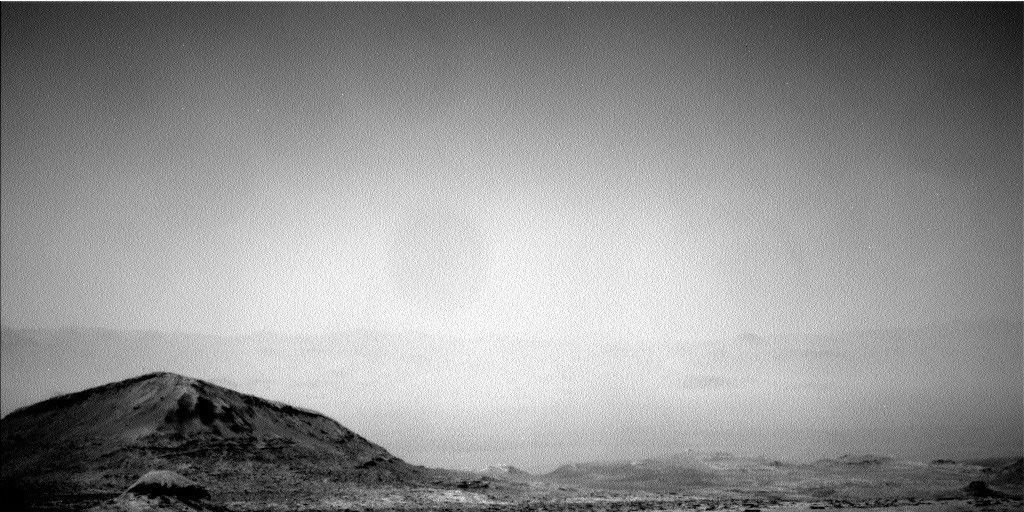
Written by Alex Innanen, Atmospheric Scientist at York University, Toronto
Earth planning date: Friday, July 10, 2026
Curiosity had a successful long weekend and came into this week ready to explore some more. We’ve been moving fairly rapidly through different mapped “units,” or distinct geological areas of interest, visiting a different one at each of our three stops this week. The terrain all around us can give us clues about the past environment of Gale Crater, and geologists can look at the different compositions and appearances of what may look like ordinary rocks to the rest of us, to infer how it was laid down and altered by its environment in the distant past.
All three of our stops this week included contact science with MAHLI and APXS, as well as compositional analyses with the ChemCam LIBS instrument. Mastcam and ChemCam also continued to study the broader context of this area with medium and longer-distance imaging of the buttes and other formations we see around us. Among the different layers and textures of bedrock are features that formed from some past erosion and we looked at different examples of these through the week, as well.
While every rock Curiosity chooses to examine is special (that’s why we give them all names!), two in particular stood out this week. Monday’s and Wednesday’s workspaces both contained rocks that were darker than the ones around them, so they may have been brought in from elsewhere, or could even be meteorites. To help figure out their histories, we turned LIBS on them to look at their compositions.
Of course we are not only interested in peering into Mars’ past — we also care about its present environment. As we approach the end of the Mars year, moving through summer in Gale Crater and looking towards autumn, the atmosphere almost seems to calm. The turn of the Mars year sees us transition from the dusty season back into the cloudy season, so we’re keeping a keen eye on both dust and clouds. This time of year is the last gasp of the dusty season, what we call the “C” storm season, when mid-size, regional dust storms can form. So we’re keeping an eye out for signs of these with both Mastcam and Navcam. Aside from our dust and cloud imaging, we — as always — have our trusty suite of REMS instruments adding to our daily meteorological record of Gale Crater with regular measurements.
-
Want to read more posts from the Curiosity team?
-
Want to learn more about Curiosity’s science instruments?
Mars is the fourth planet from the Sun, and the seventh largest. It’s the only planet we know of inhabited…
All Mars ResourcesExplore this collection of Mars images, videos, resources, PDFs, and toolkits. Discover valuable content designed to inform, educate, and inspire,…
Rover BasicsEach robotic explorer sent to the Red Planet has its own unique capabilities driven by science. Many attributes of a…
Mars Exploration: Science GoalsThe key to understanding the past, present or future potential for life on Mars can be found in NASA’s four…
Curiosity Blog, Sols 4947-4953: Gale Crater Then and Now
- Curiosity Home
- Science
- News and Features
- Multimedia
- Mars Missions
- Mars Home
3 min read
Curiosity Blog, Sols 4947-4953: Gale Crater Then and Now NASA’s Mars rover Curiosity acquired this image looking north through the dusty air of Gale Crater toward the faint crater rim. Curiosity used its Left Navigation Camera on July 8, 2026 — Sol 4948, or Martian day 4,948 of the Mars Science Laboratory mission — at 04:57:40 UTC.NASA/JPL-CaltechWritten by Alex Innanen, Atmospheric Scientist at York University, Toronto
Earth planning date: Friday, July 10, 2026
Curiosity had a successful long weekend and came into this week ready to explore some more. We’ve been moving fairly rapidly through different mapped “units,” or distinct geological areas of interest, visiting a different one at each of our three stops this week. The terrain all around us can give us clues about the past environment of Gale Crater, and geologists can look at the different compositions and appearances of what may look like ordinary rocks to the rest of us, to infer how it was laid down and altered by its environment in the distant past.
All three of our stops this week included contact science with MAHLI and APXS, as well as compositional analyses with the ChemCam LIBS instrument. Mastcam and ChemCam also continued to study the broader context of this area with medium and longer-distance imaging of the buttes and other formations we see around us. Among the different layers and textures of bedrock are features that formed from some past erosion and we looked at different examples of these through the week, as well.
While every rock Curiosity chooses to examine is special (that’s why we give them all names!), two in particular stood out this week. Monday’s and Wednesday’s workspaces both contained rocks that were darker than the ones around them, so they may have been brought in from elsewhere, or could even be meteorites. To help figure out their histories, we turned LIBS on them to look at their compositions.
Of course we are not only interested in peering into Mars’ past — we also care about its present environment. As we approach the end of the Mars year, moving through summer in Gale Crater and looking towards autumn, the atmosphere almost seems to calm. The turn of the Mars year sees us transition from the dusty season back into the cloudy season, so we’re keeping a keen eye on both dust and clouds. This time of year is the last gasp of the dusty season, what we call the “C” storm season, when mid-size, regional dust storms can form. So we’re keeping an eye out for signs of these with both Mastcam and Navcam. Aside from our dust and cloud imaging, we — as always — have our trusty suite of REMS instruments adding to our daily meteorological record of Gale Crater with regular measurements.
-
Want to read more posts from the Curiosity team?
-
Want to learn more about Curiosity’s science instruments?
Mars is the fourth planet from the Sun, and the seventh largest. It’s the only planet we know of inhabited…
All Mars ResourcesExplore this collection of Mars images, videos, resources, PDFs, and toolkits. Discover valuable content designed to inform, educate, and inspire,…
Rover BasicsEach robotic explorer sent to the Red Planet has its own unique capabilities driven by science. Many attributes of a…
Mars Exploration: Science GoalsThe key to understanding the past, present or future potential for life on Mars can be found in NASA’s four…
After a Billion Kilometres, China's Asteroid Hunter Finally Arrives
After chasing a small asteroid across a billion kilometres of space, China's Tianwen-2 probe has finally caught up, closing to within twenty kilometres of its target and beginning detailed scientific study. What it uncovers next could help settle a genuinely intriguing question, whether this quiet companion of Earth is simply another asteroid, or a long lost piece of the Moon itself.
Heat Dome Broils the Western U.S.
- Earth
- Earth Observatory
- Image of the Day
- EO Explorer
- Topics
- More Content
- About
Heat Dome Broils the Western U.S.
- Earth
- Earth Observatory
- Image of the Day
- EO Explorer
- Topics
- More Content
- About
A Relativistic Jet Could be an Indication of the 'Missing-Link' for Black Holes
Astronomers using the U.S. National Science Foundation Very Large Array (NSF VLA) have detected an extraordinary burst of radio light from a rare cosmic event in which an intermediate-mass black hole tears apart a star, revealing what appears to be the off-axis afterglow of a powerful jet.
The Oldest Stars in the Galaxy Just Weighed In on One of Cosmology's Biggest Arguments
Astronomers have measured the ages of over a hundred and fifty thousand ancient stars scattered across our Galaxy, and found the oldest of them is just the age it should be if the standard picture of the universe is correct. That simple agreement quietly undermines one of the leading attempts to explain a stubborn mystery, and hints that the real answer to the Hubble tension may lie somewhere else entirely.