
_0.thumbnail.jpg "Image (3).jpg")
Feed aggregator
Quality Assessment Report Evaluates Polar Geospatial Center EarthDEM Elevation Products
A new quality assessment report from NASA’s Commercial Satellite Data Acquisition (CSDA) program evaluates data from the Polar Geospatial Center’s (PGC) EarthDEM product. The results of the evaluation help inform NASA program management and the user community about the quality of commercial Digital Elevation Models (DEMs) for use in NASA science.
At left, the cover of the Commercial Satellite Data Acquisition programs’s recently released Polar Geospatial Center EarthDEM Quality Assessment Report. At right, a shaded relief rendering of EarthDEM data showing the Virgin River in Nevada. DEM derived from Vantor imagery. Credit: NASA CSDA program/EarthDEM Project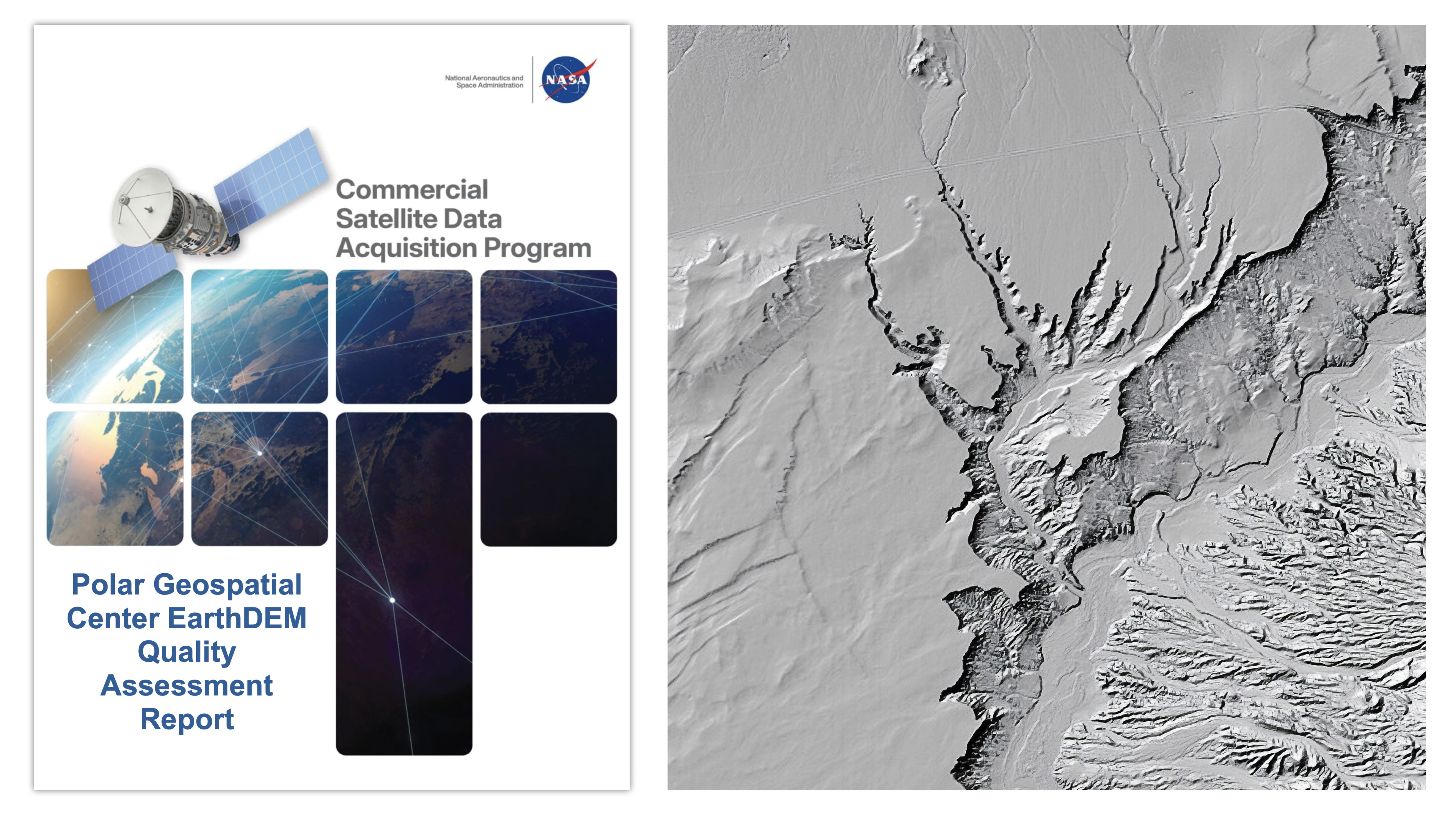
Issued August 8, 2026, the CSDA Polar Geospatial Center EarthDEM Quality Assessment Report was conducted by NASA Digital Elevation Model (DEM) subject matter experts (SMEs) enlisted to evaluate the horizontal and vertical accuracy of two PGC EarthDEM1 (i.e., Digital Elevation Model) products: the center’s “Mosaic Tile” and “Strip” Digital Surface Models (DSMs).
To assess the vertical and horizontal accuracy of the EarthDEM Strip DSM and Mosaic Tile products over a variety of surface characteristics, the SMEs compared them to airborne lidar data samples from across the United States and Senegal. They found the horizontal accuracy of the EarthDEM products (Strip DSM: 0.5-meter (m) Root Mean Square Error Horizontal (RMSEH); Mosaic Tile: 0.3 m RMSEH) agreed with the specifications provided by the PGC and graded them “Excellent.” The vertical accuracy results of the EarthDEM Strip DSM (5.6 m Root Mean Square Error Vertical (RMSEV)) and the Mosaic Tile (4.9 m RMSEV) products varied by land cover type, with all land cover types exceeding the specification provided by the PGC (0.5 m RMSEV). Strip DSM vertical accuracy was found to vary from 4.6-6.8 m RMSEV depending on the cloud cover metadata field generated by the PGC. Given this variation, the vertical accuracy compliance for the EarthDEM products was graded as “Basic.”
Overall, the assessment report supports the use of EarthDEM data for NASA Earth science research and applications, as long as the data characteristics (e.g., vertical accuracy, poor cloud masking, missing surface features, data voids, etc.) are compatible with the specific science objectives and use cases.
The report also provides a Data Provider Documentation Review for the EarthDEM product that evaluated information from the PGC website, as well as a series of peer-reviewed publications by researchers at The Ohio State University’s Byrd Polar and Climate Research Center. (Only documents listed in this report were considered in the evaluation.) The report’s authors found that, overall, the EarthDEM product is “well documented,” with most information present within the product User Guide, a series of peer reviewed papers, or the PGC GitHub repository.
About the CSDA ProgramThe CSDA program was established to identify, evaluate, and acquire data from commercial sources that support the NASA Earth science research and application goals. NASA’s Earth Science Division recognizes the potential impact commercial satellite constellations may have in encouraging/enabling efficient approaches to advancing Earth System Science and applications development for societal benefit. Commercially acquired data may also provide a cost-effective means to augment and/or complement the suite of Earth observations acquired by NASA, other U.S. government agencies, and international partners.
To read the reports in full, see the links under “Evaluation” heading on the Polar Geospatial Center vendor page on the CSDA website.
Notes:1. According the authors of the report, “it should be noted that the PGC EarthDEM product is not technically a commercial product…. EarthDEM is a digital elevation dataset derived from imagery collected from the Vantor (formerly Maxar) fleet of optical satellites.”
On this day in space! Aug. 12, 2005: Mars Reconnaissance Orbiter launched
On Aug. 12, 2005, NASA launched its Mars Reconnaissance Orbiter.
The Mars Reconnaissance Orbiter (MRO) mission lifted off on a United Launch Alliance Atlas V-401 rocket from Space Launch Complex 41 at Cape Canaveral Air Force Station (now known as the Cape Canaveral Space Force Station) in Florida.
Some of the best cameras ever launched into space are on MRO, and the spacecraft has taken some seriously amazing photos of Mars. The High-Resolution Imaging Science Experiment, or HiRISE camera, takes super-sharp photos of the Martian surface and has helped NASA scout the Red Planet for suitable landing sites for rovers like Curiosity. It also serves as a data relay station for other spacecraft on Mars that need to beam data back to Earth.
MRO has also studied water and ice on Mars, and its cameras have revealed some pretty remarkable landscapes.
The Mars Reconnaissance Orbiter (MRO) in the Hazardous Payload Service Facility at NASA's Kennedy Space Center on July 20, 2005 in Cape Canaveral, Florida. (Image credit: Matt Stroshane/Getty Images)Why it matteredNow operational for more than 20 years, MRO serves as one of NASA's oldest spacecraft in operation around the Red Planet. It has become instrumental in the space agency's ability to maintain communication with other probes in orbit around Mars and rovers on the planet's surface.
The probe's HiRISE camera revolutionized scientists' understanding of Mars' diverse surface features, with resolution high enough to picture objects as small as 3 feet (1 meter) wide. Since its arrival in orbit around Mars on March 10, 2006, MRO has snapped more than 100,000 images of the surface below and helped NASA track geologic activity like migrating dunes, impact craters, avalanches, dust storms and seasonal frost changes. And NASA is still finding ways to put the aging satellite's scientific instruments to good use. For example, the agency executed a 120-degree roll program last year designed to strengthen MRO's SHARAD radar signal by 10 times or more, allowing it to probe deeper than 1 mile (1.6 kilometers) underground to detect water ice.
MRO's role as a communications relay for probes on and around Mars became even more important earlier this year, when NASA's MAVEN mission ended in June. Today, MRO returns around 80,000 megabits of data per day, according to Astronomy.com, and remains one of NASA's most critical assets in orbit around Mars.
Green comet caught soaring over Namibia | Space photo of the day for Aug. 12, 2026
What a view. Astrophotographers in Namibia have captured a bright green comet soaring overhead in a spectacular new photograph.
What is it?In this incredible new photograph is the comet 220P/McNaught.
Discovered by Australian astronomer Robert H. McNaught, the comet orbits our sun once every 5.5 years. Back in June, the comet reached perihelion, or the closest point in its orbit around the sun. Around that time, the comet experienced a large outburst, which brightened it about 8,000 times.
The comet brightened back up this August to about 600 times its normal brightness — and it was during this period when astrophotographers Gerald Rhemann and Michael Jäger captured it streaking across the night sky over Namibia.
To capture the moment, the pair used a 12-inch Astrograph telescope with a ZWO ASI 6200 MM Pro camera.
Why is it incredible?It's not every day you see a comet in the night sky. Even if one is overhead, often they're too tricky or too far away to spot without a telescope, and even then it can be a challenge.
It's also incredible that the moment captured in the new image showcases the comet 220P/McNaught with such spectacular clarity and detail. It must have been something truly special to witness.
While spotting a comet like this might not happen every day, we can sometimes see the debris trailing behind a comet as its tail burns up in our atmosphere. These burnt comet bits are actually the "shooting stars" we see in the night sky during a meteor shower.
Right now, the Perseids meteor shower is on its annual parade across the night sky. This meteor shower is made up of debris shed by the comet Swift-Tuttle as it swoops by on its annual trip across the solar system. Under dark skies, skywatchers can see up to 100 shooting stars thanks to Swift-Tuttle.
Solar Magnetic Field Braids May Have a Previously Hidden Cause
Scientists using the Daniel K. Inouye Solar Telescope (DKIST) in Hawai'i have found a mechanism occurring on the Sun's surface that they think is heating our star's outer atmosphere. The process, called a Kelvin-Helmholtz Instability (KHI), could well be the root cause of a phenomenon called flux braiding that builds up and moves around on the Sun and heats the coronasphere. This discovery may well also explain the fundamental physics of similar activity at other stars.
Perseid meteor shower peaks under perfect skies tonight — here's what to expect
The Perseid meteor shower, one of the most prolific and impressive meteor showers of the year, peaks tonight!
Widely regarded as one of the best meteor showers of the year, the Perseids can produce up to 100 meteors per hour under ideal viewing conditions and weather permitting.
This year's display is particularly favorable because the shower peaks on the night of the new moon, leaving skies free from bright moonlight that can wash out fainter meteors.
What time should I look?The Perseids can produce meteors throughout the night, but the best viewing begins around 11 p.m. local time, with activity increasing after midnight and continuing until the predawn hours. Under dark, clear skies, patient observers could see dozens of meteors every hour with the highest rates expected just before dawn.
Where do they come from?The annual show occurs as Earth passes through a trail of comet dust and rocky debris left behind by Comet 109P/Swift-Tuttle. Every year, our planet plows through this stream of cometary material, causing tiny fragments — many no larger than a grain of sand — to slam into Earth's atmosphere at around 133,000 mph (214,000 km/h).
As these particles compress and heat the air in front of them, they burn up high above Earth's surface, creating the brilliant streaks of light we know as meteors or shooting stars.
Every year, Earth passes through the path of Comet Swift-Tuttle. With the Perseid meteor shower's peak occurring when Earth passes through the densest, dustiest area. (Image credit: Future)How can I see the Perseids?The Perseids appear to radiate from the constellation Perseus, but you don't need to look directly at the constellation to enjoy the show. In fact, the longest and brightest meteors appear about 45 degrees away from the radiant, when you're not viewing them head-on.
To give yourself the best chance of seeing as many meteors as possible, head somewhere with dark skies, away from city lights and give your eyes around 30 minutes to adjust to the darkness. Avoid checking bright phone screens (easier said than done!) and leave the telescope or binoculars at home — meteors are best enjoyed with the naked eye.
The Perseid meteor shower will appear to radiate from the Perseus constellation. (Image credit: Future)The highest number of meteors occurs in the predawn hours because it's when the side of Earth you're situated on has rotated into the stream of comet debris. You can think of it a bit like driving through rain — the windshield catches more raindrops than the rear window because it's facing the direction of travel. Likewise, before dawn, your location on Earth is facing into the stream of comet debris, meaning more meteoroids collide with Earth's atmosphere overhead.
A rare double sky showBest cameras for astrophotography(Image credit: Nikon)If you're looking for a good camera for meteor showers and astrophotography, our top pick is the Nikon D850.
Why have one remarkable sky event when you can have two? This year's Perseid peak arrives on the heels of today's total solar eclipse that crosses parts of Greenland, Iceland and Spain, making it possible to witness two of the year's most spectacular celestial events within just a few hours of each other.
If you're unable to catch the Perseids tonight, don't worry! While meteor numbers will gradually decline after the peak, the Perseids remain active through Aug. 24, meaning there are still opportunities to catch plenty of shooting stars under clear, dark skies.
If you're looking to snap photos of the meteor shower or the night sky in general, check out our guide on how to photograph meteor showers, as well as our best cameras for astrophotography and best lenses for astrophotography.
Musification of the 2026 total solar eclipse
[English] Experience a musical simulation of the 12 August 2026 total solar eclipse as seen from the Observatorio Astrofísico de Javalambre (Spain). Click here for information about ESA’s live broadcast from this observatory, or visit esa.int/solareclipse for an overview of all ESA eclipse activities & resources.
This is a ‘musification’ – an artistic interpretation of a set of data. In this case, the eclipse determines when and how much of each sound is heard. The music is simply the way those data are presented.
This musification is a collaboration ESA’s CESAR team and Rubén García Benito from the Instituto de Astrofísica de Andalucía (IAA-CSIC). It uses nine parameters extracted from a Stellarium simulation of the total solar eclipse:
Arpeggio (the rapid succession of notes): Visible sunlight. Its rhythm, range (spanning almost four octaves), and volume are determined by the light itself; the chord follows the colour of the sky. It fades out as the Sun sets. (The data determine the behaviour; the scale and pattern are artistic choices.)
Pad (background chord): The colour of the light; the redder and warmer the light becomes, the darker the chord. (The colour is the data.)
Bass (sub): The weight of the darkness; deepest during totality. (Data-driven.)
Heartbeat: The tension, reflecting how quickly the light is falling; it comes to rest during totality. (Data: rate of change.)
Bells: The actual contacts C1, C2, maximum eclipse and C3 (there is no C4, as the Sun sets before the eclipse ends). (Sonification: marking a real moment in time.)
Shimmering sound during totality: The solar corona. (A musical element placed at the real event.)
Descending whoosh: The exact moment when the Sun disappears behind the horizon. (An icon of the event; not measured wind.)
Low night drone: The onset of night (entering when the Sun passes below the horizon). (Data: when it happens and to what extent.)
Stars (soft sparkling tones): The stars that become visible at night (but not during totality). (Data: when they appear and how many are visible.)
[Spanish] Vive una simulación musical del eclipse solar total del 12 de agosto de 2026 tal como se verá desde el Observatorio Astrofísico de Javalambre (España). Visita esa.int/solareclipse para consultar un resumen de todas las actividades y recursos de la ESA relacionados con el eclipse.
Se trata de una musificación, es decir, una interpretación artística de un conjunto de datos. En este caso, el eclipse determina cuándo se escucha cada sonido y con qué intensidad. La música es simplemente la forma en que se presentan esos datos.
Esta musificación es fruto de una colaboración entre el equipo CESAR de la ESA y Rubén García Benito, del Instituto de Astrofísica de Andalucía (IAA-CSIC). Utiliza nueve parámetros extraídos de una simulación del eclipse solar total realizada con Stellarium:
• Arpegio (rápida sucesión de notas): La luz solar visible. Su ritmo, extensión (que abarca casi cuatro octavas) y volumen están determinados por la propia luz; el acorde sigue el color del cielo. Se desvanece a medida que el Sol se pone. (Los datos determinan el comportamiento; la escala y el patrón son elecciones artísticas).
• Pad (acorde de fondo): El color de la luz. Cuanto más rojiza y cálida se vuelve la luz, más oscuro es el acorde. (El color es el dato).
• Grave (subgrave): El peso de la oscuridad, que alcanza su máxima intensidad durante la totalidad. (Basado en datos).
• Latido: La tensión, que refleja la rapidez con la que disminuye la luz; se calma durante la totalidad. (Dato: tasa de cambio).
• Campanas: Los contactos reales C1, C2, máximo eclipse y C3 (no hay C4 porque el Sol se pone antes de que termine el eclipse). (Sonificación: marca un instante real en el tiempo).
• Brillo suspendido durante la totalidad: La corona solar. (Elemento musical situado en el momento real del acontecimiento).
• Soplo descendente: El instante exacto en que el Sol desaparece tras el horizonte. (Un recurso sonoro que representa el evento; no se trata de viento medido).
• Zumbido (dron) nocturno grave: El inicio de la noche (cuando el Sol desciende por debajo del horizonte). (Datos: cuándo ocurre y en qué grado).
• Estrellas (suaves tonos centelleantes): Las estrellas que se hacen visibles durante la noche (pero no durante la totalidad). (Datos: cuándo aparecen y cuántas son visibles).
SpaceX wraps Starlink double header day with the launch of 24 Starlink satellites from California
Just over 12 hours after its first liftoff of the day out of Florida's Space Coast, SpaceX has delivered a second batch of Starlink internet satellites to orbit on a rocket lifting off from the company's California launch site.
A Falcon 9 rocket lifted off from Vandenberg Space Force Base on Aug. 12, at 12:46 p.m. EDT (0346 GMT; 9:46 p.m. local time). The mission, Starlink Group 17-49, carried 24 of the broadband spacecraft to low Earth orbit (LEO) to join SpaceX's growing constellation of more than 10,000 satellites.
About 8.5 minutes after clearing the tower, the Falcon 9's first stage, Booster 1103 successfully landed on SpaceX's "Of Course I Still Love You" droneship in the Pacific Ocean." It was the fifth flight for this particular booster.
The Falcon 9's first stage is seen just after its drone-ship landing on Aug. 12, 2026. (Image credit: SpaceX)In addition to being its third Starlnk mission, B1103 also launched the NROL-179 and SDA-T1TL-E in support of U.S. national defense.
Following separation from Falcon 9's main booster, the rocket's second stage flew onward to LEO, delivering its 24 Starlink satellites about one hour after liftoff.
Previous Booster B1103 launchesNROL-179 | SDA-T1TL-E | Starlink 17-42 | Starlink 17-35
Today's liftoff was the 94th Falcon 9 launch of the year, 73 of which have delivered Starlink stacks to the growing constellation — the largest satellite constellation ever assembled.
Starlink currently consists of more than 10,900 active satellites, according to astrophysicist Jonathan McDowell. But SpaceX has even bigger megaconstellations in mind: The company has filed to operate 100,000 of its bigger, more capable Starlink V3 satellites, and SpaceX CEO Elon Musk has also stated his intent to launch a million AI data center satellites to Earth orbit as well.
New JWST images reveal the Lion Nebula in all its glory
This dying star appears to have a face of gas and a mane of space dust
Watch today’s total solar eclipse live
Follow all the latest updates about the August 12 eclipse with Scientific American
Could Rocky’s musical language in Project Hail Mary actually work?
Linguists explain how a language built from musical notes could convey complex meaning and even support conversation
A total solar eclipse will darken the sky for millions today! Here's what you need to know
Today (Aug. 12), millions of people across Greenland, Iceland and Spain will witness a total solar eclipse as the moon completely covers the sun, turning day into night, albeit briefly.
It's Europe's first total solar eclipse since 1999, and with a maximum of 2 minutes, 18 seconds of totality, it will be worth the wait … weather permitting!
Even if you're not inside the path of totality, there's still plenty to see. A dramatic partial solar eclipse will be visible across much of Europe, offering millions more the chance to watch the moon take a 'bite' out of the sun. More than 90% of the sun will be covered for major cities such as London, Paris and Dublin.
Where will the eclipse be visible?Today's eclipse will unfold over roughly 96 minutes as the moon's shadow races across Greenland, Iceland and Spain. Totality begins in Greenland in the late afternoon before reaching Spain in the evening, where skywatchers will witness the rare spectacle of a low-horizon sunset eclipse.
Not sure what you'll see from your location? Check out our where to see the total solar eclipse guide for visibility details.
Path of totalityCreated using MapHub.net. Source: Esri, Maxar, GeoEye, Earthstar Geographics, CNES/Airbus DS, USDA, USGS, AeroGRID, IGN, and the GIS User CommunityPath of totalityCreated using MapHub.net. Source: Esri, Maxar, GeoEye, Earthstar Geographics, CNES/Airbus DS, USDA, USGS, AeroGRID, IGN, and the GIS User CommunityPath of totalityCreated using MapHub.net. Source: Esri, Maxar, GeoEye, Earthstar Geographics, CNES/Airbus DS, USDA, USGS, AeroGRID, IGN, and the GIS User CommunityPath of totalityCreated using MapHub.net. Source: Esri, Maxar, GeoEye, Earthstar Geographics, CNES/Airbus DS, USDA, USGS, AeroGRID, IGN, and the GIS User CommunityWhat time is the eclipse?The eclipse occurs at different times depending on your location.
Location
Totality begins
Reykjavik, Iceland
5:48 p.m. GMT
Snæfellsjökull National Park, Iceland
5:45 p.m. GMT
Gijón, Spain
8:26 p.m. CEST
A Coruña, Spain
8:27 p.m. CEST
Mallorca, Spain
8:31 p.m. CEST
Looking for a more detailed breakdown of timings? Our what time is the eclipse guide can help.
Can I watch the eclipse online?If you can't make it to a location within the path of totality, you can still experience the eclipse from home.
We've rounded up the best ways to watch the eclipse online, including livestreams from the path of totality.
Follow the eclipse with Space.comOur eclipse live blog will bring you the latest updates throughout the day, including weather reports, photos, videos and observations from across Greenland, Iceland and Spain.
We'll also have reporters in the field. Skywatching Editor Daisy Dobrijevic is on an eclipse expedition to Greenland with HX, while Skywatching Writer Anthony Wood is observing from northern Spain with the DEB initiative and a team of citizen scientists.
Follow along throughout the day here on Space.com and our social channels (Instagram and TikTok) as we bring you firsthand reports from the path of totality and share some of the best eclipse images.
How to observe the eclipseAppropriate eye protection is a must when viewing the sun. (Image credit: Arianne de San Jose van Hoof via Getty Images)Never look directly at the sun without proper eye protection.
During the partial phases of the eclipse, you must use solar eclipse glasses or a certified solar filter. Looking at the sun without appropriate protection can cause serious and permanent eye damage.
The only time it is safe to view the eclipse without eye protection is during the brief period of totality, when the moon completely covers the sun. As soon as even a small portion of the sun reappears, eclipse glasses must be worn again.
For more information, check out our guide to observing the sun safely. If you haven't been able to get hold of some solar eclipse glasses, don't fear! We also have a handy guide on how to safely view the eclipse using items from around the home.
Editor's note: If you capture a photo of the solar eclipse and would like to share it with Space.com's readers, send your photo(s), comments, and your name and location to spacephotos@space.com.
Stops Along the Path of Totality
- Earth
- Earth Observatory
- Image of the Day
- EO Explorer
- Topics
- More Content
- About
Stops Along the Path of Totality
- Earth
- Earth Observatory
- Image of the Day
- EO Explorer
- Topics
- More Content
- About
SpaceX could make $500 billion in 2028, Elon Musk says (video)
SpaceX isn't a launch company anymore.
SpaceX is famous for launching, and landing, its Falcon 9 and Falcon Heavy rockets and sending astronauts to space aboard its Dragon crew capsule. Recently, however, the company has been transitioning into an artificial intelligence (AI) outfit — and that journey is now mostly complete.
"Our AI revenue will exceed all other SpaceX revenue probably in September — like, next month — and will significantly exceed all other SpaceX revenue in in the fourth quarter," company founder and CEO Elon Musk said during an address to employees that the company posted on X today (Aug. 11). "So, AI has become an extremely important part of SpaceX's future."
Illustration of an electromagnetic mass driver on the moon, which SpaceX plans to use to launch AI satellites into space. (Image credit: SpaceX)Earlier this year, SpaceX bought xAI, a startup that Musk founded in 2023. xAI created the chatbot Grok and also operates a powerful supercomputer cluster in Tennessee called Colossus.
But that was just the beginning. Musk laid out just how deeply SpaceX is diving into AI during his 29-minute talk, which came a week after SpaceX's first-ever quarterly earnings call as a public company.
"Probably in four or five years, AI will be 99% of the value of SpaceX; I'd say five years for sure," Musk said. "And the value of SpaceX will be some astronomical number."
Astronomical is right. According to Musk, the company aims to get 10 gigawatts of AI compute up and running by the end of next year. That's a big jump from its current 1.4 GW, which SpaceX sells to tech companies and AI labs.
"The value per watt is probably going to be 30 to $50, which means if we bring 10 gigawatts of AI online by the end of next year, it will be 300 to $500 billion a year in revenue," he said. "Big numbers."
And those numbers will get even bigger over time, if all goes according to plan. SpaceX just announced plans to build a gigantic complex in Texas called Terafab, a joint operation with Tesla that will manufacture advanced semiconductor chips for a wide range of applications. And the company aims to launch a million of its "Starmind" AI satellites to low Earth orbit in the coming years using its fully reusable Starship megarocket, which is still in development.
Over the longer haul, the company plans to establish factories on the moon that will build these off-Earth data centers. The satellites will be launched into space from the lunar surface via electromagnetic mass drivers — basically, high-powered rail guns.
SpaceX envisions Starmind and its other AI efforts as returning almost unimaginable profits down the road. For example, in paperwork the company filed just before its record-breaking IPO, SpaceX identified an eventual "total addressable market" of $28.5 trillion, nearly $23 trillion of it in the AI field.
For some perspective: The gross domestic product of the entire United States last year was about $30.8 trillion.
"The future is fundamentally AI and robots," Musk said during his address to employees. "Assuming civilization continues to progress, I think that AI will probably — the amount of digital intelligence will probably be more than a trillion times the amount of biological intelligence."
He also said he's not just in this for the money.
"It's important that we have an AI that cares about humanity, that fosters humanity and helps take us to other planets and other star systems," Musk said.
"This is why I think it's essential that SpaceX succeed not just with AI hardware but also with AI software," he added. "I think an AI that is sort of SpaceX's baby will be a very good AI. I think SpaceX is a collection of some of the very best humans on Earth, both in capability and morality and goodness."
He urged SpaceX employees to aid the company's AI efforts in any way that they can, stressing that success could lead to some amazing vacations.
"One of the nice benefits of this also is that anyone at SpaceX who wants to go to the moon or Mars will be able to go in the future," he said. "You have my word."
Editor’s note: The original headline of this story read “in 2027,” which was incorrect, given that SpaceX aims to get 10 GW online by the end of that year. It was corrected at 8:20 p.m. ET on Aug. 11.
How to Find Lunar Ice? Moonquakes to the Rescue!
The surface of the Moon is a bleak and forbidding place that might be hiding a lot of water ice on and under the dusty landscape. However, most possible ice deposits don't just stand out in an image. You need specialized mapping to find traces of water ice. So, scientists have devised another way to find the Moon's frosty hidden reserves. They use seismic waves from moonquakes as locator beacons.
Europa's Interior Ocean Could be Harder to Reach Than We Thought
Lujendra Ojha, a planetary scientist, led a study suggesting that Europa’s icy shell may be a stronger barrier between the moon’s hidden ocean and its surface than previously thought.
Every Snowflake Needs a Speck of Dust and So Do Planets
A snowflake cannot form out of nothing. Water vapour will sit in the air quite happily, supercooled and reluctant, until it finds a speck of dust to build on and then it crystallises around it. Cosmochemists have had a version of that problem for decades. The early Solar System was a furnace of gas, and the first solid grains had to condense out of it somehow, yet condensing from a perfectly uniform gas is slow and difficult work. New research from Caltech, analysing fragments of a meteorite that fell over Mexico in 1969, suggests the seeds were already there. Buried inside the oldest solids we possess are specks of stardust from a star that lived and died before the Sun existed.
The Dark Matter Detector in the Scottish Borders
Hunting for dark matter usually means building something enormous and burying it — a tank of liquid xenon in a mine, a magnet the size of a lorry, decades of engineering and a great deal of money. A team in Japan have just done it differently. They realised that the Earth's own magnetic field is larger than any magnet we could ever construct, and that the gap between the ground and the ionosphere behaves as a natural resonating cavity, ringing at around eight cycles per second. If dark matter is what some theorists suspect, it should leave a faint hum in that cavity. So they went looking, not with a new instrument, but in ten years of geomagnetic readings already recorded at a quiet observatory in Dumfriesshire in Scotland.
What Is the Nancy Grace Roman Space Telescope? (Grades 5-8)
6 min read
Preparations for Next Moonwalk Simulations Underway (and Underwater)This article is for students grades 5-8.
The Nancy Grace Roman Space Telescope is NASA’s newest astrophysics observatory. The telescope will scan large sections of space. Roman will help astronomers answer questions about dark energy, dark matter, exoplanets, and more.
The Nancy Grace Roman Space Telescope is NASA’s newest space telescope that will study dark energy, exoplanets, and astrophysics.NASA’s Goddard Space Flight Center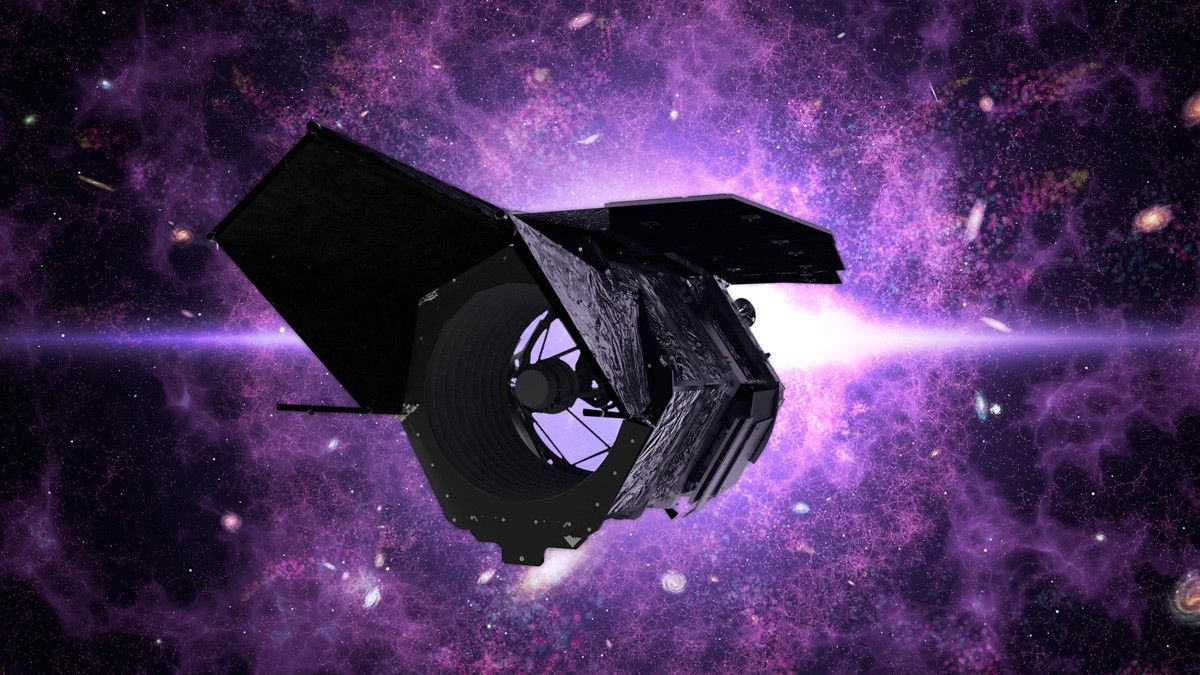
______________________________________________________________________
Words to Know
Astrophysics: a branch of space science that applies physics and mathematics to study the universe.
Lagrange point: a position in space where the gravitational forces of a two-body system, such as the Sun and Earth, are balanced. This point creates an “orbital parking spot” where minimal fuel is needed to maintain a spacecraft’s position.
Infrared light: light that is completely invisible to the human eye but can be felt as heat. It’s the area on the electromagnetic spectrum where wavelengths are longer than visible red light, but shorter than microwaves.
Dark energy: the mysterious force that is causing the universe to expand at an accelerated rate.
Exoplanet: a planet outside of our solar system.
Dark matter: the mysterious gravitational “glue” that holds cosmic structures together.
______________________________________________________________________
When and Where Will the Nancy Grace Roman Space Telescope Launch?The Nancy Grace Roman Space Telescope is scheduled to launch Aug. 30, 2026. It will launch aboard a SpaceX Falcon Heavy rocket. Liftoff will take place from Launch Complex 39A at NASA’s Kennedy Space Center in Florida.
Where Will the Nancy Grace Roman Space Telescope Go in Space?The Nancy Grace Roman Space Telescope will orbit about 930,000 miles (1.5 million kilometers) away from Earth. It will orbit around a special place in space called the second Sun-Earth Lagrange point, or L2. This gravitational sweet spot is perfect for unobstructed views of the universe.
What Instruments Does the Nancy Grace Roman Space Telescope Have?The Nancy Grace Roman Space Telescope will peer through dust and across vast stretches of space using infrared light. Roman’s primary mirror is 7.9 feet (2.4 meters) across. The large surface of the telescope mirror gathers lots of light. More light equals finer details.
The primary mirror will send light to Roman’s two science instruments: the Wide Field Instrument and the Coronagraph Instrument.
The Wide Field Instrument is a 300-megapixel infrared camera. It allows scientists to look very far back in time because the light captured by the camera has been traveling for billions of years before reaching the instrument. Seeing the universe in its early stages will help unravel how it has expanded throughout its history. This will give scientists hints about how the universe may continue to evolve.
The Coronagraph Instrument uses technology that blocks the glare from a star. This lets astronomers see planets in orbit around it. This instrument is the most powerful coronagraph ever flown in space. It will allow astronomers to see planets that are almost a billion times fainter than their host star.
On Nov. 25, 2025, technicians joined the inner and outer segments together and the observatory was complete.NASA / Sydney Rohde What Will Scientists Study With the Nancy Grace Roman Space Telescope?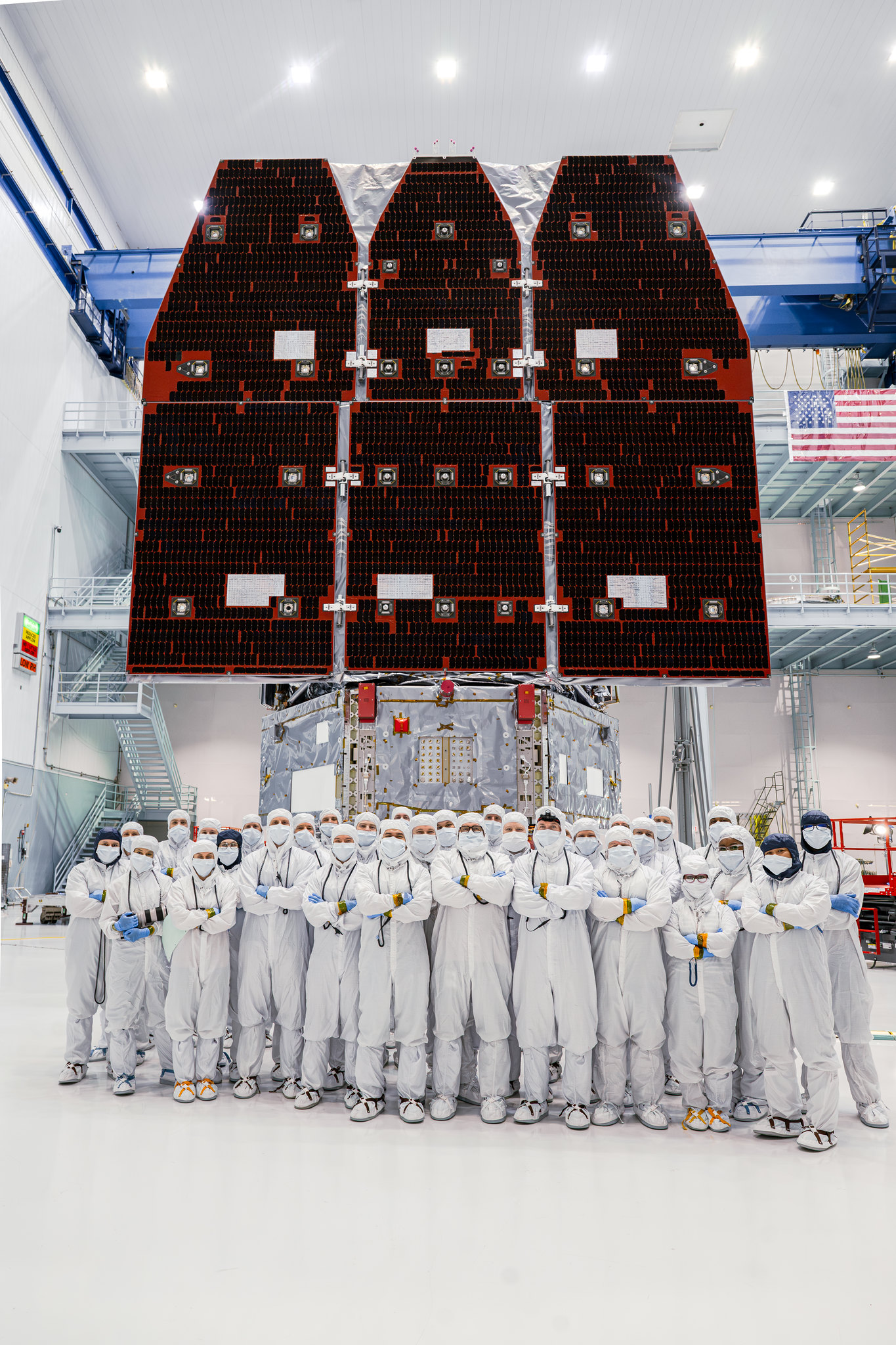
Scientists using the Nancy Grace Roman Space Telescope will focus on three main topic areas: dark energy, exoplanets, and dark matter.
Dark energy is a mysterious part of the universe. Scientists aren’t sure what it is, but it makes up about 68% of the universe’s total contents. It is believed to be responsible for the accelerating rate at which our universe is expanding. But recent observations seem to show that the pressure from dark energy is shifting over time. Scientists hope to use the Roman Space Telescope to help solve the mystery of dark energy’s true nature.
Exoplanets are planets outside of our solar system. Scientists have discovered more than 6,000 exoplanets. But they believe that billions could exist. Most of the exoplanets detected so far are wildly different than the planets in our solar system. Scientists expect Roman to find more unusual exoplanets. It will also allow astronomers to find planets in the habitable zone of their stars. This will be key to finding planets similar to Earth.
Dark matter is the invisible glue that holds the universe together. Scientists aren’t sure what dark matter is made of. Roman will allow scientists to peer back in time to trace how galaxies and galaxy clusters formed. If dark matter consists of heavy, sluggish particles, it would clump together readily and Roman should see galaxy formation early in cosmic history. If dark matter is made up of lighter, faster-moving particles, it should take longer to settle into clumps and for large-scale structures to develop. If astronomers can narrow down the candidates for dark matter particles, we’ll be one step closer to finally detecting them directly in experiments on Earth.
Who Was Nancy Grace Roman?Nancy Grace Roman was NASA’s first chief astronomer and the first female executive at the agency. Roman championed the making of the first space-based telescope — the Hubble Space Telescope. She was involved in every crucial decision about the telescope from its funding to where it was built to the details of its instruments. Her vital role in making the project a reality led her to be known as “the mother of the Hubble Space Telescope.”
Roman was born May 16, 1925, in Nashville, Tennessee. She died Dec. 25, 2018.
Nancy Grace Roman was NASA’s first chief astronomer. She is knows as “the mother of the Hubble Space Telescope.”NASA Career Corner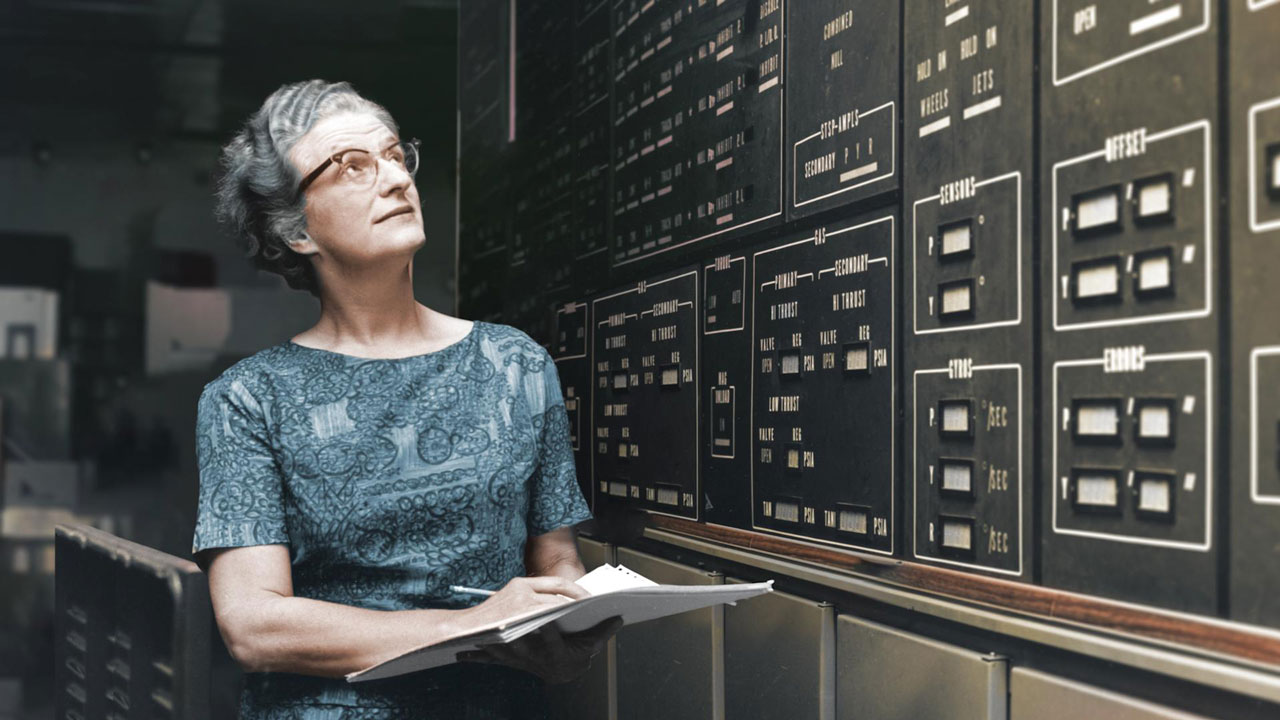
More than a thousand technicians and engineers assembled Roman from millions of individual components. Here are a few examples of the careers that shaped NASA’s newest space telescope:
Instrument technician: These experts install, calibrate, and maintain sensors and control systems. They troubleshoot issues that might come up with delicate systems and equipment. This career path often starts with an apprenticeship or hands-on training alongside experienced technicians. An associate’s degree is often required.
Mechanical engineer: This branch of engineering focuses on complex machines and engines. Mechanical engineers design, build, test, and improve mechanical systems. They play an essential role in making a complex observatory like the Roman Space Telescope a reality. A career in engineering demands a strong understanding of math and complex problem-solving and usually requires an advanced college degree.
Astrophysicist: These scientists study the physics of the universe. They are interested in learning how the universe began, how it is evolving, and how it works. Becoming an astrophysicist requires advanced college degrees.
NASA also needs people who work in photography, management, social media, videography, and much more. Learn about some of the people who have made the Roman mission possible here!
More About the Nancy Grace Roman Space TelescopeMission Website: Nancy Grace Roman Space Telescope
Video Game: Roman Space Observer
Roman Space Telescope Education and Outreach Materials
Explore More For Students Grades 5-8What Is the Nancy Grace Roman Space Telescope? (Grades 5-8)
6 min read
Preparations for Next Moonwalk Simulations Underway (and Underwater)This article is for students grades 5-8.
The Nancy Grace Roman Space Telescope is NASA’s newest astrophysics observatory. The telescope will scan large sections of space. Roman will help astronomers answer questions about dark energy, dark matter, exoplanets, and more.
The Nancy Grace Roman Space Telescope is NASA’s newest space telescope that will study dark energy, exoplanets, and astrophysics.NASA’s Goddard Space Flight Center______________________________________________________________________
Words to Know
Astrophysics: a branch of space science that applies physics and mathematics to study the universe.
Lagrange point: a position in space where the gravitational forces of a two-body system, such as the Sun and Earth, are balanced. This point creates an “orbital parking spot” where minimal fuel is needed to maintain a spacecraft’s position.
Infrared light: light that is completely invisible to the human eye but can be felt as heat. It’s the area on the electromagnetic spectrum where wavelengths are longer than visible red light, but shorter than microwaves.
Dark energy: the mysterious force that is causing the universe to expand at an accelerated rate.
Exoplanet: a planet outside of our solar system.
Dark matter: the mysterious gravitational “glue” that holds cosmic structures together.
______________________________________________________________________
When and Where Will the Nancy Grace Roman Space Telescope Launch?The Nancy Grace Roman Space Telescope is scheduled to launch Aug. 30, 2026. It will launch aboard a SpaceX Falcon Heavy rocket. Liftoff will take place from Launch Complex 39A at NASA’s Kennedy Space Center in Florida.
Where Will the Nancy Grace Roman Space Telescope Go in Space?The Nancy Grace Roman Space Telescope will orbit about 930,000 miles (1.5 million kilometers) away from Earth. It will orbit around a special place in space called the second Sun-Earth Lagrange point, or L2. This gravitational sweet spot is perfect for unobstructed views of the universe.
What Instruments Does the Nancy Grace Roman Space Telescope Have?The Nancy Grace Roman Space Telescope will peer through dust and across vast stretches of space using infrared light. Roman’s primary mirror is 7.9 feet (2.4 meters) across. The large surface of the telescope mirror gathers lots of light. More light equals finer details.
The primary mirror will send light to Roman’s two science instruments: the Wide Field Instrument and the Coronagraph Instrument.
The Wide Field Instrument is a 300-megapixel infrared camera. It allows scientists to look very far back in time because the light captured by the camera has been traveling for billions of years before reaching the instrument. Seeing the universe in its early stages will help unravel how it has expanded throughout its history. This will give scientists hints about how the universe may continue to evolve.
The Coronagraph Instrument uses technology that blocks the glare from a star. This lets astronomers see planets in orbit around it. This instrument is the most powerful coronagraph ever flown in space. It will allow astronomers to see planets that are almost a billion times fainter than their host star.
On Nov. 25, 2025, technicians joined the inner and outer segments together and the observatory was complete.NASA / Sydney Rohde What Will Scientists Study With the Nancy Grace Roman Space Telescope?Scientists using the Nancy Grace Roman Space Telescope will focus on three main topic areas: dark energy, exoplanets, and dark matter.
Dark energy is a mysterious part of the universe. Scientists aren’t sure what it is, but it makes up about 68% of the universe’s total contents. It is believed to be responsible for the accelerating rate at which our universe is expanding. But recent observations seem to show that the pressure from dark energy is shifting over time. Scientists hope to use the Roman Space Telescope to help solve the mystery of dark energy’s true nature.
Exoplanets are planets outside of our solar system. Scientists have discovered more than 6,000 exoplanets. But they believe that billions could exist. Most of the exoplanets detected so far are wildly different than the planets in our solar system. Scientists expect Roman to find more unusual exoplanets. It will also allow astronomers to find planets in the habitable zone of their stars. This will be key to finding planets similar to Earth.
Dark matter is the invisible glue that holds the universe together. Scientists aren’t sure what dark matter is made of. Roman will allow scientists to peer back in time to trace how galaxies and galaxy clusters formed. If dark matter consists of heavy, sluggish particles, it would clump together readily and Roman should see galaxy formation early in cosmic history. If dark matter is made up of lighter, faster-moving particles, it should take longer to settle into clumps and for large-scale structures to develop. If astronomers can narrow down the candidates for dark matter particles, we’ll be one step closer to finally detecting them directly in experiments on Earth.
Who Was Nancy Grace Roman?Nancy Grace Roman was NASA’s first chief astronomer and the first female executive at the agency. Roman championed the making of the first space-based telescope — the Hubble Space Telescope. She was involved in every crucial decision about the telescope from its funding to where it was built to the details of its instruments. Her vital role in making the project a reality led her to be known as “the mother of the Hubble Space Telescope.”
Roman was born May 16, 1925, in Nashville, Tennessee. She died Dec. 25, 2018.
Nancy Grace Roman was NASA’s first chief astronomer. She is knows as “the mother of the Hubble Space Telescope.”NASA Career CornerMore than a thousand technicians and engineers assembled Roman from millions of individual components. Here are a few examples of the careers that shaped NASA’s newest space telescope:
Instrument technician: These experts install, calibrate, and maintain sensors and control systems. They troubleshoot issues that might come up with delicate systems and equipment. This career path often starts with an apprenticeship or hands-on training alongside experienced technicians. An associate’s degree is often required.
Mechanical engineer: This branch of engineering focuses on complex machines and engines. Mechanical engineers design, build, test, and improve mechanical systems. They play an essential role in making a complex observatory like the Roman Space Telescope a reality. A career in engineering demands a strong understanding of math and complex problem-solving and usually requires an advanced college degree.
Astrophysicist: These scientists study the physics of the universe. They are interested in learning how the universe began, how it is evolving, and how it works. Becoming an astrophysicist requires advanced college degrees.
NASA also needs people who work in photography, management, social media, videography, and much more. Learn about some of the people who have made the Roman mission possible here!
More About the Nancy Grace Roman Space TelescopeMission Website: Nancy Grace Roman Space Telescope
Video Game: Roman Space Observer
Roman Space Telescope Education and Outreach Materials
Explore More For Students Grades 5-8