
_0.thumbnail.jpg "Image (3).jpg")
Feed aggregator
Tracking Satellites and Space Debris Using Radio Antennae
Every year, thousands and thousands of satellites get launched into orbit around our planet. The result is an increasingly congested "space" above Earth populated by equipment that provides services to the surface. At the same time, these satellites affect ground-based astronomy research and create potential for damage when they eventually fall through Earth's atmosphere to the ground. In addition, near-Earth space hosts old rocket bodies and other materials left in space by past missions.
The Risks of Debris Between the Earth and the Moon for Future Exploration
A new study from the Chinese Academy of Sciences (CAS) addresses the threat of debris in cislunar space, which could pose threats for future missions bound for the Moon.
Radio Astronomy is Getting a Big Boost from the VLA's New Sky Survey
The National Radio Astronomy Observatory has completed a new survey with the updated Karl G. Jansky Very Large Array (VLA) in New Mexico. It's called the VLASS, the Very Large Array Sky Survey, and it's the most detailed radio survey of the sky ever completed. The VLA used the power of its 28 movable dishes to complete the survey.
NASA Awards 2026 Innovative Technology Concepts
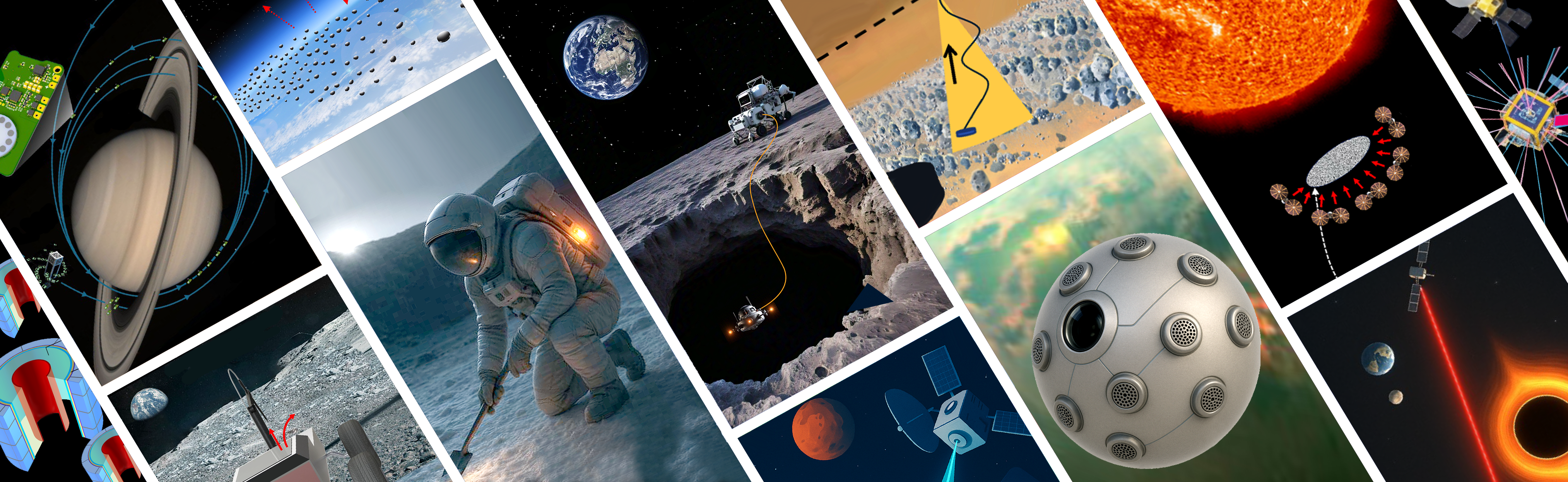
The NASA Innovative Advanced Concepts (NIAC) program has created 18 new awards to support visionary ideas to improve aerospace technologies in areas ranging from the exploration of the solar system to understanding the universe.
The 18 NIAC Phase I awards total $3.2 million. Each award provides up to $175,000 for a nine-month initial investigation. The NIAC projects are about early-stage concept development and are not considered official NASA missions.
“NASA has outlined an ambitious vision for the future of space exploration, we’re returning the Moon to stay, advancing to Mars, and pushing to deepen our understanding of space,” said Greg Stover, director of the Advanced Research and Technology division within the Research and Technology Mission Directorate at NASA Headquarters in Washington. “Achieving that will require more than incremental technological advancement. It means we need great leaps. These awards are the kinds of innovation the world needs NASA to help foster.”
As an innovation incubator, NIAC funds early development of potential breakthrough technologies. Concepts for award consideration must have both transformative potential and possible feasibility for eventual implementation.
“Every innovation, every leap in technology, starts with a seed of an idea,” said Phillip Williams, NIAC’s acting program executive. “The NIAC program allows NASA to germinate those seeds and determine if there’s something that could be grown to benefit future space missions and our nation’s aerospace economy.”
As NASA and its partners push for sustained lunar presence, some of the 2026 awardees focused on ways to help explore the Moon and build infrastructure there. These include a system to support hovering robots to explore lava tubes under the Moon’s surface, a method to manage temperatures for small mobile exploration robots, and a way to incorporate radioisotopic heat sources into suits to help keep astronauts warm when operating in the Moon’s nearly two-week-long lunar nights.
Other concepts focus on exploring some of the solar system’s most remarkable features. Venus, with its hot atmosphere, presents an imposing challenge for research vehicles, so one NIAC awardee explores methods for hardening instruments for longer missions.
Two other concepts could help study planetary rings. One would use a swarm of 10,000 tiny satellites to map and analyze the rings of Saturn, while another would create a system for collecting samples from rings such as those circling Saturn, Uranus, and Neptune.
Some NIAC awardees will look far beyond the solar system, exploring ways to power interstellar spacecraft, map out continents on exoplanets, observe the photon rings around black holes, and detect subtle gravitational waves to explain how galaxies formed. Others will work to answer questions directly related to life on Earth, like the potential use of spaceborne dust to reduce solar radiation, and awareness about the debris orbiting Earth.
Researchers, known as NIAC Fellows, will investigate their concepts and identify potential challenges and opportunities for further development.
The 18 selections for 2026 NIAC Phase 1 grants are:
- Saptarshi Bandyopadhyay, NASA Jet Propulsion Laboratory, Pasadena, California: Dimming the Sun Using Controllable Dust Cloud to Reduce Solar Insolation (DimSun)
- David Bugby, NASA Jet Propulsion Laboratory: Combinatory Architecture offering Neomobility, on-Venus Adaptability, and Survivability (CANVAS)
- A.C. Charania, Zeno Power Systems, Inc., Washington:
Extended Astronaut Radioisotope-EVA in Nighttime and Deep-space Icy Landscapes (EARENDIL)
- Anish Damodaran, University of Central Florida, Orlando: PS21: Transforming Submillimeter Space Interferometry with Photonic Technologies
- Artur Davoyan, University of California, Los Angeles: Coilable Stacked Solar Sails for Very High delta-V Missions
- Daniel Drew, University of Hawaii, Honolulu: Solid-state Propulsion for Autonomous Reconnaissance of Karst (SPARK)
- Gilly Elor, Stone Aerospace, Inc., Del Valle, Texas: Power-over-Fiber to Enable a Lunar Underground eXplorer (LUX)
- Zhaoyan Liu, NASA Ames Research Center, California’s Silicon Valley: Quantum Wind Lidar Applications for Planetary and Earth Science Missions
- Jeff Nosanov, Orbital Velocity, LLC, Decatur, Georgia: OBLIVIAN: Observing Black hole LIght Via Intensity cOrrelatioN (OBLIVIAN)
- Keunhan Park, University of Utah, Salt Lake City: Plasmon-Enhanced Radioisotope Thermophotovoltaic (PRTPV) Power Generation for Interstellar Missions
- Austin Phoenix, Virginia Polytechnic Institute and State University, Blacksburg, Virginia: Efficient variable Conductivity Lunar Insulator for Passive Surveyor Environmental Control (ECLIPSE)
- Marco Quadrelli, NASA Jet Propulsion Laboratory: PRAXIS: Planetary Rings Autonomous EXploration with In-situ Sampling (PRAXIS)
- Michael Rubenstein, Northwestern University, Chicago: Actively Steerable Femtosat Constellations for In-situ Exploration of Saturn’s Rings, Atmosphere, and Magnetosphere
- Benjamin Schafer, Rarefied Technologies Inc., Albuquerque, New Mexico: : Photophoretic Tracers for Near-Space Remote Sensing at 30-100 km Altitudes
- David Smith, Duke University, Durham, North Carolina: Robotically Assembled Electromagnetic Metamaterials for Long-Range Space Situational Awareness
- Pablo Sobron, Search for Extraterrestrial Intelligence Institute, Mountain View, California: Interworld Slingshot Resource Surveys
- Paul Stankus, Brookhaven Science Associates, Upton, New York: Mapping Alien Continents: Achieving Optical VLBI for Exoplanet Imaging
- Paul Stankus, Brookhaven Science Associates, Upton, New York: Precision Astrometry Using Optically Independent Spacecraft for Gravitational Wave Detection
To learn more about NASA’s NIAC program, visit:
https://www.nasa.gov/about-niac
-end-
Rob Margetta
Headquarters, Washington
202-358-0918
robert.j.margetta@nasa.gov
NASA Awards 2026 Innovative Technology Concepts
The NASA Innovative Advanced Concepts (NIAC) program has created 18 new awards to support visionary ideas to improve aerospace technologies in areas ranging from the exploration of the solar system to understanding the universe.
The 18 NIAC Phase I awards total $3.2 million. Each award provides up to $175,000 for a nine-month initial investigation. The NIAC projects are about early-stage concept development and are not considered official NASA missions.
“NASA has outlined an ambitious vision for the future of space exploration, we’re returning the Moon to stay, advancing to Mars, and pushing to deepen our understanding of space,” said Greg Stover, director of the Advanced Research and Technology division within the Research and Technology Mission Directorate at NASA Headquarters in Washington. “Achieving that will require more than incremental technological advancement. It means we need great leaps. These awards are the kinds of innovation the world needs NASA to help foster.”
As an innovation incubator, NIAC funds early development of potential breakthrough technologies. Concepts for award consideration must have both transformative potential and possible feasibility for eventual implementation.
“Every innovation, every leap in technology, starts with a seed of an idea,” said Phillip Williams, NIAC’s acting program executive. “The NIAC program allows NASA to germinate those seeds and determine if there’s something that could be grown to benefit future space missions and our nation’s aerospace economy.”
As NASA and its partners push for sustained lunar presence, some of the 2026 awardees focused on ways to help explore the Moon and build infrastructure there. These include a system to support hovering robots to explore lava tubes under the Moon’s surface, a method to manage temperatures for small mobile exploration robots, and a way to incorporate radioisotopic heat sources into suits to help keep astronauts warm when operating in the Moon’s nearly two-week-long lunar nights.
Other concepts focus on exploring some of the solar system’s most remarkable features. Venus, with its hot atmosphere, presents an imposing challenge for research vehicles, so one NIAC awardee explores methods for hardening instruments for longer missions.
Two other concepts could help study planetary rings. One would use a swarm of 10,000 tiny satellites to map and analyze the rings of Saturn, while another would create a system for collecting samples from rings such as those circling Saturn, Uranus, and Neptune.
Some NIAC awardees will look far beyond the solar system, exploring ways to power interstellar spacecraft, map out continents on exoplanets, observe the photon rings around black holes, and detect subtle gravitational waves to explain how galaxies formed. Others will work to answer questions directly related to life on Earth, like the potential use of spaceborne dust to reduce solar radiation, and awareness about the debris orbiting Earth.
Researchers, known as NIAC Fellows, will investigate their concepts and identify potential challenges and opportunities for further development.
The 18 selections for 2026 NIAC Phase 1 grants are:
- Saptarshi Bandyopadhyay, NASA Jet Propulsion Laboratory, Pasadena, California: Dimming the Sun Using Controllable Dust Cloud to Reduce Solar Insolation (DimSun)
- David Bugby, NASA Jet Propulsion Laboratory: Combinatory Architecture offering Neomobility, on-Venus Adaptability, and Survivability (CANVAS)
- A.C. Charania, Zeno Power Systems, Inc., Washington:
Extended Astronaut Radioisotope-EVA in Nighttime and Deep-space Icy Landscapes (EARENDIL)
- Anish Damodaran, University of Central Florida, Orlando: PS21: Transforming Submillimeter Space Interferometry with Photonic Technologies
- Artur Davoyan, University of California, Los Angeles: Coilable Stacked Solar Sails for Very High delta-V Missions
- Daniel Drew, University of Hawaii, Honolulu: Solid-state Propulsion for Autonomous Reconnaissance of Karst (SPARK)
- Gilly Elor, Stone Aerospace, Inc., Del Valle, Texas: Power-over-Fiber to Enable a Lunar Underground eXplorer (LUX)
- Zhaoyan Liu, NASA Ames Research Center, California’s Silicon Valley: Quantum Wind Lidar Applications for Planetary and Earth Science Missions
- Jeff Nosanov, Orbital Velocity, LLC, Decatur, Georgia: OBLIVIAN: Observing Black hole LIght Via Intensity cOrrelatioN (OBLIVIAN)
- Keunhan Park, University of Utah, Salt Lake City: Plasmon-Enhanced Radioisotope Thermophotovoltaic (PRTPV) Power Generation for Interstellar Missions
- Austin Phoenix, Virginia Polytechnic Institute and State University, Blacksburg, Virginia: Efficient variable Conductivity Lunar Insulator for Passive Surveyor Environmental Control (ECLIPSE)
- Marco Quadrelli, NASA Jet Propulsion Laboratory: PRAXIS: Planetary Rings Autonomous EXploration with In-situ Sampling (PRAXIS)
- Michael Rubenstein, Northwestern University, Chicago: Actively Steerable Femtosat Constellations for In-situ Exploration of Saturn’s Rings, Atmosphere, and Magnetosphere
- Benjamin Schafer, Rarefied Technologies Inc., Albuquerque, New Mexico: : Photophoretic Tracers for Near-Space Remote Sensing at 30-100 km Altitudes
- David Smith, Duke University, Durham, North Carolina: Robotically Assembled Electromagnetic Metamaterials for Long-Range Space Situational Awareness
- Pablo Sobron, Search for Extraterrestrial Intelligence Institute, Mountain View, California: Interworld Slingshot Resource Surveys
- Paul Stankus, Brookhaven Science Associates, Upton, New York: Mapping Alien Continents: Achieving Optical VLBI for Exoplanet Imaging
- Paul Stankus, Brookhaven Science Associates, Upton, New York: Precision Astrometry Using Optically Independent Spacecraft for Gravitational Wave Detection
To learn more about NASA’s NIAC program, visit:
https://www.nasa.gov/about-niac
-end-
Rob Margetta
Headquarters, Washington
202-358-0918
robert.j.margetta@nasa.gov
White Dwarfs Eat More Planetary Debris Than Thought, But Magnetic Fields Hide It
Planetary debris disks around white dwarfs appear to be more plentiful than thought. That's because some white dwarfs are magnetic, and those magnetic fields create patches of metallic debris near the stars' poles, where it's more difficult to detect. This leads to an underestimation of debris, something new research is trying to correct.
Bizarre new material discovered in Hiroshima bombing debris
The extreme conditions of atomic bomb explosions create “uncontrolled microexperiments” that, in Hiroshima, forged a never-before-seen metallic alloy
Probing Binary Stars in the Small Magellanic Cloud with the JWST
Astronomers want to know how universal the initial mass fraction (IMF) of galaxies is. To do they that, they need to discern binary stars in other galaxies, a difficult task. Researchers used the JWST to study the Small Magellanic Cloud and determine how many binary stars are there, since they can confuse measurements of the IMF.
NASA Sets Coverage for August Northern Hemisphere Total Solar Eclipse
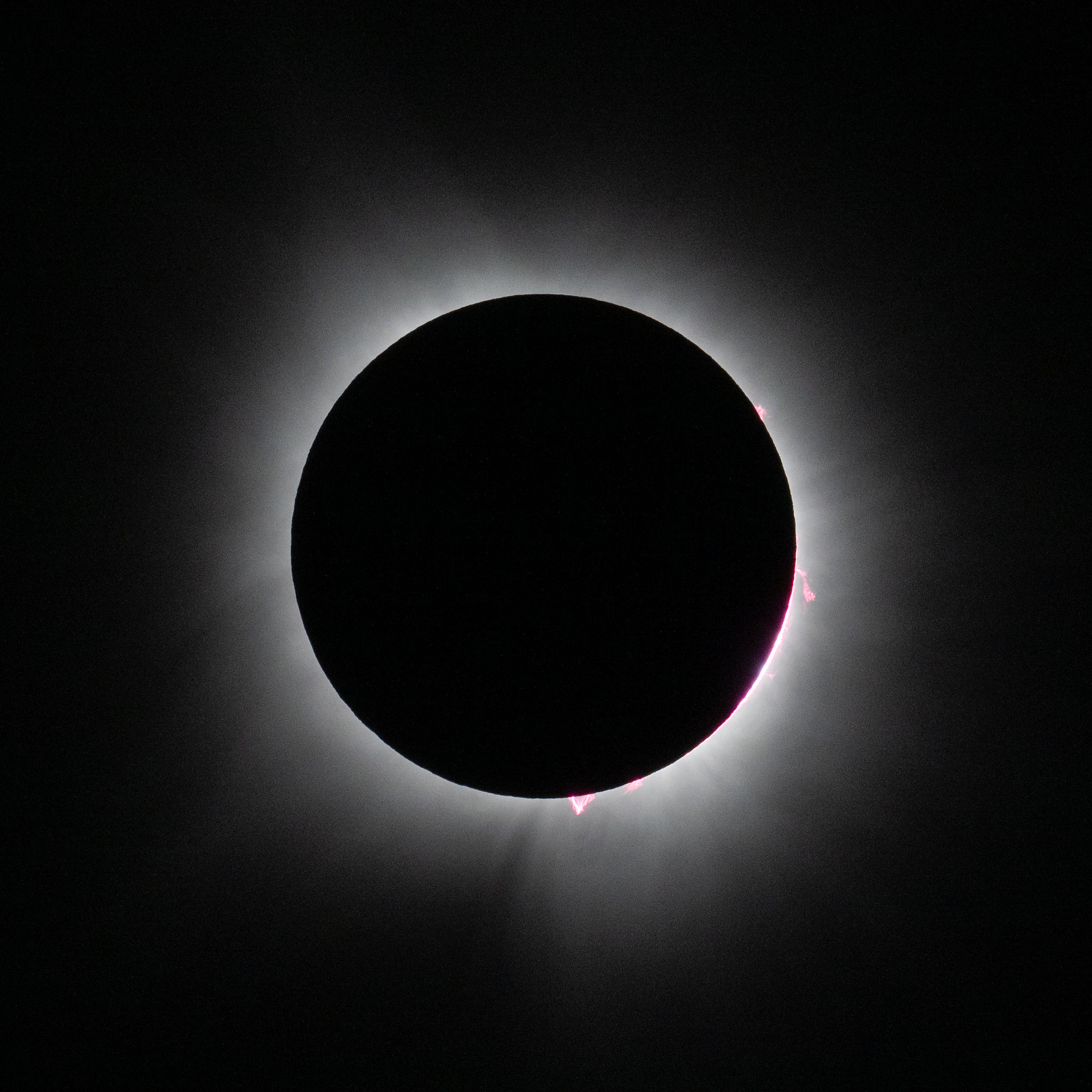
On Wednesday, Aug. 12, a total solar eclipse will be visible in parts of Greenland, Iceland, northern Russia, the Atlantic Ocean, Spain, and a small corner of Portugal. NASA will stream the eclipse live with views across the path and interviews with subject matter experts through a variety of platforms.
Learn where to watch online:
Viewers in other places in the Northern Hemisphere also will have the chance to experience a partial solar eclipse, including parts of the U.S. (from Alaska to North Carolina), most of Canada, much of Europe, and northwestern Africa.
During the eclipse, NASA will conduct experiments in the path of totality. To investigate the dynamics of the Sun’s corona, a NASA-funded science team will chase the Moon’s shadow with a WB-57 high-altitude research aircraft. The NASA-supported Nationwide Eclipse Ballooning Project is sending students from several U.S. universities to Iceland and Spain to launch scientific balloons before, during, and after the eclipse to research how the temporary darkening of our skies during the eclipse affects Earth’s atmosphere.
NASA’s eclipse coverage is as follows (all times Eastern):
Wednesday, Aug. 12
- 1:15 p.m.: Eclipse broadcast begins
- 1:45 p.m.: Totality begins in Iceland
- 2:28 p.m.: Totality begins in Spain
NASA photography coverage
Photos of the eclipse, dependent on visibility, will be available shortly after the eclipse. View images on the agency’s Flickr account.
Watch, engage on social media
During the broadcast, NASA experts will answer questions submitted on social media. Send in your questions and let people know you’re watching the eclipse on X, Facebook, and Instagram by following and tagging these accounts:
X: @NASA, @NASASolarSystem, @NASAScience_
Facebook: NASA, NASASolarSystem, @NASAScience
Instagram: @NASA, @NASASolarSystem, @NASAScience_
Learn more about the eclipse at:
https://science.nasa.gov/eclipses
-end-
Abbey Interrante / Karen Fox
Headquarters, Washington
301-201-0124 / 202-358-1600
abbey.a.interrante@nasa.gov / karen.c.fox@nasa.gov
NASA Sets Coverage for August Northern Hemisphere Total Solar Eclipse
On Wednesday, Aug. 12, a total solar eclipse will be visible in parts of Greenland, Iceland, northern Russia, the Atlantic Ocean, Spain, and a small corner of Portugal. NASA will stream the eclipse live with views across the path and interviews with subject matter experts through a variety of platforms.
Learn where to watch online:
Viewers in other places in the Northern Hemisphere also will have the chance to experience a partial solar eclipse, including parts of the U.S. (from Alaska to North Carolina), most of Canada, much of Europe, and northwestern Africa.
During the eclipse, NASA will conduct experiments in the path of totality. To investigate the dynamics of the Sun’s corona, a NASA-funded science team will chase the Moon’s shadow with a WB-57 high-altitude research aircraft. The NASA-supported Nationwide Eclipse Ballooning Project is sending students from several U.S. universities to Iceland and Spain to launch scientific balloons before, during, and after the eclipse to research how the temporary darkening of our skies during the eclipse affects Earth’s atmosphere.
NASA’s eclipse coverage is as follows (all times Eastern):
Wednesday, Aug. 12
- 1:15 p.m.: Eclipse broadcast begins
- 1:45 p.m.: Totality begins in Iceland
- 2:28 p.m.: Totality begins in Spain
NASA photography coverage
Photos of the eclipse, dependent on visibility, will be available shortly after the eclipse. View images on the agency’s Flickr account.
Watch, engage on social media
During the broadcast, NASA experts will answer questions submitted on social media. Send in your questions and let people know you’re watching the eclipse on X, Facebook, and Instagram by following and tagging these accounts:
X: @NASA, @NASASolarSystem, @NASAScience_
Facebook: NASA, NASASolarSystem, @NASAScience
Instagram: @NASA, @NASASolarSystem, @NASAScience_
Learn more about the eclipse at:
https://science.nasa.gov/eclipses
-end-
Abbey Interrante / Karen Fox
Headquarters, Washington
301-201-0124 / 202-358-1600
abbey.a.interrante@nasa.gov / karen.c.fox@nasa.gov
NASA’s Curiosity Views a Sand-Capped Butte
NASA/JPL-Caltech/MSSS Photojournal Navigation Downloads NASA’s Curiosity Views a Sand-Capped Butte
PNG (27.41 MB)
Description
NASA’s Curiosity Mars rover captured this sand-capped butte, nicknamed “Miraflores,” estimated to be about 20 feet (6 meters) tall, with its Mast Camera, or Mastcam, on June 11, 2026, the 4,923rd Martian day, or sol, of the mission. The butte was left behind as surrounding rock eroded away over time, deepening the broad valley Curiosity is climbing through.
The surrounding area includes an expanse of terrain covered in surface features called polygons.
The panorama is made up of 11 individual images that were sent to Earth and stitched together. The color has been adjusted to match lighting conditions as the human eye would see them on Earth.
Curiosity was built by NASA’s Jet Propulsion Laboratory, which is managed by Caltech in Pasadena, California. JPL leads the mission on behalf of NASA’s Science Mission Directorate in Washington as part of NASA’s Mars Exploration Program portfolio. Malin Space Science Systems in San Diego built and operates Mastcam.
To learn more about Curiosity, visit:
science.nasa.gov/mission/msl-curiosity
Keep Exploring Discover More Topics From Photojournal
Photojournal
Search Photojournal
Photojournal’s Latest Content
Feedback
NASA’s Curiosity Views a Sand-Capped Butte
NASA/JPL-Caltech/MSSS Photojournal Navigation Downloads NASA’s Curiosity Views a Sand-Capped Butte
PNG (27.41 MB)
Description
NASA’s Curiosity Mars rover captured this sand-capped butte, nicknamed “Miraflores,” estimated to be about 20 feet (6 meters) tall, with its Mast Camera, or Mastcam, on June 11, 2026, the 4,923rd Martian day, or sol, of the mission. The butte was left behind as surrounding rock eroded away over time, deepening the broad valley Curiosity is climbing through.
The surrounding area includes an expanse of terrain covered in surface features called polygons.
The panorama is made up of 11 individual images that were sent to Earth and stitched together. The color has been adjusted to match lighting conditions as the human eye would see them on Earth.
Curiosity was built by NASA’s Jet Propulsion Laboratory, which is managed by Caltech in Pasadena, California. JPL leads the mission on behalf of NASA’s Science Mission Directorate in Washington as part of NASA’s Mars Exploration Program portfolio. Malin Space Science Systems in San Diego built and operates Mastcam.
To learn more about Curiosity, visit:
science.nasa.gov/mission/msl-curiosity
Keep Exploring Discover More Topics From Photojournal
Photojournal
Search Photojournal
Photojournal’s Latest Content
Feedback
NASA’s Curiosity Discovers a Field of Martian Polygons
NASA/JPL-Caltech/MSSS Photojournal Navigation Downloads NASA’s Curiosity Discovers a Field of Martian Polygons
PNG (305.97 MB)
PIA26729 Figure A
PNG (3.37 MB)
Description
NASA’s Curiosity Mars rover captured this 360-degree view of an expanse of terrain covered in surface features called polygons on June 19 and 20, 2026, the 4,930th and 4,931st Martian days, or sols, of the mission. The rover has found polygons several times in the past, but never so many in one place. Across the center of this image, the surface is covered by shapes ranging in size from roughly 2 to 4 inches (5 to 10 centimeters) in diameter. The features also surround and wrap around a sand-capped butte nicknamed “Miraflores,” seen at far right in the image.
Figure A
Figure A is a crop from the bottom-center of the panorama highlighting the polygons and their honeycomb-like textures.
Polygonal textures can form from a variety of conditions, including drying out of the surface (like in mud cracks), temperature cycles, compaction after being buried, or shrinkage of the sediment from loss of water or mineral changes. Scientists are measuring characteristics of these polygons to home in on which process formed them.
This panorama was captured by Curiosity’s Mast Camera, or Mastcam, as the rover continued its ascent of the foothills of Mount Sharp, a 3-mile-tall (5-kilometer-tall) mountain that it’s been climbing since 2014.
The panorama is made up of 340 individual images that were sent to Earth and stitched together. The color has been adjusted to match lighting conditions as the human eye would see them on Earth.
Curiosity was built by NASA’s Jet Propulsion Laboratory, which is managed by Caltech in Pasadena, California. JPL leads the mission on behalf of NASA’s Science Mission Directorate in Washington as part of NASA’s Mars Exploration Program portfolio. Malin Space Science Systems in San Diego built and operates Mastcam.
To learn more about Curiosity, visit:
science.nasa.gov/mission/msl-curiosity
Keep Exploring Discover More Topics From Photojournal
Photojournal
Search Photojournal
Photojournal’s Latest Content
Feedback
NASA’s Curiosity Discovers a Field of Martian Polygons
NASA/JPL-Caltech/MSSS Photojournal Navigation Downloads NASA’s Curiosity Discovers a Field of Martian Polygons
PNG (305.97 MB)
PIA26729 Figure A
PNG (3.37 MB)
Description
NASA’s Curiosity Mars rover captured this 360-degree view of an expanse of terrain covered in surface features called polygons on June 19 and 20, 2026, the 4,930th and 4,931st Martian days, or sols, of the mission. The rover has found polygons several times in the past, but never so many in one place. Across the center of this image, the surface is covered by shapes ranging in size from roughly 2 to 4 inches (5 to 10 centimeters) in diameter. The features also surround and wrap around a sand-capped butte nicknamed “Miraflores,” seen at far right in the image.
Figure AFigure A is a crop from the bottom-center of the panorama highlighting the polygons and their honeycomb-like textures.
Polygonal textures can form from a variety of conditions, including drying out of the surface (like in mud cracks), temperature cycles, compaction after being buried, or shrinkage of the sediment from loss of water or mineral changes. Scientists are measuring characteristics of these polygons to home in on which process formed them.
This panorama was captured by Curiosity’s Mast Camera, or Mastcam, as the rover continued its ascent of the foothills of Mount Sharp, a 3-mile-tall (5-kilometer-tall) mountain that it’s been climbing since 2014.
The panorama is made up of 340 individual images that were sent to Earth and stitched together. The color has been adjusted to match lighting conditions as the human eye would see them on Earth.
Curiosity was built by NASA’s Jet Propulsion Laboratory, which is managed by Caltech in Pasadena, California. JPL leads the mission on behalf of NASA’s Science Mission Directorate in Washington as part of NASA’s Mars Exploration Program portfolio. Malin Space Science Systems in San Diego built and operates Mastcam.
To learn more about Curiosity, visit:
science.nasa.gov/mission/msl-curiosity
Keep Exploring Discover More Topics From Photojournal
Photojournal
Search Photojournal
Photojournal’s Latest Content
Feedback
Understanding How Martian Auroras Are Made
NASA’s Curiosity Mars Rover Discovers Field of Honeycomb Textures
3 min read
Preparations for Next Moonwalk Simulations Underway (and Underwater) NASA’s Curiosity Discovers a Field of Martian PolygonsNASA/JPL-Caltech/MSSS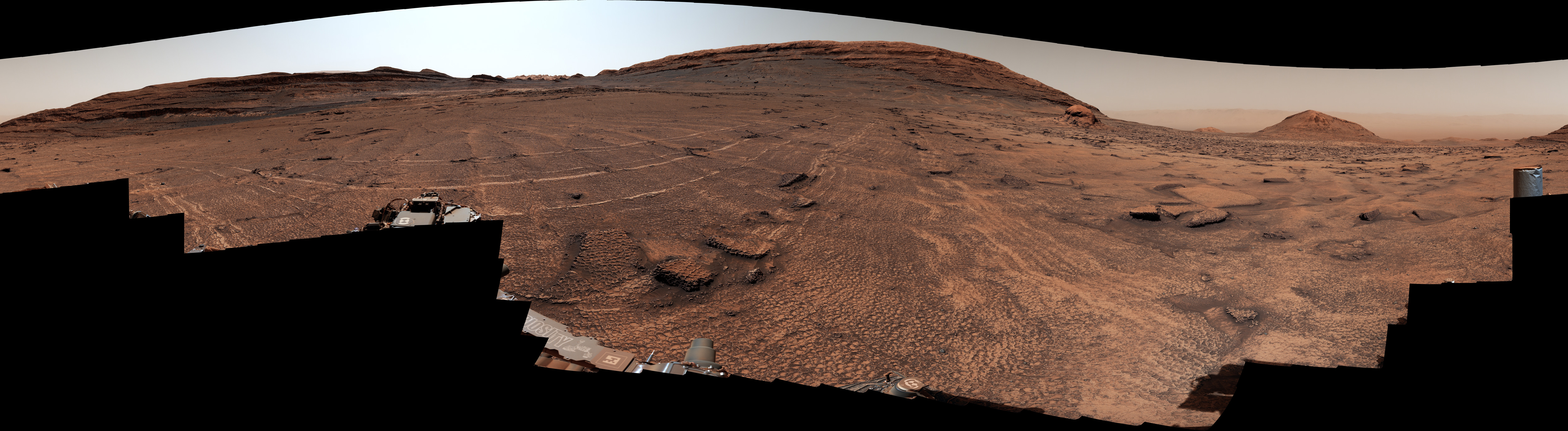
As NASA’s Curiosity rover recently began climbing up a Martian valley nicknamed “Valle Grande,” it sent back images that were a familiar sight to mission scientists: honeycomb-like textures called polygonal fractures, each one about 1.5 to 3 inches (4 to 8 centimeters) across. The mission has spotted small patches of these geometric shapes several times before, but nothing at the scale discovered in Valle Grande.
In a 360-degree panorama that the rover captured on June 19 and 20, the 4,930th and 4,931st Martian days, or sols, of the mission, the polygonal shapes spread in all directions for as far as the rover can see. They even wrap around the sides of a nearby butte nicknamed “Miraflores,” which stands 20 feet (6 meters) tall and is topped with a thick cap of sand.
“We’ve seen a lot of fascinating landscapes through Curiosity’s eyes, but this sea of polygons took our breath away,” said the mission’s project scientist, Ashwin Vasavada of NASA’s Jet Propulsion Laboratory in Southern California. “We measured their shapes and chemistry carefully and are hopeful there are clues in the data as to how these features formed.”
A close-up of the polygon fractures discovered by NASA’s Curiosity Mars rover highlights their honeycomb-like texturesNASA/JPL-Caltech/MSSS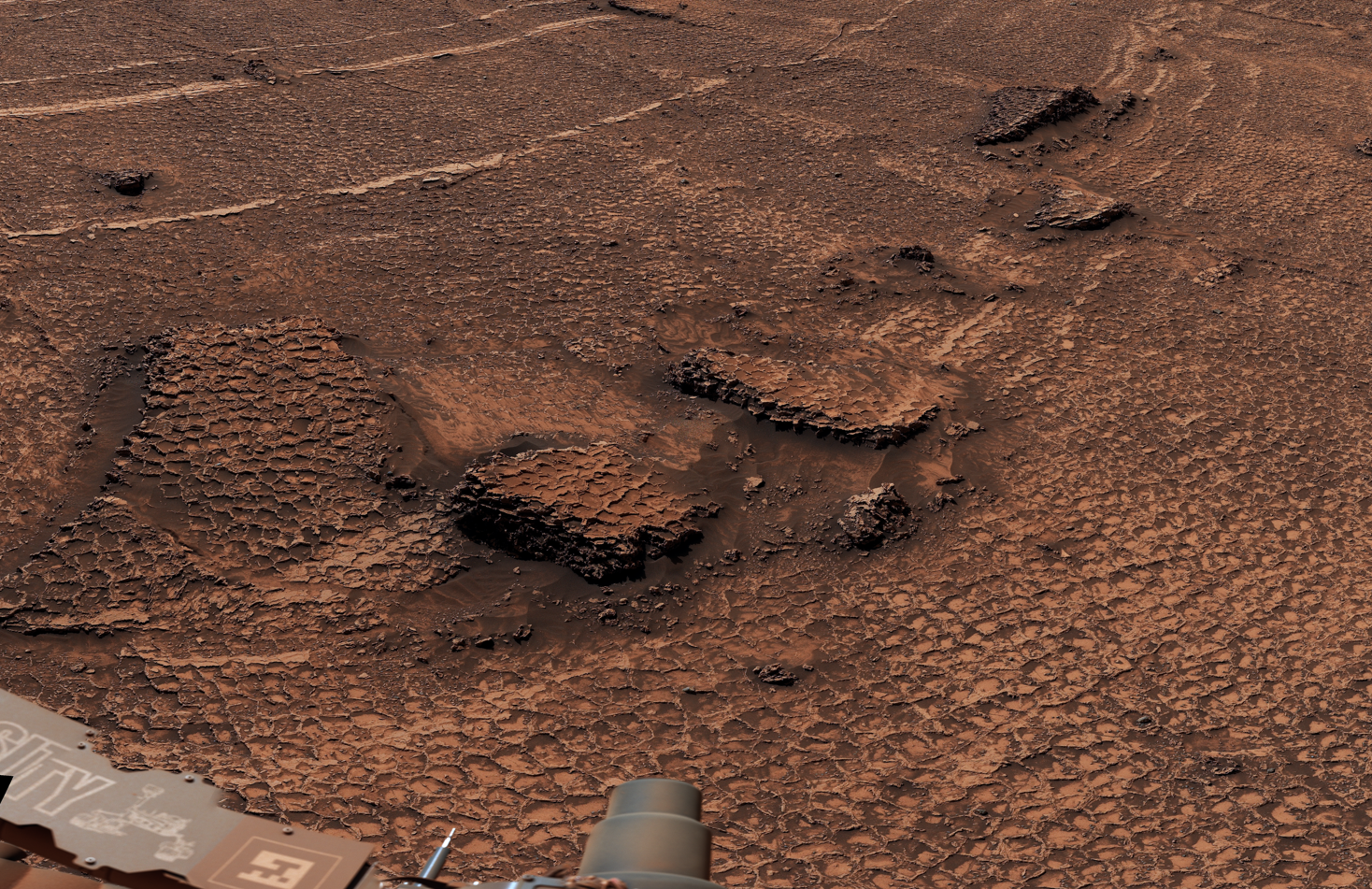
Some of the polygons that the mission has spotted in the past clearly formed as mud cracks, though a variety of processes can contribute to their honeycomb textures, including cycles of warm and cold temperatures or compression that squeezed water out of the sediment when the surface was buried.
These newly discovered polygons are among the many surprises Curiosity has trundled across since landing on Mars 14 years ago, on Aug. 5, 2012. Besides sulfur crystals, shiny meteorites, and other interesting geologic features, the rover has made major discoveries about the ancient Martian environment — most importantly, that it had the water, chemistry, and nutrients to support microbial life.
Billions of years ago, lakes and streams dappled the lower foothills of Mount Sharp, a 3-mile-tall (5-kilometer-tall) mountain that Curiosity has been ascending since 2014. The rover has previously uncovered chemistry left over from Mars’ watery history, including carbon-based molecules believed to be precursors to RNA and DNA, two nucleic acids that carry genetic information. Scientists have no way of knowing whether these organic molecules were created by biologic or geologic processes — either path is possible — but their discovery reconfirmed that ancient Mars had the right chemistry to support life.
NASA’s Curiosity Mars rover captured this sand-capped butte, nicknamed “Miraflores,” estimated to be about 20 feet (6 meters) tall, on June 11, 2026. The surrounding area includes an expanse of terrain covered in surface features called polygons.NASA/JPL-Caltech/MSSS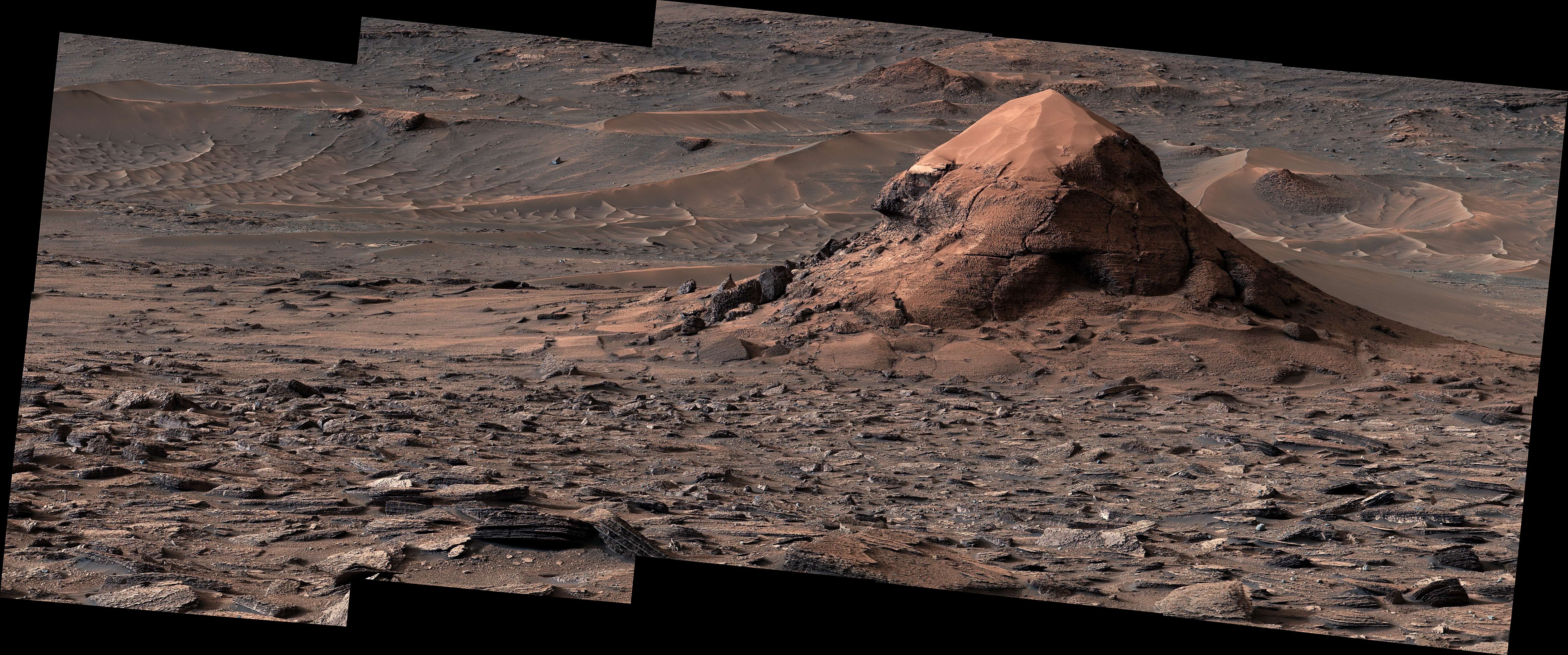
Managed by Caltech in Pasadena, JPL built Curiosity and leads the mission on behalf of NASA’s Science Mission Directorate in Washington as part of the agency’s Mars Exploration Program portfolio.
To learn more about Curiosity, visit:
https://science.nasa.gov/mission/msl-curiosity
News Media Contacts
Andrew Good
Jet Propulsion Laboratory, Pasadena, Calif.
818-393-2433
andrew.c.good@jpl.nasa.gov
Karen Fox / Alana Johnson
NASA Headquarters, Washington
240-285-5155 / 202-672-4780
karen.c.fox@nasa.gov / alana.r.johnson@nasa.gov
2026-051
Share Details Last Updated Jul 29, 2026 Related Terms Explore More 5 min read NASA’s MAVEN Illuminates New Understanding of Auroras at MarsNASA MAVEN (Mars Atmosphere and Volatile Evolution) mission scientists have uncovered a key puzzle piece…
Article 1 week ago 5 min read NASA’s Juno Takes Temperature of Jupiter’s Fiery Moon Io Article 1 week ago 5 min read US-India Satellite Delivers Data, Reveals ‘Hummingbird’ in Antarctica Article 1 week ago Keep Exploring Discover Related Topics Mars Science Laboratory: Curiosity RoverPart of NASA’s Mars Science Laboratory mission, at the time of launch, Curiosity was the largest and most capable rover…
Curiosity Science HighlightsCuriosity Finds Evidence of Persistent Liquid Water in the Past Just after landing, Curiosity found smooth, rounded pebbles that likely…
Mars ExplorationMars is the only planet we know of inhabited entirely by robots. Learn more about the Mars Missions.
Planetary ScienceNASA’s planetary science program explores the objects in our solar system to better understand its history and the distribution of…
NASA’s Curiosity Mars Rover Discovers Field of Honeycomb Textures
3 min read
Preparations for Next Moonwalk Simulations Underway (and Underwater) NASA’s Curiosity Discovers a Field of Martian PolygonsNASA/JPL-Caltech/MSSSAs NASA’s Curiosity rover recently began climbing up a Martian valley nicknamed “Valle Grande,” it sent back images that were a familiar sight to mission scientists: honeycomb-like textures called polygonal fractures, each one about 1.5 to 3 inches (4 to 8 centimeters) across. The mission has spotted small patches of these geometric shapes several times before, but nothing at the scale discovered in Valle Grande.
In a 360-degree panorama that the rover captured on June 19 and 20, the 4,930th and 4,931st Martian days, or sols, of the mission, the polygonal shapes spread in all directions for as far as the rover can see. They even wrap around the sides of a nearby butte nicknamed “Miraflores,” which stands 20 feet (6 meters) tall and is topped with a thick cap of sand.
“We’ve seen a lot of fascinating landscapes through Curiosity’s eyes, but this sea of polygons took our breath away,” said the mission’s project scientist, Ashwin Vasavada of NASA’s Jet Propulsion Laboratory in Southern California. “We measured their shapes and chemistry carefully and are hopeful there are clues in the data as to how these features formed.”
A close-up of the polygon fractures discovered by NASA’s Curiosity Mars rover highlights their honeycomb-like texturesNASA/JPL-Caltech/MSSSSome of the polygons that the mission has spotted in the past clearly formed as mud cracks, though a variety of processes can contribute to their honeycomb textures, including cycles of warm and cold temperatures or compression that squeezed water out of the sediment when the surface was buried.
These newly discovered polygons are among the many surprises Curiosity has trundled across since landing on Mars 14 years ago, on Aug. 5, 2012. Besides sulfur crystals, shiny meteorites, and other interesting geologic features, the rover has made major discoveries about the ancient Martian environment — most importantly, that it had the water, chemistry, and nutrients to support microbial life.
Billions of years ago, lakes and streams dappled the lower foothills of Mount Sharp, a 3-mile-tall (5-kilometer-tall) mountain that Curiosity has been ascending since 2014. The rover has previously uncovered chemistry left over from Mars’ watery history, including carbon-based molecules believed to be precursors to RNA and DNA, two nucleic acids that carry genetic information. Scientists have no way of knowing whether these organic molecules were created by biologic or geologic processes — either path is possible — but their discovery reconfirmed that ancient Mars had the right chemistry to support life.
NASA’s Curiosity Mars rover captured this sand-capped butte, nicknamed “Miraflores,” estimated to be about 20 feet (6 meters) tall, on June 11, 2026. The surrounding area includes an expanse of terrain covered in surface features called polygons.NASA/JPL-Caltech/MSSSManaged by Caltech in Pasadena, JPL built Curiosity and leads the mission on behalf of NASA’s Science Mission Directorate in Washington as part of the agency’s Mars Exploration Program portfolio.
To learn more about Curiosity, visit:
https://science.nasa.gov/mission/msl-curiosity
News Media Contacts
Andrew Good
Jet Propulsion Laboratory, Pasadena, Calif.
818-393-2433
andrew.c.good@jpl.nasa.gov
Karen Fox / Alana Johnson
NASA Headquarters, Washington
240-285-5155 / 202-672-4780
karen.c.fox@nasa.gov / alana.r.johnson@nasa.gov
2026-051
Share Details Last Updated Jul 29, 2026 Related Terms Explore More 5 min read NASA’s MAVEN Illuminates New Understanding of Auroras at MarsNASA MAVEN (Mars Atmosphere and Volatile Evolution) mission scientists have uncovered a key puzzle piece…
Article 1 week ago 5 min read NASA’s Juno Takes Temperature of Jupiter’s Fiery Moon Io Article 1 week ago 5 min read US-India Satellite Delivers Data, Reveals ‘Hummingbird’ in Antarctica Article 1 week ago Keep Exploring Discover Related Topics Mars Science Laboratory: Curiosity RoverPart of NASA’s Mars Science Laboratory mission, at the time of launch, Curiosity was the largest and most capable rover…
Curiosity Science HighlightsCuriosity Finds Evidence of Persistent Liquid Water in the Past Just after landing, Curiosity found smooth, rounded pebbles that likely…
Mars ExplorationMars is the only planet we know of inhabited entirely by robots. Learn more about the Mars Missions.
Planetary ScienceNASA’s planetary science program explores the objects in our solar system to better understand its history and the distribution of…
APOD: 2026 July 29 – Psyche Receives Gravity Assist from Mars
APOD
Astronomy Picture of the Day
Discover the cosmos! Each day a different image or photograph of our fascinating universe is featured, along with a brief explanation written by a professional astronomer.
Psyche Receives Gravity Assist from MarsExplanation: Solar System bodies make deep space exploration more fuel efficient! Today’s video shows the Psyche spacecraft gaining speed and changing its trajectory with minimal fuel spent due to a gravity assist from Mars in May 2026. Mars has an average orbital speed of almost 87,000 km/h (54,000 mph) around the Sun. Its orbital motion and its gravity allowed Mars to pull Psyche along with it, increasing the spacecraft’s speed. Gravity assists have been used since 1959’s Luna 3 mission to allow for spacecraft (the Voyagers, Cassini) to reach farther than they could with fuel alone. This assist helped the Psyche spacecraft on its journey to the Psyche asteroid, which it will reach in 2029. While passing Mars, the spacecraft tested instruments that will analyze the asteroid’s composition and magnetic field. This is the first mission to an asteroid thought to be largely made of metal, an essential building block for planets, rather than rock or ice.
Find dark skies and look up this August to witness the Perseids meteor shower uninhibited by the Moon!
Tomorrow’s picture: a red Sun
Date July 29, 2026 Credit NASA/JPL-Caltech/ASU/True Story Films Authors & editors: Robert Nemiroff, Jerry Bonnell, Cecilia Chirenti, Keighley Rockcliffe A service of: ASD at NASA / GSFC,NASA Science Activation & Michigan Tech. U.
Random APOD Generator
Yesterday’s Image APOD: 2026 July 28 – Barnards Loop over Twin Volcanoes
Tomorrow’s Image
Understanding How Martian Auroras Are Made
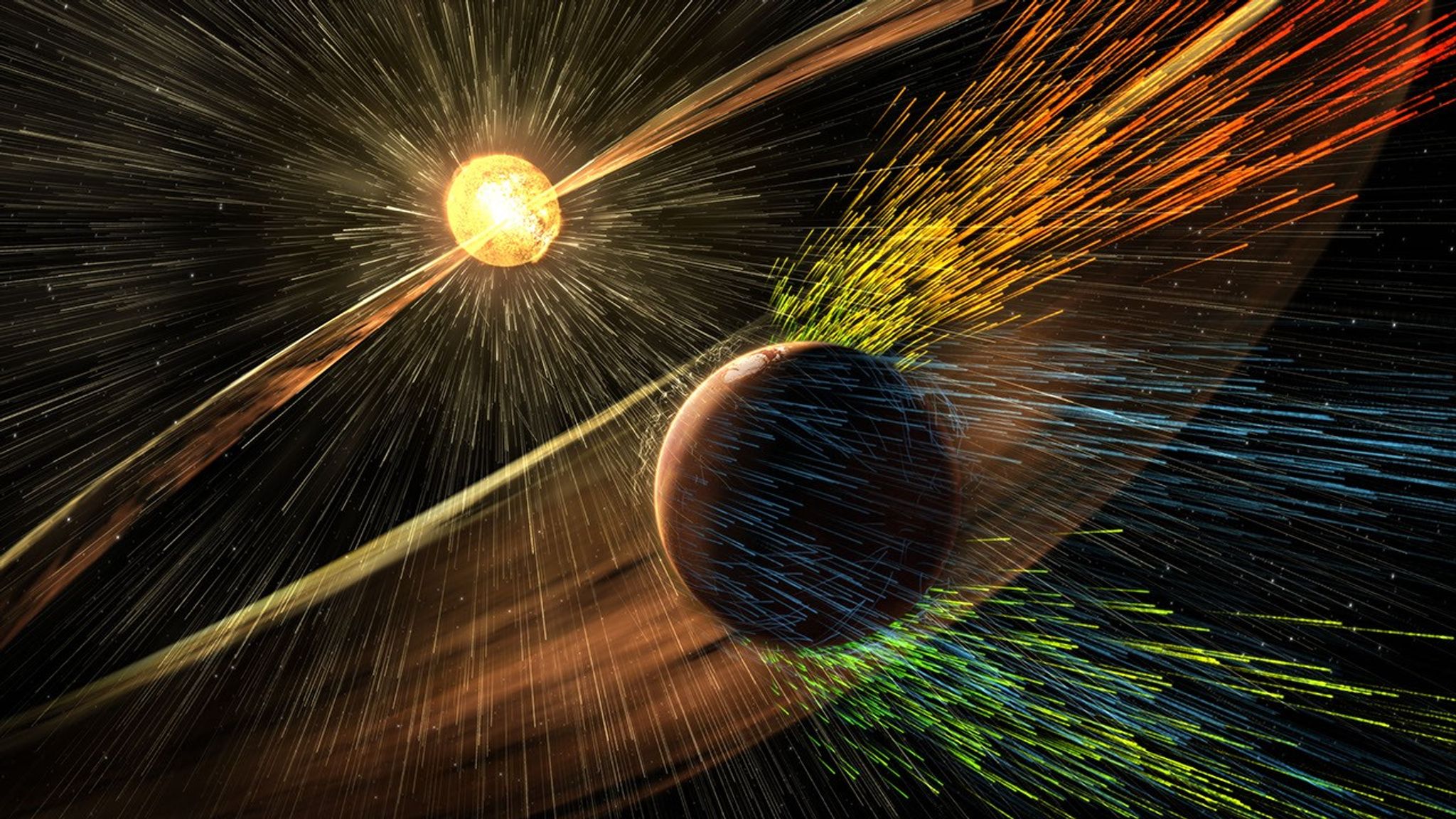
This July 23, 2026, illustration depicts charged particles from a solar storm stripping away charged particles of Mars’ atmosphere, one of the processes of Martian atmosphere loss studied by NASA’s MAVEN (Mars Atmosphere and Volatile Evolution) mission. NASA MAVEN mission scientists have found that certain types of auroras on Mars form in a similar way to Earth-based auroras.
Read more about this discovery.
Image credit: NASA