
_0.thumbnail.jpg "Image (3).jpg")
Feed aggregator
NASA Opens New Flight Dynamics Research Facility in Virginia
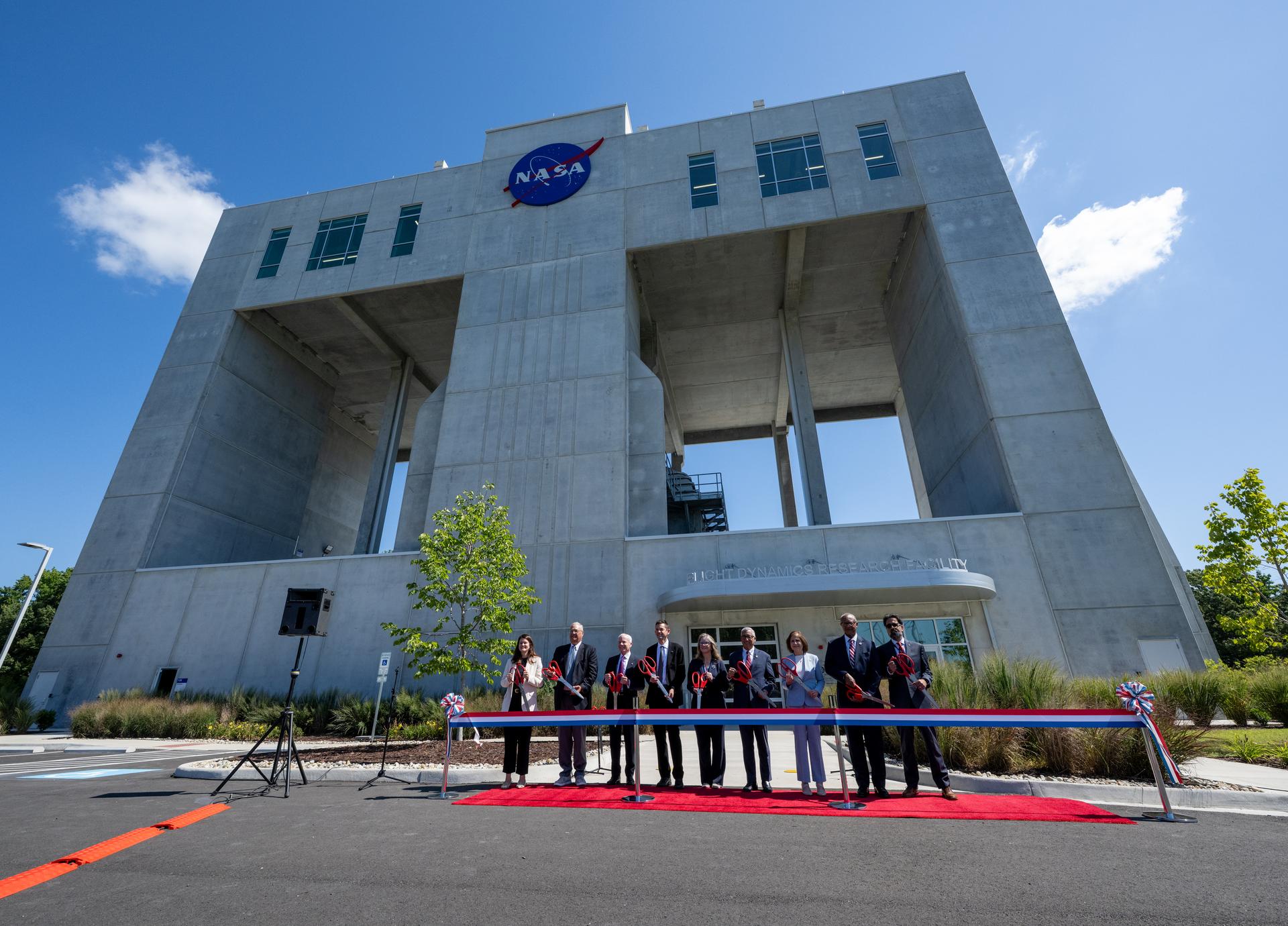
NASA opened its newest wind tunnel, the Flight Dynamics Research Facility, Friday, providing a critical resource for the agency and its partners to test the safety and performance of future generations of aircraft, rockets, and space exploration vehicles.
Located at NASA’s Langley Research Center in Hampton, Virginia, the Flight Dynamics Research Facility will support advances in aircraft safety, X‑plane development, drone research, and spacecraft technology. The facility will enable both free‑flight and mounted testing of a wide range of scale-model vehicles designed to travel through an atmosphere, from airplanes to space capsules returning to Earth.
“The Flight Dynamics Research Facility is NASA’s first major new wind tunnel in more than 40 years and gives us a powerful new platform to test the ideas and technologies that will shape the future of aviation and exploration,” said NASA Administrator Jared Isaacman. “America has led in air and space because we were willing to take on hard problems, challenge assumptions, and build what didn’t exist before. This facility gives the talented team at Langley, and our partners across government, industry, and universities, the tools to keep pushing the boundaries of what’s possible and ensure America remains the world leader in air and space.”
A ribbon-cutting ceremony at NASA Langley marked the start of a new chapter in flight research. Agency leaders, partners, and Virginia officials emphasized how the Flight Dynamics Research Facility’s state-of-the-art capabilities will shape the future of flight and exploration.
“The opening of the Flight Dynamics Research Facility represents a significant advancement for NASA and for the nation,” said Dr. Trina Dyal, NASA Langley center director. “By bringing modernized testing capabilities under one roof, we are enabling transformative research that will ensure the United States remains at the forefront of aeronautics and exploration.”
Built through a partnership with the U.S. General Services Administration (GSA), the facility replaces aging infrastructure with an energy-efficient facility that reduces maintenance costs and provides the flexibility needed for future research. The Flight Dynamics Research Facility is part of a broader, long-term collaboration between the agencies, representing the fourth new building GSA has delivered to NASA under Langley’s 20-year campus revitalization plan.
“GSA is proud to partner with NASA in delivering the Flight Dynamics Research Facility, a state-of-the-art asset that will power the next generation of American dominance in aeronautics and space exploration,” said Edward C. Forst, GSA administrator. “This facility reflects what we do best: provide the advanced, expertly designed installations that federal agencies need to carry out their missions. With these new capabilities, NASA will be better equipped to test bold ideas, validate new designs, and advance technologies that will serve the nation for decades to come.”
The Flight Dynamics Research Facility combines and improves upon the capabilities of two historic NASA Langley wind tunnels – the 20-Foot Vertical Spin Tunnel and the 12-Foot Low-Speed Tunnel. The 25,000-square-foot building features a vertical wind tunnel with improved airflow, modern digital systems, and flexible testing capabilities that will allow researchers to study how aircraft, spacecraft, parachutes, and other vehicles behave during flight.
The facility’s 20-foot diameter test chamber is much larger than those of its NASA Langley predecessors, allowing for more air to pass around test models and improving data accuracy. Its increased size also allows for the use of larger, more detailed models during testing.
The Flight Dynamics Research Facility’s top airspeed of 117 miles per hour is twice as fast as the old facilities, enabling free-flight tests of heavier scale models. This will allow simulations of full-scale vehicles flying at higher altitudes – a critical capability for operations such as studying the stability of aircraft or reentry capsules coming back from space.
The facility’s wind power comes from four 750-horsepower motors, each with an integrated, 14-foot diameter, eight-bladed fan. The fan blades are made of lightweight carbon fiber, enabling rapid, precise airspeed adjustments during free‑flight tests.
The Flight Dynamics Research Facility illustrates the powerful synergy between NASA’s aeronautics and space exploration efforts, with each driving innovation in the other. The facility will drive experimental research across a wide range of flight systems, advancing the development of autonomous flight vehicles, drones, commercial and military aircraft, and X‑planes.
As NASA prepares for a sustained human presence on the lunar surface through the Artemis program and the development of a Moon Base, the facility will play a key role in testing vehicle designs for entry, descent, and landing that will help reduce mission risk and support the safe return of crews to Earth. NASA also will be able to use the wind tunnel to help design aircraft for Mars and other destinations in our solar system where atmospheric flight is possible.
With the Flight Dynamics Research Facility now open, NASA is entering a new era in flight research – one that will shape the aircraft and spacecraft of tomorrow, strengthen industry partnerships, and extend the agency’s legacy of pioneering aerospace leadership.
The facility is managed under the Aerosciences Evaluation and Test Capabilities portfolio in the Aeronautics Division of NASA’s Research and Technology Mission Directorate.
Learn more about the Flight Dynamics Research Facility at:
-end-
Camille Gallo / Rob Margetta
Headquarters, Washington
202-358-1600
camille.m.gallo@nasa.gov / robert.j.margetta@nasa.gov
Kimiko Booker / Brittny McGraw
NASA Langley, Hampton, Virginia
757-506-5939 / 757-769-3763
kimiko.s.booker@nasa.gov / brittny.v.mcgraw@nasa.gov
The Star That Exploded Without Hydrogen
Twenty five years ago a star in the constellation Puppis blew itself apart and then vanished behind a curtain of its own soot. Astronomers knew only that the explosion contained no hydrogen at all, which for the most abundant element in the universe is a very strange absence. Now the dust has finally thinned, and the culprits have stepped into view, a white dwarf quietly stripping a rare helium star of its substance. But the emerging picture came with something nobody expected, clumps of gas tearing outwards at twenty million miles an hour, of a kind never seen in any other nova. Nobody yet knows what fired them.
Postpartum psychosis is at the center of the Lindsay Clancy trial. What is it?
A high-profile court case is calling attention to this rare and understudied condition
Astrobiologist Uses Apollo Lunar Samples As Mirror Onto Early Earth
A Tokyo-based astrobiologist is using an ingenious new way to garner insight into Earth’s 3.5-billion-year-old biosphere.
AI helped produce two proofs for the same cryptography problem
An M.I.T. Ph.D. student and two University of California system cryptographers used GPT-5.6 Sol Ultra in different ways, raising new questions about independent discovery and scientific credit
NASA Wants to Toss 10,000 Tiny Probes Directly Into Saturn's Rings
Cassini, NASA’s last major mission to Saturn, famously plunged to its fiery death in the gas giant’s atmosphere at the end of its mission. It had captured more accurate in-situ data of the Saturnian system than any mission before or since. But there’s one particular part that it couldn’t directly approach - Saturn’s rings. But NASA very obviously wants to take a nice up-close look at them, as they have recently funded a NASA Institute for Advanced Concepts (NIAC) Phase I grant to send a swarm of 10,000 highly expendable “femtosatellites” to get up close and personal with the most spectacular rings in our solar system.
What happens to a moon when its planet is stolen?
The galaxy is littered with rogue planets, worlds flung out of the systems that built them, drifting between the stars with no sun to call their own. But when a planet is torn away, does anything go with it? New simulations say yes, a passing star can rip a world out of its orbit and leave its moons still faithfully circling it, sailing off into the dark as a set. If our own Jupiter were evicted tomorrow, all four Galilean moons would go with it. And in that darkness, with no sunlight at all, one of those moons might still be warm enough for an ocean.
Eating less protein could help you live longer
While “protein maxxing” is all the rage, reducing your protein intake could add years to your life
Curiosity Blog, Sols 4961-4967: Approaching a Break in the Rock Record?
- Curiosity Home
- Science
- News and Features
- Multimedia
- Mars Missions
- Mars Home
3 min read
Curiosity Blog, Sols 4961-4967: Approaching a Break in the Rock Record? NASA’s Mars rover Curiosity acquired this image showing distant light-colored rocks sitting directly underneath dark-colored rocks, a possible “erosional supersurface” — a geologic term that describes places where layers of sediment have been stripped away by wind or water at a regional scale before newer layers are deposited atop them, marking a break in the rock record. Curiosity captured the image using its Left Navigation Camera on July 23, 2026 — Sol 4963, or Martian day 4,963 of the Mars Science Laboratory mission — at 15:53:13 UTC.NASA/JPL-Caltech
Written by Abigail Fraeman, Deputy Project Scientist, Jet Propulsion Laboratory, California Institute of Technology
Earth planning date: Friday, July 24, 2026
Curiosity spent the week continuing to climb her way up through the layers of Mount Sharp, exploring the sedimentary rock strip chart of Martian history. The rover has reached a layer where the science team had spotted a possible “erosional supersurface” by analyzing orbital data alongside images of the layers in the buttes above us. “Erosional supersurface” is a geologic term that describes places where layers of sediment have been stripped away by wind or water at a regional scale before newer layers are deposited atop them. These surfaces are common in wind-blown sand (aeolian) deposits, and they mark a break in the rock record. After eyeing this unusual section of Mount Sharp for the last few months, it’s exciting to finally be so close to this feature. Curiosity’s science instruments will give us the geologist’s-eye view of this region that we need to really understand this feature, including its composition and centimeter-scale geometry.
Our two plans this week focused on imaging the possible supersurface from a few different locations. This past weekend we backed away from the feature to get a good rover’s-eye view of the feature, which set us up nicely on Monday to collect two massive Mastcam mosaics across the entire layer. ChemCam provided additional support by collecting some long-distance RMI images of the most interesting areas of the supersurface. We also took the time to measure the composition of rocks at the bottom of this surface with a MAHLI and APXS target named “Monte Darwin” and ChemCam LIBS targets named “Patacamaya,” “Tarucachi,” and “Mojoncasa.”
Monday’s drive took us closer to the supersurface, while taking some MAHLI and Mastcam images of our wheels along the way, and the drive we planned today will bring us right up to the base of the layer. The science team was able to use Monday’s image to pick the most scientifically interesting spot to cross this surface, while also juggling constraints made by the reality of where we can drive our rather large rover — there’s some pretty sandy and steeply sloping terrain around here, so we also found a spot that looks like it’ll be one of the easier areas to traverse. Hopefully next week we’ll go up and over the supersurface — stay tuned.
-
Want to read more posts from the Curiosity team?
-
Want to learn more about Curiosity’s science instruments?
Mars is the fourth planet from the Sun, and the seventh largest. It’s the only planet we know of inhabited…
All Mars ResourcesExplore this collection of Mars images, videos, resources, PDFs, and toolkits. Discover valuable content designed to inform, educate, and inspire,…
Rover BasicsEach robotic explorer sent to the Red Planet has its own unique capabilities driven by science. Many attributes of a…
Mars Exploration: Science GoalsThe key to understanding the past, present or future potential for life on Mars can be found in NASA’s four…
Curiosity Blog, Sols 4961-4967: Approaching a Break in the Rock Record?
- Curiosity Home
- Science
- News and Features
- Multimedia
- Mars Missions
- Mars Home
3 min read
Curiosity Blog, Sols 4961-4967: Approaching a Break in the Rock Record? NASA’s Mars rover Curiosity acquired this image showing distant light-colored rocks sitting directly underneath dark-colored rocks, a possible “erosional supersurface” — a geologic term that describes places where layers of sediment have been stripped away by wind or water at a regional scale before newer layers are deposited atop them, marking a break in the rock record. Curiosity captured the image using its Left Navigation Camera on July 23, 2026 — Sol 4963, or Martian day 4,963 of the Mars Science Laboratory mission — at 15:53:13 UTC.NASA/JPL-CaltechWritten by Abigail Fraeman, Deputy Project Scientist, Jet Propulsion Laboratory, California Institute of Technology
Earth planning date: Friday, July 24, 2026
Curiosity spent the week continuing to climb her way up through the layers of Mount Sharp, exploring the sedimentary rock strip chart of Martian history. The rover has reached a layer where the science team had spotted a possible “erosional supersurface” by analyzing orbital data alongside images of the layers in the buttes above us. “Erosional supersurface” is a geologic term that describes places where layers of sediment have been stripped away by wind or water at a regional scale before newer layers are deposited atop them. These surfaces are common in wind-blown sand (aeolian) deposits, and they mark a break in the rock record. After eyeing this unusual section of Mount Sharp for the last few months, it’s exciting to finally be so close to this feature. Curiosity’s science instruments will give us the geologist’s-eye view of this region that we need to really understand this feature, including its composition and centimeter-scale geometry.
Our two plans this week focused on imaging the possible supersurface from a few different locations. This past weekend we backed away from the feature to get a good rover’s-eye view of the feature, which set us up nicely on Monday to collect two massive Mastcam mosaics across the entire layer. ChemCam provided additional support by collecting some long-distance RMI images of the most interesting areas of the supersurface. We also took the time to measure the composition of rocks at the bottom of this surface with a MAHLI and APXS target named “Monte Darwin” and ChemCam LIBS targets named “Patacamaya,” “Tarucachi,” and “Mojoncasa.”
Monday’s drive took us closer to the supersurface, while taking some MAHLI and Mastcam images of our wheels along the way, and the drive we planned today will bring us right up to the base of the layer. The science team was able to use Monday’s image to pick the most scientifically interesting spot to cross this surface, while also juggling constraints made by the reality of where we can drive our rather large rover — there’s some pretty sandy and steeply sloping terrain around here, so we also found a spot that looks like it’ll be one of the easier areas to traverse. Hopefully next week we’ll go up and over the supersurface — stay tuned.
-
Want to read more posts from the Curiosity team?
-
Want to learn more about Curiosity’s science instruments?
Mars is the fourth planet from the Sun, and the seventh largest. It’s the only planet we know of inhabited…
All Mars ResourcesExplore this collection of Mars images, videos, resources, PDFs, and toolkits. Discover valuable content designed to inform, educate, and inspire,…
Rover BasicsEach robotic explorer sent to the Red Planet has its own unique capabilities driven by science. Many attributes of a…
Mars Exploration: Science GoalsThe key to understanding the past, present or future potential for life on Mars can be found in NASA’s four…
NASA’s Roman Telescope to Carry 1.35 Million Names to Deep Space
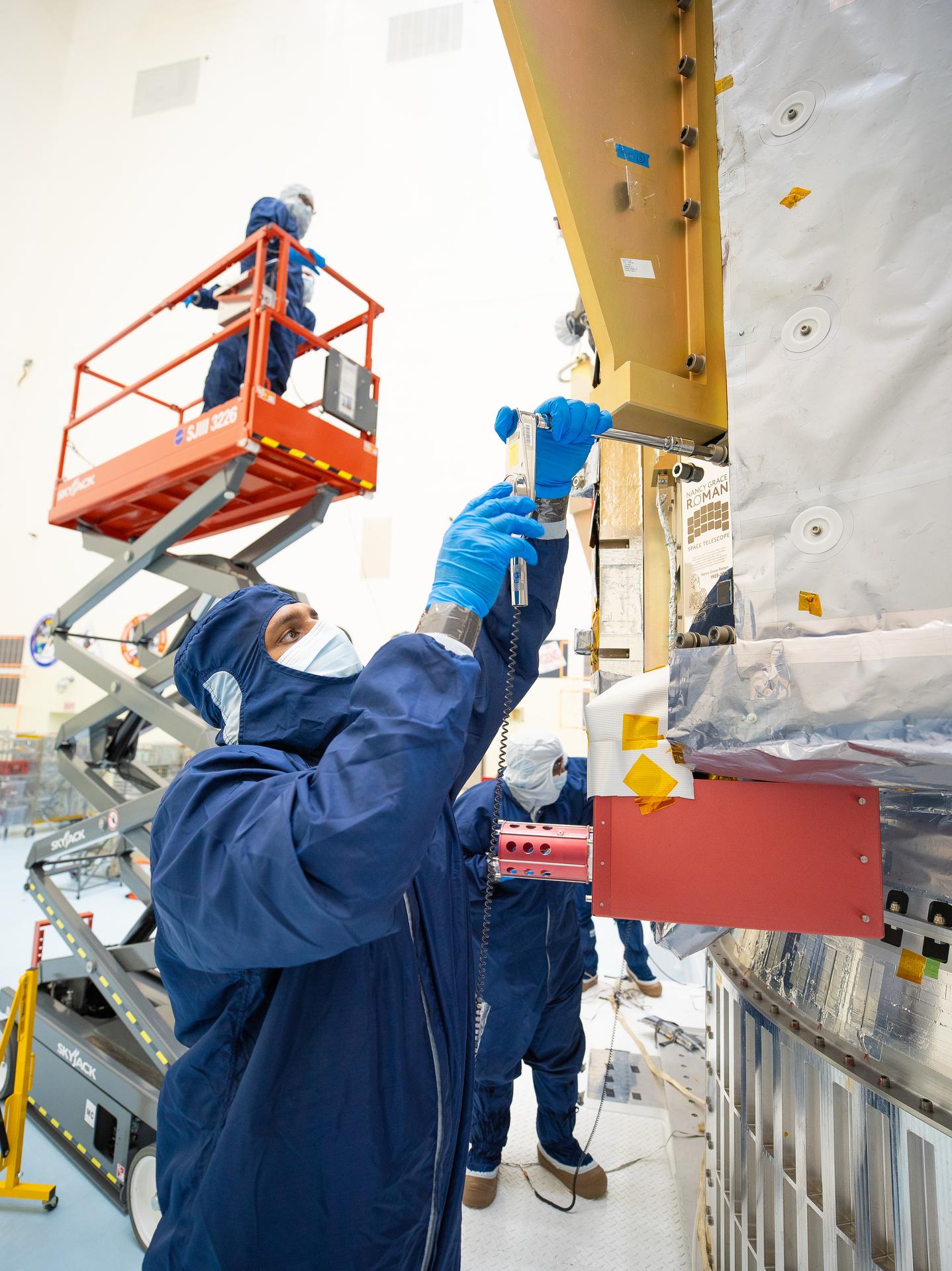
On July 27, technicians at NASA’s Kennedy Space Center in Florida installed a memory card containing 1,350,144 names as part of a commemorative plaque on the Nancy Grace Roman Space Telescope. The names were submitted by people globally, including astronauts from Artemis II and Artemis III. The memory card will travel with the Roman observatory to the Sun-Earth Lagrange point 2, or L2, about one million miles from Earth, where the Sun’s and Earth’s gravity balance out.
Roman is named after Dr. Nancy Grace Roman, NASA’s first chief astronomer and one of the architects of the agency’s modern science program. Roman championed space-based observatories that could study the universe from above Earth’s hazy atmosphere while making their data broadly available to the scientific community.
NASA and SpaceX are targeting launch for no earlier than 7:26 a.m. EDT Sunday, Aug. 30 aboard a SpaceX Falcon Heavy from Launch Complex 39A at Kennedy.
To learn more about the Roman mission, visit:
Image credit: NASA/Jolearra Tshiteya
NASA’s Roman Telescope to Carry 1.35 Million Names to Deep Space
On July 27, technicians at NASA’s Kennedy Space Center in Florida installed a memory card containing 1,350,144 names as part of a commemorative plaque on the Nancy Grace Roman Space Telescope. The names were submitted by people globally, including astronauts from Artemis II and Artemis III. The memory card will travel with the Roman observatory to the Sun-Earth Lagrange point 2, or L2, about one million miles from Earth, where the Sun’s and Earth’s gravity balance out.
Roman is named after Dr. Nancy Grace Roman, NASA’s first chief astronomer and one of the architects of the agency’s modern science program. Roman championed space-based observatories that could study the universe from above Earth’s hazy atmosphere while making their data broadly available to the scientific community.
NASA and SpaceX are targeting launch for no earlier than 7:26 a.m. EDT Sunday, Aug. 30 aboard a SpaceX Falcon Heavy from Launch Complex 39A at Kennedy.
To learn more about the Roman mission, visit:
Image credit: NASA/Jolearra Tshiteya
How to safely watch a solar eclipse
[English]: A solar eclipse is an unforgettable sight, but only if you watch it safely!
ESA reserve astronaut Sara García Alonso shows you how to enjoy this incredible cosmic event using certified eclipse glasses and explains why ordinary sunglasses are not enough.
Learn what happens during the different stages of an eclipse, when it is safe to look up, and how to experience one of the greatest shows in the Solar System without risking your eyes.
[Spanish]: Un eclipse solar es un espectáculo inolvidable, ¡pero solo si lo observas de forma Segura!
El astronauta de reserva de la ESA Pablo Álvarez Fernández te explica cómo disfrutar de este increíble fenómeno cósmico utilizando gafas de eclipse certificadas y por qué unas gafas de sol normales no son suficientes.
Descubre qué ocurre durante las distintas fases de un eclipse, cuándo es seguro mirar al Sol y cómo disfrutar de uno de los mayores espectáculos del Sistema Solar sin poner en Riesgo tu vista.
Week in images: 27-31 July 2026
Week in images: 27-31 July 2026
Discover our week through the lens
This Month at ESA: July 2026
What did space have in store for Europe this July?
The Artemis II crew visited ESA’s technical center in the Netherlands to meet the team behind Orion’s European Service Module, celebrating the colaboration that powered their trip around the Moon. Meanwhile, ESA’s Hera successfully upgraded it’s software fom 140 milliom km away, in preperation for it’s investigation of Dydimos and Dimorphos later this year.
July also saw FLEX and Copernicus Sentinel-3C head to Europe’s Spaceport in French Guiana in preperation for their launch this September. Then, the James Webb Space Telescope celebrates four years of sciency with a spectacular new view of the galaxy Centaurus A.
400 km above Earth, Sophie Adenot inaugurated the European Enhanced Exercise Device with rowing, rope-pulling, strength training and more. She also showed us the ISS veggie chamber, and how the space seedlings have been growing. From the cupola, Sophie captured her most impressive footage of Earth’s auroras yet.
Here’s your monthly roundup of everything happening at the European Space Agency.
How to surf on Saturn’s moon Titan
Lakes of liquid methane on Titan, Saturn’s largest moon, could offer exhilarating—and terrifying—opportunities for otherworldly surfing
Secret eruption offers tantalizing glimpse of underwater volcanoes
Frothy rock floating on the ocean near Papua New Guinea is the sign scientists needed that, hidden from view, an underwater volcano was erupting
The untold science and drama of Lewis and Clark’s expedition
Historian Craig Fehrman unpacks the science, politics and human stories behind one of America’s most famous expeditions
HydroGNSS data open for new insights into Earth’s water
The European Space Agency's two-satellite HydroGNSS Scout mission has completed commissioning and is now in full scientific operations.
Following extensive testing and validation of the satellites, instruments and ground segment, HydroGNSS data are now freely available to users worldwide, opening new opportunities to advance our understanding of water availability and the impacts of climate change on Earth's water cycle.
This Week's Sky at a Glance, July 31 – August 9
Once the bright Moon is out of the evening sky by Monday or so, use Altair high in the southeast to find little Delphinus and Sagitta roughly a fist at arm's length from it.
The post This Week's Sky at a Glance, July 31 – August 9 appeared first on Sky & Telescope.