Universe Today

New Cloud-Detecting Method Will Help Astronomers Characterize Exoplanets
Astronomers have developed a technique that allows them to detect cloud cycles on distant exoplanets. Using data from the James Webb Sapce Telescope (JWST), the astronomers found that mornings and evenings on the gas giant WASP-94A b have extremely different weather patterns: mornings are riddled with sand clouds, while the skies are clear in the early evenings. By isolating the clouds, researchers can more accurately measure a planet’s atmosphere and provide a clearer picture of the planet’s composition. WASP-94A b, for example, has much less oxygen and carbon than astronomers perviously calculated, making its atmosphere much more like Jupiter than they had originally thought.
Even Without A Magnetosphere, Mars Can Still Deflect Some Solar Wind
New research shows how unmagnetized worlds like Mars can still deflect some of the Sun's solar wind. Unlike magnetospheres that form around planet's like Earth, this effect takes place in Mars' ionosphere. It's called the Zwan-Wolf effect, and it's not clear how deep into the atmosphere it operates.
The Unexpected Brightness 'Gap' in an Ancient Globular Cluster
Scientists using the Euclid space telescope found a red-dwarf brightness “gap” in the population of a globular cluster—an ancient, crowded collection of stars. A similar gap was detected by the Gaia observatory in nearby stellar populations, but it has never before been seen in a globular cluster.
Cosmic Tryst: Venus Meets Jupiter at Dusk
It’s a familiar annual question, that we’re already hearing as we enter into June. “What are those two bright objects in the west?” They’re none other than the two brightest planets in the sky, Jupiter and Venus. Keep an eye on the dusk sky over the next week, and you’ll see the two worlds getting ever closer to each other in the west. Though this happens every year or so, an evening conjunction assures that lots of the general public will see one of the best planetary pairings of 2026.
A Brief-ish History of SETI. Part IX: What Have We Found?
In our final installment in the series, we'll examine all the close calls, possible candidates, and instances in which extraterrestrial signals could not be ruled out
A New Map of Stars Shows That the Small Magellanic Cloud is Expanding
A multi-year survey of millions of stars in the Small Magellanic Cloud shows that the dwarf galaxy is expanding rather than rotating. This is due to the influence of its larger neighbour, the Large Magellanic Cloud.
Here's Why So Many Massive Galaxies in the Early Universe Stop Forming Stars
The early Universe is full of massive galaxies that stopped forming stars very early. They're called massive quenchers (MQ) and they're challenging to explain. New research shows that another type of galaxy, dusty star-forming galaxies (DSFGs) can explain why. It's all about mergers, starbursts, and AGN feedback.
Exoplanetary Weather Watchers Find Strong Evidence of Magnetic Fields
Astronomers studying wind speeds on distant exoplanets have discovered weather systems driven by magnetic fields, rather than the largely hydrodynamic weather patterns observed on Earth. This discovery is among the best evidence yet for the existence of magnetic fields on exoplanets.
Asteroid Dirt is "Fluffier" Than We Thought
The strength of gravity is different on every body in the solar system. Whether it's the crushing weight of Jupiter or the miniscule pull of a small asteroid, this fundamental force of physics still has a major impact on the material those bodies are made up of. A new paper from researchers at the University of Duisburg-Essen and the German Aerospace Center (DLR) showcases just how different it can be by letting planetary simulants freefall inside a giant drop tower and measuring how “fluffy” the space dirt got.
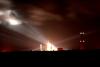
Blue Origin Issues Official Statement on New Glenn Explosion
Jeff Bezos' Blue Origin is assessing damage to its launch pad after a rocket exploded during a test firing, creating a giant orange fireball seen and felt for miles around.
Astronomers Uncover Statistical Evidence for Recoiling Supermassive Black Holes
Galactic collisions are events of breathtaking proportions. The Supermassive Black Holes (SMBHs) at their centers plunge into a chaotic orbital dance that eventually coalesce into a single remnant. On their way to that point, they could eventually get “kicked” out of the center of their galaxy - and finding these “recoiling” black holes has been a challenge of cosmology for decades. A new paper, available on arXiv by an international team, used a novel idea to track down these fast-moving behemoths.
The Next-Generation Very Large Array Prototype (ngVLA) Gathers its First Light
The prototype ngVLA antenna tested its systems by observing and tracking the Crab Nebula, also known as Taurus A (3C144), the remnant of an exploded star.
Flash-Melted Glass from Chang'e-5 Reveals a High Levels of Iron on the Moon
It might not seem like it, but the Moon is constantly being both sandblasted and baked. Its lack of a thick atmosphere allows micrometeorites to impact the surface at speed, and the solar wind isn’t held back either, baking the regolith with a constant flow of high-energy particles. These processes drive what is called “space weathering”, and it can drastically alter the physical and chemical properties of the lunar dirt over the course of billions of years. And we’re finally getting a better sense of what that means in practice thanks to two new papers from researchers at the Chinese Academy of Sciences and Peking University, which used advanced electron tomography and spectroscopic techniques to analyze samples returned from the Chang’e-5 mission to the near side of the Moon.
How Early Earth's Unlikely Chemical Hero Appeared
Though it's a toxic chemical, hydrogen cyanide (HCN) is also important for the development of life. It's a precursor to things like amino acids and nucleic acids and plays a central role in theories of the origin of life on Earth. Recently, difficult questions have been asked about how it could have formed on the early Earth. But the authors of new research in PNAS seemed to have figured it out.
Mars Hid its Warm, Wet Crystals Underground
The search for any sign of life on Mars continues. In the latest update, a new data release from Curiosity’s Chemistry and Mineralogy (CheMin) - essentially the rover’s portable X-ray diffraction lab - and published in a paper in Science, analyzes 20 different rock samples from various elevations of Mount Sharp, the mountain in the center of Gale Crater that Curiosity has been slowly climbing. In the paper, the researchers describe how the size of the crystals in those samples could help scientists determine where to look for evidence that life might have evolved on the Red Planet.
Could the Milky Way’s Missing Mass Be Hiding in a Swarm of Interstellar Comets?
3I/ATLAS has caused quite a stir over the last year, inviting astronomers to update what they know about other solar systems as well as our own. However, this third interstellar visitor may have an unexpected impact on our understanding of dark matter. A new paper, available in pre-print on arXiv from researchers at the University of Hamburg, attempts to calculate the impact that the presence of large amounts of interstellar objects (ISOs) would have on our calculation of dark matter in our galaxy.
Ceres’ Surface Is Much More Complex Than Previously Thought
The dwarf planet Ceres has a surface that seems to get more perplexing with each new study. A recent paper presented at EGU26 in Vienna only adds to its mystery.
Are the JWST's Early Overrmassive Black Holes Just Normal-Range Outliers?
The JWST found an abundance of overmassive black holes at high redshifts, pushing the limits of black hole (BH) science in the early Universe. Results have claimed that these BHs are significantly more massive than expected from the BH mass-host galaxy stellar mass relation derived from the local Universe. But new research shows they were just outliers in the normal range of masses that don't require any special causes.
Astrobiology's Looming Statistical Crisis
Multi-billion dollar space telescope programs aren’t only feats of aerospace engineering. They also feature “lies, damn lies, and statistics”. Or at least statistics. They definitely feature those, as does all good observational astronomy. The problem with statistics is, in order to get a clear definitive answer, you need lots of samples. And, to put it mildly, it’s hard to find lots of samples of planets with alien life on them. And even harder to prove that the signals we think are caused by alien life aren’t caused by some other non-biological process. Or at least that’s the theory underpinning a new paper available in pre-print on arXiv from David Kipping of Columbia University (and Cool Worlds YouTube fame).
The Filamentary Funnels That Form Stars
The universe is full of fascinating structures, and some of the most striking take shape inside the giant clouds where stars are born. There, streams of gas appear to converge from all directions toward a dense central hub, like spokes meeting at the center of a wheel. New simulations show why this is, and why star formation overall is so inefficient.